
If you are building or renovating a private villa, reaching the stage where your architect or quantity surveyor delivers a finalized Bill of Quantities (BOQ) is a major milestone. A well-prepared BOQ gives you a clear line-item inventory of what your home requires, organized room by room or trade by trade, often complete with baseline specifications and estimated local allowances.
However, a common misconception among private homeowners is assuming that a construction BOQ can simply be emailed to Chinese suppliers to receive instant, production-ready quotations.
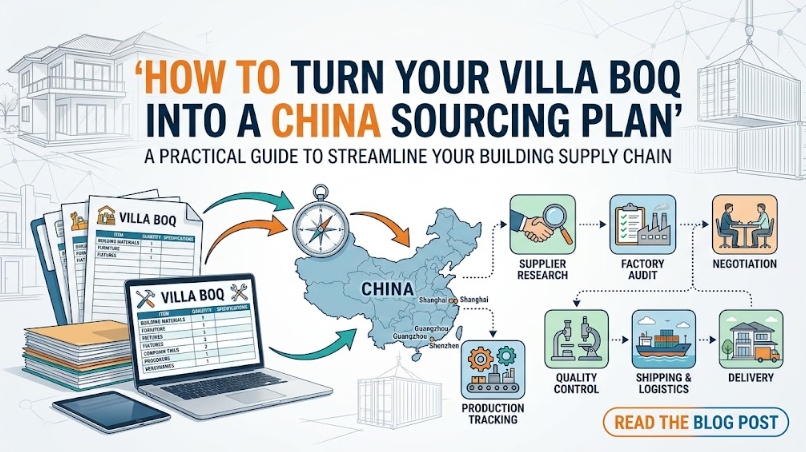
A BOQ describes what your project requires from a design and cost-estimation perspective. A China sourcing plan determines how those requirements will be specified, matched to capable factories, quoted on equivalent terms, inspected, consolidated, and shipped.
Bridging the gap between an architectural requirement document and a manufacturing execution plan is essential for a successful overseas procurement project.
Is Your Villa BOQ Ready for China Sourcing?
A professionally prepared villa BOQ serves as an essential inventory, but it is rarely a factory-ready purchasing document.
Architectural BOQs are designed for local cost estimation and trade bidding. They frequently use descriptive, design-focused language that leaves manufacturing variables open to interpretation.
┌─────────────────────────────────────────────────────────────────────────┐
│                      BOQ vs. FACTORY-READY SPEC                         │
├─────────────────────────────────────────────────────────────────────────┤
│ ARCHITECTURAL BOQ DESCRIPTION                                           │
│ "Custom kitchen cabinetry with painted finish and quartz countertop.    │
│ Total length: 8.5 linear meters. Allowance: High standard."             │
├─────────────────────────────────────────────────────────────────────────┤
│ FACTORY-READY SOURCING SPECIFICATION                                    │
│ • Carcass: 18mm moisture-resistant plywood with melamine finish        │
│ • Doors: 20mm MDF with 2-pack polyurethane matt lacquer (RAL 9010)       │
│ • Hardware: Blum Legrabox soft-close drawers & Blumotion hinges         │
│ • Drawings: Approved CAD layout Rev C with millimetric elevations       │
│ • Countertop: 20mm engineered quartz with 40mm mitred waterfall edge    │
└─────────────────────────────────────────────────────────────────────────┘
When a Chinese factory receives a generic BOQ description without technical parameters, one of two things happens:
- The factory makes assumptions using their standard, low-cost baseline materials to offer an attractive price.
- The factory declines to quote, citing insufficient technical detail to calculate material usage and labor.
The first step in turning a villa BOQ into a China sourcing plan is not sending emails to dozens of manufacturers. It is systematically auditing your BOQ to identify missing technical parameters, unconfirmed material finishes, and missing drawing references.
Which Items in a Villa BOQ Are Suitable for China Sourcing?
Sourcing building materials from China works best when applied selectively. Attempting to buy every single screw, bag of cement, or basic rough-in material overseas often adds unnecessary logistics complexity without offering clear design or financial advantages.
A practical sourcing plan categorizes your BOQ items based on manufacturing customization, product value, freight density, and local installation requirements.
                          SOCIABILITY ASSESSMENT MATRIX
┌───────────────────────────────────────┬───────────────────────────────────────┐
│ Highly Suitable for China Sourcing    │ Better Sourced Locally                │
├───────────────────────────────────────┼───────────────────────────────────────┤
│ • Custom Kitchen & Butler's Cabinets  │ • Structural Steel, Rebar, & Cement   │
│ • Built-in Wardrobes & Vanity Units   │ • Rough Building Plaster & Drywall    │
│ • Architectural Aluminum Windows/Doors│ • Basic Electrical Wire & Conduits    │
│ • Porcelains, Slabs, & Large Tiles    │ • Standard PVC Drainage Piping        │
│ • Fabricated Marble & Quartz          │ • Hazardous/Flammable Liquid Finishes │
│ • Sanitary Ware & Brassware           │ • Items with Strict Local Approvals   │
│ • Architectural & Decorative Lighting │   (unless pre-certified by supplier)  │
│ • Loose & Built-in Furniture          │                                       │
└───────────────────────────────────────┴───────────────────────────────────────┘
Selecting items for overseas procurement depends on your project timeline and local trade capabilities:
- Customization and Finish Realization: Complex joinery, bespoke metalwork, and tailored loose furniture benefit significantly from China’s concentrated manufacturing ecosystems.
- Local Technical Regulations: Items like structural aluminum windows or electrical fixtures must meet your destination country’s building codes and performance certifications (e.g., AS2047 for Australian windows, CE mark for Europe, or local voltage requirements for lighting).
- Freight and Volume Economics: Dense, high-value finishing products (like stone, tiles, and sanitary ware) pack efficiently into shipping containers, whereas bulky, low-value items may consume container space without yielding meaningful value.
How Do You Turn a BOQ into Sourcing Categories?
Architectural BOQs are typically organized by trade divisions (e.g., Concrete, Finishes, Joinery, Mechanical) or by physical rooms (e.g., Master Suite, Ground Floor Living, Guest Annex).
Factories do not operate by room numbers; they operate by manufacturing capability. To make your BOQ actionable, you must reorganize line items into product-specific procurement packages.
                       REORGANIZING BOQ INTO PACKAGES

   ARCHITECTURAL BOQ STRUCTURE              CHINA SOURCING PACKAGES
┌───────────────────────────────┐        ┌───────────────────────────────┐
│ Room 101: Master Bedroom      │        │ PACKAGE A: Custom Joinery     │
│ • Wardrobes, Flooring, Doors  │        │ • Kitchen, Wardrobes, Vanities│
├───────────────────────────────┤        ├───────────────────────────────┤
│ Room 102: Master Bathroom     │ ────>  │ PACKAGE B: Windows & Doors    │
│ • Tiles, Vanity, Brassware    │        │ • Thermal-Break Aluminum Runs │
├───────────────────────────────┤        ├───────────────────────────────┤
│ Room 103: Main Kitchen        │        │ PACKAGE C: Hard Finishes      │
│ • Cabinets, Stone, Appliances │        │ • Porcelain Tiles & Natural Stone│
└───────────────────────────────┘        └───────────────────────────────┘
Organizing your BOQ into clean category packages ensures that each Request for Quotation (RFQ) contains only the line items relevant to that specialized manufacturing sector.
How Do You Decide Which BOQ Items Should Go to the Same Factory?
A common temptation for villa owners is trying to find “one factory that makes everything” to minimize management effort. In reality, modern Chinese manufacturing is hyper-specialized.
A high-end kitchen cabinet factory in Foshan does not manufacture aluminum sliding doors, nor does a sanitary ware supplier process natural marble slabs. Forcing a factory to supply items outside their core expertise means they will sub-contract those items to third parties, adding hidden markups and diluting quality control.
                  SUPPLIER CONSOLIDATION vs. FORCED BUNDLING

     CORRECT SUPPLIER MATCHING               INCORRECT BUNDLING
  ┌─────────────────────────────┐         ┌─────────────────────────────┐
  │ Kitchen Factory             │         │ Kitchen Factory             │
  │ ├── Main Kitchen Cabinets   │         │ ├── Main Kitchen Cabinets   │
  │ ├── Prep Kitchen Joinery    │         │ ├── Aluminum Windows (SUB)  │
  │ └── Bathroom Vanity Boxes   │         │ └── Marble Flooring (SUB)   │
  └─────────────────────────────┘         └─────────────────────────────┘
      (Same core manufacturing)               (Layered middleman markups)
Strategic Grouping Rules
- Combine Similar Substrates: Consolidate built-in wardrobes, bathroom vanities, and wall paneling with your custom kitchen supplier if they utilize similar board processing and spray-finishing machinery.
- Keep Technical Enclosures Separate: Source aluminum architectural windows and exterior sliding doors directly from dedicated window system manufacturers who possess wind-load testing and glazing facilities.
- Separate Hard Surfaces from Joinery: Procure floor tiles, sintered stone slabs, and natural marble from specialized stone processing plants that have direct access to waterjet cutting equipment and gang saws.
What Information Does a Chinese Factory Need Before Giving You a Reliable Quote?
To receive a binding, production-grade quotation rather than a speculative guess, you must provide factories with a complete RFQ package.
                         COMPLETE RFQ PACKAGE CONTENTS

    ┌─────────────────────────────────────────────────────────────────┐
    │ 1. CAD Drawings: Floor plans, elevations, sections (.dwg/.pdf)  │
    ├─────────────────────────────────────────────────────────────────┤
    │ 2. Material Specifications: Substrates, finishes, hardware brands│
    ├─────────────────────────────────────────────────────────────────┤
    │ 3. Schedule of Quantities: Itemized counts with millimetric size│
    ├─────────────────────────────────────────────────────────────────┤
    │ 4. Design Intent: 3D renders, physical control sample references │
    ├─────────────────────────────────────────────────────────────────┤
    │ 5. Project Logistics: Destination port, timeline, voltage/codes │
    └─────────────────────────────────────────────────────────────────┘
Providing comprehensive information at the RFQ stage eliminates guesswork and ensures that all quoting factories calculate material utilization and machining hours against identical parameters.
How Do You Convert BOQ Descriptions into Factory-Ready Specifications?
Translating your architect’s design language into manufacturing instructions requires expanding vague descriptions into explicit technical parameters.
                      SPECIFICATION TRANSLATION MATRIX
┌──────────────────────┬───────────────────────────────┬────────────────────────────────┐
│ Product Category     │ Generic BOQ Description       │ Factory-Ready Specification    │
├──────────────────────┼───────────────────────────────┼────────────────────────────────┤
│ Custom Kitchen       │ "High-end kitchen cabinets    │ 18mm E0 plywood carcass, 20mm  │
│                      │ with painted doors and soft-  │ lacquer doors (RAL 7016), Blum │
│                      │ close drawers."               │ Legrabox runners, 20mm quartz. │
├──────────────────────┼───────────────────────────────┼────────────────────────────────┤
│ Aluminum Windows     │ "Double-glazed sliding doors  │ 120 series thermal-break aluminum│
│                      │ with aluminum frame."         │ (2.0mm profile), 6mm+12A+6mm   │
│                      │                               │ Low-E toughened glass, Siegenia│
├──────────────────────┼───────────────────────────────┼────────────────────────────────┤
│ Bedroom Wardrobes    │ "Bespoke master suite wardrobes│ Veneered MDF doors, smoked oak │
│                      │ with glass doors and LED."    │ finish, 8mm fluted glass in    │
│                      │                               │ aluminum frames, integrated sensor│
└──────────────────────┴───────────────────────────────┴────────────────────────────────┘
Taking the time to convert these descriptions before soliciting quotes ensures that factories submit pricing based on your exact expectations rather than their internal default standards.
Understanding the Hierarchy: BOQ vs. RFQ vs. Purchase Order
For private homeowners unfamiliar with commercial procurement, understanding how project documentation evolves prevents costly miscommunications.
                  THE DOCUMENT EVOLUTION PIPELINE

   ┌──────────────────┐
   │  1. VILLA BOQ    │ ──> Defines WHAT the project requires for design
   └─────────┬────────┘     and local budgeting purposes.
             │
             ▼
   ┌──────────────────┐
   │    2. RFQ        │ ──> Translates BOQ items into technical packages
   └─────────┬────────┘     for factories to price accurately.
             │
             ▼
   ┌──────────────────┐
   │ 3. PURCHASE ORDER│ ──> Binds supplier to finalized drawings, approved
   └──────────────────┘     samples, fixed scope, and commercial terms.
- Bill of Quantities (BOQ): The macro-level design inventory created by your architectural team.
- Request for Quotation (RFQ): The micro-level technical package sent to selected factories, containing detailed CAD drawings, material schedules, and performance requirements.
- Purchase Order (PO) / Commercial Contract: The binding agreement containing approved shop drawings, signed finish samples, agreed Incoterms, payment milestones, and quality control criteria.
How Do You Match Your BOQ With Chinese Factory Quotations?
Comparing factory quotes directly against your original BOQ line by line is critical. Quotations from different manufacturers rarely arrive in identical formats, making apples-to-apples evaluation challenging.
                     QUOTATION EQUIVALENCY CHECKLIST

    [ ] QUANTITY CHECK  ──> Did the factory quote the exact BOQ count or length?
    [ ] SCOPE AUDIT     ──> Are internal accessories, stone tops, and packaging included?
    [ ] HARDWARE BRAND  ──> Is specified hardware quoted, or an unnamed substitute?
    [ ] INCOTERM VERIFY ──> Is the quote EXW (factory floor) or FOB (loaded at port)?
    [ ] FINISH MATCH    ──> Does the quoted finish match your physical sample spec?
A supplier offering a price 20% lower than competitors may simply have removed specialized internal storage mechanisms, downgraded carcass substrates, or excluded stone edge fabrication.
Before evaluating prices, adjust all factory quotes to reflect an identical specification scope.
How Should You Deal With BOQ Items That Are Missing Information?
It is normal for an initial villa BOQ to contain incomplete specifications or placeholder allowances, such as “feature wall stone—$150/m² allowance.”
                     MANAGING INFORMATION GAPS

   [Identify Gap in BOQ]  ──>  e.g., "Feature wall stone spec unconfirmed"
                                              │
                                              ▼
   [Assign Owner/Designer]──>  Request slab selection and surface finish
                                              │
                                              ▼
   [Set Firm Deadline]    ──>  Must confirm before stone block cutting
                                              │
                                              ▼
   [Log in Master Plan]   ──>  Prevent production delays on dependent trades
When information gaps exist, do not allow suppliers to guess the missing details. Log missing items in your master sourcing plan, establish a decision deadline with your interior designer, and request budgetary options based on defined material tiers until final sign-off occurs.
Should You Get Chinese Factory Quotes Before All Designs Are Final?
Yes, provided you understand the distinction between a budgetary estimation quote and a final production contract.
- Early Budgetary Stage: Using schematic drawings and preliminary BOQs allows you to establish broad procurement allowances, compare structural material options, and shortlist potential manufacturing partners in Foshan.
- Final Production Stage: Final commercial contracts, shop drawing development, and factory deposits should only be executed once architectural layouts, millimetric dimensions, and material control samples are signed off by your design team.
How Should You Organize Samples and Approvals?
For high-end residential builds, physical sample approval is a non-negotiable step in the sourcing plan. Digital photos and PDF swatch cards cannot accurately convey surface texture, lacquer sheen levels, or stone veining.
                     SAMPLE APPROVAL PROTOCOL

    Step 1: Request Physical Swatches (Wood veneer, lacquer, stone, glass)
                                │
                                ▼
    Step 2: Evaluate Under Destination Site Lighting Conditions
                                │
                                ▼
    Step 3: Formal Sign-Off (Sign & date physical master control samples)
                                │
                                ▼
    Step 4: Distribute Dual Control Sets (One set to factory, one to owner/QC)
During production and pre-shipment inspections, goods are evaluated directly against these signed master control samples to ensure finish consistency.
How Do You Turn the BOQ into a Production Schedule?
Different building materials have vastly different manufacturing lead times. Your sourcing plan must map your BOQ line items onto a timeline synchronized with your local job site construction sequence.
                      VILLA PROCUREMENT TIMELINE

  Site Stage        Sourcing Action Required          Typical Lead Time
 ┌───────────────┐  ┌───────────────────────────────┐  ┌────────────────┐
 │ Foundation    │─>│ Finalize Window/Door Orders   │─>│ 45–60 Days     │
 └───────────────┘  └───────────────────────────────┘  └────────────────┘
 ┌───────────────┐  ┌───────────────────────────────┐  ┌────────────────┐
 │ Framing/Walls │─>│ Confirm Kitchen & Joinery     │─>│ 50–65 Days     │
 └───────────────┘  └───────────────────────────────┘  └────────────────┘
 ┌───────────────┐  ┌───────────────────────────────┐  ┌────────────────┐
 │ MEP Rough-in  │─>│ Produce Stone, Tiles, Sanitary│─>│ 30–45 Days     │
 └───────────────┘  └───────────────────────────────┘  └────────────────┘
 ┌───────────────┐  ┌───────────────────────────────┐  ┌────────────────┐
 │ Lock-Up       │─>│ Complete Furniture & Lighting │─>│ 35–50 Days     │
 └───────────────┘  └───────────────────────────────┘  └────────────────┘
Ordering items out of sequence leads to job site delays or forces finished interior products to sit in dusty, unprotected construction zones waiting for installation.
How Do You Plan Quality Control From the BOQ?
Quality control (QC) is not a final check performed as boxes are loaded into a container. A robust sourcing plan defines specific, measurable inspection criteria for every BOQ category before production begins.
                          CATEGORY-SPECIFIC QC FOCUS
┌──────────────────────────────┬──────────────────────────────────────────────────────────┐
│ Sourced Category             │ Critical Pre-Shipment Inspection Checks                  │
├──────────────────────────────┼──────────────────────────────────────────────────────────┤
│ Custom Joinery & Kitchens    │ Overall dry-fit assembly, door gaps, lacquer finish      │
│                              │ consistency, soft-close hardware operation, cutout sizes.│
├──────────────────────────────┼──────────────────────────────────────────────────────────┤
│ Aluminum Windows & Doors     │ Millimetric frame dimensions, corner joint sealing, glass│
│                              │ specification stamps, smooth sliding mechanism function. │
├──────────────────────────────┼──────────────────────────────────────────────────────────┤
│ Natural Stone & Slabs        │ Dry-lay pattern veining match, slab thickness tolerance, │
│                              │ surface polish quality, custom crating reinforcement.    │
├──────────────────────────────┼──────────────────────────────────────────────────────────┤
│ Loose & Built-in Furniture   │ Overall dimensions, frame stability, fabric/leather match│
│                              │ against control sample, stitching quality, protective wrap.│
└──────────────────────────────┴──────────────────────────────────────────────────────────┘
Defining these parameters beforehand allows third-party inspectors or your local sourcing consultant to evaluate finished products against objective standards on the factory floor.
How Do You Plan Shipping and Consolidation From the BOQ?
Procuring materials across multiple specialized Chinese factories requires a centralized logistics strategy. Shipping individual partial loads in separate sea freight containers increases transport costs and destination port clearance fees.
                      WAREHOUSE CONSOLIDATION WORKFLOW

    Factory A (Kitchens)    ──┐
                              │
    Factory B (Windows)     ──┼──> [Foshan Central Warehouse] ──> [40ft HQ Container]
                              │    • Receiving & QC Audit         • Single Clearance
    Factory C (Sanitary)    ──┘    • Protected Staging            • Lower Landed Freight
By staging inspected finished goods at a central warehouse in Foshan, products can be loaded into dedicated 40ft High Cube containers. This maximizes container volume, reduces ocean freight expenses, and ensures all project materials arrive at your villa site in a coordinated delivery sequence.
Should You Source Everything in Your Villa BOQ From China?
A realistic sourcing strategy does not mean buying 100% of your project items overseas. The most successful villa projects utilize a selective procurement strategy.
                   BALANCED PROCUREMENT DECISION TREE

                  Is the item custom, high-value, or
                   available in Foshan clusters?
                                │
                      ┌─────────┴─────────┐
                     YES                  NO
                      │                   │
                      ▼                   ▼
            [Source from China]   [Procure Locally]
            • Custom Joinery      • Basic Lumber & Cement
            • Windows & Stone     • Local Trade Labor
            • Tiles & Sanitary    • Structural Concrete
            • Custom Furniture    • Standard PVC Pipe
Sourcing complex, customized, and high-finish interior packages from China while procuring basic structural building commodities locally strikes the ideal balance between cost management, quality realization, and job site efficiency.
What Does a China Sourcing Plan Look Like for a Real Villa?
Below is a practical example of how a private villa BOQ is converted into a structured China sourcing plan:
                      SAMPLE VILLA CHINA SOURCING PLAN
┌──────────────────────┬────────────────────────┬──────────────────────────┬─────────────────────────┐
│ BOQ Trade Package    │ Assigned Factory Type  │ Primary Technical Doc    │ Staging & Shipping      │
├──────────────────────┼────────────────────────┼──────────────────────────┼─────────────────────────┤
│ Package A: Joinery   │ High-End Cabinets      │ Approved CAD Rev C,      │ Foshan Warehouse,       │
│ (Kitchen & Wardrobes)│ (Foshan)               │ Signed Lacquer Samples   │ Container 1 (Dry Goods) │
├──────────────────────┼────────────────────────┼──────────────────────────┼─────────────────────────┤
│ Package B: Windows   │ Architectural Window   │ Window Schedule & Glass  │ Direct Factory Load,    │
│ & Sliding Doors      │ Plant (Nanhai)         │ Performance Spec         │ Container 2 (Dedicated) │
├──────────────────────┼────────────────────────┼──────────────────────────┼─────────────────────────┤
│ Package C: Hard      │ Stone Processing & Tile│ Dry-Lay Photo Sign-off,  │ Foshan Warehouse,       │
│ Surfaces (Stone/Tile)│ Supplier (Foshan)      │ Waterjet CAD Layouts     │ Container 1 (Base Load) │
├──────────────────────┼────────────────────────┼──────────────────────────┼─────────────────────────┤
│ Package D: Loose     │ Custom Furniture       │ Fabric Control Swatches, │ Foshan Warehouse,       │
│ Furniture & Lighting │ Factory (Shunde)       │ Crate Packaging Specs    │ Container 3 (Final Fit) │
└──────────────────────┴────────────────────────┴──────────────────────────┴─────────────────────────┘
This structured approach transforms a massive architectural document into clear, manageable procurement modules.
The 10-Step BOQ-to-Sourcing Framework
Follow this structured ten-step process to convert your architectural BOQ into a factory-ready China procurement execution plan:
[Step 1: Audit BOQ] ──> [Step 2: Filter Scope] ──> [Step 3: Group Packages]
                                                                │
                                                                ▼
[Step 6: Match Factories] <── [Step 5: Prepare RFQs] <── [Step 4: Resolve Gaps]
         │
         ▼
[Step 7: Compare Quotes] ──> [Step 8: Sign Samples] ──> [Step 9: Align Timeline]
                                                                │
                                                                ▼
                                                    [Step 10: Execute QC & Ship]
Framework Step Breakdown
- Audit the Architectural BOQ: Review all line items, quantities, and descriptions alongside floor plans and elevations.
- Filter Sourceable Categories: Separate items that make practical sense to import from those best procured locally.
- Group Into Sourcing Packages: Reorganize line items by manufacturing discipline (e.g., joinery, aluminum, stone, loose furniture).
- Identify and Resolve Information Gaps: Detail missing substrate specifications, hardware models, and finish details.
- Prepare Complete RFQ Packages: Compile dimensioned CAD drawings, material schedules, 3D renders, and project parameters for each package.
- Match Packages to Specialized Suppliers: Identify established factories in specialized clusters (such as Foshan) capable of executing your required quality level.
- Compare Quotations on an Equivalent Basis: Adjust factory quotes to ensure identical material, hardware, and scope inclusions.
- Approve Physical Samples & Shop Drawings: Sign off on physical finish swatches and millimetric factory CAD drawings before releasing production deposits.
- Align Production Schedules With Site Progress: Set factory lead times to match your local construction sequencing.
- Execute Quality Control & Warehouse Consolidation: Perform factory inspections prior to packing, consolidate goods at a central warehouse, and load containers strategically.
Master BOQ Conversion Reference Table
Use this practical reference table to identify what technical details must be added to your BOQ line items before soliciting factory quotes:
| BOQ Category | Common BOQ Description | What the Factory Still Needs | Why It Matters |
| Custom Kitchen | “Wood kitchen cabinets with island and quartz top” | Carcass board type, door finish code, hardware series, cutout drawings | Prevents low-grade board substitution and missing hardware mechanisms |
| Aluminum Windows | “Double-glazed sliding glass doors” | Profile series, aluminum wall thickness, glass thermal spec, hardware brand | Ensures window systems meet structural wind-load and local energy codes |
| Master Wardrobes | “Bespoke walk-in wardrobe with glass doors” | Internal carcass layout, LED channel integration, frame profiles, door hinge spec | Eliminates costly spatial adjustments and wiring modifications on site |
| Natural Stone | “Marble flooring for living room” | Slab thickness, surface finish, dry-lay veining match approval, crating spec | Avoids color variations, thin slab cracking, and shipping damage |
| Bathroom Vanities | “Custom vanity unit with undermount basin” | Basin cutout templates, drawer plumbing notches, tap hole locations, stone edge profile | Guarantees local plumbing trades can install fixtures without modification |
| Loose Furniture | “Dining table and 8 upholstered chairs” | Internal frame timber type, foam density specs, physical fabric/leather swatches | Ensures structural longevity, comfort, and accurate finish matching |
| Architectural Lighting | “LED downlights and feature pendant” | Voltage compatibility, color temperature (K), CRI rating, driver certification | Prevents electrical component failures and local building code non-compliance |
Managing Version Control and Design Changes
Villa designs evolve during construction. If your architect revises a room layout or changes a material finish after sourcing has begun, maintaining strict version control across all suppliers is critical.
                      VERSION CONTROL PROTOCOL

    [Architect Issues Drawing Rev C]
                   │
                   ▼
    [Update Master Sourcing Register]
                   │
                   ▼
    [Issue Written Change Order to Factory]
                   │
                   ▼
    [Receive Revised Factory Shop Drawing Rev C]
                   │
                   ▼
    [Sign-Off Before Production Commences]
Never communicate design modifications verbally or via informal message threads. Every change must be recorded in writing, updated on the factory’s technical shop drawings, and signed off before production proceeds.
The Role of the Foshan Supply Chain Ecosystem
For private villa owners, the manufacturing clusters in and around Foshan, Guangdong, offer a unique advantage. Foshan represents one of the world’s most concentrated manufacturing hubs for interior building materials.
                     FOSHAN MANUFACTURING CLUSTERS

     ┌──────────────────────────────┬──────────────────────────────┐
     │ Category                     │ Regional Manufacturing Hub   │
     ├──────────────────────────────┼──────────────────────────────┤
     │ Custom Joinery & Kitchens    │ Nanhai / Shunde / Gaoming    │
     │ Architectural Windows/Doors  │ Nanhai District, Foshan      │
     │ Ceramics, Porcelain & Stone   │ Shiwan / N庄, Foshan         │
     │ Custom & Loose Furniture     │ Lecong / Longjiang, Shunde   │
     │ Sanitary Ware & Hardware     │ Foshan / Kaiping             │
     └──────────────────────────────┴──────────────────────────────┘
The primary benefit of sourcing from Foshan is not simply factory density—it is the ability to coordinate custom production across multiple specialized product categories within a compact geographic radius, simplifying sample approvals, quality control, and container consolidation.
Do You Need a China Sourcing Agent If You Already Have a BOQ?
Having a detailed BOQ gives you a clear project blueprint, but managing overseas procurement remotely presents distinct operational challenges.
                   PROJECT ROLES & RESPONSIBILITIES

    ARCHITECT / INTERIOR DESIGNER         CHINA SOURCING AGENT
   ┌───────────────────────────────┐     ┌───────────────────────────────┐
   │ • Creates project design      │     │ • Translates BOQ to factory RFQs│
   │ • Develops architectural BOQ  │     │ • Audits & matches suppliers   │
   │ • Approves material samples   │ ──> │ • Manages shop drawing CADs   │
   │ • Inspects local installation │     │ • Conducts factory floor QC   │
   └───────────────────────────────┘     │ • Handles warehouse & shipping│
                                         └───────────────────────────────┘
A Foshan-based sourcing consultant does not replace your architect, interior designer, or local building contractor. Instead, an agent acts as your local procurement manager on the ground in China:
- RFQ Preparation & Supplier Auditing: Converting your BOQ line items into technical purchasing packages and shortlisting capable, vetted manufacturers.
- Technical Communication: Working directly with factory drafting teams to ensure shop drawings accurately reflect your architectural intent.
- On-Site Factory Inspection: Visiting production lines to verify dimensions, assembly quality, and surface finishes before final balance payments are released.
- Logistics & Consolidation Management: Staging finished goods from multiple suppliers at a central Foshan warehouse, managing container loading, and overseeing export documentation.
Working with an experienced local coordinator ensures that the specifications detailed in your villa BOQ are accurately realized on the factory floor.
Homeowner Sourcing Readiness Checklist
Use this practical checklist to track your progress as you transition from your architectural BOQ to active procurement:
Phase 1: Before Contacting Factories
- [ ] Finalize architectural floor plans, elevations, and millimetric sections.
- [ ] Complete BOQ review and categorize items into specialized product packages.
- [ ] Identify and resolve missing material, substrate, and hardware specifications.
- [ ] Confirm local voltage, plumbing standards, and regional building code requirements.
- [ ] Establish target job site delivery dates and work backward to determine production deadlines.
Phase 2: Evaluating Supplier Quotations
- [ ] Ensure all factories quote against identical technical specifications and drawings.
- [ ] Confirm itemized inclusions and exclusions (e.g., stone countertops, internal hardware).
- [ ] Verify commercial delivery terms (e.g., EXW vs. FOB) and export packaging standards.
- [ ] Request physical material swatches and finish control samples for formal sign-off.
Phase 3: Production & Shipping Preparation
- [ ] Review and sign final factory shop drawings (CAD) for millimetric accuracy.
- [ ] Confirm dual sets of signed control samples are held by the owner and the factory.
- [ ] Establish an independent, on-site quality inspection protocol prior to packing.
- [ ] Arrange central warehouse staging in Foshan for multi-factory container consolidation.
Frequently Asked Questions
Can I use my villa BOQ to source building materials directly from China?
Yes, a villa BOQ is an ideal starting document. However, it must first be audited, translated into technical product specifications, and broken down into category-specific RFQ packages that match Chinese factory capabilities.
Is a BOQ enough for a Chinese factory to give an accurate quotation?
An architectural BOQ alone is rarely sufficient for a binding production quote. Factories require detailed CAD drawings, millimetric dimensions, explicit substrate specifications, finish codes, and hardware brand selections to calculate accurate pricing.
Which villa building materials are most suitable for China sourcing?
Custom joinery (kitchens, wardrobes, vanities), architectural aluminum windows and doors, porcelain tiles, fabricated stone, sanitary ware, decorative lighting, and custom loose furniture are highly suitable due to China’s specialized manufacturing capabilities.
Should I source all of my villa materials from China?
No. A balanced procurement strategy works best. Sourcing custom, high-finish interior packages from China while procuring basic structural building materials (like rebar, concrete, framing lumber, and drywall) locally maximizes project efficiency.
How do I compare Chinese factory quotations against my BOQ?
Audit each quotation line by line to ensure equivalent scope. Check that item counts, dimensions, material substrates, finish types, hardware series, stone fabrication, and packaging specs match your original specification before comparing prices.
Do Chinese factories need CAD drawings?
Yes. High-end custom manufacturers require millimetric CAD drawings (.dwg or .pdf elevations and sections) to generate accurate shop drawings and set up automated CNC production machinery.
Can Chinese factories work directly from my 3D renders?
3D renders convey design intent and aesthetic expectations, but they cannot be used for direct manufacturing. Factories use 3D renders alongside dimensioned CAD drawings to develop millimetric shop drawings for production.
How do I control design and BOQ changes during production?
Maintain a strict version control register. Any design alteration made by your architect must be issued in writing, updated on the factory’s technical shop drawings (Rev A, B, C), and formally signed off before production proceeds.
Should I arrange quality inspection before shipping?
Yes. Conducting a physical, on-site quality inspection on the factory floor before goods are packed and loaded into containers is essential. Inspecting dimensions, assembly, finish quality, and hardware operation prevents costly installation issues on site.
Do I need a China sourcing agent if my architect already prepared a BOQ?
While your architect defines design requirements, a sourcing agent manages procurement execution on the ground in China. An agent handles RFQ preparation, supplier auditing, shop drawing communication, physical QC inspections, warehouse receiving, and container consolidation.
Key Takeaway
Your architectural BOQ defines what your villa requires. A China sourcing plan determines how those requirements are specified, matched to qualified factories, quoted on equivalent terms, inspected, consolidated, and delivered to your site.
   ARCHITECTURAL BOQ                   CHINA SOURCING PLAN
┌──────────────────────┐             ┌──────────────────────┐
│ • Design Inventory   │             │ • Factory Packages   │
│ • Local Budgeting    │  ────────>  │ • Technical Specs    │
│ • Trade Quantities   │             │ • On-Site QC Protocol│
│ • Material Intent    │             │ • Consolidated Cargo │
└──────────────────────┘             └──────────────────────┘
 (Project Requirement)                (Procurement Execution)
Converting your BOQ into category-specific sourcing packages, establishing strict technical specifications, approving physical control samples, and conducting pre-shipment inspections ensures your project proceeds smoothly from drawing board to completed home.
Why Choose HSY Sourcing for Villa Procurement?
HSY Sourcing is a Foshan-based procurement coordinator and sourcing consultancy specializing in customized building materials and architectural interior products for overseas private villa builds and residential projects. We are not a manufacturer. We act as your independent, on-the-ground procurement representative in China.
Managing multiple factory communications, technical CAD drawing reviews, material sample sign-offs, and quality control across different Chinese suppliers can be challenging from abroad. HSY Sourcing provides end-to-end procurement execution:
- BOQ Auditing & Package Structuring: Reviewing your architectural BOQ, identifying technical gaps, and reorganizing line items into category-specific RFQ packages.
- Supplier Matching & Quotation Analysis: Connecting your project requirements with qualified Foshan manufacturers and auditing line-item quotes to ensure equivalent scope.
- Shop Drawing & Sample Coordination: Working directly with factory technical teams to resolve millimetric details and managing physical finish sample sign-offs before production.
- On-Site Quality Inspection: Visiting factory floors during and after production to inspect dimensions, surface finishes, hardware function, and packaging quality before balance payments are released.
- Warehouse Consolidation & Export Logistics: Receiving inspected materials from multiple suppliers at our Foshan warehouse facility, coordinating multi-factory container loading, and managing export documentation.
We do not replace your architect, interior designer, or local building contractor. We serve as your advocate on the ground in China, ensuring that what was specified in your villa BOQ is delivered accurately to your building site.
Related Guides & Resources
- How to Compare Custom Kitchen Quotes from China for a Luxury Home
- Can Chinese Factories Work Directly From Your Villa Floor Plans and 3D Designs?
- What Does a China Sourcing Agent Actually Do for a Villa Owner?
- How to Manage 5–10 Chinese Factories for One Luxury Villa
- How to Check Custom Kitchen Cabinets Before They Leave China
- How Much Should You Budget for a Luxury Villa Kitchen From China?