
If you are building or renovating a high-value villa, choosing cabinet materials is rarely as simple as picking a single “best” option.
When reviewing cabinet specifications from your architect, interior designer, or a custom cabinet manufacturer, you will likely encounter three primary engineered wood panels: Plywood, MDF (Medium-Density Fiberboard), and MFC (Melamine-faced Chipboard or Particleboard).
A common belief is that a high-end kitchen must be made entirely of plywood, while MDF and MFC belong in lower-tier cabinetry. In custom joinery production, this assumption is often incorrect.
Plywood is not automatically the superior choice for every part of a kitchen, MDF is frequently the best substrate for precision-painted cabinet doors, and high-density MFC can be a practical, durable option for internal cabinet structures.
A well-engineered luxury villa kitchen often combines multiple panel types. The right specification depends on the specific component, exposure to moisture, decorative finish, structural load, and manufacturing quality.
What Is the Difference Between Plywood, MDF, and MFC?
Before comparing performance, it helps to understand how these three engineered panels are constructed and how their physical properties differ.
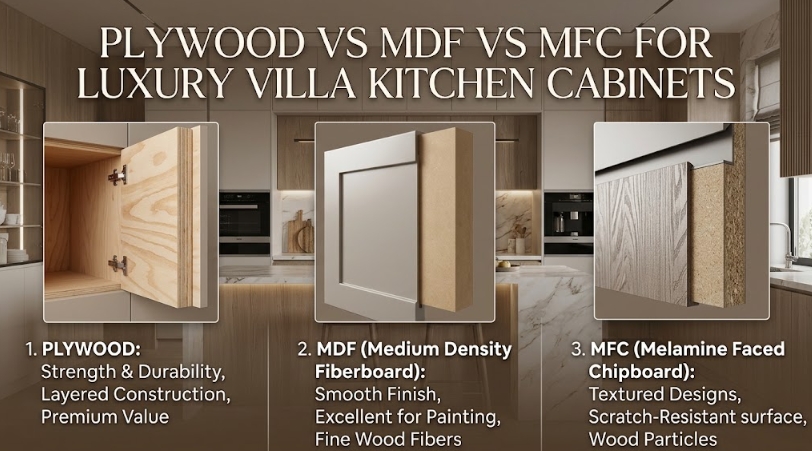
       [ PLYWOOD ]                      [ MDF ]                      [ MFC ]
 Cross-laminated veneers       Refined wood fibers           Resin-bonded wood chips
  High tensile strength          Smooth, dense core            Consistent particle core
Excellent screw-holding        Ideal for CNC routing        Melamine surface protection
Plywood
Plywood is constructed by layering thin sheets of wood veneer (plies) glued together at alternating 90-degree grain angles (cross-lamination).
- Structure: The alternating grain direction provides high tensile strength, structural rigidity, and resistance to warping over long spans.
- Performance: Excellent screw-holding capability and high resistance to physical impact.
- Variability: Plywood quality varies widely depending on the core wood species (e.g., birch, eucalyptus, poplar), ply density, glue type (such as WBP or MR adhesives), and surface sanding quality.
- Consideration: Because of its layered structure, raw plywood edges require edge banding or solid wood lipping before painting or finishing.
MDF (Medium-Density Fiberboard)
MDF is produced by breaking down hardwood or softwood residuals into fine wood fibers, combining them with resin binders, and compressing them under heat and pressure.
- Structure: A dense, homogeneous board free from natural knots, voids, or directional grain.
- Performance: Its uniform density makes it easy to route, carve, and machine using CNC machinery without chipping or flaking.
- Surface Quality: Offers a flat, smooth substrate required for flawless painted or lacquered surfaces (such as polyurethane or polyester spray finishes).
- Variability: Standard MDF expands when exposed to direct moisture. Moisture-Resistant MDF (often tinted green) uses specialized resins to reduce swelling in humid environments.
MFC (Melamine-Faced Chipboard)
MFC consists of a particleboard (chipboard) core made from wood chips bonded with resin, faced on both sides with decorative paper impregnated with melamine resin.
- Structure: Formed under heat and pressure to fuse the decorative melamine surface directly to the core.
- Performance: Provides an easy-to-clean surface resistant to light scratches, household chemicals, and everyday wear.
- Quality Markers: High-performance MFC uses high-density particleboard cores with low formaldehyde emissions (E1, E0, or ENF standards) and heavy-duty melamine layers.
- Consideration: Performance depends almost entirely on the quality of factory edge banding. Unsealed raw particleboard edges can absorb moisture if exposed to standing water.
Is Plywood Actually Better Than MDF or MFC for Kitchen Cabinets?
Not necessarily. The material name alone does not determine the quality, performance, or longevity of a completed kitchen.
A poorly manufactured plywood cabinet made with low-grade core voids, thin face veneers, and inferior urea-formaldehyde glue will perform worse over time than a cabinet built with high-density moisture-resistant MDF or high-grade MFC from a precision manufacturer.
+-----------------------------------------------------------------------------------+
|                            A QUALITY SPECIFICATION LOOKS AT:                      |
+-----------------------------------------------------------------------------------+
|  • Core Density & Grade        • Board Thickness (e.g., 18mm vs 15mm)             |
|  • Moisture Resistance Rating  • Factory Edge Banding Technology (PUR / Laser)    |
|  • Surface Coating Quality     • Precision of Joinery & CNC Machining             |
|  • Hardware Grade & Load Rating• Site Installation & Water Management             |
+-----------------------------------------------------------------------------------+
Instead of asking which board is universally superior, evaluate how individual kitchen components perform under different mechanical and environmental demands.
Should Cabinet Doors and Carcasses Use the Same Material?
In high-end residential joinery, cabinet doors and cabinet carcasses (boxes) serve entirely different functional purposes and rarely need to be made from the same panel material.
- The Cabinet Carcass (Box): Requires structural stability, high load-bearing capacity for heavy stone countertops, strong screw-holding power for drawer runners and hinges, and an internal surface that is easy to wipe clean.
- The Cabinet Door: Requires dimensional stability to prevent sagging or bowing, a flat surface for flawless paint, lacquer, or natural veneer adhesion, and clean edges when machined for detailed profiles (like shaker or handleless j-pull doors).
Specifying plywood for both the cabinet boxes and the door panels can sometimes be counterproductive. For instance, using plywood for full-height painted wardrobe or kitchen doors can lead to subtle panel bowing or telegraphing (where the internal wood grain shows through the paint coat over time).
Using moisture-resistant MDF for painted doors paired with a sturdy plywood or high-density MFC carcass often produces a technically superior result.
When Does MDF Make Sense for a Villa Kitchen?
MDF is often the preferred substrate for decorative exterior elements and specialized door profiles.
       [ MACHINED SHAKER DOOR ]                   [ HIGH-GLOSS LACQUER PANEL ]

     +--------------------------+               +------------------------------+
     |  +--------------------+  |               |                              |
     |  |                    |  |               |   Mirror-Flat MDF Surface    |
     |  |   Smooth Routed    |  |               |                              |
     |  |   MDF Recess       |  |               |  ==========================  |
     |  |                    |  |               |   Multi-Layer Paint Finish   |
     |  +--------------------+  |               +------------------------------+
     +--------------------------+
      No grain telegraphing through               Perfect paint adhesion with
        crisp, clean CNC cuts                       zero wood grain texture
- Painted Lacquer Doors: When aiming for a flawless matte, satin, or high-gloss painted finish, MDF provides a flat substrate without natural wood grain telegraphing.
- Profiled and Shaker Doors: Traditional five-piece or single-piece routed shaker doors require clean machining. MDF routes cleanly without splintering or revealing internal wood voids.
- Curved or Decorative Panels: MDF machines predictably for fluted panels, decorative wall paneling, integrated door handles, and curved island ends.
- Wood Veneer Substrates: High-grade MDF offers a flat, stable substrate for pressing delicate natural wood veneers, minimizing surface telegraphing.
When Is MFC a Practical Choice for Kitchen Cabinets?
MFC is widely used for internal cabinet carcasses and integrated shelving systems in contemporary kitchens.
- Cabinet Interiors and Drawer Boxes: Internal cabinet boxes benefit from a surface that resists wiping, moisture, and mild abrasion. Factory-fused melamine surfaces provide an easy-to-clean interior for food storage, dishware, and pantry items.
- Consistent Wood-Grain and Textured Finishes: Modern European and Asian manufacturers produce melamine surfaces featuring synchronized pores (EIR – Embossed in Register) that accurately replicate the texture and feel of natural timber, concrete, or stone at a stable panel weight.
- Large-Scale Internal Cabinetry: For extensive walk-in pantries, secondary utility kitchens, and tall appliance housings, high-density MFC provides a flat, dimensionally stable structural panel that resists warping under temperature variations.
Where Does Plywood Make the Most Sense in a Large Villa Kitchen?
Plywood excels in areas subject to heavy structural loads, dynamic mechanical stress, or potential exposure to standing water.
- Sink Cabinets: The base unit housing the kitchen sink, water filtration systems, and garbage disposals is prone to minor plumbing leaks and condensation. Plywood bonded with water-resistant adhesives retains structural strength better if exposed to intermittent water pooling.
- Heavy-Duty Appliance Cabinets: Cabinets holding heavy built-in double ovens, large steam ovens, or heavy stone-clad pantry pull-outs benefit from plywood’s high screw-holding capacity and tensile strength.
- Floating or Wall-Hung Cabinets: Upper wall units or floating base cabinets suspended off the floor exert significant pull force on wall fixings. Plywood carcasses provide secure anchoring points for heavy-duty wall-hanging brackets.
- Custom Sub-Bases and Framing: Internal plinths, toe-kicks, and internal support structures that sit directly on subfloors during installation benefit from plywood’s toughness.
Material Comparison for Villa Kitchen Components
The following breakdown illustrates how different panel materials are typically specified across distinct parts of a villa kitchen:
| Factor / Application | Plywood | MDF (Medium-Density Fiberboard) | MFC (Melamine-Faced Chipboard) |
| Basic Construction | Cross-laminated real wood veneers bonded with adhesive. | Refined wood fibers compressed into a dense, smooth panel. | High-density particleboard core with factory-fused melamine face. |
| Typical Strengths | High tensile strength, superior screw-holding, excellent structural rigidity. | Mirror-smooth surface, clean CNC routing/machining, no grain telegraphing. | Practical, scratch-resistant, easy to clean, consistent finish across panels. |
| Typical Limitations | Higher cost, weight, core quality varies by grade, requires edge treatment. | Susceptible to edge swelling if non-MR grade is exposed to water. | Edges require proper sealing; raw core vulnerable if edge banding fails. |
| Painted Doors | Less common; grain can show through paint over time. | Ideal substrate for high-gloss, matte, or routed shaker painted doors. | Rarely used for high-end painted doors; melamine is factory-finished. |
| Veneer Substrates | Suitable using high-grade panels; provides a strong internal panel. | Excellent substrate for flat, unblemished natural veneer pressing. | Possible in specialized systems; less common for custom natural veneers. |
| Cabinet Interiors | Requires clear coating, veneer, or laminated face; higher labor input. | Can be used if painted or laminated; heavier panel weight. | Practical & popular choice for durable, hygienic, easy-to-clean box interiors. |
| Moisture Performance | High resistance when built with exterior-grade glue (WBP/MR core). | High performance when specifying Moisture-Resistant (MR) grade. | Excellent surface protection; requires PUR/Laser edge banding on all raw edges. |
| Primary Consideration | Verify core wood species, internal void grade, and glue specification. | Specify MR grade for wet areas; ensure multi-layer polyurethane/lacquer finish. | Verify core density, low formaldehyde (E0/ENF), and factory edge-sealing technique. |
Does Plywood Make a Kitchen More Durable?
Not automatically. Plywood offers high mechanical strength, but overall cabinet durability is governed by a combination of material quality, hardware selection, precision engineering, and edge sealing.
1. Edge Banding and Sealing Quality
The vulnerable point of any engineered wood board is its edge. Moisture enters panels through unsealed or poorly glued edge joins.
- EVA Glue (Standard): Traditional hot-melt adhesive. Can leave a faint glue line and may soften under high ambient heat or humidity.
- PUR Glue (Polyurethane): Highly resistant to water, steam, and heat. Creates a tight, near-invisible bond that prevents moisture penetration.
- Laser / Hot-Air Edge Banding: Fuses the edge band directly to the board using a zero-glue-line technique, creating a seamless joint against moisture.
An MFC or MDF cabinet sealed with PUR edge banding will often outperform a plywood cabinet sealed with low-grade EVA glue in humid environments.
       [ EVA EDGE BANDING ]                      [ PUR / LASER EDGE BANDING ]
    Standard Hot-Melt Adhesive                    Polyurethane / Zero-Glue Line

   +--------------------------+                 +------------------------------+
   | Panel Core               |                 | Panel Core                   |
   +==========================+                 +------------------------------+
   |  Faint Glue Line (EVA)   |                 |  Seamless Moisture-Proof Bond|
   +--------------------------+                 +------------------------------+
   | Edge Band                |                 | Edge Band                    |
   +--------------------------+                 +------------------------------+
    Risk of moisture penetration                  Impervious to steam & water
2. Hardware and Load Ratings
A cabinet box is only as strong as the hardware supporting it. A plywood carcass equipped with unbranded, low-grade drawer runners will fail long before an MFC carcass equipped with heavy-duty Blum, Hettich, or Grass soft-close drawer systems rated for 40kg–70kg dynamic loads.
3. Cabinet Wall Thickness and Back Panels
High-end villa joinery generally utilizes 18mm thick side panels and 8mm to 18mm thick solid back panels. Lower-grade cabinetry often cuts costs by using 15mm side panels and thin 3mm grooved back panels, which compromise overall cabinet squareness and long-term stability under heavy stone counters.
How Should You Specify Materials for a Large Kitchen Island?
A villa kitchen island is often the focal point of the space, requiring careful structural planning to handle large stone cantilever spans, integrated appliances, and heavy usage.
                                [ KITCHEN ISLAND CROSS-SECTION ]

     +-----------------------------------------------------------------------------------+
     |==================== HEAVY SINTERED STONE / MARBLE COUNTERTOP ======================|
     +-----------------------------------------------------------------------------------+
     |  [ Steel Frame ]  |  [ Plywood Sink Base ]  |  [ MDF Painted Panels ]  | [MFC Drawer] |
     |  Internal Support |  Moisture-Resistant     |  Fluted/Routed Decorative| Easy-to-Clean|
     |  For Overhangs    |  Plumbing & Waste Zone  |  Exterior Finish         | Internal Box |
     +-----------------------------------------------------------------------------------+
When engineering a custom island, consider these structural factors:
- Stone Countertop Weight: Sintered stone, quartz, or natural marble slabs (20mm–30mm thick) place immense weight on the underlying cabinet framing. Internal vertical support panels and top stretchers should use strong plywood or reinforced structural framing.
- Cantilevered Seating Overhangs: Breakfast bars extending beyond the cabinet base require hidden structural steel supports or internal metal sub-frames welded to the island base, rather than relying on panel stiffness alone.
- Decorative Exterior End Panels: Curved ends, fluted details, or integrated LED channels on the island exterior are best achieved using routed MDF finished in polyurethane paint or matched wood veneer.
Hybrid Material Specifications for Villa Kitchens
Rather than specifying a single panel material throughout, high-end villa kitchens often blend materials based on performance needs:
[ HYBRID SPECIFICATION A ] Contemporary Painted Villa Kitchen
  ├── Doors & Exposed End Panels ──> Moisture-Resistant MDF (Polyurethane Lacquer)
  ├── Cabinet Boxes (Standard)  ──> E0/ENF High-Density MFC (18mm, PUR Edge Banding)
  ├── Sink Base & Wet Zones     ──> Birch Core Plywood (WBP Glue)
  └── Hardware                  ──> Blum Legrabox / Soft-Close Hinges

[ HYBRID SPECIFICATION B ] Veneered & Natural Wood Villa Kitchen
  ├── Doors & Tall Panels       ──> MDF Substrate with Natural Wood Veneer
  ├── Cabinet Boxes             ──> Plywood Carcass with Matched Veneer or Melamine Face
  ├── Island Structural Frame   ──> Reinforced Plywood + Internal Steel Support Frame
  └── Hardware                  ──> Hettich AvanTech YOU / Push-to-Open Systems
How Should You Compare Cabinet Quotations From Chinese Factories?
When sourcing custom joinery from manufacturing hubs like Foshan, comparing supplier quotations based solely on a single summary line—such as “Plywood Kitchen Cabinet: $XX/meter”—can lead to misaligned expectations.
To conduct a clear technical comparison, request a detailed breakdown covering every cabinet component:
| Question for the Factory | Technical Importance | What to Look For |
| 1. What is the exact board grade and core origin? | “Plywood” or “MDF” is too generic. Board density and glue types dictate longevity. | Eucalyptus/Birch core plywood; Moisture-Resistant (MR) green-core MDF; E0 or ENF emissions grade. |
| 2. What are the panel thicknesses for boxes and back panels? | Thinner panels flex under load and shorten hardware life. | 18mm side panels, bottom panels, and shelves. Solid 8mm–18mm back panels (avoid 3mm drop-in backs). |
| 3. What edge banding glue and machinery are used? | Prevents board edge delamination and moisture swelling over time. | PUR adhesive or Laser edge banding on all exposed carcass and door edges. |
| 4. What hardware brands and models are specified? | Hardware dictates daily tactile operation and drawer weight capacity. | Tier-1 brands (Blum, Hettich, Grass, Salice) with specified dynamic load ratings (e.g., 40kg/70kg). |
| 5. How are sink bases and wet units constructed? | Prevents structural decay from plumbing leaks or moisture accumulation. | Waterproof core plywood, aluminum foil lining, or stainless steel sink base floor plates. |
| 6. What paint system and coating process are applied? | Determines scratch resistance, UV color stability, and surface feel. | Multi-coat polyurethane (PU), water-based UV coatings, or PE lacquer systems with sanded primer layers. |
| 7. What engineering drawings are provided for sign-off? | Avoids misinterpretation of dimensions, appliance cutouts, and filler panels. | Full CAD shop drawings, 3D renders, MEP (Mechanical, Electrical, Plumbing) alignment plans, and material finish samples. |
Frequently Asked Questions
Is plywood better than MDF for kitchen cabinets?
Neither is universally better; they serve different purposes. Plywood offers high mechanical strength and screw-holding capacity, making it well-suited for cabinet carcasses, heavy drawer boxes, and sink base units. MDF provides an exceptionally smooth, uniform surface without grain telegraphing, making it the ideal substrate for painted, lacquered, or veneer-clad cabinet doors.
Is MDF suitable for a luxury villa kitchen?
Yes. High-density, moisture-resistant (MR) MDF is widely used in high-end residential joinery globally. It is the industry-standard substrate for precision CNC-routed shaker doors, handleless J-pull profiles, curved end-panels, and high-gloss or super-matte polyurethane painted finishes.
Is MFC good enough for a high-end villa kitchen interior?
Yes, when specified correctly. High-density MFC with E0 or ENF low-formaldehyde emission ratings and applied PUR edge banding provides an easy-to-clean, scratch-resistant, and hygienic surface for internal cabinet boxes. Many world-class European kitchen brands use high-grade MFC for standard internal cabinet carcasses while focusing budget allocation on exterior lacquers, natural stone, and premium hardware.
Is plywood waterproof?
No wood-based panel is completely waterproof. Exterior-grade plywood built with WBP (Water and Boil Proof) or MR (Moisture-Resistant) adhesives withstands indirect humidity and short-term water exposure significantly better than standard boards, but prolonged standing water will eventually damage any wood structure.
What material is best for a kitchen sink cabinet?
A high-grade moisture-resistant plywood carcass paired with PUR edge banding is typically recommended for sink base units. Adding an aluminum-dusted floor liner or an integrated stainless-steel drip tray provides an extra layer of protection against plumbing leaks and condensation.
Can a Foshan cabinet factory build cabinets to my architect’s exact specifications?
Yes. Custom cabinet manufacturers in Foshan work extensively with CAD drawings, Revit models, 3D renders, and bill-of-quantities (BOQ) provided by overseas architects and interior designers. Success depends on converting design intent into accurate factory production shop drawings before manufacturing begins.
Key Takeaways
- Avoid Single-Material Assumptions: A luxury villa kitchen does not need to be built from a single board material. Combining plywood, MDF, and MFC based on functional needs yields a technically balanced result.
- Select Materials by Component: Use MDF for seamless painted or routed doors, plywood for load-bearing structures and wet-zone carcasses, and high-density MFC for practical, easy-to-clean internal cabinet boxes.
- Prioritize Edge Sealing: Board durability depends heavily on edge treatment. Ensure your specification mandates PUR glue or Laser edge banding to block moisture entry.
- Focus on Hardware and Construction: Premium panels paired with weak hinges or thin 3mm back panels result in poor cabinet performance. Invest in 18mm structural panels and tier-1 soft-close hardware.
- Request Detailed Quotations: Require factories to detail board grades, panel thicknesses, edge banding technologies, paint processes, and hardware models line by line.
Working With HSY Sourcing for Villa Kitchen Procurement
Navigating panel specifications, factory capabilities, and technical shop drawings across overseas suppliers requires experienced ground coordination.
Based in Foshan, Guangdong—the central hub for custom cabinetry and building materials manufacturing—HSY Sourcing operates as an independent procurement and quality control agency representing overseas private villa owners, architects, and project managers.
HSY Sourcing is a dedicated procurement management firm, not a cabinet manufacturer. We help project owners translate design requirements into precise factory specifications, evaluate supplier capabilities, coordinate material samples, perform factory quality control inspections, and manage consolidated overseas logistics.
Preparing Your Kitchen Specification
If you are planning a custom villa kitchen and have existing architectural floor plans, kitchen elevations, 3D renders, or a bill of quantities (BOQ), HSY Sourcing can review your project details to help establish a clear material specification before approaching qualified Foshan manufacturers.