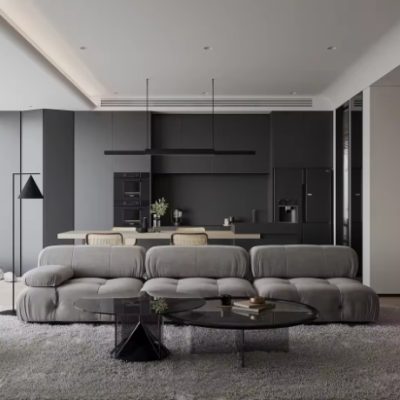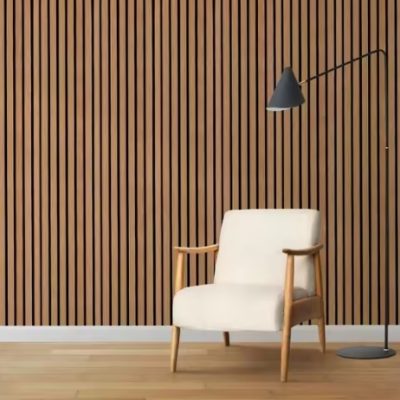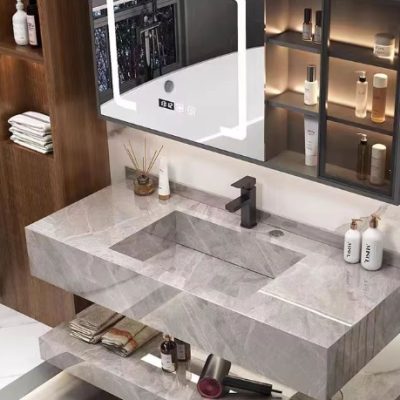

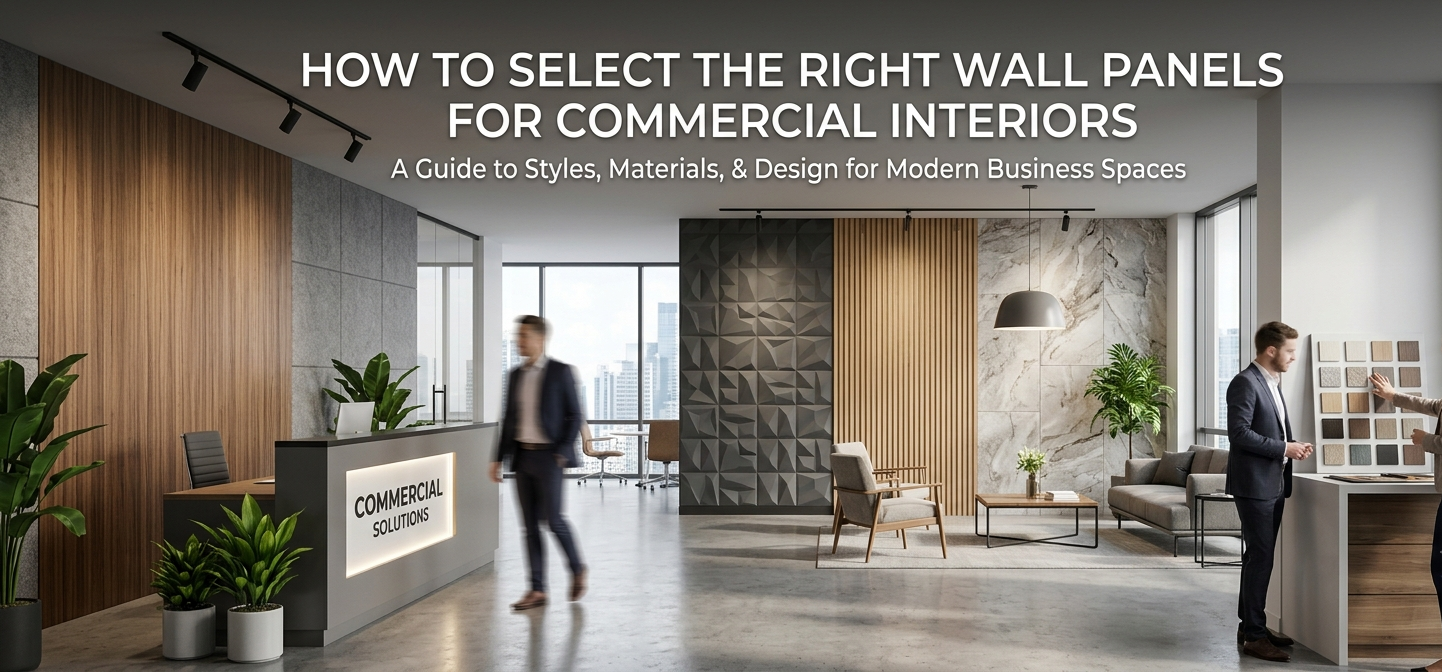
In commercial real estate developments—whether a 200-room hotel, a high-density apartment block, or a premium private villa portfolio—interior fit-out timelines directly dictate profitability. Drywall lining and traditional wet plastering cycles create significant labor bottlenecks. To compress these schedules, modern commercial projects rely heavily on prefabricated wall paneling systems. Wall panels can be installed rapidly over raw masonry, dropping room handover timelines by up to 40%.
However, sourcing wall panels for commercial spaces requires navigating technical baselines that residential retail buyers ignore. A commercial wall lining must withstand high-occupancy impact, satisfy municipal fire codes, maintain strict indoor air quality metrics, and integrate with custom furniture lines without visible finish variances.
Key Takeaways
- Audit Fire and Emission Certifications Early: Commercial interior spaces generally require a minimum of Class B1 fire retardancy and E0 or ENF formaldehyde emission ratings. Write these technical boundaries into the factory production contracts before paying deposits.
- Match Substrates to Zonal Utility: Use high-density moisture-resistant MDF or engineered wood veneers for high-impact guestrooms and lobbies, Wood-Plastic Composites (WPC) for heavy-use corridors, and Stone-Plastic Composites (SPC) for wet zones like kitchenettes and bathrooms.
- Verify Ceiling Heights to Avoid Horizontal Seams: Standard panels measure 2.8m to 3.0m. For high-ceiling hotel lobbies or villa voids, source specialized project-tier factories in Foshan that extrude continuous sheets up to 5.6m to maintain clean vertical lines.
- Enforce Cross-Factory Color Calibrations: Wall cladding often interfaces with internal doors and custom wardrobes. Centralizing procurement in Foshan allows your ground agent to route physical master swatches across disparate production floors to prevent mismatched wood stains.
Which Wall Panel Substrates Meet the Demands of High-Traffic Commercial Spaces?
Selecting the correct wall panel substrate requires a detailed understanding of the mechanical and environmental stresses each property zone will encounter. Utilizing a single material type across an entire commercial footprint often leads to premature failures.
| Substrate Type | Core Physical Composition | Primary Commercial Zone | Technical Advantage |
| Engineered Wood Veneer | High-Density MDF or Plywood Core + Real Wood Skin | Hotel guestrooms, VIP villa lounges, executive boardrooms | High tactile premium aesthetic; accepts precise routing details. |
| Wood-Plastic Composite (WPC) | Pervasive PVC Polymer + Recycled Wood Fiber | Main public corridors, apartment entryways, high-frequency steps | Highly impact-resistant; surface film resists deep scratches and scuffs. |
| Stone-Plastic Composite (SPC) | Natural Limestone Powder + Polyvinyl Chloride | Commercial bathrooms, studio kitchenettes, laundry alcoves | 100% waterproof; dimensionally stable against direct steam and ambient dampness. |
| Acoustic Fabric Panels | Open-cell Glass Wool Frame + Flame-Retardant Textile | Conference facilities, hotel media suites, private theaters | Controls echoing and sound transmission; carries verified Noise Reduction Coefficients (NRC). |
How Do You Prevent On-Site Installation Failures with Prefabricated Systems?
A major point of failure during the final fit-out phase is the reliance on onsite chemical adhesives to secure panels to uneven masonry surfaces. In commercial builds, gluing panels directly to raw brickwork or damp plaster results in rapid warping, air bubbling, and delamination when the central HVAC systems alter ambient indoor humidity.
Incorrect Glue-Down Application:
Raw Concrete Wall (Moist) ──> Standard Industrial Contact Adhesive ──> Wall Panel Layer (Prone to Buckling & Peeling)

Correct Mechanical Interlocking Configuration:
Raw Concrete Wall ──> Anti-Damp Vapor Barrier Film ──> Metal Cavity Battens ──> Interlocking Panel (Secured with Hidden Stainless Steel Clips)
To secure long-term flat alignment, your procurement specifications must mandate integrated mechanical interlocking profiles. WPC and SPC panels utilize interlocking tongue-and-groove side joints that clip together tightly. For large-format engineered wood panels, require the production lines to mill reverse-beveled edge tracks that drop onto hidden aluminum Z-clip rails anchored to lightweight steel wall studs. This mechanical spacing provides a 15mm to 30mm structural void behind the lining, allowing for clean wire management, hidden LED driver access, and constant back-panel air ventilation.
What Technical Compliance Standards Are Mandatory for Hospitality and Real Estate Projects?
Commercial developments must clear strict local municipal handovers. Importing residential-grade residential panels lacking proper laboratory documentation creates severe legal exposure, leading to customs delays or forced tear-outs by safety inspectors.
1. Fire Retardant Thresholds
Public hospitality corridors, assembly halls, and apartment exit routes require building materials to meet strict flame-spread indexes. When sourcing from China, panels must achieve a minimum of Class B1 (Flame Resistant) certification. For Western jurisdictions, ensure the factory formulation is verified under ASTM E84 Class A (US) or EN 13501-1 Class B-s1, d0 (Europe). This performance is achieved by infusing the core polymer or composite mix with specialized ammonium polyphosphate flame-suppressant additives during manufacturing.
2. Formaldehyde and VOC Limits
Because commercial hotels and rental apartments must operate immediately post-handover to capture revenue, indoor air quality is vital. Low-tier factories trim costs by using cheap urea-formaldehyde adhesives on their lamination lines. Your purchasing contracts must specify a minimum of E0 or ENF (Environmental Ultra-Low) emission ratings. Ensure your sourcing partner verifies that the factory operates automated lines using PUR (Polyurethane Reactive) hot-melt adhesives, which contain zero volatile solvents and emit no hazardous gases over time.
Why Is Finish Calibration Crucial When Sourcing Panels Separately From Cabinetry?
A common aesthetic defect in luxury real estate handovers is the “patchwork” effect. This happens when the vertical wall cladding panels, flush internal doors, and walk-in wardrobe casings display mismatched wood stains or different gloss reflections, despite all being ordered under the same generic design label like “Natural Oak.”
This occurs because independent factories utilize entirely different finishing setups. A wall panel extruder in Nanhai may utilize automated UV-cured film roll bonding, while a custom wardrobe manufacturer in Shunde uses manual spray-applied PU lacquers on raw wood lots.
To eliminate this variation on the project site, utilize Foshan’s geographic industrial density. Your ground sourcing agent must manage a centralized master sample system. A physical control sample of the approved veneer and finish is secured from the principal designer and hand-delivered to each separate assembly plant. The technical engineers at each factory use this master sample to calibrate their color runs, ensuring that the natural grain tone and light reflection indexes remain consistent across all adjacent interior fit-out surfaces.
Why Choose HSY Sourcing for Your Wall Panel Project?
Operating directly within Foshan’s high-volume building material and furniture manufacturing zones, HSY Sourcing serves as your independent project engineering, quality management, and logistics consolidation team on the ground in China.
- Cross-Sector Technical Coordination: We analyze your complete interior architectural drawings, BOQ lines, and spatial layout specs. We check that panel dimensions, milled wire cutouts, and baseboard clearances align with your chosen furniture and flooring manufacturers before production lines are booked.
- Unannounced Production Floor Audits: We do not accept factory self-reporting or polished showroom samples. Our quality control engineers conduct unannounced physical checks on the factory floors, testing substrate density with digital scales, checking core moisture metrics, and verifying adhesive types directly at the lamination lines.
- Compliance Document Verification: We oversee the collection and third-party laboratory verification of mandatory safety certifications (including Class B1 fire ratings, ASTM E84 logs, and ENF environmental sheets), protecting your project against local compliance failures.
- Reinforced Staging and Heavy-Duty Crating: Long, flat architectural sheets are highly fragile during maritime transit. We manage the collection of your materials at our local warehouse, supervising the construction of fully enclosed, reinforced horizontal plywood crates to prevent edge-chipping and surface scratching during container loading.
Visit www.hsysourcing.com to share your project’s architectural floor plans and material schedules. Let our ground engineers construct a stable, highly efficient, and transparent interior supply chain for your next property development.
Frequently Asked Questions (FAQ)
How do we manage factory Minimum Order Quantities (MOQs) for custom panel colors or unusual project heights?
Standard catalog sizes and stock colors usually carry low MOQs (often around 100 square meters). However, if your hotel design requires custom wood veneer matching or specific flame-retardant runs, factories generally require an MOQ of 500 to 1,000 square meters to offset machine setup waste. We resolve this for smaller boutique developments by sourcing from flexible, project-tier contract factories in Foshan who adapt their production lines for lower volumes using specialized CNC tooling.
What is the standard production lead time for a commercial wall panel order in Foshan?
For standard stock polymer-based profiles like WPC or SPC, production runs take 15 to 20 days from deposit confirmation. For custom architectural wood veneers, complex geometric fluted routings, or specialized chemical fire-retardant treatments, the manufacturing window shifts to 30 to 40 days due to required core conditioning and stabilization cycles.
How do wall panels behave under severe temperature fluctuations in coastal real estate projects?
Polymer-based panels like SPC are completely water-resistant and hold excellent dimensional stability in high-humidity zones. However, wood-composite materials (like MDF veneers or low-tier WPC) expand and contract slightly along their length when exposed to major temperature swings. We prevent field buckling by ensuring the installation shop drawings incorporate calculated vertical expansion joints hidden behind aluminum transitional profiles every 4 to 6 meters.