
Key Takeaways:
- Spec Synchronization: Ensure all factories use the same RAL color codes and hardware brands to maintain project-wide consistency.
- Centralized QC: Use a single inspection team across all vendors to ensure a uniform standard of “acceptable quality.”
- Buffer Management: Schedule production completion 14 days before the actual shipping date to account for vendor-specific delays.
- Consolidated Documentation: Manage multiple packing lists into one master document for smoother customs clearance at the destination.
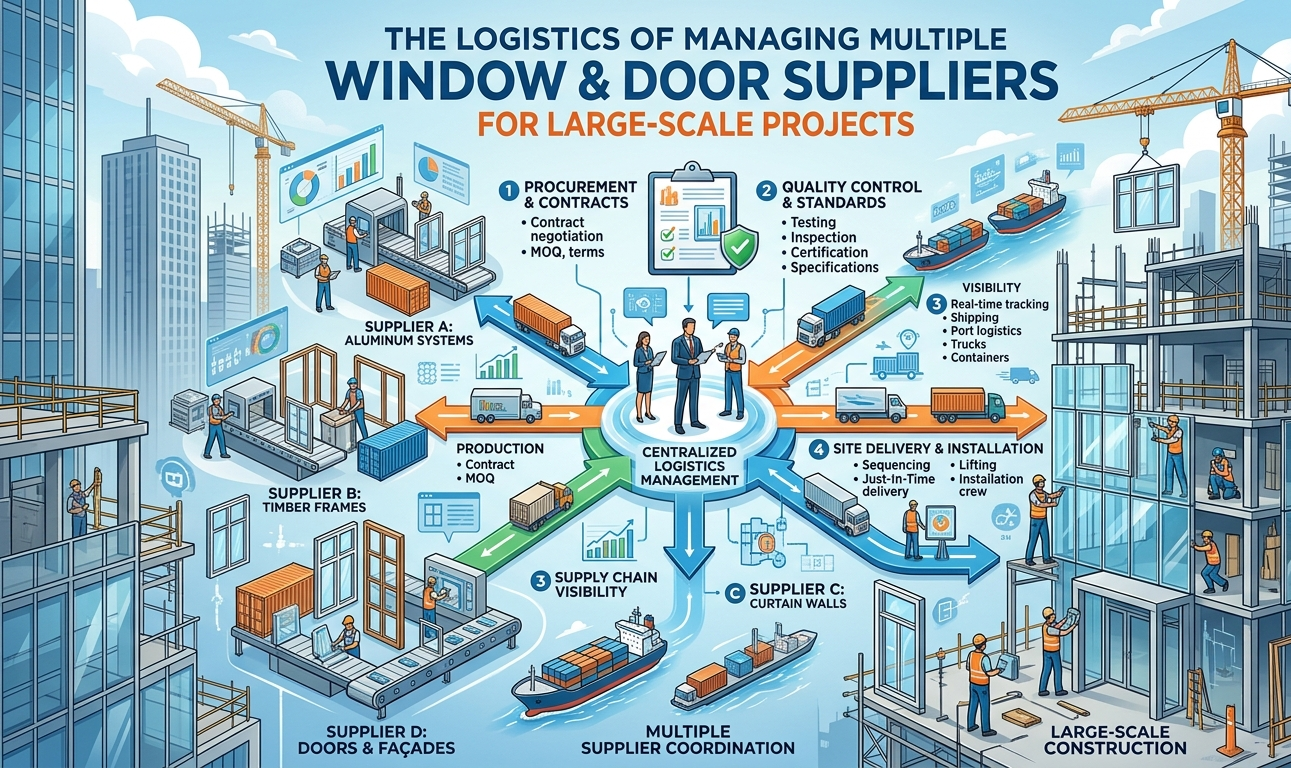
In large-scale construction—such as a 200-room hotel or a multi-building apartment complex—it is rarely feasible to source every opening from a single factory. You might need high-performance aluminum windows from one specialist, fire-rated steel doors from another, and decorative internal timber doors from a third.
While splitting orders reduces the risk of total supplier failure, it creates a massive coordination burden. Here is how to manage that complexity logically.
Why Should a Large Project Use Multiple Suppliers?
For a complex project, “specialization” usually beats “generalization.” A factory that excels at high-rise curtain walls may not be cost-effective or experienced in producing interior MDF doors. By splitting the Bill of Quantities (BOQ), you can:
- Optimize Costs: Get the best price for each specific category of material.
- Mitigate Capacity Risks: Avoid bottlenecks if one factory faces power outages or labor shortages.
- Access Niche Expertise: Ensure that specialized items (like acoustic-rated windows or smart-lock entry doors) are made by experts in those specific fields.
How Do You Maintain Aesthetic Consistency Across Different Factories?
The biggest risk with multiple suppliers is that the “Black” window frames from Factory A don’t quite match the “Black” door frames from Factory B.
- Standardize the Finishes: Never rely on “standard” color names. Mandate a specific RAL or Pantone code and require every factory to submit a physical color chip for approval against a single “master sample” kept by your agent.
- Unified Hardware Sourcing: If possible, specify a single hardware brand (e.g., KinLong or Hoppe) for the entire project. Having different handle designs or lock cylinder types across a hotel creates a maintenance nightmare for the operator later.
What Are the Risks of Fragmented Production Schedules?
In construction, timing is everything. If the window frames arrive but the glass is delayed, or the interior doors arrive two months before the building is watertight, your site logistics will collapse.
Managing multiple timelines requires a Master Procurement Schedule. You must account for different lead times: aluminum windows usually take 35–45 days, while custom-carved timber doors may take 60. A professional sourcing agent in Foshan will “pull” production from the slower factories earlier to ensure that all goods reach the consolidation warehouse simultaneously.
How Does Centralizing Quality Control Solve the “Finger-Pointing” Problem?
If you use each factory’s internal QC, you will receive different reports with different standards. When a problem occurs on-site, Factory A will blame the installer, and Factory B will claim their product was within “their” tolerance.
The solution is an independent, third-party inspection team that applies a single project standard across all vendors. This ensures that:
- Measurements are taken using the same tools and methods.
- The “AQL” (Acceptable Quality Limit) is consistent.
- The packaging is uniform, making it easier for your site crew to identify and unbox materials in order.
Why Choose HSY Sourcing for Your Multi-Vendor Projects?
At HSY Sourcing, we act as the “Control Tower” for your procurement in Foshan. We specialize in the architectural and technical demands of the hospitality and real estate sectors.
- Foshan Proximity: We are on the ground. We can visit three different factories in a single day to verify production status, rather than relying on their email updates.
- Technical Synchronization: We review your architectural drawings and ensure that the tolerances between different products (e.g., the gap between a door frame and the wall) are consistent across all suppliers.
- Expert Consolidation: We manage a central warehouse where we collect, inspect, and safely load containers. We prioritize the loading so that the items you need first on-site are the ones easiest to access in the container.
- Transparent Communication: You get one point of contact. Instead of chasing five factory managers, you get one comprehensive status report covering your entire project.
Visit www.hsysourcing.com to simplify your project’s China supply chain.
Frequently Asked Questions (FAQ)
Q: Is it more expensive to ship from multiple suppliers?
A: If shipped individually (LCL), yes. However, by using HSY Sourcing to consolidate multiple vendors into Full Container Loads (FCL), you actually save significantly on freight and port charges.
Q: How do you handle a delay from one of the five suppliers?
A: We monitor production milestones weekly. If one factory lags, we can often adjust the consolidation schedule or, in extreme cases, ship the critical items first while the delayed items follow in a later “phase” of the project delivery.
Q: Can you help with the technical shop drawings for all suppliers?
A: Yes. We ensure that the shop drawings from the window factory align with the requirements of the door factory and the site measurements provided by your contractor.