
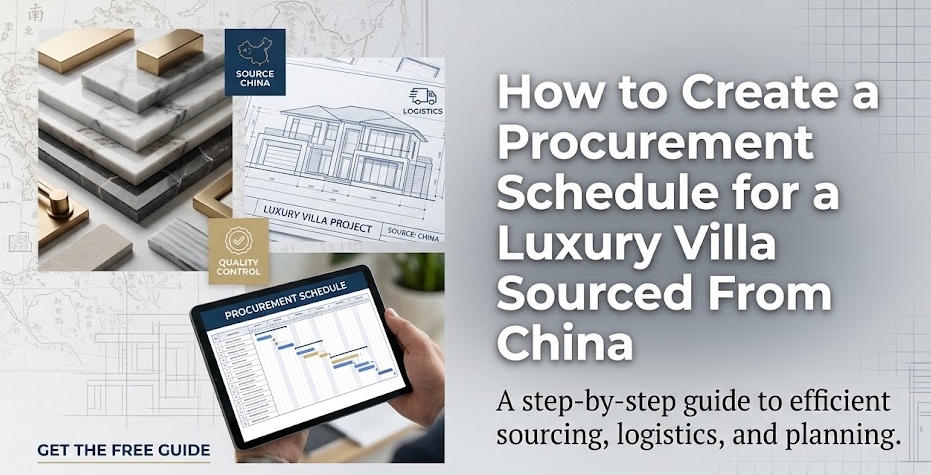
To build an accurate procurement schedule for a luxury villa sourced from China, you must plan backward from your site installation dates. Rather than simply adding a generic 30- or 60-day lead time to every product category, a functional schedule maps backward from when each item is required on site, incorporating time for local receiving, international transit, export preparation, quality checks, manufacturing, shop drawing approvals, and preliminary supplier selection.
While preliminary supplier research, budgeting, and specification development can begin early in the design stage, final production releases often depend on specific project conditions—such as verified site dimensions, approved MEP (mechanical, electrical, and plumbing) layouts, or adjacent trade progress. Aligning your procurement schedule with these technical dependencies ensures that materials arrive in the correct sequence without causing site delays or incurring unnecessary storage costs.
1. Start With the Villa’s Construction and Installation Schedule
A procurement schedule does not exist in isolation. It is an operational tool designed to supply the site with the correct materials at the exact moment the contractor needs them. Before attempting to establish dates for Chinese manufacturers, gather the following foundational documents and data:
- The Master Construction Programme: The target dates for structural completion, enclosure, MEP rough-ins, interior framing, finishes, and final handover.
- The Interior Design Schedule: Deadlines for sign-offs on layouts, material selections, finish boards, and custom detailing.
- Architectural and Engineering Drawings: Plans, elevations, door/window schedules, ceiling details, and CAD files.
- Bill of Quantities (BOQ) or Material Schedule: Preliminary or finalized item lists detailing quantities, material types, and performance specifications.
- Planned On-Site Installation Sequence: Target dates for windows/doors, primary MEP, wet trade finishes, joinery, sanitary ware, lighting, and loose furniture.
- Logistics and Site Parameters: The project location, destination port, local transport access, and on-site storage availability.
- Decision-Making Framework: Explicit identification of who holds authority to review drawings, sign off on finish samples, and issue written production releases (e.g., owner, architect, interior designer, or project manager).
Why the Project Completion Date Is Not Enough
Setting procurement deadlines based solely on a single project completion date usually leads to site congestion or critical path delays. Different trades require materials at distinct stages of construction:
- Windows and Exterior Doors: Required early to enclose the structure, making the site weather-tight so interior wet trades (plastering, tiling) and dry trades (cabinetry, flooring) can proceed safely.
- Kitchen Cabinets and Millwork: Must be installed before stone worktops can be accurately templated. Cabinet dimensions must also be finalized early to ensure rough-in locations for electrical, water, and drainage services match the factory production drawings.
- Flooring and Interior Doors: Finished floor levels (FFL) dictate the clear opening heights required for interior doors and custom joinery.
- Lighting: Recessed trimless architectural lights require housings to be installed prior to ceiling plastering, whereas decorative pendant fixtures are hung after painted finishes are complete.
- Furniture: Delivered only when the villa is fully enclosed, climate-controlled, dust-free, and secure.
Understanding these operational relationships allows you to establish realistic target delivery dates for each product category.
2. Divide the Procurement Process Into Clear Milestones
A procurement schedule tracks the multi-stage progression of technical approvals, commercial agreements, and quality control checks. Dividing the pipeline for each category into defined milestones prevents premature production releases and highlights potential bottlenecks.
+-------------------+     +------------------+     +-------------------+     +--------------------+
| 1. Scope & Specs  | --> | 2. Sourcing &    | --> | 3. Commercial     | --> | 4. Technical       |
|    Definition     |     |    Shortlisting  |     |    Terms & Deposit|     |    Approvals       |
+-------------------+     +------------------+     +-------------------+     +--------------------+
                                                                                    |
+-------------------+     +------------------+     +-------------------+            v
| 8. On-Site        | <-- | 7. Freight &     | <-- | 6. QC, Packing &  | <-- +--------------------+
|    Installation   |     |    Consolidation |     |    Pre-Shipment   |     | 5. Production      |
+-------------------+     +------------------+     +-------------------+     +--------------------+
- Scope and Specification Definition: Compiling CAD files, design intent renderings, BOQs, and specific performance criteria.
- Supplier Research and Shortlisting: Identifying potential factories in key manufacturing hubs (e.g., Foshan for tiles, sanitary ware, and furniture; Dongguan for custom joinery; Zhongshan for lighting) based on technical capability, capacity, and quality standards.
- Quotation Review and Commercial Finalization: Comparing itemized quotes, material breakdowns, packaging specifications, payment terms, and lead times.
- Technical Approval Stage: Developing, reviewing, and approving factory shop drawings, physical material control samples, finish mock-ups, and hardware specifications.
- Production Release and Manufacturing: Issuing formal written authorization to commence manufacturing after receiving deposit payments and sign-offs on shop drawings and physical samples.
- Quality Control and Pre-Shipment Inspection: Conducting in-line manufacturing checks and final pre-shipment inspections (verifying dimensions, finishes, assembly mock-ups, quantities, and export packaging).
- Consolidation, Warehousing, and Freight: Receiving inspected goods at a central consolidation facility, organizing container loading, managing customs export documentation, and coordinating sea freight.
- Destination Import, Local Delivery, and Installation: Clearing customs at the port of entry, managing inland transport, receiving goods on site, and handing off items to specialized installation teams.
Critical Distinction: Quoting vs. Production Release
A common project risk is confusing an initial factory estimate with a production-ready commitment.
- Indicative Quotation: Based on initial design intent or preliminary CAD drawings. It allows for budget alignment and supplier shortlisting.
- Production Release: Occurs only when factory shop drawings are fully dimensioned, material finishes are signed off on physical physical samples, MEP integration points are verified, and the deposit is paid.
Manufacturing should never begin based on unapproved preliminary design drawings.
3. Build the Schedule Around Product-Specific Dependencies
Different product categories carry distinct technical inputs, approval requirements, and manufacturing characteristics. The table below outlines how dependencies vary across major villa categories:
| Product Category | Key Technical Inputs Required | Primary Project Dependencies | Primary Scheduling Considerations |
| Custom Kitchen Cabinets & Wardrobes | Coordinated architectural layouts, appliance cut-out sheets, MEP connection points, finish samples. | Final wall dimensions, MEP rough-in verification, stone counter interface details. | Require detailed millwork shop drawings. Production must not proceed without confirmed appliance model numbers and physical finish approval. |
| Windows & Exterior Doors | Rough opening dimensions, structural wind-load requirements, glass performance specs, frame profile details. | As-built structural openings (concrete/steel frame execution), local building codes. | Critical path item. Required on site early to achieve a weather-tight building envelope. Final site dimensions should be verified before frame fabrication begins. |
| Interior Doors | Wall thickness, frame details, swing directions, hardware specifications, Finished Floor Level (FFL). | Confirmed FFL, plaster/drywall wall thickness, opening height/width site checks. | Subframe installation may precede leaf manufacturing, but final leaf dimensions rely on accurate FFL benchmarks. |
| Marble & Sintered Stone | Slab selection, vein-matching layouts, edge profiles, cut-out details for sinks and cooktops. | Substructure installation (e.g., cabinet carcasses), physical site templating (or verified 3D scan). | Slabs should be selected early for lot consistency, but final cutting often depends on as-built measurements of installed cabinetry or framing. |
| Flooring & Tiles | Laying patterns, tile sizes, transition details, waterproofing membrane thickness. | Subfloor levelness, FFL benchmarks, wet room sloping details. | Tile orders should include overage allowances (typically 10–15%) to avoid color-lot discrepancies if reorders are needed later. |
| Sanitary Ware & Vanities | Rough-in dimensions, waste outlet positions, valve/faucet mounting specs, power requirements. | Wall framing, concealed valve installation, drainage and water supply positioning. | Concealed valves and wall-hung toilet frames must arrive on site well before vanity units and surface fixtures. |
| Architectural & Decorative Lighting | Reflected Ceiling Plans (RCP), driver locations, dimming protocol (DALI, 0-10V, Triac), fixture dimensions. | Ceiling framing height, junction box positioning, home automation control specs. | Trimless mounting housings must arrive during ceiling framing; decorative shades/pendants arrive post-painting. |
| Loose & Custom Furniture | Fabric/leather approvals, dimensioned space plans, wood/metal finish samples, density specs. | Access paths (stairwells, elevators, doorways), room completion, climate control. | Long production lead time, but delivery must be deferred until the site is clean, dry, dust-free, and lockable. |
4. Identify Which Decisions Can Be Made in Parallel
Waiting for one phase of a project to conclude entirely before starting the next creates unnecessary delay. A functional procurement schedule manages activities concurrently while establishing strict control gates for actual production authorization.
Phase 1: Early Parallel Planning (Pre-Site Measurement)
-----------------------------------------------------------------------------------------
[ Kitchen Cabinets ] --> Shortlist Factories --> Review Preliminary Quotes --> Select Finishes
[ Lighting         ] --> Review RCP Specs      --> Source Fixtures/Drivers     --> Approve Samples
[ Sanitary Ware    ] --> Confirm Rough-ins     --> Match Faucet Details        --> Order In-Wall Valves
-----------------------------------------------------------------------------------------

Phase 2: Technical Gate (Requires Site Verification)
-----------------------------------------------------------------------------------------
[ Site Milestone ]   --> Structural Framing Complete / As-Built Dimensions Scanned
-----------------------------------------------------------------------------------------

Phase 3: Dependent Production Release
-----------------------------------------------------------------------------------------
[ Kitchen Cabinets ] --> Final Shop Drawings Approved --> Release Factory Production
[ Interior Doors   ] --> Verify Wall Thickness/FFL    --> Release Factory Production
-----------------------------------------------------------------------------------------
Parallel Sourcing vs. Production Release
While structural work is occurring on site, several procurement tasks can proceed simultaneously:
- Supplier Qualification: You can evaluate factory qualifications, review material performance test reports, and negotiate commercial terms for kitchen joinery, windows, tiles, and furniture in parallel.
- Sample Sign-Offs: Physical control samples (wood stains, metal finishes, stone slabs, fabric swatches) can be reviewed and approved months before manufacturing starts.
- Concealed Components First: You can finalize orders for in-wall mixer valves, frame housings, or floor channels early, allowing these items to ship via air freight or fast sea freight to meet early site rough-in deadlines.
The Technical Control Gate
Although research and negotiation happen in parallel, formal production authorization must wait for technical prerequisites. For example, you can select your kitchen manufacturer, approve cabinet door samples, and agree on pricing while the site is still at the concrete frame stage.
However, issuing the final shop drawing approval and authorizing cutting must remain on hold until the physical room partition walls are built and as-built measurements are verified.
5. Work Backward From Each Required On-Site Date
To establish accurate ordering deadlines, map the timeline backward from the required installation date on site using real, verified durations rather than generalized assumptions.
The Backward Calculation Sequence
For every product category, calculate the timeline in reverse using this sequence:
- Required On-Site Date: The day the contractor requires the material on site.
- Minus Inland Transport & Port Handling: Time required for customs clearance at the destination port, staging, and final truck transport to the site (typically 5 to 14 days, depending on country and infrastructure).
- Minus Ocean Freight Shipping Time: Port-to-port transit time (varies significantly by trade lane—e.g., 12–18 days from South China to Australia, 25–35 days to Europe or the US West Coast, 35–45 days to the US East Coast or Caribbean).
- Minus Export Customs & Container Loading: Time to consolidate items at a China warehouse, load containers, handle export filings, and ship to the departure port (typically 7 to 10 days).
- Minus Pre-Shipment Inspection & Packing: Time for quality control checks, addressing any identified punch-list items, custom crating, and packing (typically 5 to 10 days).
- Minus Manufacturing Duration: Confirmed factory production time after drawing sign-off and deposit receipt (varies by product: 30 to 60+ days).
- Minus Technical Approval & Shop Drawing Phase: Iterative CAD reviews, material sample physical sign-offs, and site dimensional verification (typically 14 to 30 days).
- Equals Required Order Confirmation & Release Deadline.
Hypothetical Timeline Comparison
The following example illustrates how three product categories for a single villa project might carry distinct timelines based on ocean transit to a European destination (assumed 30-day ocean transit) and different site installation requirements:
PRODUCT CATEGORY 1: EXTERIOR WINDOWS & DOORS
[ Required On-Site: Day 120 ]
  │
  ├── Minus 10 days: Local destination clearance & delivery
  ├── Minus 30 days: Ocean freight transit (Foshan to Destination Port)
  ├── Minus 7 days:  China export customs & container loading
  ├── Minus 7 days:  Pre-shipment inspection, glass testing & timber crating
  ├── Minus 45 days: Factory manufacturing duration
  └── Minus 21 days: Shop drawing iterations & site opening measurement sign-off
  │
  └── [ MUST RELEASE PRODUCTION BY: Day 0 ]

PRODUCT CATEGORY 2: CUSTOM KITCHEN CABINETS
[ Required On-Site: Day 180 ]
  │
  ├── Minus 10 days: Local destination clearance & delivery
  ├── Minus 30 days: Ocean freight transit
  ├── Minus 10 days: Consolidation warehouse staging & packing
  ├── Minus 7 days:  Pre-shipment inspection & trial assembly checks
  ├── Minus 40 days: Factory manufacturing duration
  └── Minus 28 days: Shop drawing sign-off, MEP alignment & finish sample approval
  │
  └── [ MUST RELEASE PRODUCTION BY: Day 55 ]

PRODUCT CATEGORY 3: LOOSE FURNITURE
[ Required On-Site: Day 240 ]
  │
  ├── Minus 10 days: Local destination clearance & delivery
  ├── Minus 30 days: Ocean freight transit
  ├── Minus 7 days:  China export customs & loading
  ├── Minus 7 days:  Final inspection, frame checks & export packing
  ├── Minus 45 days: Upholstery & timber furniture production
  └── Minus 14 days: Fabric selection, wood stain approval & CAD dimension sign-off
  │
  └── [ MUST RELEASE PRODUCTION BY: Day 127 ]
Note: The durations listed above are purely illustrative for this hypothetical scenario. Actual timelines must be confirmed directly with selected suppliers and freight forwarders for your specific project location.
6. Add Approval Deadlines and Responsibility Owners
A schedule with dates but no assigned ownership often leads to project delays. Every milestone must specify who generates the technical input, who reviews it, and who holds final sign-off authority.
Assigning Clear Ownership
In luxury residential projects involving multiple parties, unassigned technical responsibility can stall procurement. Ensure your schedule identifies ownership across the core project team:
- Homeowner / Client: Approves overall budgets, aesthetic direction, material selections, and formal commercial releases.
- Interior Designer: Provides specifications, sign-offs on physical control samples, approves joinery finishes, and reviews shop drawing design intent.
- Architect: Approves window/door structural performance, exterior integration details, floor plans, and elevation CADs.
- General Contractor / Site PM: Confirms as-built site dimensions, agrees on FFL benchmarks, verifies MEP rough-in compatibility, and sets site delivery dates.
- Sourcing & Coordination Partner: Translates design intent into technical factory inputs, manages supplier schedules, collects CAD shop drawings, organizes physical sample approvals, conducts quality control, and manages consolidation logistics.
Structuring an Approval Control Log
For critical items like custom kitchen cabinets, use a structured sign-off tracker to maintain accountability:
Example Approval Log Entry: Kitchen Joinery
- Action Item: Final Approval of Kitchen Cabinet Shop Drawings & Material Control Samples
- Information Input Required: Confirmed site wall dimensions (Contractor), appliance spec sheets (Designer), electrical layout (MEP Engineer).
- Action Owner: Interior Designer & General Contractor.
- Review Deadline: November 12.
- Consequence of Delay: Every week of delayed approval shifts the factory production slot by one week, risking window overlap and pushing back on-site stone counter templating.
- Next Dependent Step: Release of factory deposit and commencement of carcass cutting.
7. Plan Quality Checks Before Goods Are Ready to Ship
Quality assurance should be built directly into the schedule as a distinct milestone, rather than treated as an afterthought right before loading. Rectifying an error at a factory in Foshan takes days; discovering an error on site thousands of miles away can cost months.
+---------------------------------------------------------------------------------+
|                         IN-LINE / MID-PRODUCTION CHECK                          |
|  Verifies raw materials, substrate quality, framing, and early dimension checks |
+---------------------------------------------------------------------------------+
                                        │
                                        ▼
+---------------------------------------------------------------------------------+
|                        FINAL PRE-SHIPMENT INSPECTION                            |
|  Evaluates full pre-assembly, surface finishes, dimensions, hardware, color    |
+---------------------------------------------------------------------------------+
                                        │
                         ┌──────────────┴──────────────┐
                         ▼                             ▼
                 [ PASSES QC ]                 [ DEFECT DETECTED ]
                         │                             │
                         │                             ▼
                         │                     +---------------+
                         │                     | RECTIFICATION |
                         │                     | TIME BUFFER   |
                         │                     +---------------+
                         │                             │
                         └──────────────┬──────────────┘
                                        │
                                        ▼
+---------------------------------------------------------------------------------+
|                          PACKING & CRATING VERIFICATION                         |
|  Inspects protective wrap, corner guards, moisture protection, labeling         |
+---------------------------------------------------------------------------------+
Essential QC Milestones to Schedule
- Material Control Sample Approval (Pre-Production): Formal sign-off on physical physical finish boards (stone slabs, wood veneers, powder coat chips) that serve as the baseline inspection standard.
- In-Line / Mid-Production Check: Conducted when raw materials are prepped or frames are assembled (e.g., inspecting raw timber carcasses before lacquering, or checking glass specifications before double-glazing sealing).
- Final Pre-Shipment Inspection (PSI): Conducted when manufacturing is 100% complete and at least 80% of items are packaged. Key checks include:
- Dimensional Verification: Checking overall length, depth, height, cutout positions, and clearances against approved shop drawings.
- Pre-Assembly Mock-ups: Assembling custom cabinets, vanity units, or complex dining tables at the factory to confirm fit, joinery alignment, and structural stability.
- Finish & Color Consistency: Comparing finished products against signed physical control samples under standardized lighting.
- Functional Testing: Operating hardware, drawers, soft-close hinges, sliding mechanisms, and verifying electrical safety compliance.
- Packing and Crating Inspection: Verifying drop protection, reinforced wooden crating for fragile items (stone, glass, sanitary ware), moisture-barrier wrapping, and room-by-room box labeling.
Factoring Rectification Time Into the Schedule
A thorough inspection may reveal minor defects—a scratched lacquered panel, an incorrect hinge drill hole, or a color shade mismatch. Your schedule must include a 7- to 14-day quality contingency buffer between the completed inspection date and the planned container loading date to allow the factory to re-finish, repair, or replace non-conforming items without disrupting shipping logistics.
8. Coordinate Consolidation and International Shipping
Procuring a full villa from China often involves sourcing items from dozens of specialized factories across Guangdong and other provinces. Coordinating the arrival, storage, and loading of these items requires careful staging in a centralized facility.
+------------------+     +------------------+     +------------------+
| Factory A: Stone |     | Factory B: Doors |     | Factory C: Joinery|
+------------------+     +------------------+     +------------------+
         │                        │                        │
         └──────────────────┐     │     ┌──────────────────┘
                            ▼     ▼     ▼
               +----------------------------------+
               | CENTRAL CONSOLIDATION WAREHOUSE  |
               | (Foshan / Port Staging Facility) |
               +----------------------------------+
                                  │
                                  ▼
               +----------------------------------+
               | FULL CONTAINER LOAD (FCL) SHIPMENT|
               +----------------------------------+
                                  │
                                  ▼
               +----------------------------------+
               | DESTINATION PORT & SITE DELIVERY |
               +----------------------------------+
Key Consolidation Decisions
- Single Master Shipment vs. Phased Container Shipments:
- Single Shipment: Consolidating all villa materials into a single container shipment reduces freight overhead and simplifies destination customs entry. However, early-finished items (like tiles or sanitary ware) must sit in warehouse storage until custom millwork or furniture is completed.
- Phased Shipments: Shipping items in stages aligned with construction progress (e.g., Container 1: Windows & Structural Items; Container 2: Tiles, Sanitary Ware & Joinery; Container 3: Furniture & Lighting) prevents on-site damage and avoids storage delays at origin, though it increases total transport administration.
- Warehouse Staging Capacity: Confirming that your sourcing partner’s facility can store and organize large volumes, keeping items secure, clean, and dry while waiting for remaining factory deliveries.
- Room-by-Room Labeling & Packing Lists: Mandating that every package bears clear, multi-language labels identifying the specific room location (e.g.,
Villa - Master Bedroom - Item #MB-WD-01 (Wardrobe Left Panel)). This drastically reduces sorting time and damage risk during site unboxing. - Site Readiness & Container Access: Verifying that the construction site has accessible unloading space, security, weatherproofing, and labor available before releasing containers from the destination port.
9. Build Contingency Into the Schedule
Unforeseen changes occur on almost every residential construction project. Building sensible contingency buffers into critical milestones protects the target completion date from common execution risks.
Primary Sourcing Risks and Mitigation Buffers
- Design and Specification Revisions: Changes to layout, finishes, or hardware mid-stream require shop drawing revisions and sample re-approvals.
- Mitigation: Freeze design specifications before issuing factory production deposits.
- Factory Peak Seasons and Holidays: Production times slow significantly around major domestic holidays—most notably Lunar New Year (CNY), when factories shut down for 3 to 4 weeks, with production disruption often extending to 6 weeks total as workers return and supply chains restart.
- Mitigation: Add a 3- to 4-week lead time buffer for any orders with production windows falling within two months of CNY.
- Failed Quality Control Inspections: If items fail pre-shipment checks, factory rework requires time.
- Mitigation: Allocate a standard 10-day post-inspection buffer before container loading dates.
- Logistics and Ocean Freight Delays: Port congestion, container shortages, transshipment delays, or weather disruptions can extend sea transit times.
- Mitigation: Track freight schedules dynamically and add a 10- to 14-day buffer to ocean shipping estimates during peak freight seasons (Q3 to early Q4).
- Site Readiness Delays: Delivering custom joinery or high-end furniture to an unfinished, dusty, or un-conditioned site leads to damaged goods and voided warranties.
- Mitigation: Treat site completion milestones (enclosure, painting, climate control) as absolute prerequisites before dispatching containers from origin consolidation.
10. A Practical Villa Procurement Schedule Template
Below is an adaptable tracking framework designed for integration into project management spreadsheets. Use this structure to monitor each product category across its critical decision lifecycle:
| Product Category | Target On-Site Date | Required Inputs & Specs | Supplier Final Selection Deadline | Drawing & Sample Sign-off Gate | Factory Production Release | Expected Factory Completion | QC Inspection & Packing | Consolidation & Port Loading | Target Delivery To Site | Responsible Owner | Outstanding Actions / Notes |
| Windows & Exterior Doors | [Insert Date] | Architectural CADs, wind loads, glass performance specs. | [Insert Date] | [Insert Date] | [Insert Date] | [Insert Date] | [Insert Date] | [Insert Date] | [Insert Date] | Architect / Contractor | Site structural openings require final measurement. |
| Custom Kitchen Cabinets | [Insert Date] | Final kitchen layouts, appliance cut-out sheets, MEP plans. | [Insert Date] | [Insert Date] | [Insert Date] | [Insert Date] | [Insert Date] | [Insert Date] | [Insert Date] | Interior Designer / Client | Appliance models locked; awaiting physical door finish sample sign-off. |
| Marble & Sintered Stone | [Insert Date] | Slab selections, edge details, cut-out locations, joint plans. | [Insert Date] | [Insert Date] | [Insert Date] | [Insert Date] | [Insert Date] | [Insert Date] | [Insert Date] | Interior Designer / Client | Slab lots reserved at factory; final cutting waits on cabinet installation. |
| Sanitary Ware & Fittings | [Insert Date] | Plumbing specifications, finish selections, mounting details. | [Insert Date] | [Insert Date] | [Insert Date] | [Insert Date] | [Insert Date] | [Insert Date] | [Insert Date] | Interior Designer | Concealed in-wall valves separated for early air shipment. |
| Loose & Custom Furniture | [Insert Date] | Dimensioned furniture plans, fabric/leather approvals, finish boards. | [Insert Date] | [Insert Date] | [Insert Date] | [Insert Date] | [Insert Date] | [Insert Date] | [Insert Date] | Interior Designer / Client | Upholstery swatches approved; awaiting site climate-control sign-off. |
Note: Populate all date fields with actual, confirmed figures provided by your architect, selected factories, and freight forwarders.
Frequently Asked Questions
How early should I create a procurement schedule for a villa sourced from China?
You should establish a preliminary procurement schedule during the schematic design phase, at the same time your architect and interior designer draft detailed CAD layouts and material schedules. Creating the schedule early allows you to align supplier lead times with your contractor’s construction programme and identify long-lead items (such as custom windows or specialized joinery) well before site break-ground.
Can I source different villa materials from several factories at the same time?
Yes. Sourcing different categories from specialized regional manufacturing hubs—for example, sanitary ware and tiles from Foshan, high-end joinery from Dongguan, and architectural lighting from Zhongshan—allows you to achieve higher quality and better commercial value than relying on a single generalist factory. Managing multiple suppliers concurrently requires active coordination to track shop drawings, verify finish consistency, and align completion dates for consolidated shipping.
Should I order all villa materials together?
Not necessarily. While consolidating materials into fewer shipments reduces logistics costs, releasing production for every product category at the exact same moment is rarely practical. Items required early in the construction sequence (such as window subframes, exterior glazing, or concealed plumbing valves) should be manufactured and shipped before delicate interior finishes, custom joinery, or loose furniture.
What should I do if the architect’s drawings are not finalized?
You can still proceed with preliminary sourcing activities, including factory research, budget estimation, supplier shortlisting, and physical sample reviews. However, you should refrain from issuing production deposits or authorizing factory manufacturing until CAD drawings, MEP integration details, and material specifications are fully finalized and signed off by your project team.
Which product categories should be scheduled first?
Windows, curtain walls, exterior doors, and concealed MEP components (such as in-wall shower valves and trimless lighting housing frames) should be scheduled first. These items are required early to enclose the structure, ensure weather tightness, and allow interior wall trade work to begin.
How do I coordinate factory production with international shipping?
Require each factory to commit to a firm manufacturing milestone schedule with weekly progress updates. Map these factory completion dates against your consolidation warehouse schedule, allowing a 7- to 10-day window for quality control inspections, packaging, and staging. Coordinate ocean freight bookings 2 to 3 weeks prior to expected production completion to secure shipping container availability.
Who should maintain and update the procurement schedule?
The procurement schedule should be maintained by a dedicated project coordinator or your professional sourcing coordination partner, working in direct communication with the homeowner, interior designer, general contractor, and factory project managers. Regular schedule reviews ensure all parties remain accountable for upcoming approval deadlines and site delivery windows.
Can a China sourcing agent help coordinate the schedule?
Yes. A professional, Foshan-based sourcing coordination team acts as your on-the-ground operational manager. They interface directly with factory engineering departments, track shop drawing revisions, monitor production progress, conduct physical on-site quality control inspections, manage warehouse consolidation, and arrange international shipping documentation to ensure your procurement schedule aligns with site requirements.
Key Takeaways
- Build Backward From Installation Dates: Base your procurement schedule on when items are actually required on site by the installation trades, not on a generic lead time added to an order date.
- Separate Quoting From Production Release: Use initial estimates for budgeting and supplier shortlisting, but hold formal production authorization until final CAD drawings, physical samples, and site measurements are approved.
- Respect Product Dependencies: Recognize that custom items like stone worktops and interior doors depend on preceding trade milestones (such as installed cabinetry carcasses and confirmed finished floor levels).
- Schedule Quality Control Explicitly: Build defined milestones for in-line inspections, pre-shipment checks, and potential factory rework directly into your timeline before container loading.
- Manage Ownership and Approval Gates: Clearly define who holds approval authority for every drawing, finish board, and commercial milestone to prevent project stalling.
- Balance Consolidation and Site Readiness: Stagger production and shipping to match construction progress, ensuring delicate joinery and furniture arrive only when the villa is secure, clean, and climate-controlled.
How HSY Sourcing Can Help Coordinate Villa Procurement
HSY Sourcing is a specialized sourcing and procurement coordination service based in Foshan, Guangdong—the heart of China’s premium building materials and furniture manufacturing region. We act as your dedicated on-the-ground representative, working in close collaboration with your project team, architect, interior designer, and contractors.
Depending on your specific project requirements and service agreement, our coordination services include:
- Supplier Research & Pre-Screening: Matching your project’s technical and aesthetic requirements with qualified, audited factories across Guangdong.
- Quotation Collection & Analysis: Compiling detailed, itemized cost breakdowns and commercial evaluations across multiple product categories.
- Technical & Drawing Coordination: Facilitating shop drawing iterations, sample sign-offs, and communication between your design team and factory engineers.
- Production Monitoring & Quality Control: Performing scheduled in-line checks and thorough pre-shipment inspections against agreed standards to catch and correct defects before items leave the factory.
- Centralized Consolidation & Warehousing: Staging goods from various suppliers at our Foshan facility, ensuring correct packaging, room-by-room labeling, and efficient container loading.
- Logistics & Freight Facilitation: Managing export documentation, customs filings, and coordinating ocean freight through qualified shipping partners.
We do not manufacture products directly, nor do we replace your architect’s design authority or contractor’s site management. Instead, we provide the technical execution, oversight, and project coordination necessary to bridge the gap between your design vision and factory production in China.
Ready to Schedule Your Villa Procurement?
If you have established floor plans, CAD drawings, 3D renderings, or a preliminary Bill of Quantities (BOQ) for your new villa build or major renovation, contact HSY Sourcing today to discuss how we can help you build a structured procurement plan for your China-sourced materials.