
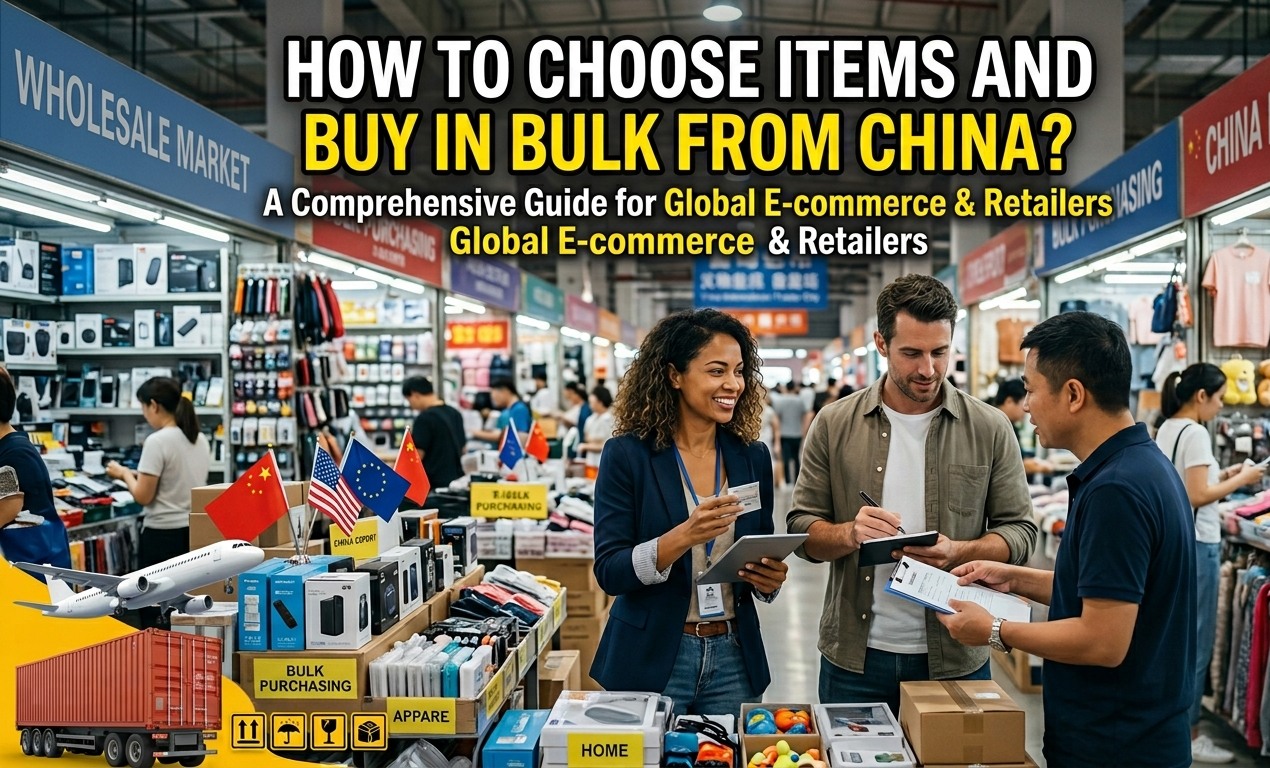
Buying in bulk from China is a math problem, not a shopping trip. For importers and Amazon sellers in 2026, the goal is no longer just “finding the cheapest price.” It’s about calculating the total landed cost while minimizing the risk of a container full of unsellable goods.
Whether you are looking for Consumer Goods, high-end Foshan building materials, or outdoor hospitality gear, bulk buying requires a move from “browsing” to “procurement engineering.”
How do you identify which products are actually worth a bulk order?
Not every product is a good candidate for bulk buying. To avoid ending up with “dead stock” in your warehouse, you need to filter your choices through three realistic lenses:
- The “Landed Cost” Reality: If a product is bulky but low-value (like cheap plastic bins), the sea freight and storage might eat your entire margin. Bulk buying works best for items with a high value-to-volume ratio.
- Market Stability vs. Hype: Don’t go bulk on “TikTok trends” unless you can get the goods into your warehouse in under 30 days. For long-term profitability, look for “evergreen” items with stable demand—things like workwear, construction hardware, or essential home decor.
- Technical Complexity: Can you define the quality in a contract? If a product is too complex to inspect (like high-end medical sensors), bulk buying without an engineering background is risky. Stick to products where you can clearly define “Pass/Fail” criteria, such as fabric weight, color matching, or structural dimensions.
Why is Alibaba often just the “starting line” for bulk buyers?
Online marketplaces are great for research, but they are often filled with trading companies posing as factories. In 2026, serious bulk buyers are looking deeper:
- 1688.com vs. Alibaba: 1688 is designed for the Chinese domestic market. Prices are often lower, but the factories there rarely have export licenses or English-speaking staff.
- The Guangdong Cluster Advantage: If you are buying furniture or tiles, you look in Foshan. For lighting, you look in Zhongshan. For garments, you look in Guangzhou or Dongguan. Being “in the cluster” means your sourcing agent can visit three different factories in a single afternoon to compare raw material quality.
- Trade Fairs (Canton Fair 2026): Physical verification is back. Meeting a factory owner face-to-face at the Canton Fair tells you more about their reliability than a “Gold Supplier” badge ever will.
How do you protect yourself with a “Golden Sample”?
The biggest mistake in bulk buying is moving from a quote directly to a 1,000-unit order. You need a “Golden Sample”—the final, perfect version of the product that acts as the legal and technical baseline for the entire production run.
Once you approve this sample, it should be cut in half: you keep one half, and the factory keeps the other. If the bulk shipment arrives and the zipper isn’t the same or the aluminum frame is thinner than the sample, you have the physical proof needed to demand a rework or a refund.
What is the most effective way to negotiate bulk terms?
Forget about “haggling” for the sake of a few cents. Professional negotiation focuses on the Total Terms:
- FOB (Free On Board) is King: Always ask for FOB prices. It gives you control over your shipping and ensures the factory is responsible for getting the goods through Chinese customs. Avoid DDP (Delivered Duty Paid) for large bulk orders; you lose transparency on what you are actually paying for freight and taxes.
- The 30/70 Payment Rule: Standard bulk terms are 30% deposit to start production and 70% balance paid after a successful third-party inspection, but before the container leaves the port. Never pay the full balance until your QC team has seen the goods.
- Tiered Pricing: Negotiate “Price Breaks” based on volume. If you buy 500 units now, what is the price for 2,000 units next quarter? Setting these targets early keeps the factory motivated to maintain quality.
Key Takeaways
- Do the Math First: Calculate your total landed cost (including tariffs and port fees) before placing a deposit.
- Verify the Source: Determine if you are talking to a factory or a middleman. In bulk buying, you want to be as close to the raw materials as possible.
- Never Skip Inspection: A $300 inspection fee is the cheapest insurance policy you will ever buy for a $30,000 order.
- Focus on Clusters: Source from regions like Guangdong that have the specialized supply chain infrastructure to handle bulk volume efficiently.
FAQ: Bulk Buying in China
Q: What is a realistic Minimum Order Quantity (MOQ) for bulk prices?
A: It depends on the product. For customized garments, it might be 300-500 pieces. For large furniture, it could be as low as 10-20 units. Generally, “bulk” pricing kicks in when you can fill at least half a 20ft container.
Q: How do I handle customs and duties?
A: For bulk orders, work with a licensed customs broker in your home country. They will use the HS Code provided by your Chinese supplier to calculate exactly what you owe in duties.
Q: Can I mix different products in one container?
A: Yes. This is called “Consolidation.” You can buy chairs from one factory and tables from another, have them sent to a central warehouse in Foshan, and load them into a single container to save on shipping.
Why Choose HSY Sourcing?
Buying in bulk is easy; getting exactly what you ordered is the hard part. HSY Sourcing operates as your eyes, ears, and technical advisors on the ground in the heart of China’s manufacturing hub.
Based in Foshan, Guangdong, we specialize in the “unfiltered reality” of procurement.
- Boots on the Ground: We don’t just call factories; we visit them. Whether it’s checking the wash on a batch of denim or measuring the thickness of a window frame, we are there in person.
- Technical Vetting: We understand the engineering behind the products. We verify raw materials and production processes to ensure the factory isn’t sub-contracting your order to a lower-quality workshop.
- Consolidation Experts: If you are sourcing building materials or furniture from multiple Foshan suppliers, we manage the storage and loading, ensuring your container is packed safely and efficiently.
- No Kickbacks: Our loyalty is to the buyer. Our fee structure is transparent, ensuring our advice is always aligned with your bottom line, not the factory’s profit.