
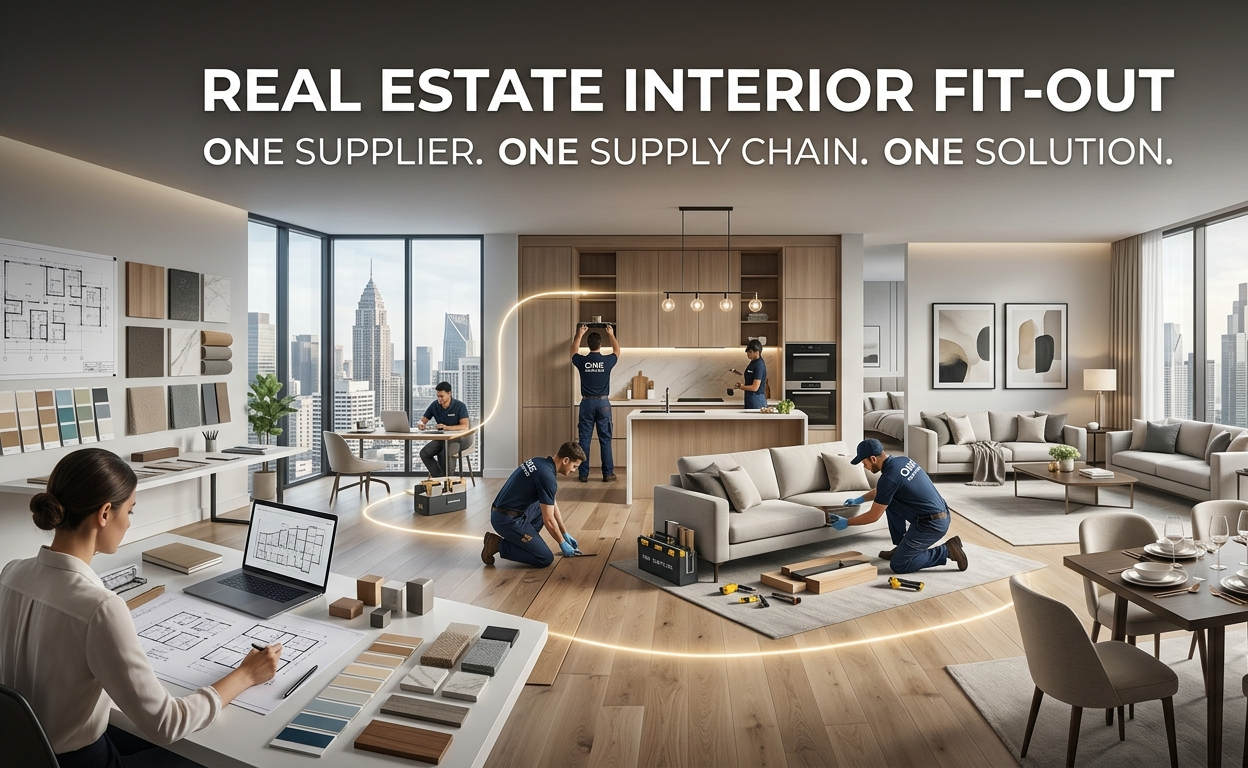
Managing the interior fit-out phase of a commercial real estate project—whether a 150-key hotel, a multi-family apartment complex, or a portfolio of premium villas—presents a high degree of logistical risk. A standard Bill of Quantities (BOQ) regularly spans multiple distinct manufacturing sectors: architectural flooring, structural wall paneling, custom cabinetry, sanitary ware, and loose contract furniture.
When developers treat these categories as independent procurement silos, they inherit a fragmented supply chain. This fragmentation leads to dimensional conflicts at building handovers, uncoordinated factory delays, and inflated shipping costs.
Key Takeaways
- Eliminate Interface Discrepancies: A single supply chain ensures that technical clearances—such as where custom bathroom vanities meet rough plumbing inlets—are cross-verified across factories before mass production begins.
- Synchronize Construction Timelines: Instead of juggling five independent domestic delivery schedules, a unified supply chain releases materials based on the actual progress of your on-site construction crews.
- Minimize Total Landed Freight Costs: Local consolidation allows your logistics team to manually balance high-weight ceramic materials with high-volume upholstery, maximizing container payload efficiency and lowering per-unit freight costs.
- Centralize Accountability: Operating through one independent ground agent eliminates the cross-factory finger-pointing that typically occurs when separate components fail to fit together on site.
Why Does Managing Multiple Factory Contracts Increase Project Failure Rates?
Traditional real estate procurement often slices a BOQ into isolated line items to hunt for the lowest individual unit cost. A developer might contract a tile mill in one province, a toilet factory in another, and a furniture shop elsewhere.
While the individual factory invoices may appear competitive, this decentralized approach introduces high hidden administrative and structural costs:
- Compounded Delivery Dependency Loops: If your flooring contractor is ready, but the sanitary ware factory slips behind schedule by two weeks, the entire bathroom plumbing assembly halts. A delay at a single factory can stall your entire on-site labor force.
- Uncoordinated Material Tolerances: Independent factories do not communicate with one another. A wardrobe manufacturer working in isolation will build to nominal design dimensions, failing to account for the real-world thickness variations of raw wall cladding sheets sourced from a separate plant. This lack of coordination results in costly, slow manual trimming during field installation.
- Fragmented Communication Overhead: Your internal team is forced to manage multiple communication lines, tracking down production logs, container logistics, export documentation, and payment schedules across a disorganized web of suppliers.
How Does the Foshan Cluster Consolidate Furniture, Bathrooms, and Flooring Into a Single Supply Chain?
The city of Foshan in Guangdong province provides a unique geographic advantage for real estate procurement. It is not merely a generalized manufacturing town; it is a highly concentrated network of specialized, industrial micro-clusters positioned within a short driving radius.
| District | Industrial Specialization | Core Materials Sourced |
| Chancheng District | Ceramics & Sanitary Ware | Porcelain slabs, commercial tiles, stone basins, toilets, shower glass. |
| Shunde District | Contract Furniture & Cabinetry | Custom guestroom wardrobes, loose sofas, mattresses, lobby millwork. |
| Nanhai District | Architectural Metal & Openings | Aluminum window frames, interior timber doors, structural hardware. |
Because these distinct product ecosystems are physically adjacent, your procurement chain is tightly integrated. Technical adjustments can be handled locally and immediately.
If an architect alters the design of an integrated LED vanity mirror, your ground representative can physically coordinate the change between the glass processing plant in Chancheng and the cabinetry workshop in Shunde within a single morning. This direct alignment ensures absolute structural compatibility before any cargo is packed.
What Are the Core Technical Checkpoints for Verifying Cross-Category Material Integration?
Successful interior fit-outs rely on precise interface engineering. Below are the three critical structural intersections that require cross-factory verification prior to authorizing mass production:
1. The Vanity-Basin Interface
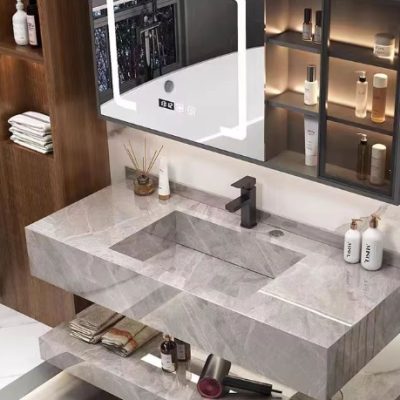
Custom natural stone or sintered porcelain vanity tops are frequently fabricated at specialized stone yards, while the underlying timber chassis and the ceramic basins are made elsewhere. The drainage cutouts, faucet hole clearances, and under-mount mounting bracket points must be physically checked against real ceramic basin casts to prevent on-site leaks or structural alignment failures.
2. Cabinetry-to-Wall Cladding Boundaries
Built-in floor-to-ceiling wardrobes must fit flush against finished interior wall surfaces. Your ground team must audit the exact thickness profiles of the chosen wall paneling systems (such as WPC fluted tracks or bamboo charcoal fiber sheets) to adjust the wardrobe’s outer filler strips, preventing ugly gaps or raw, exposed edges at the joints.
3. Door Jamb to Wall Thickness Calibration
Pre-hung interior doors require precise wall-thickness calculations. The factory fabricating the timber door frames must receive verified data regarding the final finished wall assembly—including the raw brick blockwork, plaster depths, and the thickness of the decorative wall cladding panels—to ensure the door trim frames clamp securely and seamlessly onto the finished wall.
How Does a Single-Source Logistics Strategy Reduce Total Landed Freight Costs?
Shipping international building and interior assets involves managing two strict physical constraints: total container weight and total volumetric capacity (Cubic Meters, or CBM). Shipping independent material categories leads to severe shipping inefficiencies.
Decentralized Shipping Layout (High Cost / Low Efficiency):
Container A (Porcelain Tiles): Hits maximum legal weight payload at only 40% CBM capacity.
Container B (Upholstered Sofas): Fills 100% CBM capacity while utilizing only 25% of allowable weight.

Consolidated One-Supply-Chain Layout (Optimized Cost):
┌───────────────────────────────────────────────────────────────┐
│ Top Volume: Lightweight Modular Cabinetry & Upholstered Sofas │
├───────────────────────────────────────────────────────────────┤
│ Bottom Base: Dense Porcelain Slabs, Ceramic Tiles, & Toilets  │
└───────────────────────────────────────────────────────────────┘
Result: 100% Weight and 100% CBM Utilized = Fewer Total Containers Shipped.
By routing all your multi-category project assets through a single localized staging warehouse in Foshan, logistics engineers can optimize the payload manually. Heavy, rigid products like porcelain floor tiles and stone basins are loaded flat to form a stable, low center of gravity. Lightweight, high-volume items like flat-packed cabinetry and vacuum-compressed seating are then packed securely on top.
This consolidation approach maximizes both weight and CBM boundaries, frequently reducing the total container count on a commercial real estate project by 15% to 20%, while simplifying customs clearance down to a single, unified set of export documents.
Why Choose HSY Sourcing for Your Real Estate Project?
Based directly in the center of Foshan’s major manufacturing clusters, HSY Sourcing operates as your independent engineering, quality management, and logistics consolidation partner on the ground in China.
- Holistic BOQ System Auditing: We review your complete interior architectural drawings and material schedules as a cohesive system, checking that panel thicknesses, cabinetry clearances, and plumbing layouts match across all chosen factories.
- Direct Production Floor Verification: Our quality control engineers conduct unannounced physical checks on production lines in Chancheng, Shunde, and Nanhai. We check frame moisture content, test edge-banding seals using PUR hot-melt standards, and verify structural tolerances using digital calipers.
- Centralized Cargo Consolidation & Crating: We manage the collection and staging of your orders at our local warehouse. We supervise container loading directly, mandating and inspecting the construction of reinforced wooden crates to ensure your premium assets arrive straight and undamaged.
- Unified, Transparent Documentation: We handle the collection and third-party verification of required international environmental and safety certifications (such as E0/E1 formaldehyde ratings, ASTM E84 Class A fire ratings, or BS 5852 flammability standards), providing a single point of accountability.
Visit www.hsysourcing.com to submit your project floor plans and material specification sheets. Let our local engineers build a compliant, synchronized, and highly efficient interior supply chain for your next property development.
Frequently Asked Questions (FAQ)
Q: How do you handle financial payments when sourcing across diverse manufacturing sectors in Foshan?
A: Managing deposits and balance wires across dozens of separate factories creates massive banking overhead and accounting complexity for international buyers. We simplify this process by acting as your single financial node. You wire project funds to us based on your overall BOQ milestone schedule, and we distribute deposits locally to the individual flooring, bathroom, and furniture factories, tracking and auditing every transaction transparently.
Q: What is the risk of utilizing a generic trading company instead of a localized technical sourcing agent?
A: Generic trading companies typically operate as simple paper-shippers, selecting items out of static retail catalogs and adding a blind markup. They lack the engineering capacity to read complex CAD architectural blueprints, audit cross-factory tolerances on a dirty factory floor, or verify chemical lamination standards like PUR hot-melt technology. A localized technical agent operates as your independent quality and engineering office, protecting your asset lifecycle.
Q: Can custom one-stop interior packages be scaled down for high-end boutique villa developments?
A: Yes. While massive mass-production plants have rigid volume requirements, Foshan’s deep ecosystem includes highly specialized, project-tier contract manufacturers who adapt their lines for lower volumes using flexible CNC machinery. This allows us to consolidate highly customized, premium material choices across furniture, flooring, and wall cladding for low-density luxury developments without incurring steep customization penalties.