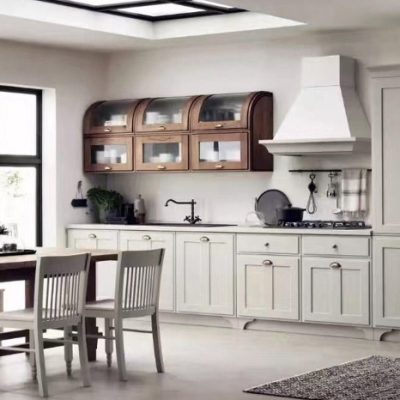

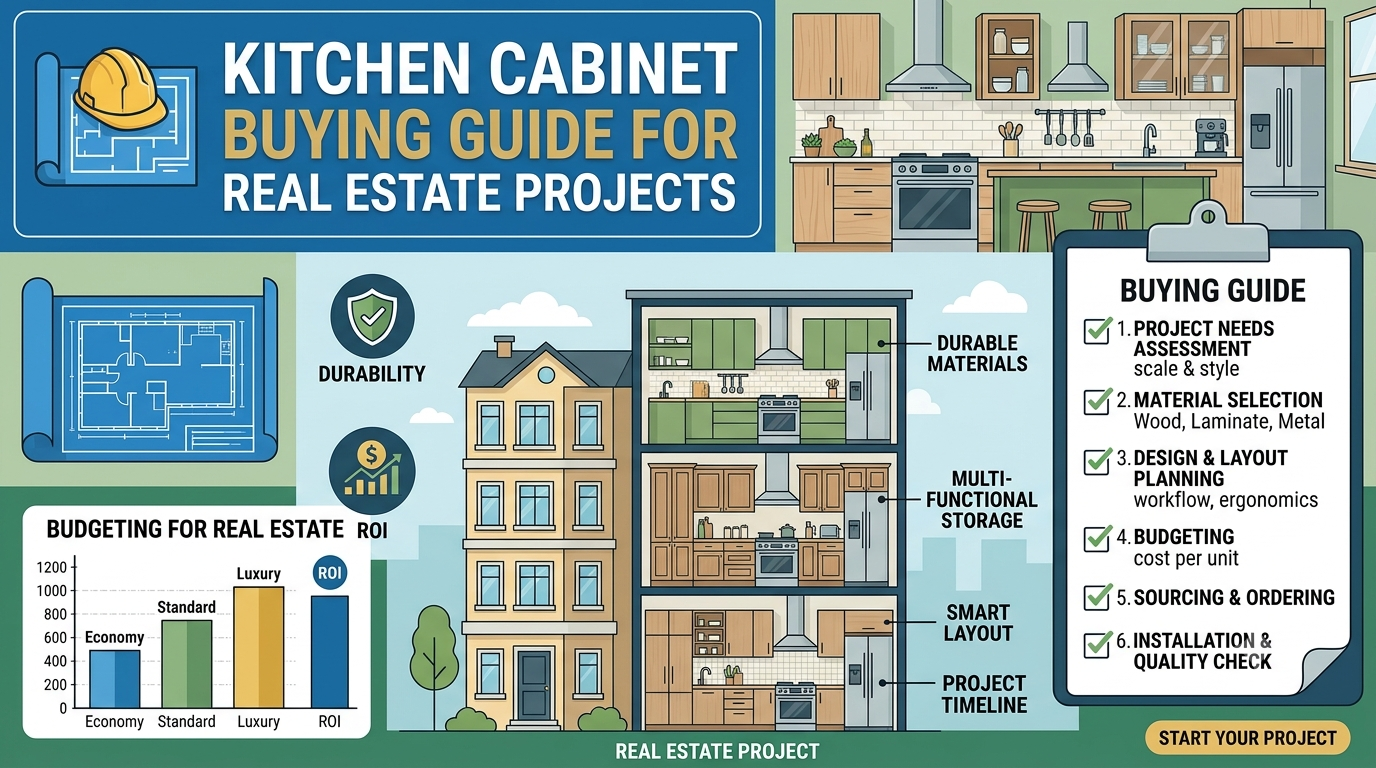
Procuring kitchen cabinets for commercial real estate—whether a 200-unit apartment complex, a boutique hotel, or a luxury villa development—requires a fundamentally different approach than retail residential buying. In high-volume institutional projects, built-in cabinetry must integrate flawlessly with pre-planned plumbing rough-ins, standardized electrical layouts, and heavy-duty tenant usage.
Sourcing these architectural fixtures directly from Foshan, China, allows international developers to bypass secondary trading markups and access primary automated manufacturing lines. However, maximizing this geographical advantage requires strict technical oversight. A dimensional error of a few millimeters or the selection of inadequate core substrates can halt a construction timeline and incur massive on-site remediation costs.
This guide outlines the critical engineering baselines and procurement strategies required to source commercial kitchen cabinets safely and cost-effectively.
Key Takeaways
- Mandate Moisture-Resistant Cores: Never accept standard MDF for structural cabinet carcasses. Specify multi-layer plywood for wet zones (under sinks) to prevent irreversible swelling.
- Enforce Hardware Cycle Ratings: The lifespan of commercial cabinetry depends on its moving parts. Contractually require tier-one hardware brands certified for a minimum of 80,000 open-close cycles.
- Utilize 1:1 Physical Mockups: Do not authorize mass production based on 2D shop drawings. Demand a full-scale physical prototype to test appliance integration and structural tolerances.
What board materials dictate the lifespan of commercial kitchen cabinets?
The most common point of failure in overseas cabinetry procurement is treating the structural core as an afterthought. Factories default to the cheapest available substrate unless a strict Bill of Materials (BOM) is enforced. For real estate projects, the substrate must be specified layer by layer based on its physical location in the kitchen.
- Under-Sink and Wet Zones (Multi-Layer Plywood): Base cabinets housing plumbing fixtures must be constructed from marine-grade or highly water-resistant plywood. If a minor pipe leak occurs, plywood resists structural swelling, whereas standard composite boards will disintegrate.
- Standard Cabinet Carcasses (High-Density MFC): For standard dry-zone wall and base cabinets, high-density Melamine Faced Chipboard (MFC) provides excellent screw retention and structural stability, provided the density exceeds $700 \text{ kg/m}^3$. It is a cost-effective standard for multi-family projects.
- Decorative Door Fronts (MDF): Medium-Density Fiberboard (MDF) should strictly be reserved for cabinet doors. Its uniform, grain-free surface is necessary for high-gloss lacquer finishes, PVC thermofoil wrapping, or CNC router profiling. It must never be used for the structural box.
How does edge banding technology prevent moisture damage?
The edge banding—the protective strip applied to the exposed edges of a cut cabinet board—is the first line of defense against internal moisture. The technical failure point lies in the adhesive used to apply it.
Many standard factories utilize EVA (Ethylene Vinyl Acetate) glue because it is cheap and requires less maintenance on the machinery. However, EVA can soften and reactivate when exposed to the continuous heat and steam generated by ovens, dishwashers, and boiling pots. When the glue softens, the edge banding peels, exposing the vulnerable wood core to humidity.
For commercial projects, you must explicitly enforce the use of PUR (Polyurethane) hot-melt adhesive in your manufacturing contract. PUR utilizes a chemical curing process that forms an unbreakable, water-resistant, and heat-resistant bond. It leaves a nearly invisible glue line and permanently seals the core board.
Why is automated CNC machinery non-negotiable for project orders?
For a multi-unit real estate project, consistency across hundreds of identical cabinets is mandatory. Relying on manual carpentry workshops or outdated semi-automatic panel saws guarantees dimensional variance. If a base cabinet is cut 3mm out of square, the quartz countertop will not sit flush during final installation.
Institutional procurement requires primary factories equipped with computer numerical control (CNC) nesting machinery. These automated lines read the CAD shop drawings directly, executing cuts, hinge routing, and shelf-pin drilling with sub-millimeter accuracy. This ensures that unit #1 and unit #300 are identical, allowing your on-site installation teams to work rapidly without stopping to scribe or modify ill-fitting components.
How can developers utilize Foshan’s geographical advantage for cabinet sourcing?
Foshan is not just a cabinet manufacturing hub; it is a fully integrated interior supply chain ecosystem. A commercial kitchen requires more than just wood—it requires stone countertops, stainless steel basins, structural hardware, and appliances.
Sourcing cabinetry in Foshan allows developers to physically match custom joinery finishes with adjacent interior materials manufactured within the exact same city limits. An on-the-ground engineering team can transport a physical countertop control sample directly to the cabinet factory to verify cutout tolerances and finish alignment before mass production begins.
Furthermore, this geographical density enables highly efficient logistics. Your flat-pack kitchen cabinets can be consolidated into engineered mixed-containers alongside your porcelain floor tiles and sanitary ware, maximizing ocean freight volume and lowering the landed cost per unit.
Why Choose HSY Sourcing for Your Cabinet Procurement?
Managing multi-unit millwork specifications from overseas creates severe communication and quality control gaps. HSY Sourcing operates as your dedicated, on-the-ground engineering and purchasing office directly within the Foshan and Shunde manufacturing clusters.
- Direct OEM Factory Access: We bypass decorative showrooms and high-markup intermediaries. Your commercial orders are placed directly with automated, primary manufacturing facilities equipped with precision CNC machinery.
- Technical Contract Enforcement: We translate your architectural layouts into strict manufacturing contracts. We physically audit the factory lines to ensure PUR edge-banding is utilized, substrate moisture content is controlled, and hardware brands are authentic.
- 1:1 Prototype Management: We mandate full-scale physical mockups of your kitchen configurations. We test appliance drop-ins, structural rigidity, and plumbing clearances before authorizing mass production.
- Mixed-Container Consolidation: By utilizing our centralized Foshan staging facilities, we consolidate your cabinetry with other heavy building materials. We execute engineered container load plans—placing heavy masonry on the floor and flat-pack cabinets on top—to maximize your freight efficiency and prevent transit damage.
Frequently Asked Questions (FAQ)
What is the standard production lead time for commercial kitchen cabinets?
For a standard multi-unit apartment or hotel project, mass production typically requires 40 to 45 days after the final CAD shop drawings and 1:1 physical mockups are approved. This timeline is necessary to accommodate raw board conditioning, custom lacquer or veneer finishing, and comprehensive pre-shipment quality control.
Should we ship our project cabinets flat-packed (RTA) or pre-assembled?
The decision relies on a cost-analysis of your local site labor versus ocean freight rates. Flat-pack (Ready-to-Assemble) shipping maximizes container volume, drastically lowering your freight cost per unit, but requires skilled carpenters to assemble the boxes on-site. Pre-assembled cabinets significantly speed up site installation but consume substantial shipping space.
How do you guarantee the hardware used is the brand we specified?
Counterfeit hardware (fake Blum or DTC hinges) is a known risk in unmanaged supply chains. Our QC engineers conduct randomized, unannounced physical inspections during the final assembly phase. We verify the stamped branding on the hinge plates against approved control samples and demand official supply chain invoices from the hardware manufacturer.
How do you handle dimensional variations if our construction site walls are uneven?
Site walls are rarely perfectly plumb. To prevent installation gaps, we engineer specialized filler panels (scribing pieces) that match your cabinet door finishes. These are installed at the ends of cabinet runs or where the cabinets meet the ceiling. Your on-site installation crew trims these panels to follow the exact irregular contours of the wall, resulting in a flawless, built-in appearance.