
For commercial property buyers, managing furniture logistics is often more complex than negotiating the raw manufacturing price. Traditional upholstered sofas are among the most inefficient items to transport internationally because they are essentially rigid frames surrounding large volumes of trapped air.
When a project requires furnishing a 150-room hotel, a multi-block apartment development, or a portfolio of investment villas, standard shipping methods quickly inflate the budget.
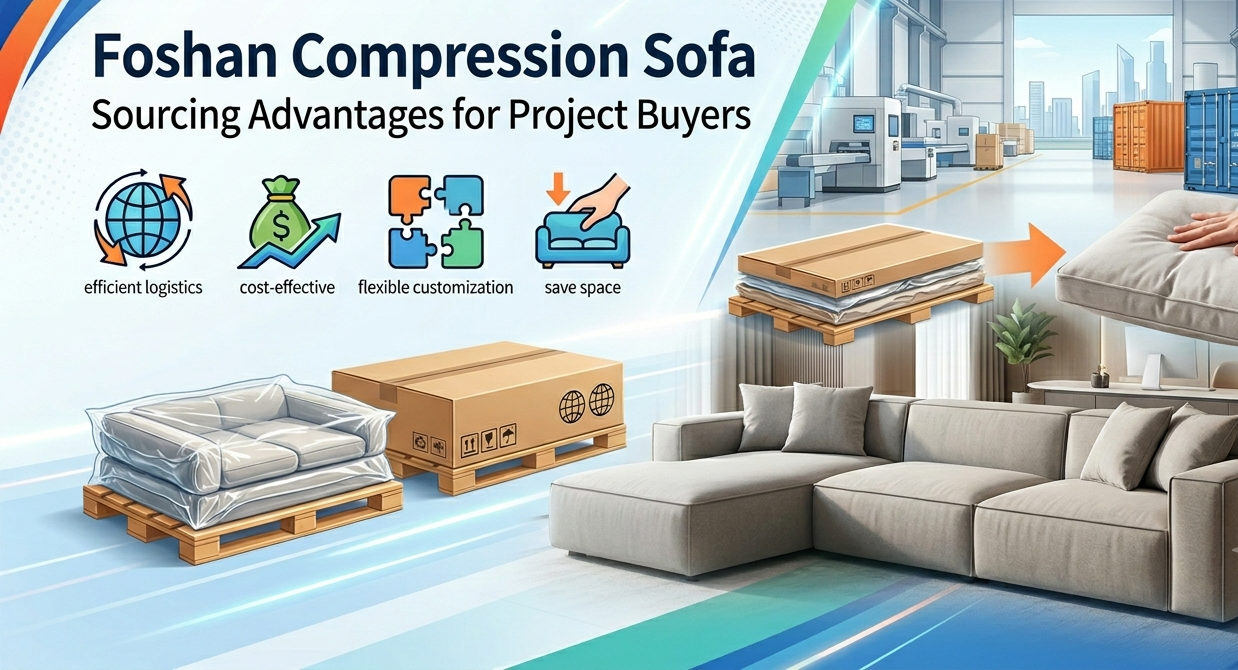
Vacuum-compressed (or “sofa-in-a-box”) engineering directly solves this spatial problem. By using heavy hydraulic machinery to extract air from the foam core, manufacturers collapse individual seating units into a fraction of their assembled size.
Sourcing these optimized pieces from Foshan—the global hub for upholstered furniture production—gives project buyers a distinct structural and financial advantage.
Key Takeaways
- Maximize Container Volume: Compressing upholstered furniture reduces individual unit volume from ~1.6 CBM to ~0.45 CBM, allowing you to load up to three times more inventory per container.
- Insist on High-Resilience Core Foam: Enforce a strict minimum baseline of 35kg/m³ to 45kg/m³ foam density to guarantee the cushions recover their original shape after weeks of maritime pressure.
- Streamline Interior Setup: Flat-boxed modular sofas slide easily into standard passenger lifts and narrow corridors, reducing on-site labor overhead and preventing wall scuffs.
- Balance the Freight Weight: Combine lightweight compressed sofa boxes with heavy building materials (like porcelain tiles) to maximize both container weight and space limits.
How Do Compression Sofas Reduce International Ocean Freight Costs?
Ocean freight rates significantly dictate the final landed cost of furniture assets. Shipping lines bill containers based on a flat rate per slot, meaning empty space costs money. A standard, fully assembled three-seater sofa consumes roughly 1.5 to 1.8 cubic meters (CBM). A standard 40ft High Cube container hits its volumetric limit at approximately 35 to 40 assembled units, leaving the container significantly under its maximum payload weight capacity.
Container Capacity Comparison (40ft HQ Volume):
┌───────────────────────────────────────────────────────────────┐
│ Fully Assembled Traditional Sofas                             │
│ [████████████████████] 35-40 Units (Fills volume, wastes weight)│
├───────────────────────────────────────────────────────────────┤
│ Vacuum-Compressed Modular Sofas                               │
│ [██████████████████████████████████████████████████] 120-150 Units│
└───────────────────────────────────────────────────────────────┘
When a sofa is engineered for vacuum packaging, its arms, backrest, and seating cushions are either built with a flexible frameless structure or split into modular, knock-down (KD) components. Once compressed and flat-boxed into heavy-duty corrugated cartons, the individual volume drops to about 0.4 CBM to 0.5 CBM.
This change allows the same 40ft HQ container to hold 120 to 150 units. Tripling your payload capacity per container immediately drops your per-unit ocean freight costs by up to 70%.
Will Vacuum-Packed Foam Fully Recover Its Original Shape After Maritime Transit?
The primary risk associated with vacuum-packed seating is permanent material deformation. If a sofa remains flattened inside a hot shipping container for 45 days during ocean transit, buyers want to know if the foam will sag or show surface wrinkles upon unboxing.
The recovery performance depends entirely on the chemical formulation and density of the polyurethane foam core. Low-grade workshops cut costs by using cheap, low-density foam (under 25kg/m³) mixed with heavy mineral fillers. Under sustained hydraulic pressure, the thin cell walls of low-density foam rupture permanently, and the cushion fails to recover its shape.
| Foam Property | Low-Density Retail Foam (<25kg/m³) | High-Resilience Contract Foam (35-45kg/m³) |
| Cellular Structure | Large, thin-walled air pockets | Tight, open-cell irregular matrix |
| Compression Behavior | Collapses under sustained load | Compresses linearly, stores kinetic energy |
| Post-Unboxing Recovery | Permanent sagging, hollow centers | Regains 95% shape in 30 mins, 100% in 48 hours |
| Project Lifespan | 6 to 12 months under commercial use | 5+ years under high-occupancy use |
Foshan’s contract factories prevent this issue by using High-Resilience (HR) polyurethane foam. HR foam features an open-cell, highly elastic molecular structure. When the vacuum seal is broken on-site, air re-enters the cells immediately, causing the foam to regain its full structural calibration without affecting its long-term lifespan.
Why Does Foshan Hold a Structural Advantage for Fabricating Upholstered Furniture?
While vacuum packing appears straightforward, executing it reliably at scale requires a highly synchronized regional supply chain. Foshan’s industrial layout provides three distinct advantages for this product class:
- Specialized Hydraulic Tooling: The local machinery sector fabricates industrial hydraulic presses capable of applying up to 20 tons of uniform pressure without tearing outer upholstery seams or breaking hidden internal framing lines.
- Advanced Polymer Film Barriers: Standard plastic bags split under the pressure of rebounding foam. Foshan suppliers utilize heavy-duty, multi-layered TPU (Thermoplastic Polyurethane) and PE composite bags equipped with proprietary one-way valves that prevent air leakage for up to 180 days.
- Modular Structural Design: Compressing a sofa requires a complete rethink of internal framing geometry. Foshan’s technical teams work directly with local hardware and wood mills to design heavy-duty interlocking steel brackets and reinforced timber skeletons that slide together quickly on-site without complex tools.
How Does Boxed Compression Furniture Accelerate On-Site Installation Timelines?
The logistics of an apartment or hotel renovation do not end when the shipping container clears customs. Moving traditional bulk furniture from the delivery bay up to rooms on higher floors is highly labor-intensive and frequently causes structural property damage.
Traditional wide-set sofas often cannot fit inside standard passenger lifts, forcing moving crews to carry heavy loads up fire stairwells. This slow process leads to high on-site labor overhead, scratched hallway walls, and dented door frames during the final property handover phase.
Because compressed sofas ship in uniform, flat-boxed geometric packages, they can be stacked onto basic hand-trucks and moved rapidly by a single worker. They slide easily through standard apartment doorways and narrow interior corridors. The packaging is peeled away only once the item is safely placed inside its designated room zone, completely eliminating transit scuffs and ensuring a pristine interior presentation.
Why Choose HSY Sourcing for Your Project?
Operating directly from the center of Foshan’s manufacturing districts, HSY Sourcing functions as your independent engineering, quality oversight, and logistics consolidation partner on the ground in China.
- Foam Density Verification: We do not rely on factory-provided spec sheets. Our quality control engineers conduct unannounced visits to the production line, physically measuring foam core density via weight-displacement tests before compression begins.
- Pressure Duration Stress Tests: We mandate that factories execute a 72-hour trial compression hold on sample units from your production batch. This confirms that both the one-way mechanical valves and the polymer film walls can withstand sustained storage without micro-leaks.
- Volumetric Cargo Optimization: We utilize our local staging warehouse to combine your vacuum-packed sofa assets with heavy construction materials (like porcelain tiles, stone kitchen islands, and bathroom ceramics). We organize the container loading plan directly, placing dense building materials on the floor while utilizing compressed furniture boxes to fill the upper vertical volume safely.
- Clear, Unedited Inspection Reports: We provide transparent, metrics-driven documentation including real-time video feeds, digital caliper readouts, and weight verifications so you can audit product accuracy prior to clearing final factory balance wires.
Visit www.hsysourcing.com to submit your project furniture schedules and interior drawings. Let our local engineers build a secure, highly optimized, and predictable supply chain for your next property development.
Frequently Asked Questions (FAQ)
How long can a compression sofa safely remain vacuum-sealed inside its packaging box?
For optimal performance and shape recovery, we advise keeping compressed upholstered items sealed for no longer than 60 to 90 days. While high-grade 40kg/m³ HR foam can technically survive longer durations, leaving it fully compressed beyond three months increases the risk of setting deep creases into the outer fabric lining.
Are there specific upholstery fabrics that cannot be used on compression sofas?
Yes. Thick, natural split leathers and highly rigid, resin-backed heavy jacquards do not handle vacuum compression well, as they are prone to developing permanent, unfixable structural crease marks. We highly recommend specifying engineered synthetic microfibers, high-tensile polyester blends, or flexible performance linens that possess excellent elastic recovery properties.
Can we customize sofa dimensions for small apartment floor plans without a large price penalty?
Yes. Because Foshan’s commercial contract factories utilize automated CNC wood routers and computerized fabric cutting tables, altering the length or depth of a sofa frame does not require expensive new structural molds. As long as the project batch satisfies the factory’s minimum volume baseline, dimensions can be adjusted to match your CAD floor plans with a minimal surcharge based purely on raw material consumption.