
If you are sourcing air fryers, blenders, or rice cookers from Shunde, you’ve likely received quotes that vary by $3 or $4 for what looks like the exact same product. In the world of high-volume electronics, a $3 difference is massive.
Most buyers think the price difference is just about the factory’s profit margin. It isn’t. In the Shunde appliance clusters (Beijiao, Leliu, and Ronggui), factories are experts at “Value Engineering”—which is a polite way of saying they know exactly which internal parts to swap out to hit a lower price point.
As your feet on the ground in Foshan, our job is to make sure those cost-cuts don’t turn into your customer’s house fire or a 20% return rate on Amazon. Here is the reality of what’s happening inside those machines.
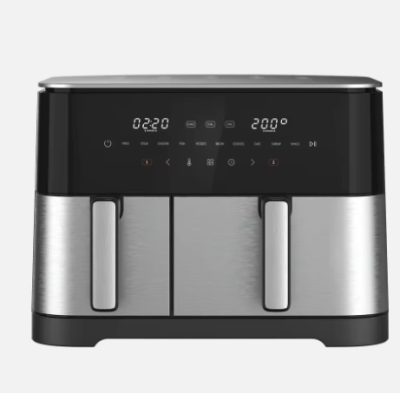
Why does the same-looking air fryer vary so much in price?
The plastic shell of an appliance is cheap. Whether it’s a $20 air fryer or a $60 one, the “housing” often comes from the same injection molding neighborhood. The real price difference is invisible from the outside.
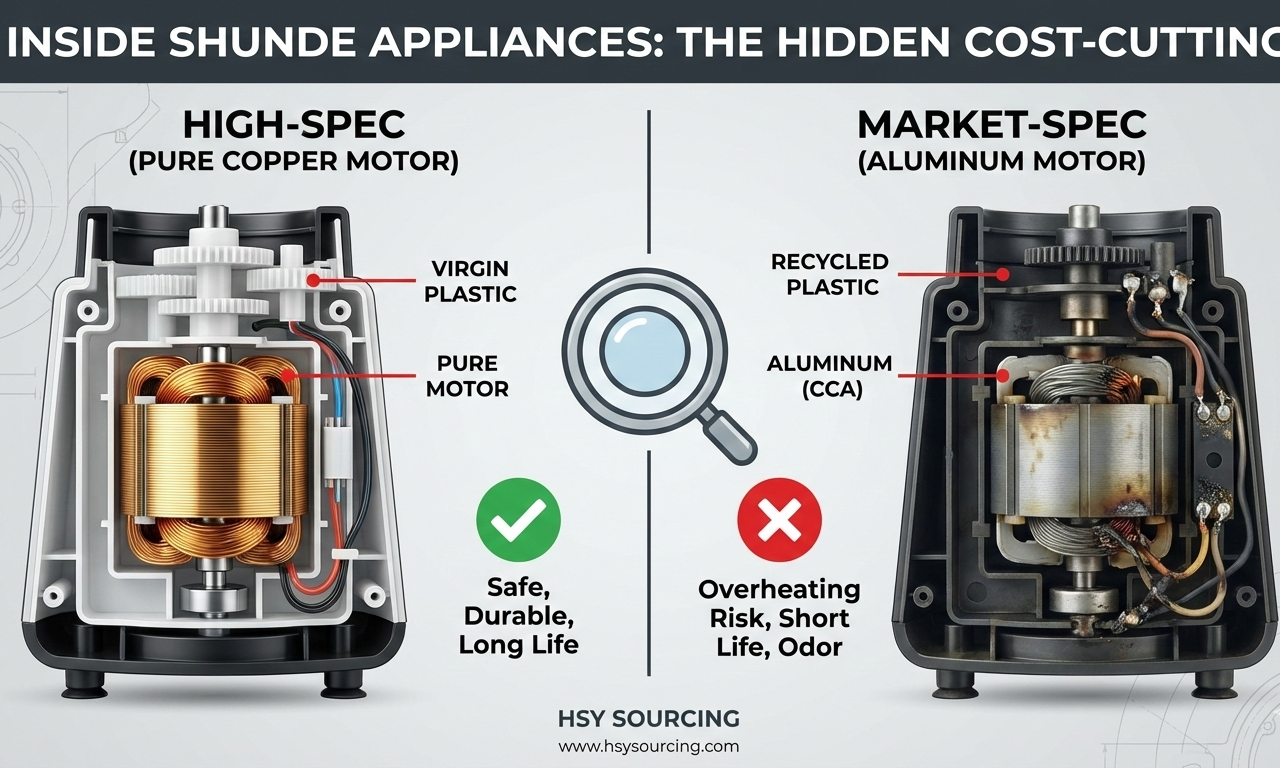
Factories often offer two versions of the same model: the “High-Spec” and the “Market-Spec.” The Market-Spec uses thinner internal wiring, cheaper sensors, and—most importantly—lower-grade motors. If you aren’t specific in your contract, the factory will naturally default to the cheaper components to stay competitive.
Copper vs. Aluminum Motors: Are you paying for a fire hazard?
This is the most common “secret” in the industry. The motor is the heart of any appliance with a fan or a blade (juicers, fans, air fryers).
- Pure Copper Motors: These are the gold standard. Copper is a superior conductor, handles heat well, and lasts for years.
- Copper-Clad Aluminum (CCA): This is where the cost-cutting happens. It is an aluminum wire with a thin coating of copper. It’s significantly cheaper and lighter.
The problem? Aluminum has higher resistance. It gets much hotter, much faster. In a high-speed blender or an air fryer that runs for 30 minutes, a CCA motor can literally melt or burn out. If your customers are complaining about a “burning smell” after three uses, you bought an aluminum motor. We physically open the motor housing during audits to verify the winding material.
Is “Recycled Plastic” making your customers sick?
When a factory quotes you a price that seems too good to be true, they are often using “regrind” plastic. This is scrap plastic that has been melted down and reused.
For the external legs or non-heat-sensitive parts, this is fine. But for the parts that touch food or get hot (like the inner housing of an air fryer), regrind plastic is a disaster. It off-gasses toxic chemicals and creates that “cheap plastic” smell that ruins food. We check the raw material pellets in the warehouse to ensure they are “Virgin Grade” BPA-free materials before the injection machines start running.
How do we spot these “invisible” shortcuts during an audit?
A factory will never tell you they are using cheaper capacitors or thinner heating elements. You have to find them. When we audit a Shunde appliance factory, we don’t just look at the finished box.
- The “Teardown” Test: We take a random sample from the production line and take it apart with a screwdriver. We check the PCB (Circuit Board) soldering quality and the thickness of the internal wiring.
- The Temperature-Rise Test: We run the appliance at max power for an hour and use infrared thermometers to see if the motor is overheating beyond its safety rating.
- The Component Audit: We verify that the “brand name” parts promised in the specification (like the thermostat or the fuse) are actually the ones being installed.
Can you still get a good price without sacrificing quality?
Yes, but it requires honesty. We tell our clients: “Don’t ask for the lowest price in Shunde; ask for the best price for a reliable specification.”
If you try to squeeze a factory too hard on price, they won’t say “no”—they will just switch the copper motor to aluminum and the virgin plastic to recycled. Our value as your Foshan Agent is knowing exactly where the line is. We negotiate a price that is fair for the factory but safe for your brand.
FAQ: Sourcing Electronics in Shunde
Q: Does every cheap appliance use aluminum motors?
A: Not every one, but most “budget” models do. It’s acceptable for some low-power products (like a small desk fan), but for kitchen appliances, it is a high-risk move that usually leads to returns.
Q: Can I trust the CE/RoHS certificates provided by the factory?
A: Only if you verify them. We see many “Photoshopped” certificates. We check the certificate number directly with the issuing lab (like TUV or Intertek) to make sure it covers the specific model you are buying.
Q: What is the standard MOQ for custom-branded appliances in Shunde?
A: Usually 1,000 units for OEM (with your Logo and box). If you are a smaller Amazon seller, we can often negotiate this down to 500 units by using a “standard” box with a custom sticker.
Q: Should I pay for a 3rd-party inspection?
A: If you have an agent like us on the ground, we do the inspection as part of our service. If you don’t have an agent, then YES—a professional inspection is mandatory for electronics. Never ship a container of appliances without a “Function Test” on at least 5% of the goods.