
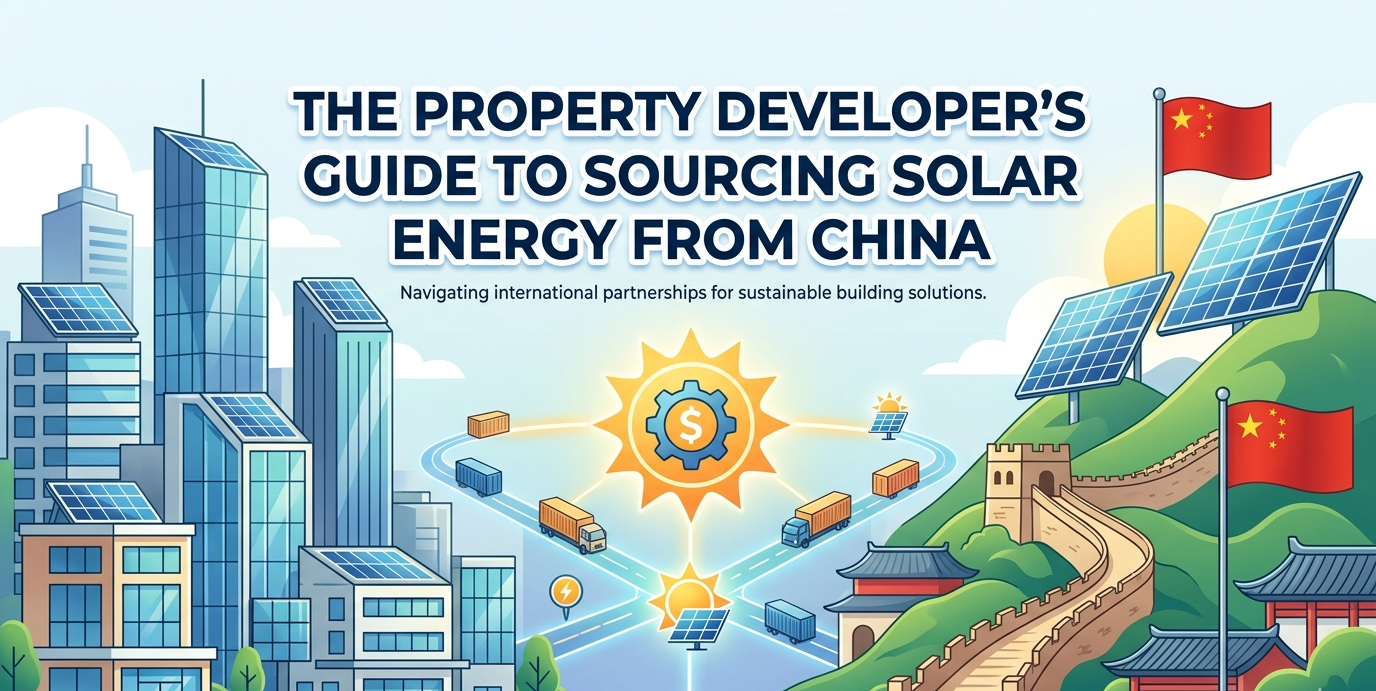
For modern property developers, integrating solar energy into new builds is no longer an optional “green” upgrade; it is a regulatory requirement and a core selling point. As the scale of residential and commercial developments grows, buying solar components from local distributors severely eats into project margins.
To maintain profitability, developers are turning to direct procurement from China. However, sourcing utility-scale or multi-residential solar systems requires a completely different strategy than buying standard building materials. Here is the technical roadmap for developers to source solar energy safely and profitably.
Why is direct solar sourcing a strategic necessity for developers?
When a developer buys solar panels, inverters, and battery storage locally, they are typically absorbing a 30% to 50% markup from importers and distributors.
By sourcing directly from China—which controls over 80% of the global solar supply chain—developers reclaim that margin. More importantly, direct sourcing gives developers control over the Supply Chain Schedule. Instead of waiting for local stock to replenish, you can align the factory production schedule directly with your construction milestones, ensuring the panels arrive exactly when the roofing contractors are ready for them.
How do you differentiate Tier 1 manufacturers from unreliable assemblers?
The solar market in China is vast, ranging from massive automated mega-factories to small workshops that simply solder cells together. For a property development, you cannot afford “Quality Fade.”
You must mandate the use of Tier 1 Manufacturers. These are vertically integrated companies (like Jinko, LONGi, or Trina) that manufacture their own silicon wafers and cells. To verify a supplier, do not just look at their website. You must demand:
- Bankability Reports: Proving the company has the financial stability to honor a 25-year performance warranty.
- Third-Party Testing: Certificates from TUV or SGS verifying compliance with IEC 61215 (Design qualification) and IEC 61730 (Safety qualification).
- EL (Electroluminescence) Test Records: Factory-level X-ray images of the exact batch of panels you are buying to prove there are no hidden micro-cracks before shipping.
What are the hidden integration challenges for large-scale developments?
Solar procurement cannot happen in a vacuum. The biggest mistake developers make is treating the solar system as an afterthought.
When sourcing, the solar components must align with your architectural and structural materials. This is where BIPV (Building-Integrated Photovoltaics) is becoming crucial. If you are sourcing premium roofing tiles or custom facade panels, your solar sourcing team needs to coordinate with your building material suppliers to ensure structural compatibility, weight-load safety, and aesthetic harmony. Furthermore, the inverters and battery storage units must be dimensioned properly to fit within the designated mechanical rooms of your floor plans.
How do you navigate the complex logistics of solar components?
Shipping a complete solar energy system is a logistical minefield. You are dealing with three distinctly different types of freight:
- Solar Panels: Highly fragile and require specialized vertical crating to prevent micro-cracks during ocean transit.
- Inverters: Heavy, sensitive electronic equipment that must be protected from moisture.
- Lithium Batteries (Energy Storage): Classified as Class 9 Dangerous Goods (DG).
You cannot simply throw these into a standard container. Shipping DG requires specific UN-certified packaging, a verified State of Charge (SoC) limit, and specialized customs declarations. A failure in battery logistics can result in your entire shipment being impounded at the port.
Key Takeaways
- Bypass the Middleman: Direct sourcing reclaims 30-50% margins, making standard housing projects significantly more profitable.
- Demand Tier 1: Only accept panels from vertically integrated manufacturers with proven financial bankability to secure your warranties.
- Integrate Early: Coordinate your solar procurement with your roofing and structural material sourcing to avoid installation clashes on site.
- Prepare for DG Logistics: Lithium battery storage requires specialized freight management; do not treat it like standard cargo.
FAQ: Solar Sourcing for Developers
Q: Can I consolidate solar panels with my other building materials?
A: Yes, but it requires precise volumetric planning. Heavy items like floor tiles can be loaded at the bottom of the container, while carefully crated solar panels and lighter fixtures can maximize the remaining space. This is a highly effective way to reduce freight costs per unit.
Q: What is the typical lead time for a project-scale solar order?
A: For Tier 1 manufacturers, production typically takes 3 to 5 weeks from the deposit date, depending on the wattage and cell technology (e.g., N-Type TOPCon). Add 4 weeks for ocean freight to most Western ports.
Q: How do I handle local grid compliance?
A: The physical panels are universally accepted, but the Inverter must be certified for your specific country’s electrical grid (e.g., UL 1741 for the US, EN 50549 for Europe). Always confirm the inverter’s grid-tie certification before placing the order.
Secure Your Project’s Supply Chain with HSY Sourcing
For property developers, managing multiple factories across different product categories—from structural steel to delicate solar inverters—is a massive drain on resources.
At HSY Sourcing, we act as your dedicated procurement office in China. We don’t just source products; we engineer supply chain solutions. Because we specialize in both Building Materials and Solar Energy Systems, we offer a unique advantage: Complete Project Consolidation.
We perform the rigorous on-site factory audits required for Tier 1 solar verification, manage the complex Class 9 Dangerous Goods logistics for your battery systems, and seamlessly consolidate your renewable energy components with your tiles, cabinetry, and windows in our Foshan hubs.
By partnering with HSY Sourcing, you ensure that every component of your development arrives on time, on budget, and fully compliant.
Build smarter. Contact Ando and the HSY Sourcing team today to streamline your project procurement.