
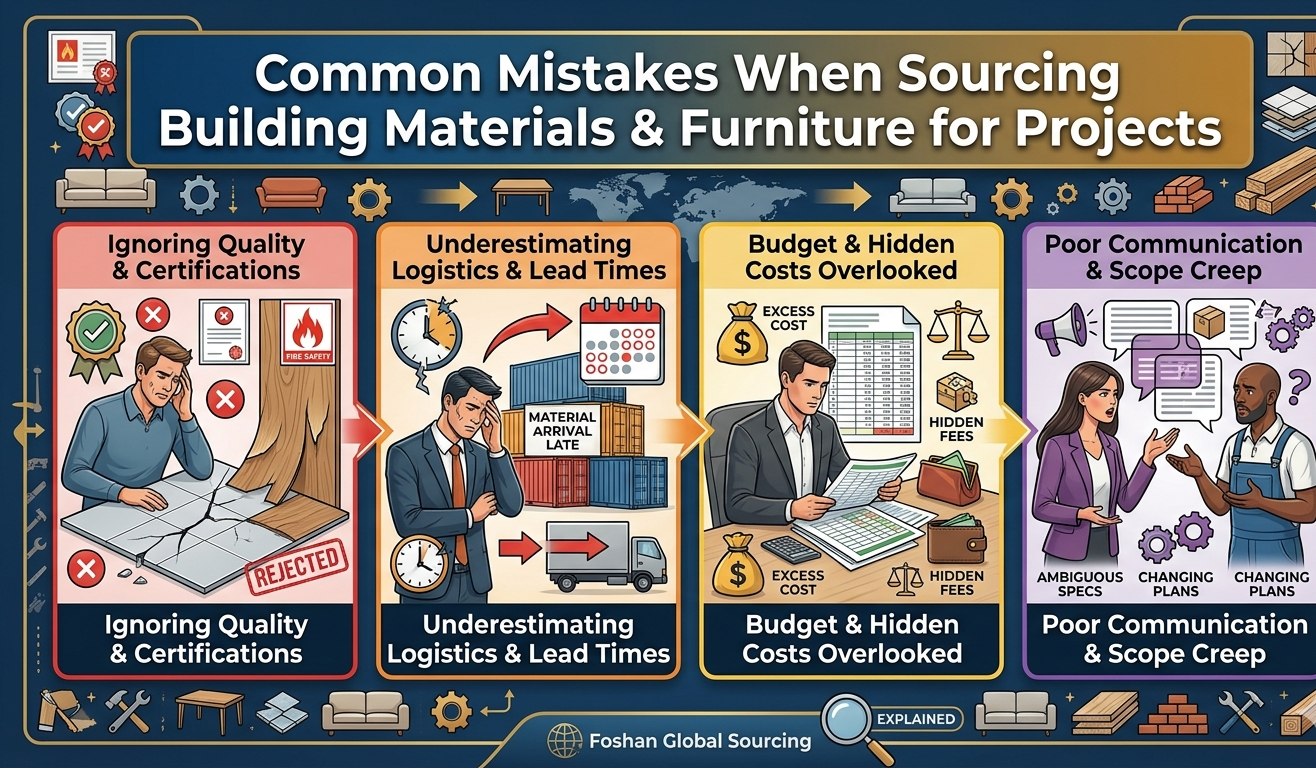
Sourcing for a large-scale project in China often starts with a beautiful spreadsheet showing 40% cost savings compared to local suppliers. However, for many developers, that “saving” evaporates the moment the container door opens at the construction site.
The reality of international procurement is that the most expensive mistakes aren’t made in the factory—they are made in the planning and coordination phases. Based on years of managing projects in the Foshan cluster, here are the most common pitfalls project buyers face and how to avoid them.
Why is fragmented sourcing across different provinces a logistical trap?
A common error is chasing the lowest price for every individual item. You find tiles in Shandong, faucets in Zhejiang, and sofas in Guangdong. On paper, you’ve saved money.
In practice, you’ve created a logistical nightmare. You now have to manage three different export filings, three sets of local trucking fees, and three different production timelines. More importantly, you lose the ability to color-match. A “brushed gold” finish in Zhejiang will not match a “brushed gold” handle in Foshan. Centralizing your sourcing in a single hub like Foshan allows for physical finish-matching and consolidated shipping, which usually outweighs a 5% price difference from a distant province.
Are you ordering based on blueprints or “as-built” reality?
This is the mistake that kills custom cabinetry and millwork projects. Many buyers send the architect’s original CAD drawings to the factory and start production.
Blueprints are a vision; the construction site is the reality. Walls are rarely perfectly plumb, and floor levels can vary by 10–20mm. If you order a floor-to-ceiling wardrobe based on a blueprint, and the actual ceiling height is 15mm lower after the flooring is installed, the unit will not fit. You must provide “As-Built” measurements—taken after the drywall and basic flooring are in place—before the factory starts the final CNC cutting.
Why is skipping the “Trial Assembly” the most expensive shortcut?
Many buyers try to save time by having the factory ship custom items as soon as they are finished. This is a gamble you will almost certainly lose.
For any custom kitchen, vanity, or complicated wardrobe system, a Trial Assembly is non-negotiable. The factory must build the units on their floor so you can verify:
- Gap & Flush: Are the margins between doors consistent?
- Hardware Function: Do the soft-close hinges and drawer slides operate smoothly?
- Integration: Does the sink actually fit into the stone countertop cutout?
Seeing a video of a trial assembly in Foshan is free. Fixing a structural error at a construction site in New York or London costs thousands in skilled labor and project delays.
How does improper container loading destroy your project’s ROI?
Loading a container is an engineering task, not just a packing job. Two major errors occur here:
- Shipping “Air”: If you only ship furniture, you are paying for the empty space inside the wardrobes and sofas.
- Improper Ballast: If you put heavy tiles on top of delicate cabinetry, you will arrive at a pile of firewood.
The professional approach is Volumetric Optimization. Use heavy building materials (tiles, stone, toilets) as the base layer to maximize weight limits, and stack high-volume, lightweight FF&E (furniture) on top. If you don’t coordinate these two categories, your freight-per-item cost will skyrocket.
Key Takeaways
- Avoid the “Fragmented Trap”: Centralize your suppliers in one region (like Foshan) to ensure color consistency and lower logistics costs.
- Measure Twice, Cut Once: Only move to mass production for custom joinery once “as-built” measurements are verified.
- Demand a Trial Assembly: Never ship custom cabinetry without seeing it fully built on the factory floor first.
- Engineer the Container: Mix heavy building materials with light furniture to maximize every cubic meter of shipping space.
- Hardware Matters: Don’t go cheap on the “moving parts.” Use high-end hinges and slides to ensure the longevity of the custom furniture.
FAQ: Avoiding Sourcing Disasters
Q: How do I handle color matching if I have to use different factories?
A: Use a “Master Sample” strategy. Select one physical sample of the wood, metal, or fabric you want. Have your agent physically carry pieces of that sample to every factory involved. Never rely on digital photos or Pantone codes alone.
Q: What is the most common reason for breakage during shipping?
A: Lack of structural “crating.” Standard cardboard boxes are not enough for international sea freight. High-value items, especially stone tops and pre-assembled cabinets, should be packed in reinforced plywood crates with internal foam bracing.
Q: Is it a mistake to use the factory’s “standard” hardware?
A: Often, yes. For commercial or high-end residential projects, you should specify the brand (e.g., Blum, Hettich, or premium DTC). The hardware is the first thing to fail; specifying a global brand ensures your local team can find replacement parts in ten years if needed.
Professional Risk Management with HSY Sourcing
At HSY Sourcing, we’ve seen every mistake in the book, and our job is to make sure you don’t make them. Based in Foshan, we provide the technical oversight that most factories lack.
From verifying “as-built” dimensions to managing the critical trial assembly and container optimization, we ensure that your project arrives as a solution, not a problem.