
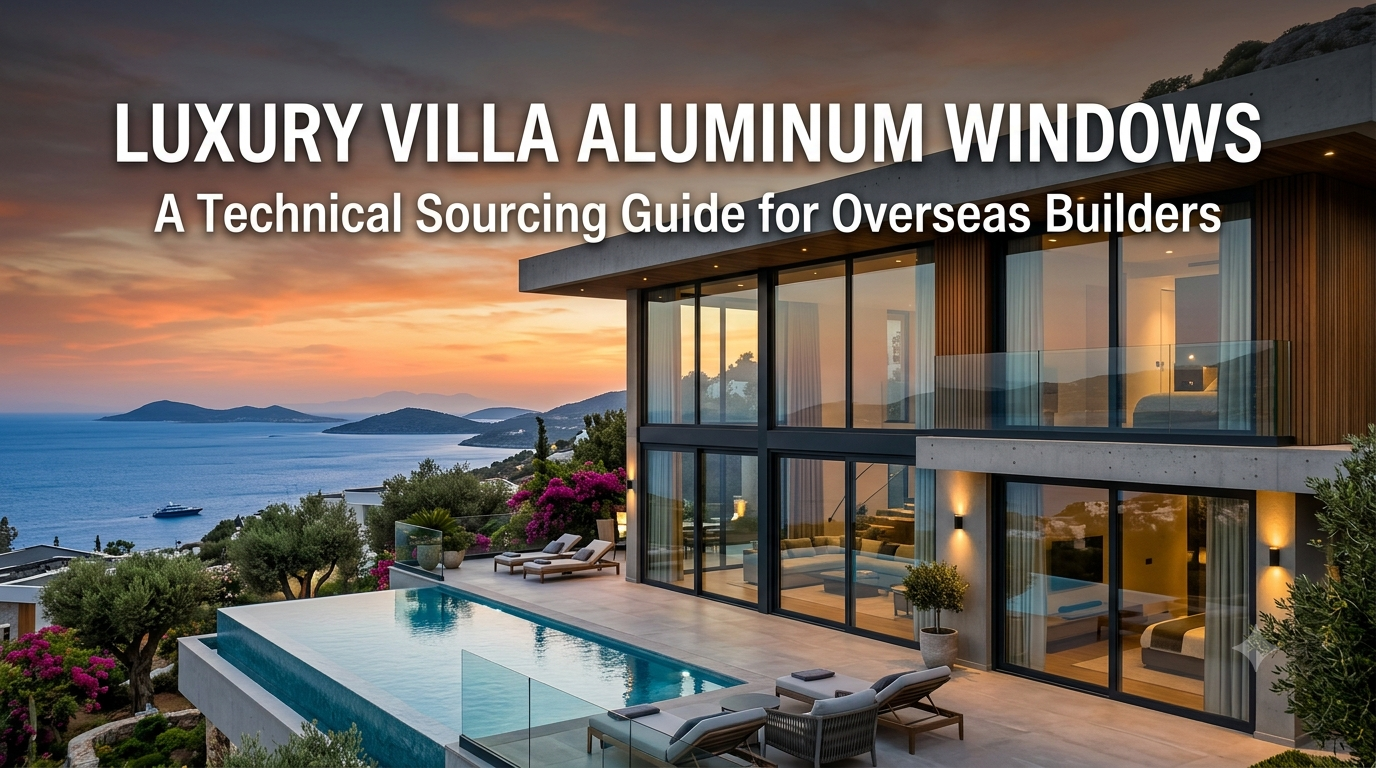
Exterior windows and sliding doors define both the architectural identity and structural performance of a luxury villa. Accounting for 20% to 25% of the total finishing material budget, window systems must withstand extreme wind pressure, prevent water infiltration, block outdoor noise, and limit interior solar heat gain.
Sourcing custom aluminum window systems directly from manufacturing clusters like Foshan, China allows property developers, contractors, and private homeowners to access advanced thermal break engineering at 40% to 50% lower costs than domestic European or North American retail brands.
However, custom glazing is a highly engineered product category. Purchasing remotely requires clear technical specifications—covering extrusion alloys, thermal barrier materials, double/triple glazing units, and heavy-duty hardware—along with strict on-the-ground quality control.
Key Takeaways
- Extrusion Alloy Specs: Always specify 6063-T5 aluminum extrusions with a structural wall thickness of $1.8\text{mm}$ to $2.5\text{mm}$ for standard windows, and $2.0\text{mm}$ to $3.5\text{mm}$ for heavy sliding doors or curtain walls.
- Thermal Barrier Material: Ensure the profile uses Polyamide 66 with 25% glass fiber (PA66 GF25) thermal break strips. Avoid cheap PVC thermal strips, which lose structural integrity under high UV exposure.
- Glass Performance Standards: Specify double or triple-glazed Low-E tempered glass units filled with Argon gas ($6\text{mm} + 12\text{A} + 6\text{mm}$ or laminated $8\text{mm} + 1.52\text{PVB} + 8\text{mm}$ for wind-rated coastal zones) carrying international safety certifications (SGCC, CE, AS/NZS 2208).
- Engineering Sign-Off: Never release factory production deposits without signed, millimeter-accurate shop drawings (CAD) cross-referenced against as-built site opening dimensions.
What Architectural Specifications Make Aluminum Windows Suitable for Luxury Villas?
High-performance villa windows rely on three core structural elements: profile alloy purity, thermal barrier quality, and surface coating durability.
Cross-Sectional Structure of a Thermal Break Window Profile:
[Exterior Aluminum Profile: 6063-T5 Alloy]
    └── [PA66 GF25 Polyamide Thermal Barrier Strip]
        └── [Interior Aluminum Profile: 6063-T5 Alloy]
1. Aluminum Alloy Grade and Wall Thickness
Primary window extrusions must use 6063-T5 aluminum alloy, which offers superior tensile strength, surface flatness, and corrosion resistance.
- Casement & Fixed Windows: Wall thickness should be at least $1.8\text{mm}$ to $2.0\text{mm}$ to prevent frame warping under wind loads.
- Large-Span Sliding Doors ($3.0\text{m}+$ Height): Main load-bearing vertical stiles require wall thicknesses between $2.2\text{mm}$ and $3.5\text{mm}$ to eliminate structural deflection when operating heavy glass panels.
2. Thermal Break Insulation (PA66 GF25)
Standard aluminum conducts thermal energy rapidly. To create an energy-efficient envelope, a non-conductive insulating strip is mechanically crimped between the interior and exterior aluminum profiles.
- Industry Standard: PA66 GF25 (Polyamide 66 reinforced with 25% glass fiber) matches the coefficient of thermal expansion of aluminum, maintaining a tight structural joint through extreme heat and cold cycles.
- Red Flag: Low-cost factories often substitute PA66 with recycled PVC strips. PVC degrades rapidly under solar UV radiation, loses elasticity, and leads to air leaks and frame separation within a few years.
3. Outdoor Surface Coatings
Exterior aluminum finishes must resist chalking, fading, and salt spray corrosion:
- Fluorocarbon (PVDF) Coating: Recommended for high-UV or coastal environments. Delivers a coating film thickness of $\ge 30\mu\text{m}$ with a 15–20 year color retention guarantee.
- Architectural Powder Coating (Qualicoat Standard): Ideal for inland villas. Provides a durable matte finish with a coating film thickness of $\ge 60\mu\text{m}$.
Which Glass Configurations Provide Optimal Insulation and Wind Resistance?
Glazing makes up roughly 80% of a window assembly’s surface area. Selecting the correct Insulated Glass Unit (IGU) configuration depends on your project’s climate, acoustic environment, and local building codes.
IGU Structure: [Outer Glass Pane] + [Air/Argon Gap + Warm Edge Spacer] + [Inner Glass Pane]
The table below outlines common glass structures used in modern luxury villa builds:
| Glazing Configuration | Structure & Specs | Target U-Value (W/m2K) | Primary Application |
| Double Low-E + Argon | $6\text{mm Low-E} + 12\text{A} + 6\text{mm}$ Tempered | $\approx 1.4 – 1.8$ | Tropical or warm climates requiring solar heat reduction |
| Triple Low-E + Argon | $5\text{mm Low-E} + 12\text{A} + 5\text{mm} + 12\text{A} + 5\text{mm}$ | $\approx 0.8 – 1.2$ | Cold or temperate zones requiring interior heat retention |
| Laminated Hurricane Impact | $6\text{mm} + 1.52\text{PVB} + 6\text{mm} + 12\text{A} + 6\text{mm}$ Low-E | $\approx 1.5 – 1.8$ | Coastal hurricane zones & high-security applications |
| Acoustic Laminated Double | $8\text{mm} + 1.14\text{PVB} + 6\text{mm} + 12\text{A} + 8\text{mm}$ | $\approx 1.6 – 1.9$ | Urban/highway-adjacent villas requiring noise reduction (STC $> 42\text{dB}$) |
Note: All glass supplied for residential exterior openings must carry recognized regional safety certifications, such as SGCC (North America), CE / EN 12150 (Europe), or AS/NZS 2208 (Australia).
How Do You Choose Between Slim-Frame Sliding, Lift-and-Slide, and Casement Systems?
Selecting the correct operating mechanism ensures proper functional flow and weather sealing across different zones of the villa.
Window & Door System Selection Matrix
 ├── Minimalist Slim-Frame Sliding  --> Unobstructed patio views, low-profile tracks
 ├── Lift-and-Slide Heavy Systems    --> Oversized panels (up to 400kg), high wind/water sealing
 ├── Tilt-and-Turn Systems          --> Secure ventilation, high acoustic & thermal efficiency
 └── Concealed Frame Casements      --> Clean modern facades, maximum perimeter gasket compression
1. Minimalist Slim-Frame Sliding Doors
- Features: Ultra-thin vertical sightlines ($21\text{mm}$ to $25\text{mm}$) with outer frames embedded directly into finished walls, floors, and ceilings.
- Best Uses: Main ground-floor living areas opening onto terraces, pools, or garden views where continuous visual flow is desired.
2. Heavy Lift-and-Slide Systems
- Features: Turning the heavy-duty handle lifts the door panel off its weather gaskets, allowing large glass panels weighing up to $400\text{kg}$ to slide smoothly along stainless steel tracks. Locking the door lowers the panel back down, compressing multi-channel EPDM rubber gaskets against the sill.
- Best Uses: Exposed coastal or high-elevation openings that require strict air tightness and water-penetration resistance under heavy wind pressure.
3. Tilt-and-Turn & Outward Casements
- Features: Multi-point perimeter locking hardware compresses double or triple EPDM rubber seals tight against the frame when locked.
- Best Uses: Master bedrooms, study rooms, and upper-floor openings where sound insulation and thermal performance are critical.
What Are the Most Common Mistakes Overseas Buyers Make When Sourcing Windows from China?
Direct factory procurement offers substantial cost savings, but managing orders remotely without technical oversight can lead to expensive site installation issues.
1. Ordering Based on Preliminary Architectural Sketches
Manufacturing custom window frames before the site’s concrete structure, wall plastering, and finished floor levels are complete often results in sizing mismatches.
- Prevention: Require your site contractor to issue verified “as-built” rough opening dimensions before approving factory CAD shop drawings.
2. Overlooking Water Drainage Channel Engineering
Inexpensive window profiles often feature simple drilled drain holes that allow wind-driven rain to back up into the interior track.
- Prevention: Specify hidden downward-drainage profiles or pressure-equalized drainage caps that prevent water backflow during rainstorms.
3. Inadequate Export Packaging
Standard domestic cardboard wrapping is insufficient for ocean shipping. Unprotected frames scratch during transit, and glass units risk cracking if subjected to shifting container loads.
- Prevention: Insist on fully enclosed, fumigated plywood crates or heavy-duty steel A-frame glass racks with foam corner pads and plastic shrink wrapping.
How Does the Sourcing and Inspection Process Work Step-by-Step?
A structured procurement workflow ensures quality standards and delivery timelines remain under control throughout the project lifecycle.
Procurement & Quality Control Timeline:
Phase 1: BOQ Audit & Structural Wind-Load Review (Week 1–2)
 └── Phase 2: Factory CAD Shop Drawing Sign-Off (Week 3)
      └── Phase 3: Physical Corner Sample Sign-Off & Deposit (Week 4)
           └── Phase 4: Production & Multi-Stage On-Site Quality Control (Week 5–8)
                └── Phase 5: Factory Mock-Up Test & Water Tightness Check (Week 8)
                     └── Phase 6: Reinforced Crate Packing & Container Consolidation (Week 9)
- BOQ & Performance Mapping: Define profile series, RAL color codes, PVDF/powder coating specs, glass thickness, and hardware brands (e.g., Siegenia, Hoppe, CMECH).
- CAD Shop Drawing Approval: Review 1:1 scale cross-section drawings, sill drainage details, and installation sub-frame attachments provided by the factory.
- Corner Sample Verification: Inspect a physical corner sample showing powder coat finish quality, PA66 thermal strip crimping, rubber gasket seals, and corner joint sealant injection.
- On-Site In-Line Quality Control: Check raw aluminum wall thickness, measure paint film thickness with a digital gauge, and inspect insulated glass unit seals.
- Pre-Shipment Assembly Test: Perform a complete trial assembly of key door and window units at the factory to test smooth hardware operation and perimeter gasket compression before releasing final balance payments.
Why Partner with HSY Sourcing for Your Villa Window Procurement in Foshan?
Foshan’s Dali and Nanhai districts represent China’s largest manufacturing cluster for architectural aluminum extrusions and window systems. Navigating hundreds of assembly workshops requires local technical expertise and daily presence on the ground. HSY Sourcing operates as your dedicated technical procurement team in Foshan.
1. Direct Access to Tier-1 Dali Aluminum Manufacturers
We work directly with vetted tier-1 aluminum extrusion plants and window assembly factories in Foshan. We negotiate directly at factory-gate rates, bypassing intermediate trading companies and showroom markups.
2. Technical CAD Verification and Engineering Review
Our team reviews factory shop drawings against your architectural plans. We calculate profile deflection limits based on local wind-load requirements, verify hardware load ratings, and check rough opening tolerances to prevent installation errors on-site.
3. Hands-On Three-Stage Quality Control
We enforce mandatory quality inspection steps at the factory:
- Raw Material Checks: Verifying 6063-T5 aluminum wall thickness, PA66 thermal strip authenticity, and glass safety stamps (SGCC, CE, AS2208).
- Coating & Corner Checks: Testing paint coating thickness ($\ge 30\mu\text{m}$ PVDF / $\ge 60\mu\text{m}$ powder) and verifying hydraulic corner crimping sealant injection.
- Assembly & Packaging Audit: Testing handle and track smoothness, inspecting gasket compression, and supervising the loading of reinforced plywood crates into export containers.
4. Turnkey Warehouse Consolidation
Windows are typically shipped alongside other villa finishes. HSY Sourcing collects window crates at our central Foshan warehouse, combining them with your porcelain slab, custom joinery, and sanitary ware orders into consolidated 20ft or 40ft High Cube containers to optimize ocean freight costs.
Frequently Asked Questions About Sourcing Villa Aluminum Windows
What is the typical lead time for custom aluminum windows from Foshan?
Production generally takes 30 to 45 days after factory CAD shop drawings and control samples are officially approved. Factor in an additional 15 to 40 days for ocean transit, depending on your destination port.
Should I order windows fully assembled or Knocked-Down (KD packed)?
For luxury villa projects, fully assembled window frames (or assembled outer sub-frames with glass packed in separate crates) are recommended. Factory-assembled window corners utilize specialized hydraulic crimping machines and two-component corner sealants that ensure superior water tightness compared to field-assembled joints.
How do you ensure imported windows comply with local building codes?
We cross-reference product specifications against your destination region’s building regulations before placing factory orders. We ensure that glass units carry the required safety certifications (SGCC for North America, CE for Europe, AS2208 for Australia) and that profile engineering meets local design wind pressure ($Pa$) criteria.
How are fragile glass panels and frames protected during sea freight transport?
Insulated glass units and assembled aluminum frames are packed in heavy-duty, fully enclosed fumigated plywood crates or steel A-frame glass racks. Crates are fitted with foam corner protectors, internal rubber spacers, and plastic shrink wrap to prevent shifting or moisture ingress inside ocean containers.