
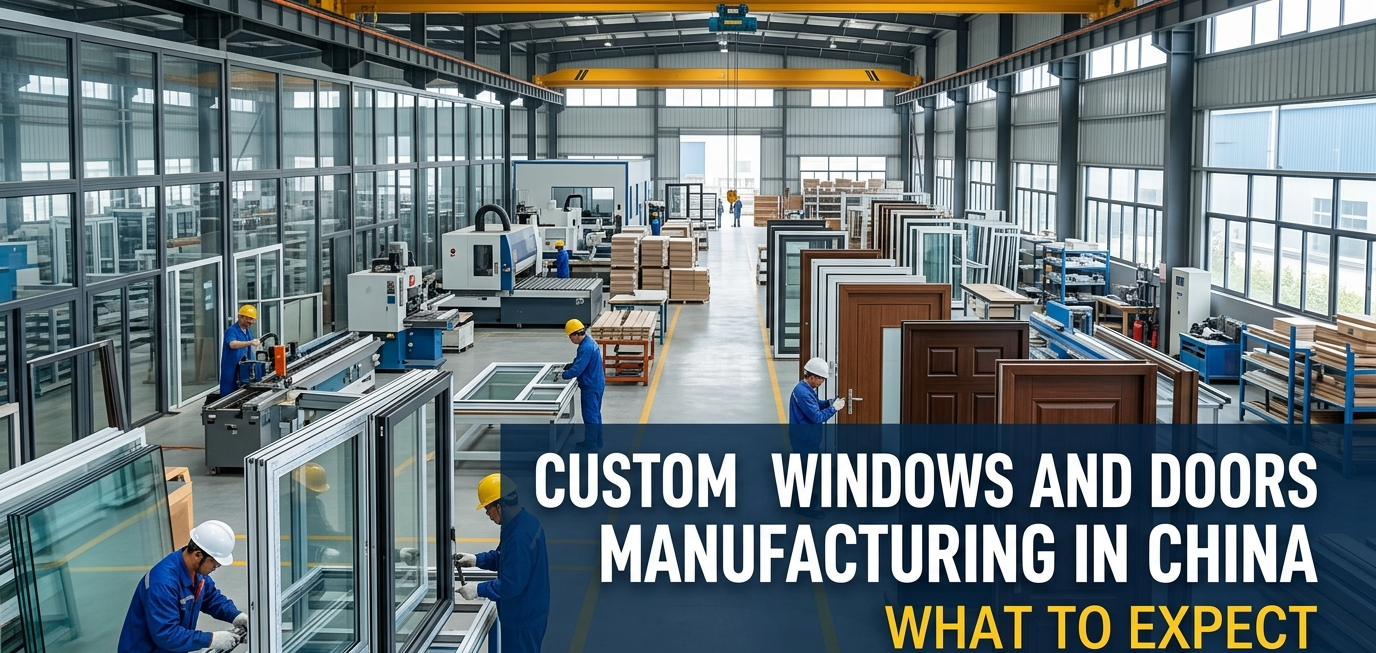
Sourcing custom windows and doors for a commercial real estate project—whether a high-rise apartment, a luxury villa, or a 200-room hotel—is one of the highest-risk procurement tasks. If a sofa breaks, you replace it. If a window leaks or fails a local building inspection, you face massive structural repair costs and project delays.
While China (specifically the Foshan industrial cluster) manufactures the majority of the world’s commercial glazing systems, the quality variance between a Tier-1 extrusion plant and a small assembly workshop is massive. Buying based on a catalog picture is a recipe for disaster. Here is the technical and operational reality of what to expect when manufacturing custom windows and doors in China.
What dictates the structural integrity of custom aluminum windows?
When factories quote a surprisingly low price for a hotel or villa project, they are almost always compromising on the internal aluminum structure. For commercial applications, you cannot accept residential-grade extrusions.
- Aluminum Grade and Thickness: Commercial projects require 6063-T5 aluminum alloy. For high-rise apartments or coastal villas facing high wind loads, the aluminum wall thickness must be strictly specified. Do not accept the standard 1.2mm or 1.4mm. You must mandate 1.8mm to 2.0mm thickness in your Bill of Materials (BOM).
- Thermal Insulation: If your project is in a climate with distinct temperature changes, specify PA66 nylon thermal breaks. Cheaper factories will try to substitute this with PVC strips, which become brittle and crack over time, destroying the window’s insulation properties.
How do Chinese factories handle commercial glass and acoustic ratings?
Glass typically makes up 70% to 80% of the window unit. For hotels and apartments, energy efficiency and soundproofing (STC rating) are the primary concerns.
- Standard Commercial Glazing: The baseline for any commercial project should be 5mm + 12A + 5mm tempered glass (where 12A is a 12mm Argon gas spacer).
- Acoustic Needs for Hotels: If your hotel or apartment project is near a highway or airport, standard double glazing is insufficient. You need to specify laminated acoustic glass (e.g., 5mm + 0.76PVB + 5mm) on the exterior pane to break sound wave frequencies.
- Certifications: Ensure the glass factory holds the specific tempering certifications required by your country’s customs and building codes, such as SGCC (USA), AS/NZS 2208 (Australia), or CE (Europe). A physical stamp must be visible on the corner of every pane.
Why is hardware specification the most critical step in procurement?
The most frequent point of failure in commercial doors and windows is not the glass or the aluminum, but the moving parts. Heavy double-glazed sashes put immense strain on friction stays and hinges.
Never leave the hardware choice up to the factory. You must explicitly name the hardware brand in your contract:
- Global Premium: Specify German brands like Siegenia or Hopo for luxury villas or high-end hospitality projects.
- Commercial Domestic: For high-volume apartment projects where budget is a concern, specify top-tier Chinese brands like Kinlong or Weihai.
- Material: Ensure all exterior screws, hinges, and tracks are made from 304 or 316 stainless steel to prevent rust.
How does container consolidation in Foshan save your project budget?
Foshan possesses a unique geographical advantage: it is the global manufacturing hub for both heavy building materials (windows, doors, tiles) and commercial furniture (hotel beds, compression sofas).
Windows are incredibly heavy and require structural plywood crating, but they often leave a lot of empty vertical space in a shipping container. A professional sourcing strategy leverages this. By consolidating your heavy window crates at the bottom of the container and loading lightweight, high-volume items—like vacuum-compressed sofas and mattresses—on top, you maximize the cubic meter (CBM) usage of the container. This cross-category consolidation can reduce your overall project freight costs by 20% to 30%.
Key Takeaways
- Mandate Specifications: Explicitly define aluminum thickness (1.8mm+), thermal break materials (PA66), and hardware brands (Hopo, Kinlong) before paying a deposit.
- Verify Glass Certifications: Ensure the factory provides verified testing reports for local building code compliance (SGCC, CE, AS2047).
- Require Plywood Packaging: Custom windows must be shipped in fully enclosed, fumigated plywood crates with EPE foam separators to survive ocean transit.
- Leverage Cross-Consolidation: Use Foshan’s supply chain to mix heavy building materials with lightweight furniture (like compression sofas) to optimize freight ROI.
Why Choose HSY Sourcing?
Sourcing structural building materials requires engineering oversight and physical presence. HSY Sourcing operates directly out of Foshan, managing the entire supply chain for real estate developers, hoteliers, and construction firms.
- Engineering Audits: We do not rely on factory claims. We physically measure aluminum wall thickness with digital calipers and verify thermal break materials on the assembly line.
- Foshan Cross-Category Consolidation: We maximize your logistics budget. Our local warehouses allow us to consolidate your custom windows and doors with interior furniture (including Foshan’s famous compression sofas and hospitality case goods) into single, highly-optimized container shipments.
- Direct Factory Access: HSY team bypass trading companies, connecting your project directly with Tier-1 extrusion plants and glass tempering facilities to secure factory-direct pricing.
- Strict Pre-Shipment Inspections: We conduct rigorous AQL inspections and supervise the container loading process to ensure your fragile goods are crated and secured properly for international freight.
FAQ
Q1: What is the typical lead time for custom commercial windows and doors?
A: Production typically takes 30 to 45 days after the final architectural shop drawings are signed off. If you require custom powder-coating colors or complex curved extrusions, expect lead times closer to 50 days.
Q2: Will Chinese factories provide installation CAD drawings?
A: Yes, reputable Tier-1 factories will provide detailed architectural shop drawings based on your rough openings. Mass production should never begin until your local engineers approve these CAD drawings.
Q3: Can I order a sample window before the mass project order?
A: Absolutely. We highly recommend ordering a full-sized corner sample or a complete 1×1 meter window unit. This allows your local installation team to inspect the extrusion quality, hardware functionality, and thermal breaks before committing to the bulk order.
Q4: How does HSY Sourcing ensure the windows aren’t damaged during shipping?
A: We enforce a strict packaging protocol. All windows must be separated by pearl cotton (EPE) and packed in rigid, fully enclosed plywood crates (not standard cardboard). We then physically supervise the container loading in Foshan to ensure crates are strapped and balanced correctly.