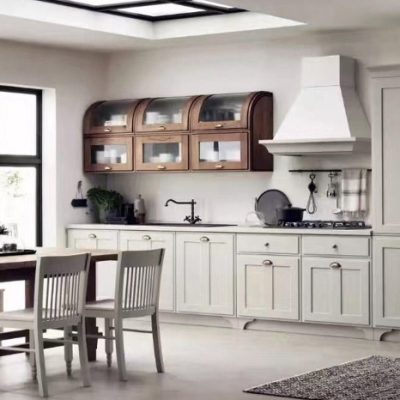

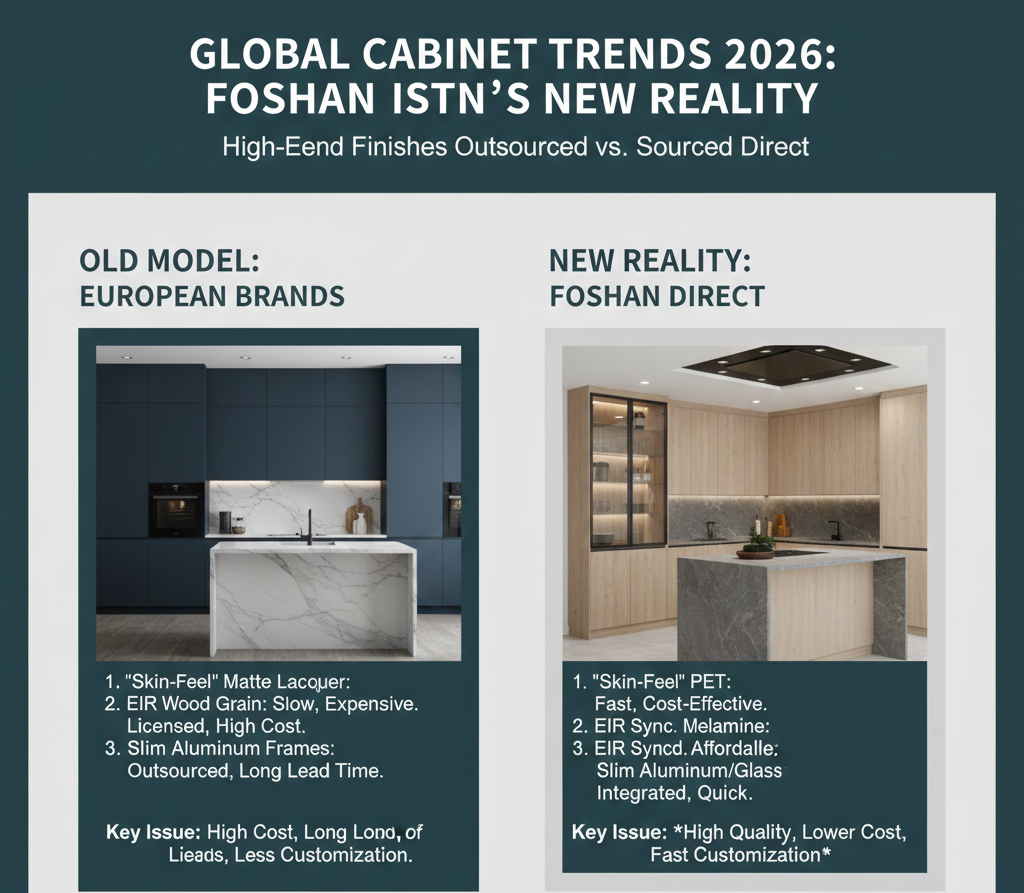
For years, the script was always the same: if you wanted a kitchen that looked like a million dollars, you bought Italian. If you wanted a kitchen that worked like a machine, you bought German. But by early 2026, the global cabinetry market has seen a massive shift. In high-end developments from Dubai to Sydney and New York, the labels on the back of the cabinet doors are increasingly saying “Made in Foshan.”
At HSY Sourcing, we spend every day in these factories. We aren’t seeing buyers choose Foshan just because it’s cheaper—though the price gap is still significant. They are choosing Foshan because the “factory of the world” has mastered the aesthetics of the European brands while offering lead times and customization that the Europeans simply can’t match.
If you are a wholesaler or a developer planning an apartment project for late 2026 or 2027, you need to know which finishes are actually moving the needle. Here is the unfiltered truth about the trends currently dominating the Foshan supply chain.
Why is “Skin-Feel” matte finish replacing high-gloss lacquer?
Go back five years, and every luxury apartment had “Piano White” high-gloss cabinets. Today, that look feels dated. The biggest trend in Foshan right now—and the one currently crushing European imports in the B2B sector—is the Super-Matte “Skin-Feel” finish.
This isn’t just standard matte paint. It’s a specialized coating (often using PET or high-end UV lacquer) that feels soft, almost like velvet or human skin, when you touch it.
Why it’s outselling the Europeans: Italian brands charge a massive premium for “Anti-fingerprint” technology. In Foshan, we have found that the top-tier PET lamination lines have perfected this. You can press your greasy hand against the door, and it leaves zero marks. For a developer, this is a huge selling point for prospective tenants. It looks expensive, feels premium, and—most importantly—it doesn’t require a cleaning crew to wipe it down every ten minutes.
Is “Synchronized Wood Grain” the secret to making melamine look like a luxury villa?
For a long time, melamine was the “cheap” option. It looked like plastic wood. But in 2026, the most popular finish for large-scale residential projects in Foshan is EIR (Embossed-In-Register) Melamine.
In the industry, we call this “Synchronized Texture.” Instead of a flat print, the texture of the board perfectly follows the grain of the wood in the picture. If you see a knot in the wood grain, you can feel that knot with your finger.
The Reality Check: European brands like Egger have led this market for years. However, Foshan manufacturers have invested heavily in German-made pressing plates. We are now seeing “Made in China” synchronized boards that are indistinguishable from real wood veneer to the naked eye. For a builder, this is a game-changer. You get the “luxury wood” look for your 100-unit project, but at a melamine price point and with much higher scratch resistance.
Why are slim aluminum frames and tinted glass taking over island designs?
If you walk through the high-end showrooms in Lecong right now, you’ll see less solid wood and more Glass and Metal. The “Foshan Look” for 2026 involves ultra-slim aluminum profiles (often in matte black, brushed gold, or gunmetal gray) paired with tinted or reeded glass. These are usually used for upper cabinets or display islands.
The European Disruption: In Europe, these aluminum-framed doors are often outsourced to specialist workshops, which adds weeks to the lead time and thousands to the cost. In Foshan, the aluminum industry is literally down the street from the cabinet industry. We can get custom-sized, aluminum-framed glass doors manufactured and integrated into a kitchen order in a fraction of the time. It gives developers that “Italian Designer” look without the 6-month wait time.
What is the truth about Sintered Stone (Rock Plate) door fronts?
You’ve seen sintered stone (often called “Rock Plate” in China) on countertops. But the 2026 trend is moving that stone onto the cabinet door fronts. By using 3mm or 5mm ultra-thin stone slabs bonded to an aluminum honeycomb core, Foshan factories are creating doors that are essentially indestructible. They are fireproof, waterproof, and scratch-proof.
Is it actually worth it? For a standard rental project? No. It’s too heavy and too expensive. But for luxury penthouse developments or high-end wholesale showrooms, this is the “Italian Killer.” European brands sell stone-fronted kitchens for astronomical prices. Foshan has democratized this technology. Because the stone is produced locally in Nanzhuang (the tile capital next to Foshan), the cost of materials is significantly lower. It allows a developer to market a “Stone Kitchen” as a unique selling point that no one else in their local market can offer.
Why does the “Boring Stuff” (Edge Banding) matter more than the finish?
As a sourcing agent, I tell my clients: “Don’t fall in love with the color until you look at the edge.”
The reason European brands used to be superior wasn’t the wood; it was the Edge Banding. They used laser technology to make the seam between the door face and the edge invisible.
In 2026, the gap has closed. The top-tier factories we work with in Foshan have moved away from cheap EVA glue. They are now using PUR glue and Laser Edge Banding as standard for project-grade orders.
The real-world impact: If you buy a “trending” finish but the factory uses cheap glue, the doors will peel in two years when the kitchen gets steamy. When we audit a factory for a building project, we don’t just look at their pretty doors; we go to the back and check if they are running Homag or Biesse machines. If they have the right machinery and the right glue, the Foshan cabinet is technically equal to the German one.
FAQ: Sourcing the Latest Trends from Foshan
Q: Are these “trending” finishes more expensive than standard ones?
A: Skin-feel PET and EIR Melamine are slightly more expensive than basic matte melamine, but they are still roughly 40-60% cheaper than the equivalent European brands. The “Rock Plate” stone doors are the most expensive, reserved for luxury tiers.
Q: Can Foshan factories handle custom designs for a 200-unit project?
A: That is their specialty. Unlike European brands that have rigid “standard sizes,” Foshan factories are built for “Mass Customization.” However, you need an agent to manage the technical drawings (Shop Drawings) to ensure the factory’s “custom” interpretation matches your architectural requirements.
Q: How do I know if the “Skin-Feel” finish will hold up in a rental property? A: We always perform a “Stain and Scratch Test” on samples before production. We leave red wine, vinegar, and oil on the surface for 24 hours to ensure it doesn’t ghost. For rental projects, we usually suggest PET over Lacquer because PET is more impact-resistant.
Q: Why do I need an agent if I can just find these factories on Alibaba? A: On Alibaba, every factory uses the same beautiful photos. In person, one factory might be using high-end PUR glue while the one next door is using cheap EVA glue that will peel in a year. We are your “eyes on the ground” to ensure the internal quality matches the trending exterior.
Conclusion
The “European Look” is no longer a European monopoly. Foshan has moved beyond being a cheap alternative; it is now a center for finishing technology. Whether it’s the buttery touch of Skin-Feel PET or the rugged luxury of Sintered Stone, the 2026 trends are all about High Performance + High Aesthetics.
For wholesalers and developers, the goal is simple: you want your project to look like it cost double what you actually paid. Foshan can deliver that, but only if you know which factories have invested in the right machinery and which ones are just faking the look.
Are you looking to upgrade your cabinet supply chain for your next project? Don’t guess based on a catalog. At HSY Sourcing, we know which factories are currently leading the market in these 2026 finishes.