
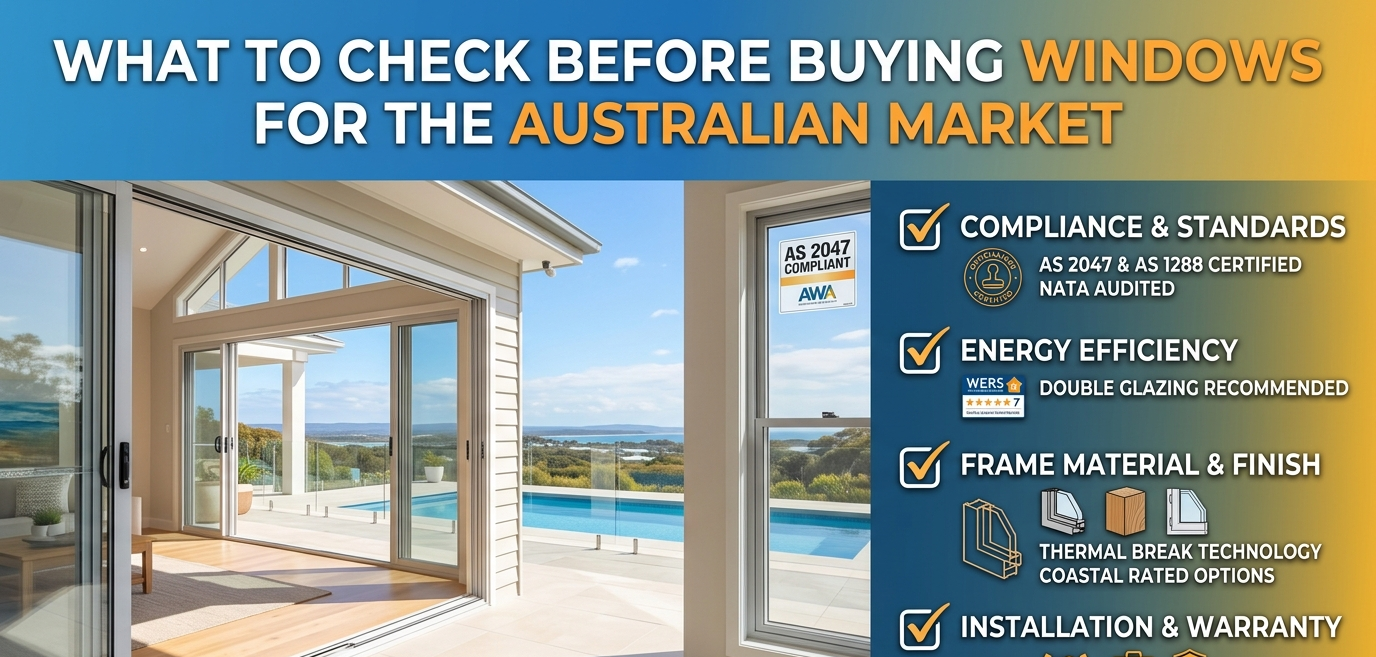
Key Takeaways:
- Certification is Mandatory: Do not buy any window system that lacks physical, verifiable AS2047 and AS1288 test reports from a NATA-recognized laboratory. Local building surveyors will reject uncertified products.
- Energy Ratings are Strict: The Australian National Construction Code (NCC) requires low U-values. Thermal break aluminum profiles and Low-E double glazing are practically mandatory for new builds.
- Hardware Must Survive the Climate: Coastal Australian projects require Marine Grade 316 stainless steel hardware and commercial-grade powder coating to prevent rapid corrosion.
- Verify with Real Physical Evidence: Never trust a supplier’s digital renderings. Demand physical, real-life photos of the factory floor, the aluminum extrusion process, and the packing methods.
Buying windows from Foshan—the global center for aluminum extrusion and glass manufacturing—can significantly reduce the FF&E budget for Australian real estate and hospitality projects. However, the Australian market has some of the strictest building codes in the world.
If you import windows that fail to meet local compliance, the site surveyor will refuse to issue an occupancy permit, leaving you with containers of unusable glass and metal.
If you are a procurement buyer for hotels, apartments, or villa developments, here is exactly what you need to verify before placing a window order in China.
Do the Windows Hold Legitimate AS2047 and AS1288 Certifications?
The most critical check is regulatory compliance. In Australia, a window is not just a building material; it is a structural component that must withstand specific environmental loads.
- AS2047 (Windows and External Glazed Doors): This standard tests the window system for structural deflection, operating force, air infiltration, and water penetration resistance.
- AS1288 (Glass in Buildings): This dictates the use of Grade A safety glass (toughened or laminated) to prevent severe human injury upon impact.
Many factories claim they “can do” Australian standards, but you must ask for the actual laboratory test reports (from recognized testers like Intertek or SGS). The test report must match the exact aluminum profile series you are purchasing. A report for a sliding window does not cover a bi-fold door.
Are the Profiles Engineered to Meet Australian Energy Ratings (NCC/NatHERS)?
Australia’s energy efficiency requirements (such as Section J of the NCC) heavily penalize poor window performance. Standard aluminum is a highly conductive metal, meaning it transfers outside heat inside during summer, and loses interior heat during winter.
For commercial apartments, hotels, and modern villas, standard aluminum is obsolete. You must specify:
- Thermal Break Profiles: The aluminum frame must be separated by a structural polyamide strip (PA66). This breaks the temperature transfer.
- High-Performance DGU (Double Glazed Units): Specify an Argon gas-filled gap and Low-E (Low-Emissivity) glass coatings. This combination drives down the U-value and manages the Solar Heat Gain Coefficient (SHGC) to pass Australian energy audits.
Has the Factory Accounted for Specific Bushfire (BAL) or Acoustic Requirements?
If your project is a villa near bushland or a hotel in a busy CBD, standard glass and frames will not pass inspection.
- Bushfire Attack Level (BAL): Projects in bushfire zones require windows rated for BAL-29, BAL-40, or BAL-FZ (Flame Zone). This dictates using specific fire-rated toughened glass, metal (not nylon) hardware components, and stainless-steel bushfire mesh screens.
- Acoustics (Rw Rating): For hotels and urban apartments, noise reduction is directly tied to asset value. To achieve a high Rw rating, you cannot use standard double glazing. You must specify asymmetric glass (e.g., one 6mm pane and one 8mm pane) or acoustic laminated PVB glass to disrupt different sound frequencies.
How Will the Hardware Hold Up to Coastal Australian Environments?
A large percentage of Australian real estate development occurs within 50 kilometers of the coast. High salt content in the air will rust standard zinc or low-grade steel hardware within months.
When finalizing the BOQ (Bill of Quantities), you must explicitly state the hardware specifications:
- Friction Stays, Hinges, and Locks: Must be Marine Grade 316 Stainless Steel.
- Surface Treatment: Standard powder coating will degrade under Australian UV rays. Specify commercial architectural coatings (like AkzoNobel or PPG) with a minimum 10-to-15-year warranty against fading and salt corrosion.
Are the Windows Packed Correctly for Ocean Freight and Site Handling?
Commercial windows are incredibly heavy and fragile. A common procurement mistake is allowing the factory to pack heavy glass panels in cheap plywood crates. When the container experiences turbulence at sea, the wood splinters, and the glass shatters.
Before approving an order, establish the packing protocol. Heavy aluminum windows and sliding doors must be packed on reinforced steel or iron A-frames. These frames provide structural rigidity inside the shipping container and allow Australian builders to safely unload the goods using a forklift or crane on-site.
Why Choose HSY Sourcing for Your Window Procurement?
Sourcing technical building materials requires on-the-ground presence. Located in Foshan, the heart of China’s door and window industry, HSY Sourcing acts as your local project management and quality control team.
- Factual Verification, Not AI Marketing: We know project buyers need truth, not exaggeration. We do not send you AI-generated graphics or polished marketing renders. We provide real-life, physical photos and videos of the factory workshops, the aluminum extrusion lines, and your actual windows undergoing water-testing before packaging.
- AS2047 Supply Chain: We bypass generic trading companies and work exclusively with tier-one Foshan manufacturers who hold valid, NATA-recognized AS2047 test reports.
- Technical Drawing Coordination: We take your Australian architect’s window schedules and coordinate directly with the factory engineers to produce accurate CAD shop drawings, ensuring mullion details and thermal breaks match your site requirements perfectly.
- Consolidation and Logistics: If your project requires windows, tiles, and cabinetry, we merge these orders locally. We oversee the physical consolidation in our Foshan warehouse, ensuring heavy A-frames are loaded securely without crushing lighter FF&E items.
Visit www.hsysourcing.com to share your window schedule, and let us manage the technical procurement for your next Australian development.
Frequently Asked Questions (FAQ)
Q: Do Chinese factories install the windows in Australia?
A: No. Factories and sourcing agents supply the finished product. The installation must be completed by licensed Australian builders or glaziers to ensure the waterproofing and flashing meet local building codes. We provide the technical installation manuals and shop drawings required by your local team.
Q: What is the typical lead time for custom thermal break windows from Foshan?
A: After you approve the final shop drawings and pay the deposit, manufacturing usually takes 35 to 45 days. Ocean freight to major Australian ports (Sydney, Melbourne, Brisbane) takes about 18 to 25 days. You should factor 10 to 12 weeks into your project schedule from order to site delivery.
Q: How do we handle custom colors for the aluminum frames?
A: Foshan factories can powder coat or anodize frames to match almost any color requirement. You simply need to provide the standard RAL or Pantone color code, or send us a physical color chip. We will have the factory produce a physical aluminum color sample for your approval before bulk production begins.