
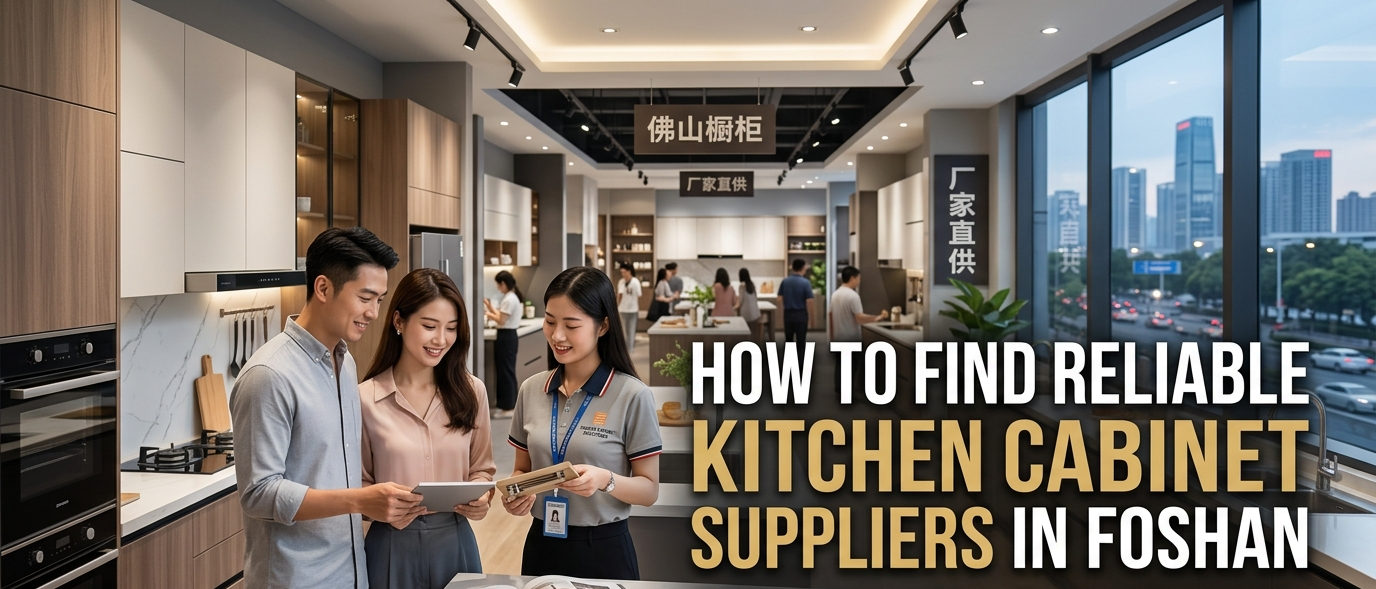
For international real estate developers, hospitality procurement executives, and general contractors, sourcing custom kitchen cabinetry directly from Foshan—specifically the Shunde industrial cluster—provides direct access to high-volume, automated OEM manufacturing lines. The local industrial density allows for highly competitive raw material procurement and advanced fabrication capabilities that can significantly lower project capitalization costs.
However, the scale of the Foshan market presents a structural challenge for overseas buyers: How do you separate primary, reliable manufacturers from trading intermediaries, secondary assembly workshops, or financially unstable suppliers?
In large-scale commercial developments (such as a 150-unit multi-family apartment complex or a luxury villa project), partnering with an unverified supplier introduces severe structural risks. A minor breakdown in a vendor’s quality management system can lead to systemic dimensional deviations across an entire batch, peeling edge bands under humid conditions, or shipping delays that trigger expensive penalty clauses in your main construction contract.
Identifying a truly reliable manufacturing partner requires moving past decorative showrooms and executing a disciplined, technical verification process directly on the factory floor.
Key Takeaways
- Verify True Manufacturing Status: Look past high-end retail showrooms in furniture malls; verify a supplier’s actual operating capacity by auditing their physical factory footprint, machine assets, and primary business license scope.
- Mandate Mechanical and Adhesive Standards: Reliable B2B suppliers must demonstrate the use of automated CNC nesting machinery and advanced PUR hot-melt edge-banding lines rather than manual panel saws or cheap EVA adhesives.
- Establish Physical Contract Gates: Contractually require a 1:1 scale physical mockup of your exact kitchen configuration to test structural tolerances and appliance drop-ins before releasing deposits for mass production.
What clear indicators separate a primary factory from a trading middleman?
When sourcing kitchen cabinets in Foshan, many entities that present themselves as “direct factories” are actually independent trading houses, sourcing brokers, or small-scale assembly shops that outsource their primary machining. For a large-scale real estate development, buying from a middleman adds unnecessary markups and decouples you from direct control over the production line.
[Trading Broker Route]   ──> Outsourced Cutting ──> Manual Edging ──> No Line Traceability ──> High Risk
[Primary OEM Factory]    ──> In-House CNC Lines ──> PUR Edge Banding ──> Direct Quality Control ──> Low Risk
True primary manufacturers can be verified through three explicit operational metrics:
- Machinery Asset Ownership: A reliable high-volume supplier must own and operate heavy automated machinery. During a physical audit, look for multi-station CNC nesting centers (such as Homag or Biesse lines) and automated edge-banding machinery. If a facility relies primarily on manual sliding panel saws, they lack the capacity to maintain sub-millimeter tolerances across a 200-kitchen order.
- Corporate and Licensing Alignment: Review the factory’s official Chinese business license (Business License). The registered business scope must explicitly include words like “Manufacturing” or “Processing” , rather than just “Sales” or “Trading” . Furthermore, verify that the factory’s physical address matches the location listed on their environmental impact compliance certifications.
- Raw Material Supply Chain Traceability: A direct manufacturer maintains structural relationships with tier-one sheet-goods suppliers (such as EGGER, Kronospan, or reliable local E0-grade brands). They can instantly provide valid laboratory test reports verifying formaldehyde emission compliance (such as CARB Phase 2, EPA, or EN13986 metrics) for their incoming board stock.
Which technical machinery checks must be included in your factory audit?
A visual walk-through of a factory is insufficient. To evaluate structural reliability, your on-the-ground sourcing team must inspect specific operational zones along the active production line.
1. The Cutting Station (CNC Calibration)
Verify whether the factory uses manual labor to interpret cutting sheets or if they feed CAD files directly into an automated CNC machine. Direct digital integration ensures that panel dimensions remain identical from unit #1 to unit #500, eliminating installation gaps when cabinets meet structural site walls.
2. The Edge-Banding Setup (Adhesive Verification)
Ask the production manager to show you the glue pots on their active edge-banding machinery. Reliable commercial-grade suppliers utilize PUR (Polyurethane) hot-melt adhesive or advanced laser edge-banding systems. If the factory runs standard, cheap EVA glue, reject the line for wet-zone cabinetry; EVA glue can reactivate and soften when exposed to steam from dishwashers and ovens, causing the edge strips to peel over time.
3. The Boring and Hardware Insertion Station
Examine how hinge holes and drawer runner holes are drilled. A reliable supplier utilizes automated multi-spindle boring machines that drill all structural pilot holes simultaneously based on fixed templates. Manual hand-drilling leads to loose screws and misaligned cabinet doors during final on-site installation.
How can buyers protect their investment before mass production begins?
The most effective method to mitigate manufacturing errors is establishing an absolute technical gate before any mass fabrication takes place. Never authorize full production based entirely on 2D shop drawings or 3D renderings.
[2D Blueprint Approval]   ──> High Risk of Mass Dimensional Disconnects on the Construction Site
[1:1 Physical Prototype] ──> Physical Assembly Check ──> Component Interface Testing ──> Low Risk
A reliable supplier will agree to construct a 1:1 scale physical mockup of a complete kitchen layout based on your project specification. This prototype must be assembled using the exact substrate, adhesive, edge-banding, and hardware specified in your contract Bill of Materials (BOM).
Your ground sourcing agent must physically audit this prototype:
- Verify that your specified project appliances drop into the cutouts smoothly with proper ventilation clearances.
- Check the structural rigidity of the base carcass under weight loading.
- Test drawer runner dampening and hinge alignment under repetitive mechanical opening cycles.
- Approve the physical mockup as the baseline “Master Control Sample” against which all future production batches will be measured.
Why Choose HSY Sourcing as Your Cabinet Verification Partner in Foshan?
Managing multi-unit millwork engineering from an overseas office creates severe communication and quality control gaps. HSY Sourcing operates as your independent, on-the-ground purchasing and engineering team in the heart of the Foshan and Shunde cabinet manufacturing clusters.
- Rigorous Field Factory Auditing: We do not rely on factory-provided marketing photos. Our team conducts unannounced, physical audits on the factory floor, evaluating machine assets, verification standards, and business legality to protect your capital.
- Strict Technical Contract Enforcement: We translate your architectural project plans into precise manufacturing contracts. We mandate and physically check that PUR edge-banding is applied, substrate densities meet structural standards, and hardware brands are authentic.
- Independent Milestone Inspections: Our QC engineers monitor production at key milestones—checking panel moisture levels (ensured between 8% and 12% to prevent post-export warping), verifying color-batch consistency, and inspecting structural joints.
- Engineered Mixed-Container Consolidation : Using our central Foshan warehouse facility, we consolidate your cabinetry with heavy materials like porcelain floor tiles or stone countertops. We design density-stratified load plans—securing heavy goods to the floor and stacking flat-pack cabinets safely on top—to optimize shipping costs and eliminate transit crushing.
Frequently Asked Questions (FAQ)
How can we confirm that a factory is using genuine E0 or CARB Phase 2 boards?
We verify board compliance through a multi-step check. First, we cross-check the manufacturer’s incoming raw material invoices against verified timber board mills. Second, during active production runs, our QC engineers inspect the original brand stamps and edge markings printed on the raw, uncut sheets before they hit the panel saw line. Finally, we can coordinate independent third-party laboratory testing (such as SGS or Intertek) on randomized panel cutouts taken directly from the production line.
What happens if a supplier fails our on-site quality control check during production?
Our contracts include explicit, milestone-based quality gates. If a batch of cabinet doors displays finish defects or dimensional deviations during our in-line check, production is halted immediately. The non-compliant batch is documented with high-resolution imagery and video, and the factory is legally required to re-fabricate the defective run at their own cost before we authorize any milestone payments or clear the goods for warehouse transit.
Why is board moisture content critical for kitchen cabinets exported overseas?
Foshan has a humid, subtropical climate, whereas your project site might be located in a dry, arid environment or a strictly climate-controlled Western region. If a factory uses timber core boards with excessive internal moisture (above 14%), the dry air at the destination country will cause the wood to contract rapidly, leading to hairline cracks, panel warping, and structural hardware misalignment. We enforce an optimal internal moisture range between 8% and 12% across all wood substrates before loading.
Can we source custom quartz countertops from the same supplier as the cabinets?
While some large cabinetry factories offer stone processing as an add-on service, they usually outsource the fabrication to specialized stone cutting yards in neighboring local districts. HSY Sourcing typically recommends sourcing your quartz or sintered stone countertops directly from primary stone fabricators in the local cluster, then coordinating the exact cutout templates between the cabinet factory and the stone line to ensure a perfect fit while eliminating middleman markups.