
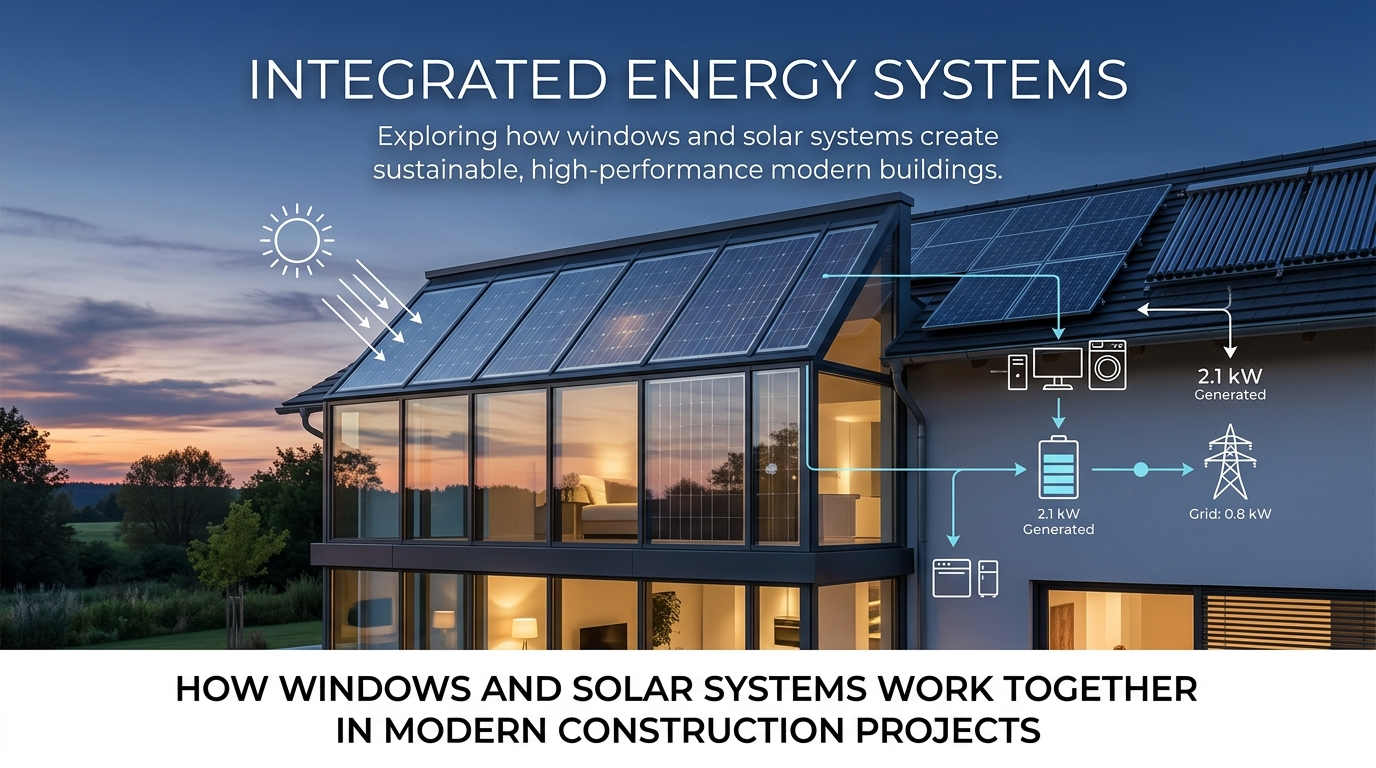
In current construction, the boundary between “building materials” and “energy systems” is disappearing. Property developers and architects no longer view windows and solar panels as separate line items on a spreadsheet. Instead, they are treated as two halves of a single energy-saving machine: the windows minimize energy loss (the passive side), while the solar system generates power (the active side).
For those sourcing from China—particularly the industrial hubs of Foshan and Zhongshan—the goal is to ensure these two systems are technically aligned before they reach the job site.
Why should you treat windows and solar as a single energy strategy?
If you install a massive solar array on a building with poor-quality windows, you are essentially trying to fill a bucket that has holes in it. The solar panels generate electricity to run the HVAC, but the windows allow that cooled or heated air to leak out.
The most efficient projects use high-performance windows to “shrink” the building’s energy demand. By using thermal break aluminum frames and Low-E glass, you reduce the load on the air conditioning system. This allows for a smaller, more cost-effective solar installation, or it allows the electricity generated to be sold back to the grid rather than being wasted on inefficient climate control.
How do high-performance windows reduce your solar ROI period?
The Return on Investment (ROI) of a solar system is tied directly to how much of that power stays inside the building. In most commercial projects, the biggest energy “leak” is the window frame.
Standard aluminum is a conductor. Without a proper thermal break (Polyamide strips like PA66GF25), heat moves freely through the frame. When you upgrade to thermally broken windows sourced from specialized Foshan factories, you are essentially installing a thermal barrier. This stabilizes the internal temperature, meaning your solar-powered heat pumps don’t have to work in “overdrive” mode. By lowering the peak energy demand, the solar system pays for itself years faster.
What is the reality of BIPV (Building-Integrated Photovoltaics) in 2026?
We are seeing a massive shift from “Solar on the Roof” to “Solar as the Skin.” BIPV (Building-Integrated Photovoltaics) refers to solar cells built directly into the glass of the window or the facade panels themselves.
In 2026, the technology has moved past pilot projects into commercial reality. You can now source semi-transparent solar glass from China that replaces traditional curtain walls. These systems typically offer 20% to 50% transparency, allowing natural light into offices while generating power from the facade. While the upfront cost of BIPV is higher than standard windows, it turns the “dead space” of a building’s exterior into a revenue-generating asset.
How do you manage technical alignment between two different factories?
One of the biggest risks in construction procurement is “Technical Disconnect.” A developer might buy windows from a factory in Foshan and solar panels from a plant in Zhongshan, only to find the mounting brackets don’t fit or the wiring conduits are missing.
Successful integration requires sharing CAD shop drawings between both manufacturers during the production phase. For example, if you are planning a solar-ready facade, the window manufacturer needs to know where the cabling will exit the frame. Likewise, the solar supplier needs to ensure their panel dimensions account for the mullions and transoms of the window system. Managing this communication is the difference between a smooth installation and a costly on-site modification.
Key Takeaways
- The Envelope First Rule: Invest in high-quality thermal break windows first; it makes your solar system significantly more effective.
- Specify the Glass: In hot climates, use Solar Control Low-E glass to block infrared heat while letting in visible light.
- BIPV for High-Density Areas: If roof space is limited, look into power-generating glass facades (BIPV) to maximize energy surface area.
- Technical Oversight: Ensure your window and solar suppliers are “speaking” to each other through shared technical drawings before production begins.
FAQ: Windows & Solar Integration
Q: Do I need special “Solar Windows” for my house?
A: Not necessarily. For most residential projects, it is more cost-effective to use high-performance triple-glazed windows and put standard monocrystalline panels on the roof. Solar windows (BIPV) are generally reserved for high-end commercial buildings where roof space is insufficient.
Q: Can I source both systems from one factory?
A: Very rarely. Window extrusion and solar cell manufacturing are two different industries. You will likely work with two specialized factories. This is why having a sourcing agent on the ground to coordinate the two is vital.
Q: Does shading from windows affect solar panel placement?
A: Yes. Modern 3D modeling should be used to ensure that overhanging window eaves or balcony structures don’t cast shadows on your solar array, which can significantly drop the system’s efficiency.
Why Choose HSY Sourcing for Your Integrated Project?
At HSY Sourcing, we don’t just “find products.” we manage the technical intersection of your building materials. Based in Foshan, we are at the heart of the window industry and minutes away from the solar manufacturing hubs of Guangdong.
- Systems Coordination: We bridge the gap between your window and solar suppliers, ensuring that frame designs and electrical requirements are aligned before the first container is loaded.
- Technical Verification: Our team doesn’t just check colors; we verify U-values, SHGC ratings, and solar conversion efficiencies. We ensure the “Energy Saving” stickers on the products are backed by real laboratory test reports.
- Logistics Safety: Shipping fragile glass and heavy solar components together is risky. We manage the consolidation, using custom plywood crating and professional loading to ensure your entire energy system arrives intact.