
The most dangerous mistake a buyer can make is falling in love with the “China Price.” If a factory in Shunde quotes you $200 for a luxury outdoor sofa that retails for $1,200 in the US, it looks like a goldmine. But if you haven’t calculated the landed cost—the total price of the product by the time it sits in your warehouse—you are flying blind.
Too many first-time importers watch their profit margins evaporate because of a 25% surprise tariff or a $500 “port handling fee” they didn’t see coming. Here is the blunt reality of what it actually costs to move goods from a factory floor in China to your door.
What is the difference between the “Unit Price” and the “Landed Cost”?
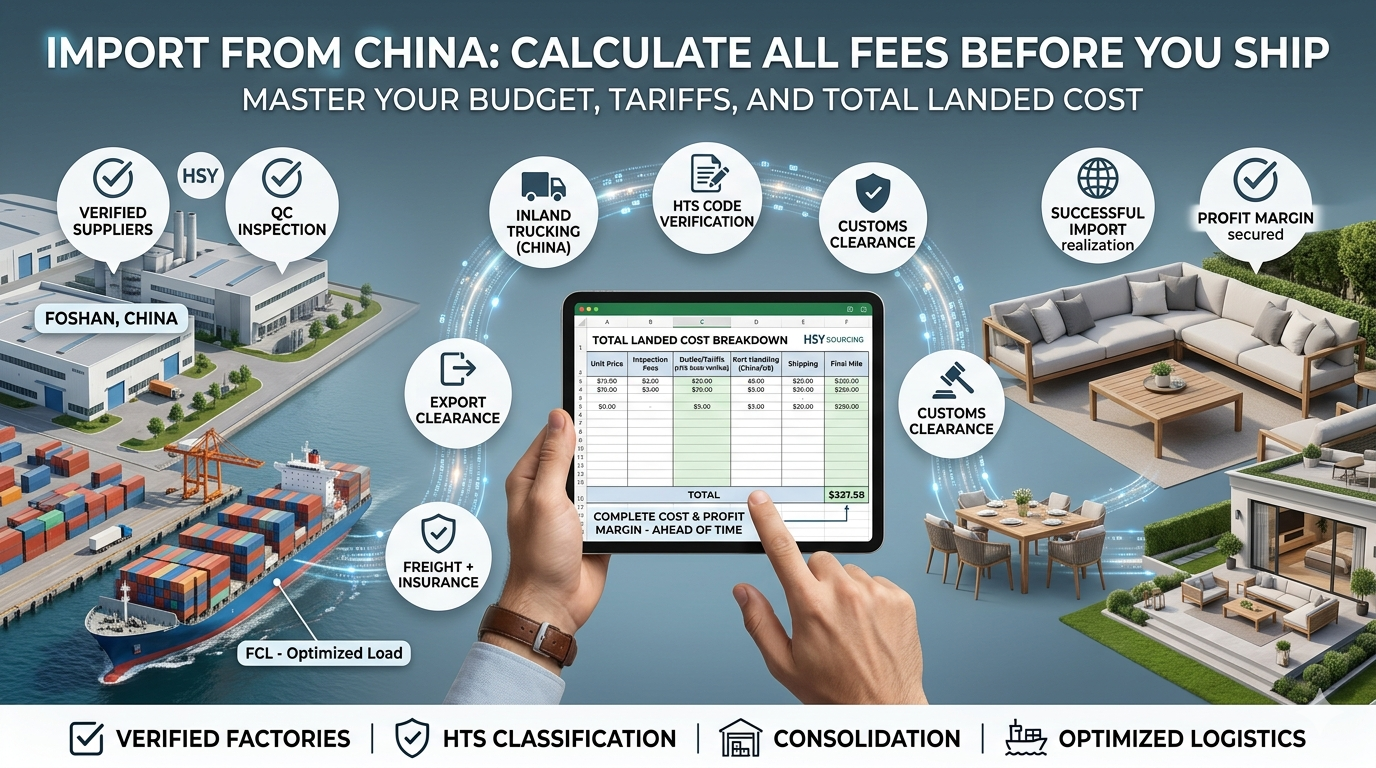
The unit price is what you pay the factory to manufacture the item. The Landed Cost is the only number that actually matters for your business. It is the sum of:
- Unit Price + Inspection Fees + Bank/Wire Fees
- Inland Trucking (China) + Export Clearance
- Ocean/Air Freight + Insurance
- Customs Duties + Harbor Maintenance Fees
- Port Handling (Destination) + “Final Mile” Trucking to your door.
If your unit price is $50, your landed cost might easily be $85. If you priced your retail at $100 based on the $50 figure, you’ve just lost your marketing budget and your profit.
Why are Incoterms (FOB, EXW, DDP) the biggest “budget killers”?
Incoterms define exactly where the factory’s responsibility ends and yours begins.
- EXW (Ex Works): You are responsible for the goods from the moment they leave the factory door. You pay for the truck in China, the export paperwork, and the port fees. Beginners often choose this because the unit price looks lowest, but the logistical headaches are the highest.
- FOB (Free On Board): The factory pays to get the goods onto the ship. This is the industry standard for a reason—it’s clean and transparent.
- DDP (Delivered Duty Paid): The “all-in” price. While convenient, suppliers often pad this price with a 20% “safety margin” to cover themselves. You are usually overpaying for the convenience.
How do you find your “Duty Rate” before it’s too late?
For US-based importers, the HTS Code (Harmonized Tariff Schedule) is everything. You cannot guess your taxes. Because of “Section 301” tariffs, many Chinese goods (including certain furniture and electronics) carry an additional 25% tax on top of the standard duty. If you source a $10,000 shipment and don’t realize it falls under Section 301, you will get a $2,500 bill from US Customs before they release your containers. Always ask your sourcing agent or a customs broker to verify your HTS code before you pay the factory deposit.
What are the “Invisible Fees” that beginners always forget?
It’s rarely the big shipping bill that ruins a budget; it’s the “death by a thousand cuts” from small fees:
- Bank Transfer Fees: Most banks charge $35–$50 per wire. If you are paying five different vendors, that’s $250 gone.
- Destination Terminal Handling Charges (DTHC): The port at your end will charge to move the container off the ship.
- Customs Entry & Bond Fees: A broker will charge $150–$300 just to file your paperwork.
- Demurrage/Detention: If your paperwork isn’t ready and your container sits at the port for more than a few days, you can be charged $150+ per day.
How can consolidation in Foshan “shrink” your total landed cost?
If you are buying outdoor furniture, lighting, and tiles from three different factories, shipping them in three separate LCL (Less than Container Load) shipments is a financial disaster. Each shipment triggers its own set of “minimum” port fees and customs entries.
By using a local agent to consolidate these into one Full Container Load (FCL) in a Foshan warehouse, you trigger only one set of fixed fees. Furthermore, we can mix “heavy” goods (like tiles) with “volumetric” goods (like sofas) to ensure you aren’t paying for empty space in the container.
Key Takeaways
- The 30% Rule: As a rough starting point, expect your landed cost to be at least 30–50% higher than the factory’s unit price.
- Verify HTS Codes Early: Don’t ship a single carton until you know the exact duty and tariff percentage.
- Standardize on FOB: It offers the best balance of control and cost-efficiency for most professional buyers.
- Budget for the “Final Mile”: Trucking a container from the port to your warehouse can sometimes cost more than the entire journey across the ocean.
FAQ: Calculating Import Costs
Q: Is shipping insurance expensive?
A: No, and it’s a mistake to skip it. Insurance typically costs about 0.5% to 1% of the commercial value of the goods. For a $20,000 shipment, $150 of insurance is a small price to pay for peace of mind.
Q: Why is the shipping quote I got last month different today?
A: Ocean freight rates fluctuate weekly based on fuel prices, peak seasons, and container availability. Always get a “fresh” quote 7–10 days before your goods are ready to move.
Q: Can I pay my duties after I receive the goods?
A: No. US Customs requires payment (or a guaranteed payment through your broker/bond) before the goods are “cleared” for entry.
Get a Transparent Landed Cost Quote with HSY Sourcing
At HSY Sourcing, we hate “surprise” fees as much as you do. Our job is to give you a realistic financial picture before you commit your capital.
We don’t just give you a factory price; we help you architect a budget.
- HTS Classification: We help identify the correct codes to avoid tariff surprises.
- Local Logistics Optimization: We coordinate the inland trucking and port fees in China to ensure you aren’t overpaying on the “front end.”
- Consolidation Services: We turn multiple small, expensive shipments into one cost-effective container.