
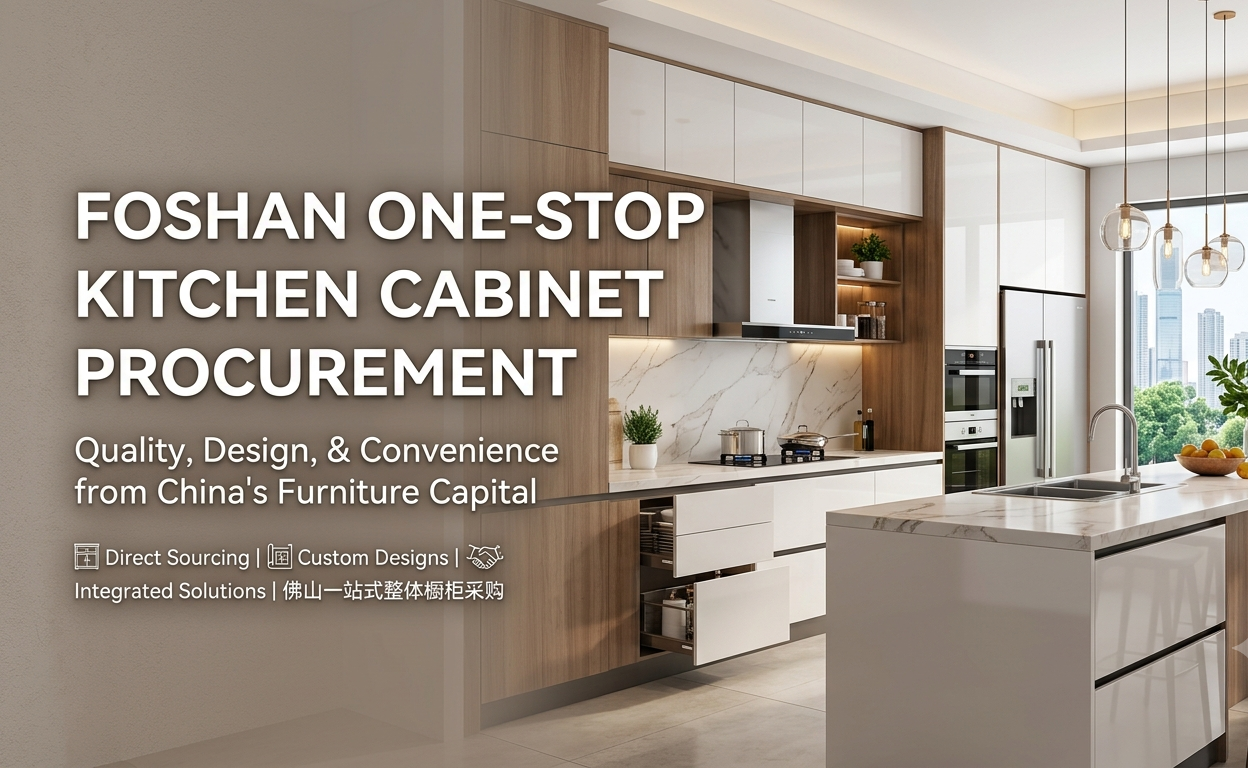
For international real estate developers, hospitality procurement managers, and general contractors, managing the supply chain for multi-unit millwork is a high-stakes variable. Sourcing custom kitchen cabinetry directly from the industrial clusters of Foshan provides direct access to primary automated manufacturing lines, bypassing secondary trading markups.
To capitalize on this geographic advantage without encountering quality discrepancies or structural failures on-site, institutional buyers must understand the mechanics of the local supply chain and execute strict technical oversight.
Key Takeaways
- Geographic Cluster Density: Sourcing cabinetry from the Shunde district allows project buyers to physically coordinate custom joinery finishes with hardware, countertops, tiles, and aluminum systems manufactured within a 50-kilometer radius.
- Technical Substrate Mandates: Commercial multi-family projects require high-density Melamine Faced Chipboard (MFC) exceeding 700 kg/m³ for dry zones and multi-layer moisture-resistant plywood for wet zones.
- Logistics Optimization: Flat-pack kitchen cabinetry can be engineered into mixed-container load plans alongside heavy porcelain tiles and sanitary ware, significantly dropping the landed cost per unit.
Why is Foshan the Epicenter for Project-Scale Kitchen Cabinet Sourcing?
Foshan functions as a highly specialized, localized ecosystem for global construction and interior procurement. The efficiency of executing one-stop kitchen cabinet procurement here is driven entirely by extreme manufacturing density, centered primarily in the Shunde industrial cluster.
Rather than relying on scattered suppliers across different regions, a buyer can access primary OEM factories, raw material processors, specialized hardware developers, and surface finish treatment plants within the same city limits. This proximity minimizes domestic logistics friction and compresses prototype development timelines.
Furthermore, because Foshan simultaneously hosts world-class clusters for porcelain tiles (Chancheng district) and aluminum architectural systems (Nanhai district), project layouts can be cross-verified at the factory floor level. For instance, a custom kitchen countertop cutout can be physically matched with a stone control sample from a neighboring district before mass production begins.
How Do Multi-Unit Real Estate Projects Optimize Costs via Foshan Sourcing?
For large-scale developments like hotels, apartments, and luxury villa communities, the financial benefit of sourcing in Foshan goes beyond a lower per-unit factory price. It is achieved through structural supply chain optimizations:
1. Direct Access to Automated CNC Nesting Lines
True primary manufacturers in Foshan utilize high-volume, computer numerical control (CNC) nesting machinery. These automated lines read CAD shop drawings directly, executing panel cuts, hinge routing, and structural boring with sub-millimeter precision. Bypassing standard retail showrooms and middle-tier trading houses allows buyers to secure original factory-floor pricing while ensuring consistent component tolerances across hundreds of units.
2. Strategic Material Substitution
Foshan’s raw material supply chain allows buyers to specify precise engineered wood substrates based on localized project budgets and durability requirements:
| Cabinet Zone | Recommended Substrate | Technical Requirement | Project Target |
| Standard Dry Carcasses | High-Density MFC | Density > 700 kg/m³, E0 or CARB Phase 2 | Multi-family apartments |
| Wet Zones (Under-Sink) | Multi-layer Plywood | Moisture-resistant core, PUR edge-banded | Hotels & high-traffic units |
| Premium Visible Panels | MDF / Solid Wood | High-gloss lacquer or calibrated veneer | Luxury villas & penthouses |
3. Freight Consolidation and Staging
Kitchen cabinets are highly volumetric. Sourcing them flat-packed allows an independent agent to execute an engineered mixed-container load plan. By staging cargo at a centralized warehouse, heavy building materials like porcelain floor tiles and sanitary ware are loaded onto the container floor, while the lighter, volumetric cabinet panels are layered securely on top. This eliminates the cost of shipping unutilized air and dramatically lowers ocean freight expenses per project unit.
What Technical Risks Must International Buyers Manage When Sourcing Cabinets?
Managing a millwork order from overseas introduces communication and quality control gaps. Institutional procurement requires shifting focus from superficial showroom aesthetics to explicit mechanical and material benchmarks.
Panel Edge-Banding Quality
The primary cause of cabinet failure in commercial properties is moisture infiltration leading to substrate swelling. Buyers should contractually mandate the use of Polyurethane (PUR) hot-melt edge-banding rather than standard Ethyl Vinyl Acetate (EVA) adhesives. PUR edge-banding provides a virtually invisible seam with superior heat and moisture resistance, protecting the core boards from steam and ambient humidity.
Hardware Cycle Ratings
The functional lifespan of multi-family and commercial cabinetry depends entirely on its moving components. Do not accept unbranded or generic hinges and drawer slides. Contracts must specify tier-one functional hardware certified for a minimum of 80,000 open-close operational cycles under load.
The 1:1 Physical Mockup Rule: Never authorize mass factory production based entirely on 2D shop drawings or digital renderings. International buyers must mandate the fabrication of a full-scale physical kitchen array mockup. This prototype serves as the ultimate quality benchmark to test appliance integration, structural hardware tolerances, alignment, and color-batch accuracy under calibrated lighting.
Why Choose HSY Sourcing as Your On-The-Ground Partner in Foshan?
Navigating the industrial zones of Foshan requires independent, technically competent representation. The HSY Sourcing team acts strictly as your boots-on-the-ground engineering and procurement office.
- 100% Independent Representation: We maintain zero factory alliances and do not accept hidden supplier commissions. We operate transparently on a service-fee framework, ensuring you receive genuine factory-direct pricing with absolute transparency.
- Cross-Category Engineering Competence: Our team understands how different building materials intersect on-site. We actively coordinate technical drawings between your window fabricators, appliance vendors, tile manufacturers, and cabinet engineers to ensure every component integrates perfectly before loading.
- Rigorous Field Quality Control: We do not rely on factory-provided progress photos. Our QC engineers conduct strict in-line and pre-shipment inspections, physically verifying board moisture content, PUR adhesive application, and hardware authenticity directly on the production floor.
- Turnkey Warehouse Consolidation: From our centralized Foshan staging facility, we manage incoming multi-factory deliveries, enforce rigid export-grade packaging standards (including reinforced crating and corner protectors), and execute optimized container stuffing plans to minimize landed costs.
Frequently Asked Questions (FAQ)
How do you verify that a Foshan factory is using genuine E0 or CARB Phase 2 boards?
We verify compliance by auditing the factory’s raw material intake records, matching their supplier delivery invoices with corresponding batch testing certificates. Additionally, we conduct random physical checks on substrate inventory during production to ensure markings match project specifications.
What is the typical lead time for a multi-unit project cabinet order?
For standard apartment or hotel projects, mass production generally requires 40 to 45 days. This timeline begins only after the final CAD shop drawings are signed off and the 1:1 physical mockup has been structurally approved.
Can your team handle the custom integration of European or American standard appliances?
Yes. During the shop drawing phase, we extract the exact cutout dimensions and technical data sheets of your specified appliances (ovens, ranges, hoods, microwaves). The CNC machinery is programmed to route these precise paths, and we cross-check the spacing using physical templates during production audits.
How are architectural drawings converted into manufacturing orders?
Our engineering team takes your structural Bill of Quantities (BOQ) and architectural layouts, breaking them down into precise production shop drawings that align with local manufacturing methodologies. We resolve any dimension conflicts or structural discrepancies before the factory issues the final fabrication contract.