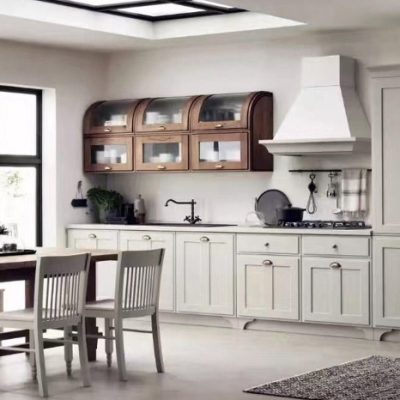


For international real estate developers, hotel procurement managers, and multi-family residential contractors, reviewing kitchen cabinet quotes from different Chinese factories can be misleading. On paper, two quotations for a 100-unit apartment layout may look identical—matching the same room dimensions, finish colors, and layout configurations—yet differ in price by 30% to 40%.
Accepting the lowest bid without auditing the underlying technical line items frequently results in severe site problems, including delaminated edge-banding, sagging carcasses, and failing hardware under commercial use.
To protect your construction budget and ensure project durability, you must look past the superficial showroom appearance and evaluate the mechanical and material specifications of each quote. This guide outlines how to structurally audit kitchen cabinet quotations within the Foshan manufacturing cluster.
Key Takeaways
- Unmask Hidden Line Items: A reliable cabinetry quote must explicitly break down panel densities, substrate types, edge-bonding technologies, and hardware brand specifications rather than using vague “commercial grade” descriptors.
- Audit Core Material Densities: Ensure dry zones utilize High-Density Melamine Faced Chipboard (MFC) exceeding $700\text{ kg/m}^3$, while high-moisture under-sink areas mandate multi-layer plywood with Polyurethane (PUR) bonding.
- Verify Hardware Cycle Ratings: Demanded hardware must be backed by independent test certifications confirming a minimum lifespan of 80,000 open-close operational cycles under weight load.
Why are low ex-works cabinetry quotes often structurally flawed?
When a factory submits an unusually low ex-works (EXW) quote for a multi-unit development, the cost reductions are almost always achieved by altering invisible material thresholds.
The most common method to lower production costs is reducing the density of the wood fiber cores. Low-density particleboard uses less raw timber and more air pocket volume, which significantly lowers its shear strength and screw-holding capacity. Over time, the heavy weight of stone countertops and continuous daily use will cause low-density cabinet carcasses to sag, warp, or pull away from wall anchors.
Furthermore, low-tier factories often cut corners on chemical binders, utilizing cheap urea-formaldehyde glues that fail international environmental standards like E0 or CARB Phase 2, resulting in hazardous outgassing on your job site.
How do you audit panel substrates and edge-banding specs across different quotes?
To conduct a true apples-to-apples comparison, every quotation must specify the exact engineered wood substrate and the mechanical edge-bonding method used for each cabinet component.
| Cabinet Component | Low-Cost Option (High Risk) | Commercial Standard (Recommended) | Technical Performance Metric |
| Standard Carcass Backs & Sides | Low-Density Particleboard ($<600\text{ kg/m}^3$) | High-Density Melamine Faced Chipboard (MFC) | Density $\ge 700\text{ kg/m}^3$; structural screw-holding capacity. |
| Under-Sink Base Units | Standard MDF or unfinished chipboard | Multi-layer Plywood or Aluminum Honeycomb Core | 100% moisture-barrier; zero swelling when exposed to plumbing leaks. |
| Edge-Banding Adhesives | Standard EVA (Ethylene Vinyl Acetate) Cold Glue | PUR (Polyurethane) Hot-Melt Lamination | Irreversible chemical bond; zero moisture infiltration or seam peeling. |
Standard EVA glues break down when exposed to ambient kitchen steam and heat from ovens. PUR hot-melt lamination forms a highly durable, moisture-resistant seal that prevents the edge tape from peeling, which is critical for preserving cabinet life in high-turnover rental apartments and hospitality environments.
What structural hardware line items must you verify to prevent functional failure?
A kitchen cabinet is only as durable as its moving parts. When reviewing factory quotes, look closely at how hinges, drawer glides, and pull-out mechanisms are specified.
Low-cost quotes often omit the hardware brand entirely or list generic phrases like “local top-brand.” This usually means the factory intends to use low-grade, thin-gauge steel hinges that lack hydraulic soft-close dampers and rust quickly in damp environments.
Institutional procurement managers should contractually enforce specified hardware tiers. The quotation should list certified hardware brands (such as Blum, DTC, or Grass) and state the exact functional grade. True commercial-grade hardware must be backed by certified laboratory test reports confirming a minimum lifespan of 80,000 to 100,000 operational cycles under full load without mechanical degradation or alignment drift.
How do you compare structural assembly options: flat-pack vs. pre-assembled?
Your logistical and on-site labor setup should dictate how cabinet configurations are quoted. Factories can quote millwork in two distinct shipping states:
[Flat-Pack / RTA]      ➔ Minimizes Ocean Freight Volumetric Space (CBM) ➔ Increases On-Site Labor Assembly Costs & Timelines
[Pre-Assembled / Rigid] ➔ Increases Ocean Freight Volumetric Space (CBM) ➔ Minimizes On-Site Installation Time & Error Rates
- Flat-Pack (Ready-to-Assemble): Drastically reduces the cubic meter (CBM) volume inside shipping containers, lowering your ocean freight bill. However, it requires your on-site construction crew to spend considerable time assembling boxes, increasing local labor costs and the risk of alignment errors.
- Pre-Assembled (Rigid Construction): The factory completely assembles, squares, and clamps the cabinet boxes using industrial dowel-and-glue methods before shipping. This setup speeds up on-site installation, but it consumes significant container volume, which increases your overall freight expenses.
Your sourcing agent must calculate the total landed cost for both options, balancing your local job site labor rates against current ocean freight pricing.
Why Choose HSY Sourcing as Your On-The-Ground Partner in Foshan?
Auditing quotes from across the world is difficult without direct access to the factory floor. The HSY Sourcing Team acts as your local technical procurement department within the Foshan industrial cluster.
- Granular Line-Item Auditing: We dissect multi-vendor quotations for you. We strip away vague commercial filler and verify the exact board densities, adhesive classifications, and hardware series numbers to ensure you are getting a fair comparison.
- 1:1 Mockup Verification: Before authorizing a full mass-production run for a hotel or housing development, we mandate and supervise the construction of a physical 1:1 kitchen prototype at the factory. We physically test appliance cutouts, hinge tolerances, and stone countertop seating to resolve errors before they reach a container.
- Raw Material and Certification Audits: Our QC team conducts unannounced checks on the production floor. We audit raw board inventory stamps, check edge-banding machine temperatures, and verify that specified hardware isn’t swapped for cheaper replicas during mass production.
- Strategic Container Consolidation: Operating out of our local staging facilities, we engineer mixed-container loads. We combine volumetric flat-pack cabinets with heavy building materials like porcelain tiles or quartz countertops from the Foshan area, maximizing your container space and lowering landed costs.
Frequently Asked Questions (FAQ)
Why is there such a massive price discrepancy between UV finishes and Lacquer (2K Paint) cabinet doors?
UV (Ultraviolet) doors are produced using automated rolling lines that instantly cure pre-coated films onto flat boards, making them fast and highly cost-effective for large-scale apartment builds. Lacquer or 2K painted doors require manual multi-layer spray painting, sand-polishing, and baking in dust-free chambers. This labor-intensive process supports routed J-pull handles and seamless edges, making it ideal for high-end luxury villas but significantly increasing the price per square meter.
How does the thickness of the carcass material impact structural quote values?
Many low-cost factories quote a 15mm or 16mm thickness for carcass side panels to save on material mass. Standard commercial-grade engineering demands a 18mm thick carcass panel for base and wall units, with a minimum 9mm solid back panel. Substituting 15mm panels lowers structural rigidity and risks screw pull-out under heavy stone loads.
Can your team verify environmental formaldehyde compliance reports on-site?
Yes. We do not just look at PDF certificates provided by factory sales representatives. We audit the raw material manufacturers’ delivery manifests directly at the factory intake gate and can perform random field chamber testing for formaldehyde emission levels to ensure materials comply with your local CARB Phase 2 or European E0/E1 construction mandates.