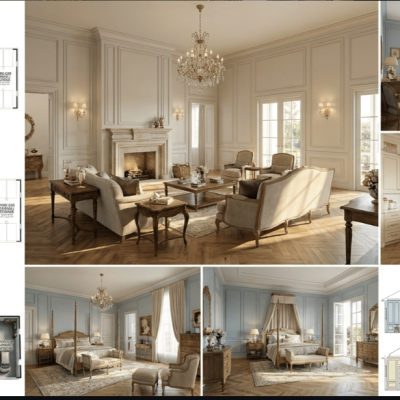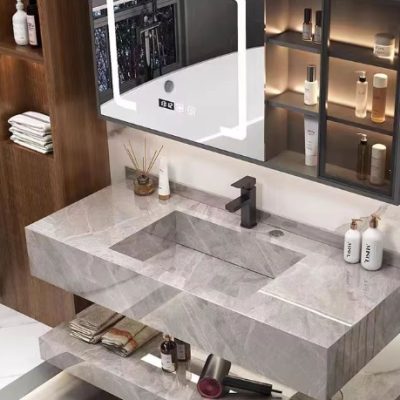

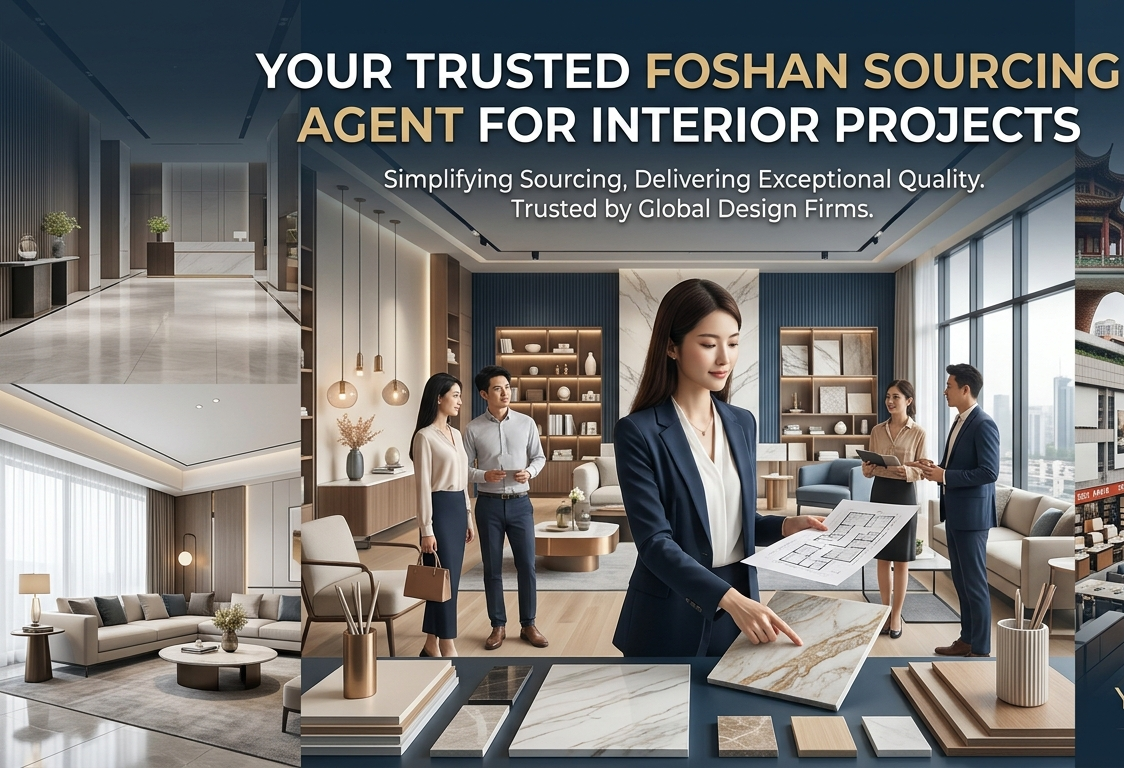
Executing an interior fit-out for a hotel, an apartment complex, or a luxury villa community requires managing a fragmented Bill of Quantities (BOQ). A single architectural drawing package relies on multiple distinct industrial manufacturing sectors: large-format porcelain flooring, custom kitchen cabinetry, bathroom vanities, sanitary ware, structural aluminum profiles, and contract-grade loose furniture.
When international developers or procurement managers try to deal directly with five or ten different factories across these separate categories, serious execution gaps often appear. Minor communication errors regarding shop drawings translate into physical misalignments on-site, uncoordinated production schedules lead to compounding storage fees, and fragmented shipping splits a project into inefficient Less than Container Load (LCL) consignments.
The structural solution is establishing a dedicated, ground-level engineering and procurement office in Foshan, China. Operating directly within the world’s dense interior material manufacturing cluster allows an independent sourcing agent to bridge the gap between architectural intent and factory execution.
Key Takeaways
- Risk Control at the Source: Shifting from transactional importing to milestone-based physical factory audits prevents manufacturing and dimensional errors before goods are packed.
- Cluster Logistics Advantage: Utilizing Foshan’s unique geographic aggregation enables seamless domestic collection and dense mixed-container consolidation.
- Commercial Interest Protection: Working with an independent agent ensures completely transparent pricing, independent quality control, and strict contract enforcement against primary OEM factories.
What are the hidden failure points when importing interior finishes directly from China?
The most critical vulnerabilities in cross-border real estate procurement do not happen during ocean transit; they occur on the factory floor due to decentralized management.
When a development firm splits its BOQ among separate, isolated factories, the developer inherits the complex role of a supply chain integration engineer.
[Decentralized Route] ──> Fragmented Factory Execution ──> Mismatched Specs & On-Site Installation Failure
[Centralized Agent Route] ──> Ground-Level Cross-Category QC ──> Unified Interface Control & Seamless Assembly
Without a local representative enforcing cross-category interface control, projects face three specific failure points:
- Dimensional Incompatibility: A marble countertop cut in Chancheng may not align with a vanity carcass built in Shunde, because neither factory reviewed the other’s active shop drawings.
- Compliance Failures: If raw material baselines are not physically checked, cabinetry cores or furniture foams may fail local destination compliance metrics, such as CARB Phase 2 formaldehyde emission limits or BS5852 fire retardancy standards.
- Compounding Logistical Costs: Separate factories operate on completely different production cycles. Fast-moving lines complete orders early, forcing those goods to sit in port warehouses accumulating daily storage and demurrage fees while waiting for slow, custom items to finish production.
How does Foshan’s local industrial cluster simplify multi-vendor management?
A multi-category procurement strategy requires a tight geographic spread between your project suppliers and your consolidation hub. If you source materials from factories scattered across different provinces, long-haul domestic trucking costs quickly erase your purchasing margins.
Foshan represents a unique, closed-loop manufacturing ecosystem. Within a 50-kilometer radius of a central local office sits a global hub for the architectural and interior design industries:
- Chancheng and Nanzhuang: The worldwide epicenter for porcelain floor tiles, sintered stone slabs, and sanitary ceramics.
- Shunde District (Lecong): The largest contract furniture, seating, and custom cabinetry cluster in the world.
- Nanhai District (Dali): A major industrial zone for structural aluminum window profiles, glazing systems, and commercial interior doors.
Because these specialized manufacturing sectors share physical borders, a local sourcing team can easily drive to three different factories in a single day. This close proximity makes frequent quality control check-ins efficient, ensures low internal logistics costs, and allows for rapid issue resolution on the factory floor.
What does a professional sourcing agent’s operational workflow look like?
Managing complex project packages requires moving away from basic emails and showroom order-writing toward a strict, milestone-driven technical workflow.
1.BOQ Technical Auditing and Shop Drawing Alignment:Phase 1: Procurement Engineering.
We translate the project’s original architectural designs into manufacturing shop drawings. Our engineers explicitly map out plumbing lines, appliance cutouts, material densities, and hardware clearances to resolve hidden design conflicts before any deposits are released.
2.1:1 Scale Prototype Mockup and Substrate Verification:Phase 2: Validation Gate.
The primary factories build full-scale physical mockups of critical built-in units (such as a complete kitchen configuration or hotel guest room vanity). We conduct a physical audit to test joint tolerances, verify color-batch consistency under calibrated lighting, and check wood core moisture content.
3.In-Line Manufacturing Inspections and Bond-Strength Testing:Phase 3: Production Control.
During active mass production, our QC team carries out unannounced factory floor inspections. We verify that specific technical parameters—such as the application of PUR hot-melt edge-banding for wet zones or the utilization of certified hardware cycle ratings—are being strictly followed on the line.
4.Staged Warehousing, Mixed-Container Load Planning, and Customs Clearance:Phase 4: Logistics Consolidation.
Incoming goods are received and tracked at our central Foshan warehouse. We implement a dense container loading strategy, securing heavy masonry flat across the floor and layering flat-pack cabinetry on top. We then generate a single, clean export customs declaration pack using precise HS codes.
Why choose HSY Sourcing as your independent partner in Foshan?
Navigating thousands of contract manufacturers across the South China industrial zone requires deep technical competence, localized contract enforcement, and completely independent ground representation. HSY Sourcing operates strictly as your dedicated procurement, engineering, and logistics office in Foshan, engineered to protect the commercial interests of developers and asset managers.
- 100% Transparent B2B Representation: We cut out export trading fronts and decorative middlemen. We operate on a clear, professional service framework, giving you direct access to primary OEM factory floor pricing with zero hidden markups.
- Cross-Category Technical Oversight: Our team understands the intersection where different building materials meet. We coordinate between your appliance vendors, cabinetry lines, and stone fabricators to ensure every single element slots together perfectly on the job site.
- Milestone-Based Quality Enforcement: Our QC engineering team conducts rigorous, physical inspections at multiple manufacturing stages—including substrate moisture content testing (ensured between 8% and 12%), hardware mechanical testing, and color-batch auditing under calibrated lighting.
- Turnkey Warehouse Consolidation: From our centralized Foshan staging facility, we manage incoming factory deliveries, enforce rigid export-grade packaging standards (such as reinforced crating and corner protectors), and execute engineered mixed-loading plans to guarantee safe transit.
Frequently Asked Questions (FAQ)
How does HSY Sourcing protect us from hidden factory commission markups?
We maintain a strict separation between our operations and the factories we audit. We do not accept hidden commissions or kickbacks from suppliers. All factory contracts, original invoices, and material material costs are presented completely transparently to our clients. Our revenue is derived solely from our agreed-upon professional management fees, ensuring our loyalty remains 100% with the buyer.
Can you handle destination building code compliance for different countries?
Yes. During the pre-production phase, we review your destination country’s municipal building codes. We filter out manufacturers that lack active, independently verified laboratory certifications. We verify emissions standards (such as CARB Phase 2 or E0 for cabinetry cores), slip resistance metrics (DCOF) for commercial flooring, and electrical safety markings (UL, CE, SAA) for all integrated lighting elements.
What happens if an order fails inspection during our warehouse check-in?
If our receiving team identifies structural defects, wrong dimensions, or finish deviations at our warehouse dock, we immediately halt the check-in process. We document the issue with high-resolution photos and video, file an immediate claim with the manufacturing factory, and coordinate local transport to return the defective batch for remanufacturing before the primary container loading date arrives.
How are fragile interior finishes protected inside a mixed container?
We enforce a strict load-segregation protocol at our local consolidation warehouse. Heavy masonry and tile pallets are securely blocked and braced at floor level using industrial timber and airbags to prevent lateral shifting. Fragile items, such as custom tempered glass shower partitions or mirrored vanity panels, are packed in heavy plywood crates and vertically lashed to the container’s structural tie-down points using high-tensile strapping.