
When sourcing electronics from China, many overseas buyers face a common question:
Should you visit the Shenzhen electronics market or use an online platform like Alibaba?
Both options are widely used, but they serve different purposes. Choosing the right one depends on your sourcing goals, order size, and experience.
For buyers new to sourcing electronics from China, understanding the differences can help avoid confusion and save time.
What Is the Shenzhen Electronics Market?
The Shenzhen electronics market usually refers to areas like Huaqiangbei Electronics Market in Shenzhen.
It is a large physical marketplace made up of multiple buildings where vendors sell:
- electronic components
- phone accessories
- small consumer electronics
- spare parts and tools
Most sellers in this market are traders or distributors. Some may have connections to factories, but they are not always manufacturers themselves.
Buyers often visit the Shenzhen electronics market to:
- explore products in person
- compare different suppliers quickly
- find small quantities or samples
What Is Alibaba and How Does It Work?
Alibaba is an online B2B platform that connects buyers with suppliers across China.
On Alibaba, buyers can:
- search for products and suppliers
- compare prices and minimum order quantities
- communicate directly with suppliers
- request samples
Unlike the Shenzhen market, Alibaba includes both factories and trading companies from all over China, not just Guangdong.
For many overseas buyers, Alibaba is often the first step when trying to find electronics suppliers in China.
What Are the Main Differences Between Shenzhen Market and Alibaba?
Although both options are used for sourcing, they work in very different ways.
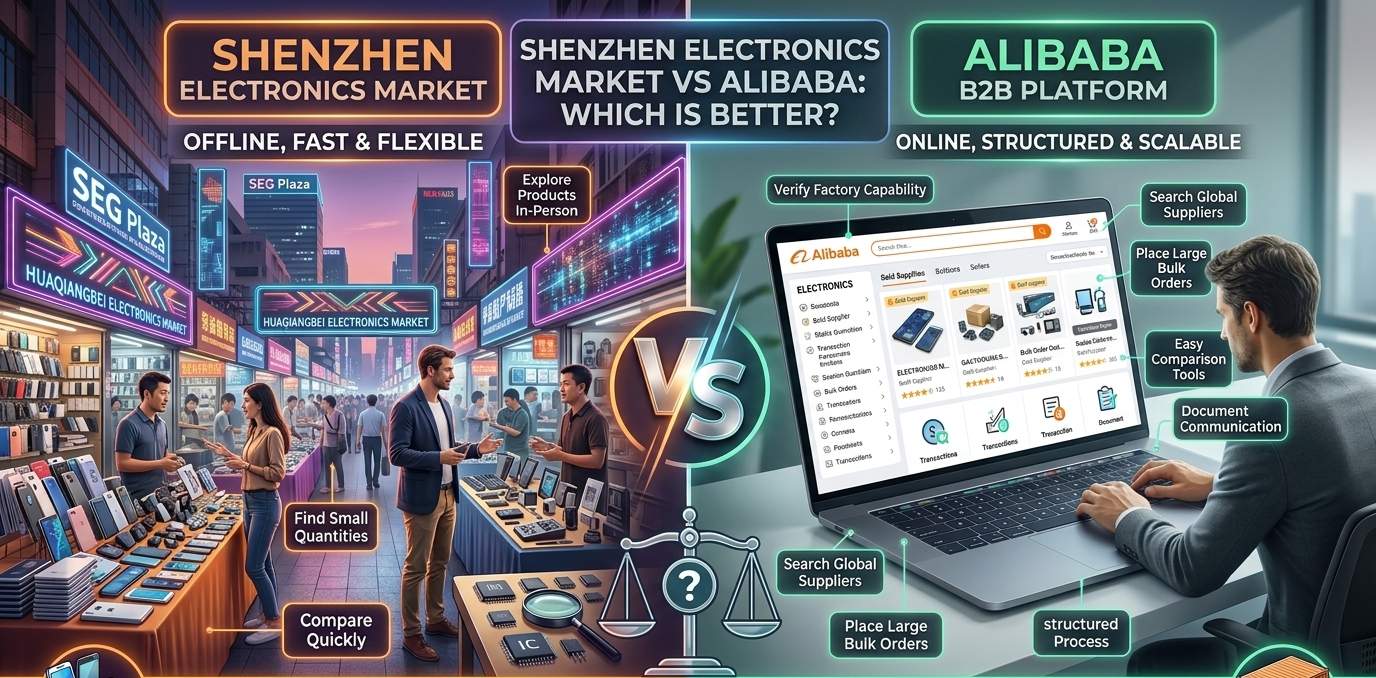
The Shenzhen electronics market is offline and fast-paced. You can see products directly and make quick decisions.
Alibaba is online and more structured. It allows you to compare multiple suppliers without traveling.
Key differences include:
Shenzhen market:
- physical, in-person sourcing
- better for small quantities
- faster product comparison
- harder to verify supplier background
Alibaba:
- online sourcing platform
- better for bulk orders
- easier supplier comparison
- more tools for communication and documentation
In simple terms:
Shenzhen market = fast and flexible
Alibaba = structured and scalable
Which Option Is Better for Small Orders?
For small orders or testing products, the Shenzhen electronics market can be more practical.
Buyers can:
- purchase small quantities
- mix different products
- get items quickly
This is useful for:
- product testing
- market research
- trial orders
However, pricing may not always be consistent, and product quality can vary between vendors.
Which Option Is Better for Bulk Orders?
For larger orders, Alibaba is usually more suitable.
On Alibaba, buyers can:
- find factories with production capacity
- negotiate pricing based on volume
- confirm product specifications
- arrange production timelines
Bulk production typically requires more structure, which Alibaba supports better than a physical market.
That said, buyers still need to verify suppliers carefully when using Alibaba.
How Do Buyers Verify Suppliers in Each Option?
Supplier verification is important in both cases.
In the Shenzhen electronics market, it can be difficult to know whether a seller is a factory or just a reseller.
On Alibaba, suppliers provide company profiles, but the information still needs to be checked.
Buyers often use steps such as:
- requesting samples
- checking business registration
- reviewing export experience
- arranging factory audits
- conducting pre-shipment inspections
These steps are part of a broader quality control process when sourcing electronics from China.
Can Buyers Use Both Shenzhen Market and Alibaba Together?
Yes, and many experienced buyers do exactly that.
A common approach is:
Step 1
Visit or research the Shenzhen market to understand products and pricing.
Step 2
Use Alibaba to find factories for bulk production.
Step 3
Verify suppliers and arrange inspections before shipment.
This combined approach helps buyers use the strengths of both sourcing channels.
Should You Work with a Sourcing Agent?
For buyers who cannot travel to China, working with a local sourcing agent can make the process easier.
A sourcing agent can help:
- visit markets like Huaqiangbei
- communicate with suppliers
- verify factories
- arrange inspections and shipping
This is especially useful for buyers who want to source electronics from China without being on-site.
Final Thoughts
There is no single answer to whether the Shenzhen electronics market or Alibaba is better.
Each option serves a different purpose.
The Shenzhen market is useful for exploring products and sourcing small quantities.
Alibaba is more suitable for finding suppliers and managing bulk production.
Many importers use both as part of their sourcing strategy.
By understanding how each option works, buyers can choose the right approach based on their needs and reduce common sourcing risks.
FAQ: Shenzhen Electronics Market vs Alibaba
Is the Shenzhen electronics market cheaper than Alibaba?
Not always. Prices in the Shenzhen market can be flexible for small orders, but Alibaba may offer better pricing for bulk production.
Can I find factories in Huaqiangbei?
Most sellers in Huaqiangbei are traders. Buyers usually need to connect with factories outside the market for large-scale production.
Is Alibaba safer than buying from the market?
Alibaba provides more structured communication and documentation, but buyers still need to verify suppliers and arrange quality checks.
Which is better for beginners?
Alibaba is often easier for beginners because it allows supplier comparison and communication online. The Shenzhen market can be more complex for first-time buyers.