
For international developers, general contractors, and procurement managers handling hotel, apartment, or villa projects, sourcing from China is highly cost-effective but logistically fragmented. A typical premium real estate development requires custom cabinetry, porcelain tiles, sanitaryware, aluminum windows, and loose furniture.
When these items are bought from ten different specialized factories, managing ten separate international shipments generates unsustainable overhead. The structural solution lies in Foshan’s geographic industrial density, managed through a structured cargo consolidation process.
Why is fragmented shipping the biggest hidden cost in project procurement?
Sourcing cross-category building and finishing materials without a centralized logistics plan forces buyers into the LCL (Less than Container Load) trap. Shipping multiple independent LCL batches creates three major financial and operational vulnerabilities:
- Compounding Customs and Administrative Fees: Export customs clearance in China and import clearance at your destination port incur fixed charges per entry. Ten separate factory shipments mean paying ten distinct customs brokerage invoices, terminal handling charges (THC), and documentation fees.
- Exorbitant Destination CFS Fees: Public LCL shipments are routed to a Container Freight Station (CFS) at the destination port to be physically unpacked and sorted. CFS operators charge significant labor premiums based on volume or weight, often exceeding the cost of the actual ocean freight.
- High Structural Damage Rates: In a standard public LCL container, your custom hotel furniture or fragile glass shower enclosures are stacked alongside random, heavy industrial freight from other shippers. The original factory packaging is rarely engineered to withstand the erratic loading patterns of third-party consolidation yards.
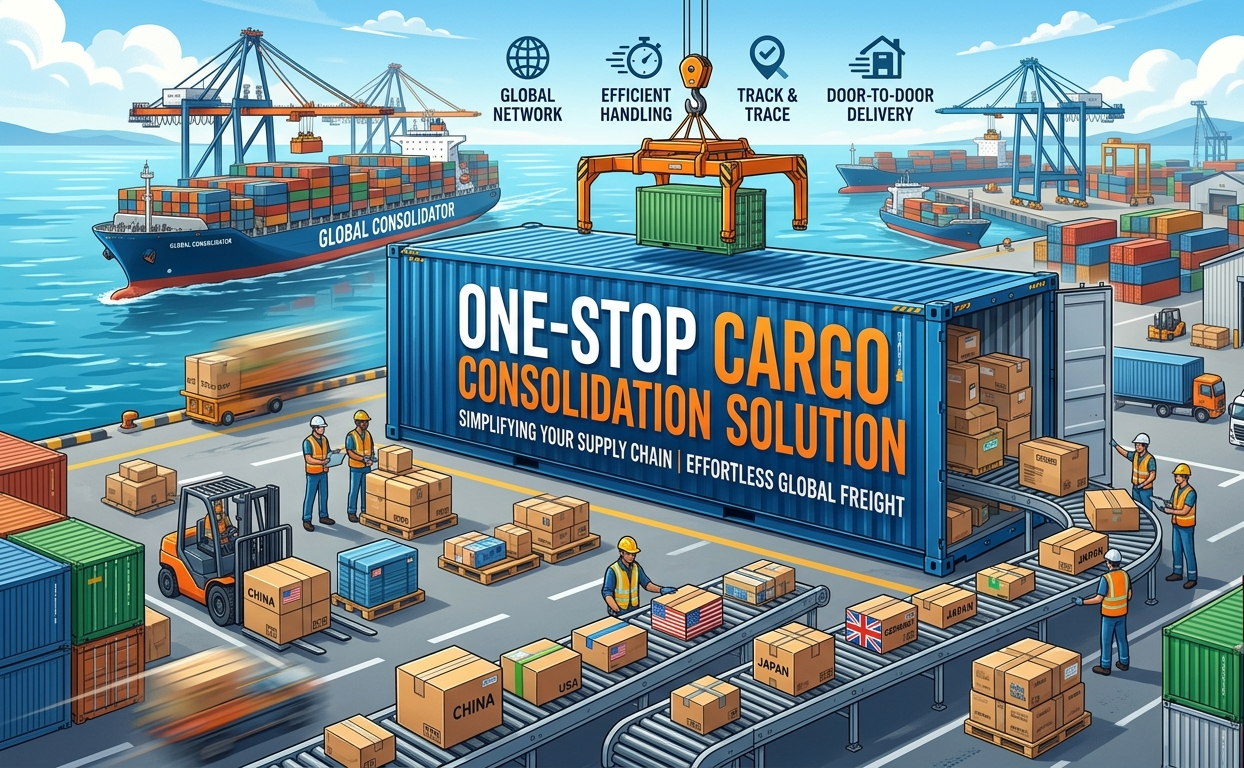
By converting multiple fragmented LCL shipments into a single, unified FCL (Full Container Load) shipment, you eliminate destination CFS unpacking fees, pay one single set of customs entry clearance fees, and gain absolute control over how your materials are handled.
How does Foshan’s regional density enable cost-effective consolidation?
Foshan is a hyper-dense, specialized manufacturing ecosystem for the global construction and interior decoration industries. The city and its immediate neighboring districts house distinct, world-scale industrial clusters:
- Chancheng & Nanhai: Global hubs for porcelain tiles, sintered stone, and sanitaryware.
- Shunde (Lecong): The largest furniture manufacturing and wholesale market hub in the world.
- Nanhai (Dali): China’s primary production zone for architectural aluminum profiles, windows, and doors.
- Zhongshan (Guzhen): Located just south of Foshan, the undisputed center for commercial and residential LED lighting.
Because these highly specialized component factories operate within a 30-to-50-kilometer radius of each other, the internal domestic logistics costs to move goods from the production line to a central warehouse are minimal. A Foshan-based sourcing agent can dispatch local flatbed trucks to collect completed production batches within hours, turning the city into an ideal staging ground for complex, multi-category mixed container engineering.
What is the technical process of balancing volume and weight in a mixed container?
Professional cargo consolidation is an exact spatial and weight-distribution engineering process. Loading a 40HQ container (which provides roughly 68 cubic meters of usable space and a maximum payload of approximately 26 to 28 metric tons) with diverse building materials requires strict architectural planning:
| Material Category | Physical Property | Structural Loading Position |
| Porcelain Tiles & Marble | High Weight / Low Volume | Placed flat across the floor of the container to establish a low, stable center of gravity. |
| Sanitaryware & Toilets | Medium Weight / High Fragility | Positioned directly above tiles, stabilized with heavy-duty crating. |
| Custom Cabinetry / Joinery | Rigid Dimensions / Medium Weight | Loaded mid-container, utilizing flat-pack box edges for structural support. |
| Loose Furniture & Mattresses | High Volume / Low Weight | Stacking on top levels to maximize the upper volumetric air space without crushing. |
| LED Lighting & Accessories | Low Volume / Fragile Components | Tucked into remaining spatial gaps using protective foam dunnage. |
Staggered Production Synchronization
Different building materials have fundamentally different manufacturing timelines. Standard porcelain tiles might take 15 days to produce, while bespoke kitchen cabinets or hotel-grade aluminum windows require 35 to 45 days.
To prevent early-arriving goods from sitting in a warehouse for weeks—which incurs costly storage fees and increases handling risks—the sourcing agent coordinates the release of factory deposits based on a calculated countdown. The goal is to ensure all distinct product categories converge at the consolidation warehouse within a tight 3-to-5-day window.
Key Takeaways
- Drastic Cost Reduction: Consolidating fragmented factory orders into Full Container Loads (FCL) can lower total ocean freight and port handling costs by 30% to 50% compared to multiple LCL shipments.
- Minimized Damage Risk: Mixed container loading places heavy masonry on the bottom and lightweight interior finishes on top, separated by load-bearing plywood dividers and air bags.
- Streamlined Administration: Ten different factory orders are legally merged into a single commercial invoice, single packing list, and single Bill of Lading (B/L).
Why Choose HSY Sourcing as Your Foshan Partner?
HSY Sourcing functions as your comprehensive operational office on the ground in South China. We do not operate as an online trading middleman; we manage the physical realities of your supply chain.
- Turnkey Warehouse Staging: We operate dedicated consolidation and warehouse facilities directly within the Foshan industrial zone, ensuring your goods are stored in dry, secure, and organized spaces.
- In-Line & Dock Inspections: We do not accept factory-reported data. Our quality control team physically inspects your building materials at the factory floor during production, and checks them a second time on our warehouse receiving dock before they enter the shipping container.
- Advanced Load Engineering: We cross-reference your Bill of Quantities (BOQ) with the physical dimensions of each crate, calculating exact weight-to-volume ratios before the container arrives to ensure zero paid airspace is wasted.
- Unified Export Documentation: We collect individual packing lists from multiple factories, classify every item under its precise harmonized system (HS) code, and compile a single, clean customs declaration to ensure smooth compliance.
Frequently Asked Questions (FAQ)
What is the minimum project volume required for cargo consolidation?
Cargo consolidation provides the highest return on investment when your total combined order volume across all suppliers is sufficient to fill at least one 20GP container (approximately 28 cubic meters) or one 40HQ container (approximately 68 cubic meters). For smaller interior projects, we can evaluate structured LCL consolidation alternatives.
How do you manage export customs clearance when combining products from different factories?
Different factories in China operate under different tax and export profiles; some have direct export licenses, while others sell domestically. HSY Sourcing manages this complexity by compiling all individual factory invoices, resolving local tax compliance structures, and generating a single consolidated export customs declaration under legal transport guidelines.
How are fragile items like custom glass, vanities, or stone slabs protected from breaking during transit?
We enforce strict export packaging standards before allowing cargo to leave the factory. Natural stone, sintered slabs, and glass must be secured in heavy-duty, fumigated wooden A-frames or enclosed crates. Inside the container, we utilize load-bearing dunnage, reinforced plywood vertical barriers, and industrial airbags to prevent cargo shifting during ocean transit.