
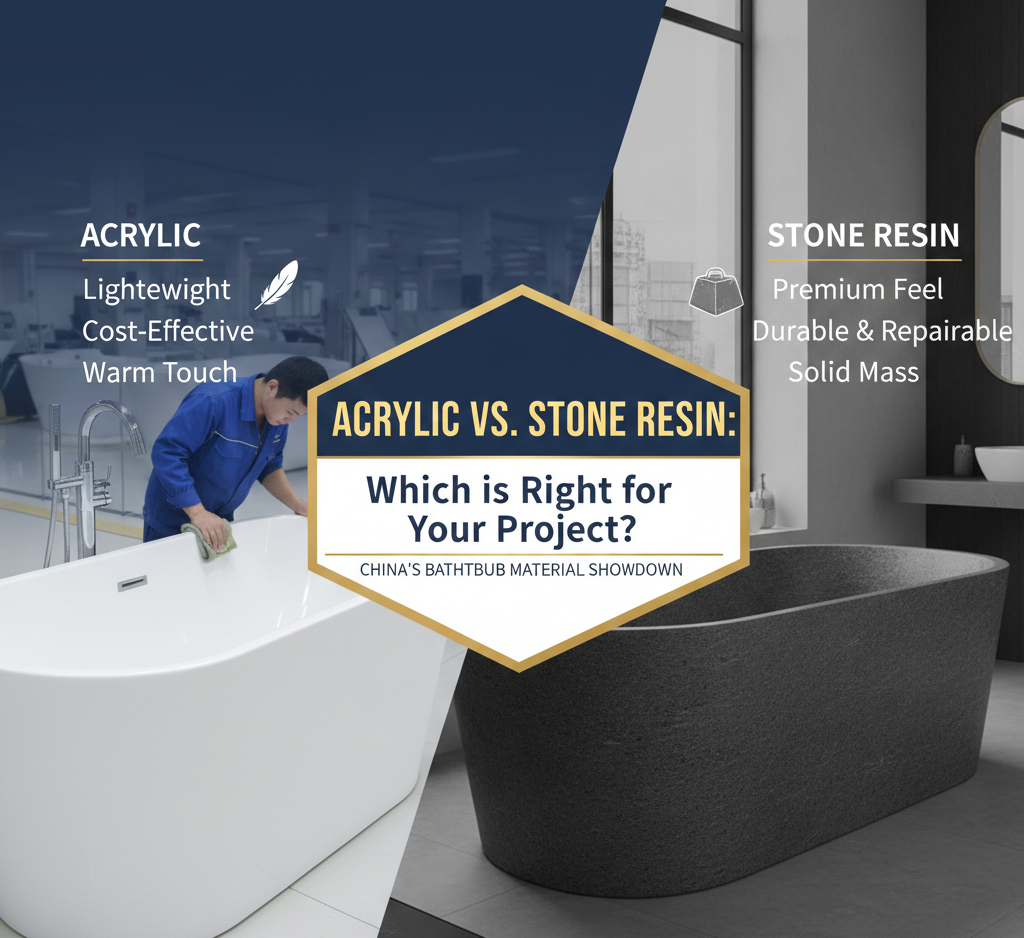
When you start browsing bathtub suppliers in Foshan or on Alibaba, you are immediately confronted with a choice that will define your entire procurement strategy: Acrylic or Stone Resin?
This isn’t just a matter of aesthetics. The material you choose will dictate your shipping costs, your target retail price, the complexity of your quality control, and even the type of container you need to book. In the Chinese manufacturing landscape, both materials have reached a high level of maturity, but they serve two very different masters.
At HSY Sourcing, we’ve handled hundreds of bathtub shipments. We’ve seen projects where Acrylic was the hero that saved the budget, and others where Stone Resin was the only option that could satisfy a 5-star hotel’s requirements. Here is an honest, practical breakdown of how these materials compare in the real world of 2026.
Why is Acrylic still the go-to choice for high-volume retailers?
If you are an Amazon seller or a large-scale building materials wholesaler, Acrylic is likely your best friend. It has been the industry standard for decades, and for good reason.
The biggest advantage of Chinese Acrylic tubs is the cost-to-weight ratio. Acrylic is lightweight. A standard freestanding acrylic tub can often be moved by two people without special equipment. In the world of international shipping, where weight affects your “last mile” delivery costs significantly, this is a massive win. You can fit more units in a container without hitting the weight limit, and your domestic couriers won’t charge you “heavy-lift” surcharges as often.
From a manufacturing standpoint, Acrylic is versatile. It’s made from a sheet of plastic that is heated and vacuum-formed into a mold. This process allows for sharp lines and complex shapes that are harder to achieve with poured materials. Moreover, Acrylic is “warm.” Because it is a natural insulator, the water stays warm longer, and the surface doesn’t feel freezing when you first step in—a major selling point for residential consumers.
However, the pitfall with Chinese Acrylic is the quality variance. Not all “Acrylic” is 100% pure. To lower prices, some factories use ABS-capped Acrylic (a sandwich of cheap plastic with a thin acrylic top). At HSY, we always warn our clients: if the price looks too good to be true, you’re probably buying a tub that will turn yellow or crack under UV light within two years.
What makes Stone Resin the rising star of luxury developments?
Stone Resin (also known as Solid Surface or Man-made Stone) is a completely different beast. It’s a mixture of natural stone powder (usually aluminum hydroxide) and high-quality resin. The mixture is poured into a mold, cured, and then hand-polished.
When you touch a Stone Resin tub, you immediately understand the appeal. It feels like natural stone—heavy, solid, and premium. There is no “hollow” sound when you tap it. For high-end hotel projects or luxury apartment developments, Stone Resin is often the non-negotiable choice because it screams “expensive.”
One of the biggest functional benefits of Stone Resin is that it is homogeneous. This means the material is the same all the way through. If a contractor accidentally scratches an Acrylic tub, the repair is difficult and often visible. If you scratch a Stone Resin tub, you can literally sand the scratch away with fine-grit sandpaper and buff it back to a perfect finish. It is a “forever” material.
But beauty comes with a literal weight. These tubs are incredibly heavy—often 150kg to 200kg or more. This changes your entire logistics plan. You will hit your container’s weight limit long before you fill the space. You also need to ensure that the floors of the building where they will be installed are reinforced to handle the weight of the tub plus a hundred gallons of water and a human being.
How does the manufacturing process in China affect your lead times?
The way these two products are made in Foshan factories directly impacts how you plan your inventory.
Acrylic production is relatively fast. Once the mold is ready, the vacuum-forming process takes minutes. The reinforcement (fiberglass spraying) and drying take a few hours. A large factory can pump out hundreds of Acrylic tubs a day. If you have a sudden spike in demand, an Acrylic supplier can usually ramp up production quickly.
Stone Resin is a “slow” craft. After pouring the liquid stone into the mold, it must stay there to cure. If you pull it out too early, it will warp. After it comes out of the mold, it requires hours of manual labor for sanding and polishing to get that perfect matte or glossy finish. Because of this, lead times for Stone Resin are almost always longer. If you are sourcing for a project with a tight deadline, you need to factor in an extra 2-3 weeks for Stone Resin compared to Acrylic.
Which material is more likely to break during the journey to your warehouse?
This is where the logic gets interesting. You might assume that the “heavy stone” tub is tougher, but that’s not always true.
Stone Resin is brittle. While it is hard, it doesn’t flex. If a container is dropped or if the tub is hit with a sharp impact during loading, it can snap or develop a structural crack. Because they are so heavy, if they move even an inch inside a crate during a storm at sea, the momentum can cause them to shatter their own packaging.
Acrylic, on the other hand, has a bit of “give.” It’s a flexible material. It’s much harder to “shatter” an Acrylic tub, though it is much easier to scratch it.
The pitfall we see most often is in the packaging of Stone Resin. Many factories try to save money by using standard wooden pallets. At HSY, we insist on fully enclosed plywood crates for Stone Resin. The cost of the crate is nothing compared to the cost of a $800 tub arriving in three pieces. With Acrylic, you can often get away with high-quality 7-layer cardboard boxes if the “nesting” (stacking) is done correctly.
How do you decide which one fits your specific business model?
The choice ultimately comes down to your target margin and your customer’s expectations.
If you are selling to the mass market, DIY renovators, or through e-commerce platforms like Amazon or Wayfair, Acrylic is the winner. It’s affordable, easy to ship, and fits the budget of 80% of homeowners. Your risk is lower, and your turnover will be higher.
If you are a boutique showroom owner, a luxury interior designer, or a developer for 5-star hospitality, Stone Resin is the clear choice. Your customers are looking for an experience, not just a place to wash. They want the matte finish, the stone-like touch, and the prestige. You can charge a significant premium for Stone Resin, which helps cover the higher shipping and handling costs.
Summary Table: At a Glance
| Feature | Acrylic | Stone Resin |
| Weight | Lightweight (Easy to handle) | Very Heavy (Requires equipment) |
| Durability | Good (But can scratch/yellow) | Excellent (Homogeneous & repairable) |
| Heat Retention | Excellent (Insulator) | Good (Thermal mass) |
| Price Point | Budget to Mid-range | High-end / Luxury |
| Shipping Cost | Lower (Fit more per container) | Higher (Weight limits) |
| Best For | Retail, E-commerce, Rentals | Hotels, Luxury Villas, Designer Projects |
Conclusion: Making the Final Call
In the Foshan market, you will find “expert” factories for both materials. The key to a successful import project isn’t just choosing the material; it’s ensuring the factory you pick actually specializes in that specific material. A great Acrylic factory might produce terrible Stone Resin tubs because the chemistry and polishing requirements are totally different.
At HSY Sourcing, we help you bridge that gap. We visit the factories to see if they are using pure PMMA acrylic or cheap ABS. We check the curing rooms of the stone resin suppliers to ensure your tubs won’t warp after six months.
Frequently Asked Questions
Which material is easier to maintain in the long run?
Acrylic is generally easier for day-to-day cleaning because its non-porous surface resists stains well; however, it can be scratched by abrasive cleaners. Stone Resin is also non-porous and highly resistant to mold, but because of its matte finish, it may require a bit more effort to scrub away soap scum. The big advantage of Stone Resin is that you can “renew” the surface with fine sandpaper if it ever loses its luster, which you cannot do with Acrylic.
Does Stone Resin hold heat better than Acrylic?
Both are excellent at heat retention, but they work differently. Acrylic is a natural insulator, so the water stays warm without the tub itself absorbing much heat. Stone Resin has “thermal mass,” meaning it takes a few minutes to warm up as it absorbs heat from the water, but once it is warm, it stays warm for a very long time.
Are Stone Resin tubs more expensive to ship?
Yes. While a Stone Resin tub might not take up more physical space than an Acrylic one, its weight (often 3-4 times heavier) means you will reach the maximum weight capacity of a 20ft or 40ft container much sooner. This increases the “shipping cost per unit.” You also need to factor in the cost of a pallet jack or forklift at your warehouse to move them.
Can I get custom colors in both materials?
In Foshan, yes. Acrylic tubs usually come in standard white, but “matte black” or “grey” options are becoming common. Stone Resin is much more flexible for color customization; we can often match specific RAL colors for hotel projects because the pigment is mixed directly into the resin before pouring.