
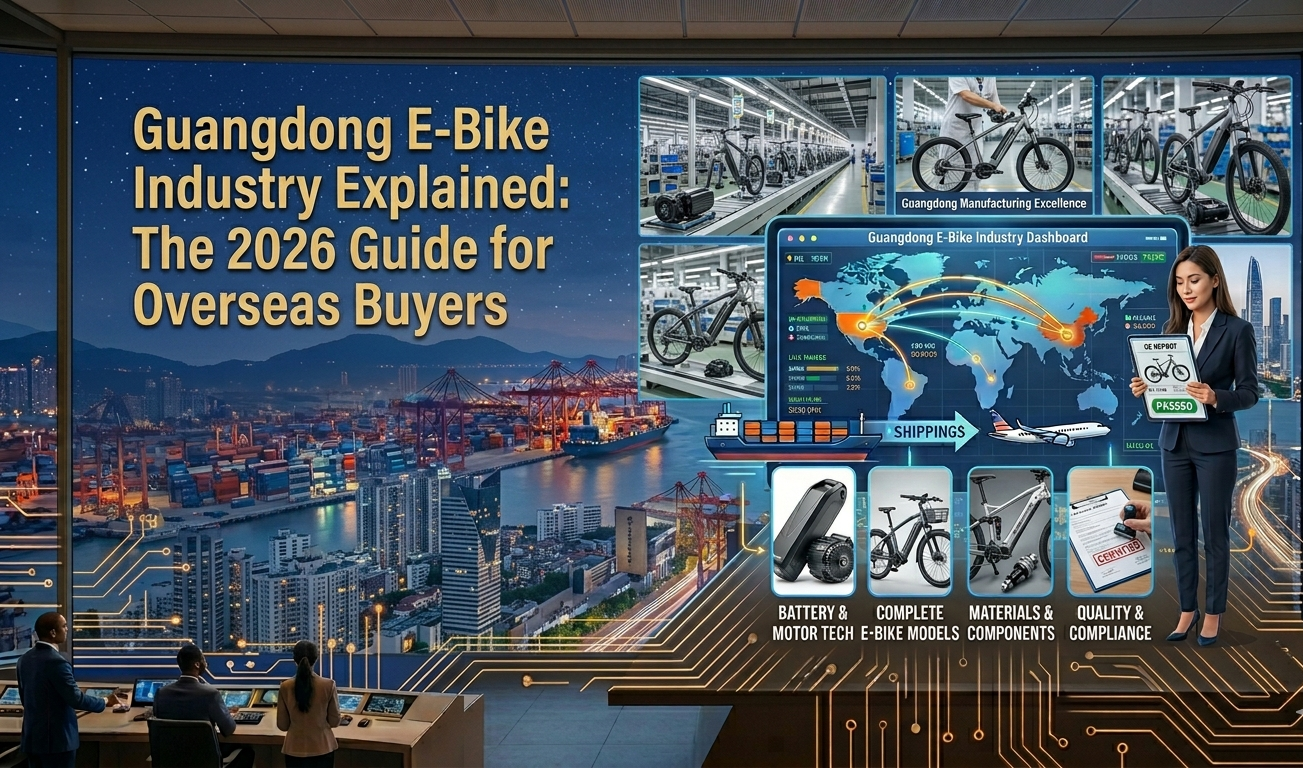
Guangdong province has long been the “Silicon Valley of Hardware,” and nowhere is this more evident than in the electric bicycle (e-bike) sector. As global demand for sustainable urban transport peaks in 2026, Guangdong has solidified its position as the world’s most sophisticated micromobility hub. For overseas buyers, understanding this ecosystem is the difference between finding a “gadget” and finding a market-leading product.
Key Takeaways
- Cluster-Based Sourcing: Focus on Shenzhen for tech-heavy “smart” bikes and Foshan or Dongguan for mass-scale manufacturing.
- Certification is Non-Negotiable: For the US market, UL 2849 is the gold standard; for Europe, EN 15194 is mandatory.
- Battery Tech Matters: 2026 is the year of high-density cells and AI-managed Battery Management Systems (BMS).
- Supply Chain Proximity: Guangdong’s advantage lies in having battery, motor, and frame factories within a two-hour radius.
Where are the main e-bike manufacturing hubs in Guangdong?
The industry is not centralized in a single city but distributed across a high-tech “Golden Triangle”:
- Shenzhen: The heart of R&D. If you are looking for e-bikes with integrated GPS, IoT connectivity, app-controlled locks, and high-end carbon fiber frames, Shenzhen is your destination.
- Dongguan: Known for its massive electronic components supply chain. Dongguan excels in mid-to-high-end assembly and is home to many of the world’s leading battery pack manufacturers.
- Foshan & Guangzhou: These cities focus on robust manufacturing and logistics. They are excellent for finding reliable commuter e-bikes and cargo bikes with high production capacities and proximity to major ports like Nansha and Yantian.
Why should overseas buyers source from Guangdong instead of other regions?
While other provinces in China produce e-bikes, Guangdong offers a unique “Turnkey” ecosystem.
- Innovation Speed: Nowhere else can a prototype go from design to a working model faster than in the Pearl River Delta.
- Component Variety: Buyers can choose from premium mid-drive motors (like Bafang) to specialized local hub motors, all within the same province.
- Export Maturity: Manufacturers here are highly experienced with international maritime laws, dangerous goods (batteries) shipping, and Western quality expectations.
How do you ensure compliance with international safety standards?
Regulatory scrutiny on e-bike batteries has reached an all-time high in 2026. To protect your business from customs seizures or liability:
- For US Buyers: Ensure the entire system (battery, motor, and charger) is UL 2849 certified. Many factories claim “UL cells,” but the certification must cover the whole drive system.
- For EU Buyers: Products must meet EN 15194 standards and carry the CE mark.
- Battery Transparency: Always request a UN38.3 test report and a Material Safety Data Sheet (MSDS). This is required for all lithium-ion battery shipments.
What are the emerging trends in the 2026 e-bike market?
To stay competitive, look for manufacturers offering these “Next-Gen” features:
- AI-Optimized Range: Software that adjusts power output based on rider behavior and terrain to extend battery life.
- Sustainable Materials: Frames made from recycled aluminum or eco-friendly composites are seeing a massive surge in demand from the European market.
- Integrated Safety: Look for built-in turn signals, 360-degree LED visibility, and even radar-based proximity sensors for urban commuting.
How can you verify an e-bike supplier’s quality control?
E-bikes are complex machines. You must verify a supplier’s technical competence:
- The Aging Test: Ask to see the battery aging room. A reputable factory will test every battery pack for 24–48 hours before assembly.
- Waterproofing (IP Rating): Check if they have an IPX5 or IPX6 testing booth. E-bikes must be able to handle rain and pressure washing.
- On-Site Inspection: If you cannot visit in person, use a local sourcing agent to perform a Pre-Shipment Inspection (PSI). They will check the motor torque, brake responsiveness, and frame weld quality.
Frequently Asked Questions (FAQ)
What is the typical Minimum Order Quantity (MOQ) for e-bikes?
For custom-branded (OEM) e-bikes, most Guangdong factories require an MOQ of 50 to 100 units. If you are buying “off-the-shelf” designs with minor logo branding, some suppliers may go as low as 10–20 units.
How are e-bike batteries shipped?
Batteries are classified as Class 9 Dangerous Goods. They are usually shipped via sea freight in specialized containers. In 2026, many importers are using “Battery-Separated” shipping to reduce insurance costs and comply with stricter airline/sea-carrier regulations.
Can I source custom-designed e-bike frames?
Yes. Many factories in the region are ODM (Original Design Manufacturer) specialists. You can provide a 3D CAD drawing, and they can produce the molds and frames. However, be prepared for a high initial tooling cost (typically $5,000–$15,000 depending on the material).
Expert Tip: When visiting the Canton Fair or local factories, always ask to meet the Lead Engineer, not just the sales representative. In the e-bike industry, the engineer’s understanding of torque sensors and BMS logic is what will ultimately determine the quality of your brand.
Would you like me to generate a Product Specification Checklist specifically for auditing e-bike factories in 2026?