
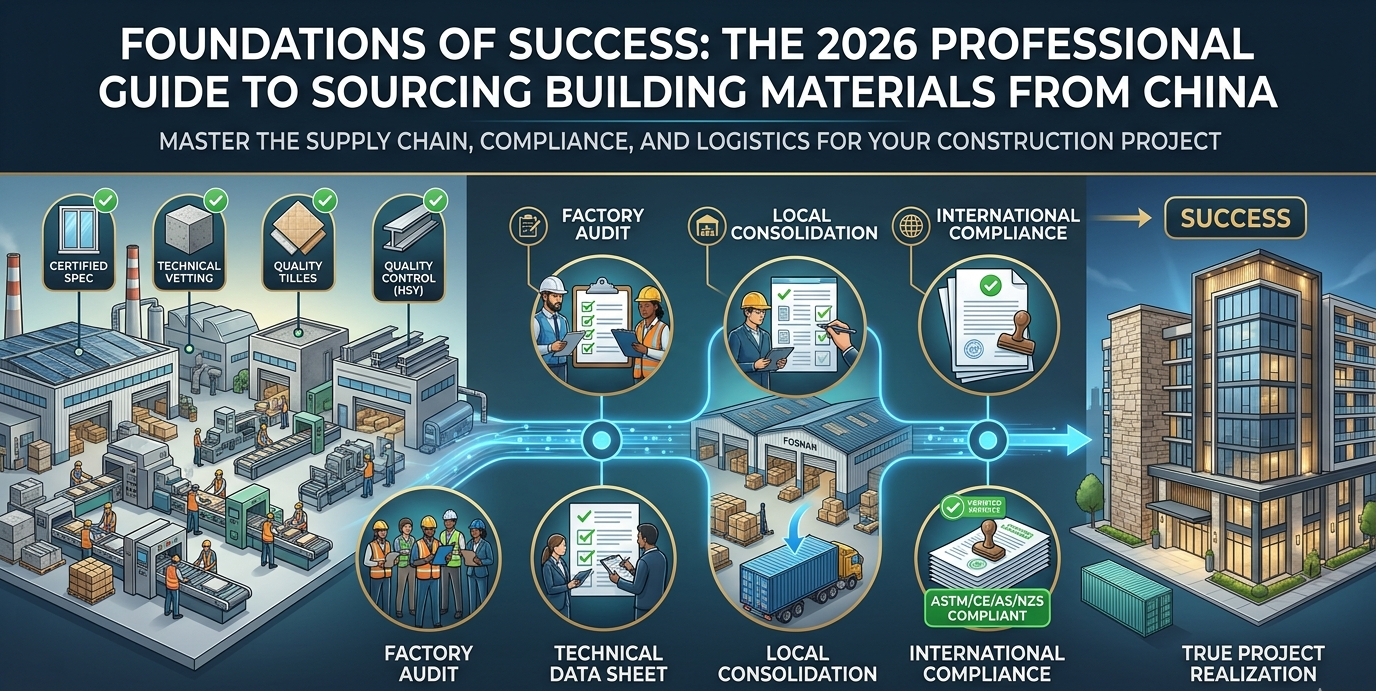
Sourcing building materials from China is a high-stakes endeavor. Unlike small consumer electronics, a mistake in a construction shipment—whether it’s the wrong grade of stainless steel, non-compliant tiles, or moisture-damaged cabinetry—can halt a multi-million dollar project and lead to massive legal liabilities.
To succeed, you need to move beyond simply finding a “low price” and focus on technical compliance and logistical precision.
Why is China the global hub for construction and building materials?
China produces nearly half of the world’s construction materials, ranging from structural steel and glass to high-end finishing materials like sintered stone and designer lighting. The sheer scale of the supply chain allows for incredible variety and competitive pricing. However, the real advantage for professional developers is the industrial clustering. In regions like Guangdong, you can source everything from the foundation to the roof within a 50-mile radius, allowing for unparalleled consolidation efficiency.
Where are the primary industrial clusters for building materials?
If you are looking for quality and variety, you must focus on Guangdong Province, specifically the Foshan and Zhongshan regions.
- Foshan: The world capital for ceramics, furniture, and sanitary ware.
- Guzhen (Zhongshan): The global center for lighting.
- Liling/Chaozhou: Specialist hubs for architectural ceramics and stoneware. Understanding these clusters is vital because proximity reduces inland transport costs and allows your quality control team to move between factories quickly.
How do you ensure products meet international building standards?
One of the biggest risks is “compliance drift.” A product that looks identical to your local requirement may fail to meet specific certifications like ASTM (USA), CE (Europe), or AS/NZS (Australia/NZ). The Solution: Do not take a supplier’s word for it. You must request valid test reports from accredited third-party labs (like SGS or Intertek). More importantly, your on-site inspector must verify that the raw materials used in the current production batch match the materials used in the certified test sample.
What are the logistical challenges for heavy construction shipments?
Building materials are notoriously heavy, fragile, and bulky. Shipping “air” is expensive. Efficiency in this sector comes down to Container Optimization. For example, when shipping heavy floor tiles, you will hit the weight limit of a container before you hit the volume limit. A smart sourcing strategy involves “balancing” the load—combining heavy items (tiles/stone) with high-volume, lightweight items (lighting/cabinets) to maximize every dollar spent on ocean freight.
Key Takeaways
- Audit the Factory, Not the Website: Physical verification of production capacity and QC equipment is mandatory for construction-grade materials.
- Demand Technical Data Sheets (TDS): Ensure every material—from adhesives to tempered glass—comes with a technical spec sheet that matches your project requirements.
- Consolidate in a Local Hub: Use a central warehouse in Foshan to inspect and load goods from multiple vendors into single, balanced containers.
- Account for Lead Times: Building materials often require longer production windows. Always add a 2-week “buffer” for customs inspections and seasonal delays.
FAQ: Sourcing Construction Goods
Q: Can I source small quantities for a single house project?
A: Yes, but be aware that many top-tier factories have high MOQs. For a single villa or home, you are often better off sourcing from large “showroom” markets in Foshan, though you will still need an agent to handle the QC and shipping.
Q: How do I handle broken or defective items like marble or glass?
A: Prevention is the only cure. This requires professional “Export Standard” crating (often involving heat-treated wooden pallets) and high-level marine insurance. If a defect is found at the factory, it must be replaced before loading.
Q: What is the best Incoterm for building materials?
A: FOB (Free On Board) is generally best. It allows you to control the shipping costs while ensuring the supplier is responsible for getting the heavy goods safely to the port and through Chinese customs.
Meet the HSY Sourcing Team: Your On-Site Project Managers
Sourcing building materials isn’t just a transaction; it’s a project management challenge. At HSY Sourcing, we act as your technical eyes and ears on the ground in the heart of China’s construction hubs.
- Technical Vetting: We don’t just check the color; we check the specs, the certifications, and the structural integrity.
- Professional Consolidation: We manage your “Bill of Quantities” (BOQ), ensuring that items from 20 different factories arrive at our warehouse and are loaded into your containers with mathematical precision.
- Zero-Defect Goal: Our QC process happens during production, catching errors when they can still be fixed, ensuring your project stays on schedule and on budget.