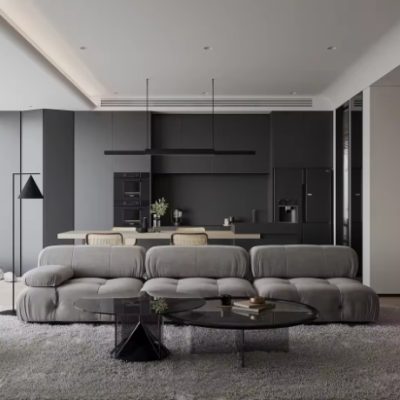

If you are a hotel owner, developer, or project manager sourcing furniture from China, you already know that the biggest headache isn’t the price of the sofa itself. It’s the cost of getting that sofa from the factory in Foshan to your property in Los Angeles, London, or Dubai.
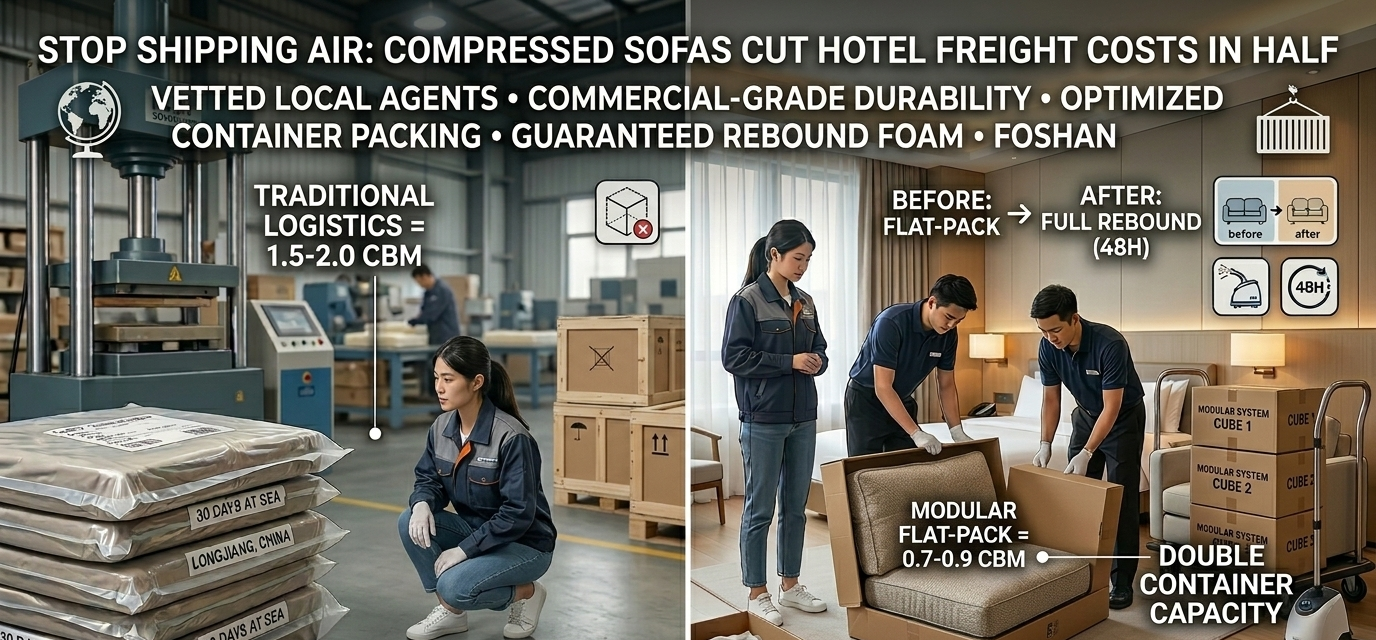
For years, we’ve been shipping huge amounts of air across the ocean. A traditional three-seater sofa takes up about 1.5 to 2 cubic meters (CBM) in a container. Inside that sofa is a whole lot of empty space under the frame and between the cushions.
With current ocean freight rates fluctuating wildly, paying to ship air is a luxury no hotel project can afford.
This is where compressed sofas (sofa-in-a-box) are changing the game for hospitality procurement. It’s not magic, and it’s not too good to be true, but it does require understanding how it actually works.
Here is the realistic look at how compressed sofas can cut your freight costs dramatically.
Why are traditional sofas such a logistics nightmare for hotels?
In the furniture world, we talk about “chargeable weight” versus “volumetric weight.” Most hotel furniture is bulky but relatively light. Ocean freight is charged by the CBM (volume).
When you buy 100 traditional sofas for a hotel guestroom renovation, you are essentially renting a massive amount of container space just to hold empty gaps. A standard 40HQ container might only hold 30–35 traditional upholstered sofas. If your project needs 100, that’s three containers just for sofas.
Furthermore, traditional sofas are hard to handle on-site. Getting a fully assembled 2.2-meter sofa into a hotel elevator or through a tight hallway often results in damaged walls or, worse, damaged furniture right before the grand opening.
How does the “sofa-in-a-box” concept actually work factually?
Let’s be clear: we aren’t crushing a wooden frame.
A factory-certified compressed sofa is usually modular or designed as a knock-down (KD) piece. The heavy engineering happens with the cushioning.
- High-Resiliency Foam: The cushions are made from special, high-density, high-resiliency foam (often D35 or higher). Cheap, low-quality foam cannot handle compression and will stay flat.
- Vacuum Sealing: The foam cushions are placed in heavy-duty plastic bags, and massive industrial vacuums suck out all the air. The cushion is reduced to a fraction of its original size.
- Smart Framing: The wooden or metal frame is designed to be easily bolted together on-site. It is flat-packed along with the compressed cushions into one or two relatively flat boxes.
What is the realistic impact on freight costs and container loading?
Here is the math, without the exaggeration.
By flat-packing the frame and vacuum-sealing the foam, a sofa that used to take up 1.8 CBM now takes up roughly 0.7 to 0.9 CBM.
The Loading Reality:
- Traditional Sofas: Approx. 30–35 units fit in a 40HQ container.
- Compressed/Modular Sofas: Approx. 65–80 units fit in a 40HQ container.
You are roughly doubling your container capacity. If you double the capacity, you effectively cut your ocean freight cost per unit in half.
For a 200-room hotel project, this means the difference between paying for six containers versus paying for three. That is a massive saving that goes directly to your bottom line.
What are the downsides or trade-offs you need to know about?
We promise no over-beautification. Compressed sofas are excellent for freight, but they aren’t perfect for every situation.
- On-Site Assembly Time: Unlike traditional sofas that you just unwrap and place, compressed sofas require assembly. Your FF&E installation team will need time to bolt frames together and insert cushions. You save on freight, but you might spend slightly more on installation labor.
- Rebound Time: When you cut open the vacuum bag, the foam doesn’t snap back to 100% instantly. It usually takes 24 to 72 hours for the foam to fully regain its shape and for the fabric wrinkles to smooth out. You cannot install them and have guests sleep on them an hour later.
- Design Limitations: Deep, classic Chesterfield-style sofas with complex tufting do not compress well. Compressed designs tend to be more modern, sleek, and modular.
FAQ: Sourcing Compressed Sofas in China
Here are the questions we hear most often from hotel buyers.
Q: Does compression ruin the foam quality?
A: If done correctly with high-density (D35+) foam, no. However, if a factory uses cheap foam to save money, it will ruin it. A good Foshan sourcing agent must verify the foam density during production.
Q: Can you compress leather sofas?
A: We strongly advise against it. Real leather, and even high-end PU leather, will develop permanent creases and cracks when vacuum-sealed tightly for 30 days in a hot container. Compression is best for woven fabrics (linen, polyester, velvet).
Q: How do I know if the hardware won’t break?
A: Since these sofas rely on bolts and brackets, quality control (QC) is crucial. We perform “dry-run” assemblies at the factory, picking a random box to ensure the holes align and the hardware is sturdy enough for commercial (hotel) use.
How HSY Sourcing can help manage your hotel furniture project in Foshan
Sourcing compressed sofas is a smart financial move, but it is a high-risk move if you don’t know who you are buying from. You are trusting a factory in Longjiang to use the right foam, the right hardware, and pack it correctly.
At HSY Sourcing, we are your feet on the ground in Foshan. We are not a trading company just emailing catalogs; we are factory-floor inspectors.
For hotel projects, we provide:
- Source Verification: We find the actual manufacturers of commercial-grade compressed seating, avoiding middlemen.
- Strict QC Inspections: We cut open foam to verify density, check fabric rub-counts, and supervise the actual vacuum-packing process to ensure the boxes aren’t over-stressed.
- Logistics & Consolidation: We manage the consolidation of your sofas with lighting, casegoods, and other FF&E into the same containers to ensure you are truly optimizing container packing and reducing hotel FF&E shipping costs.
Paying to ship air is outdated. Compressed modular seating is the future for hospitality freight savings. Send us your furniture list, and let’s calculate how much container space we can save you on your next project.