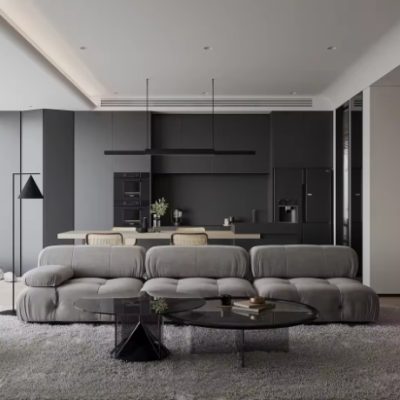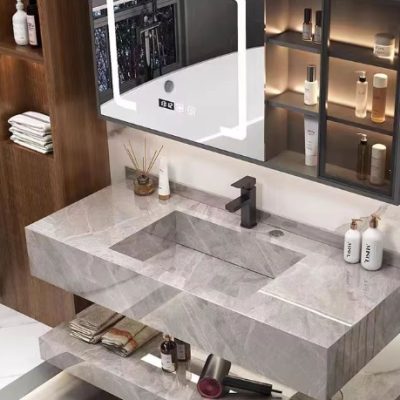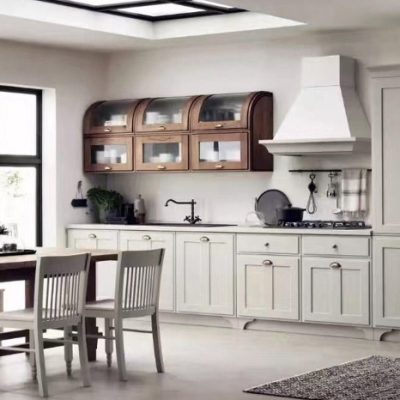

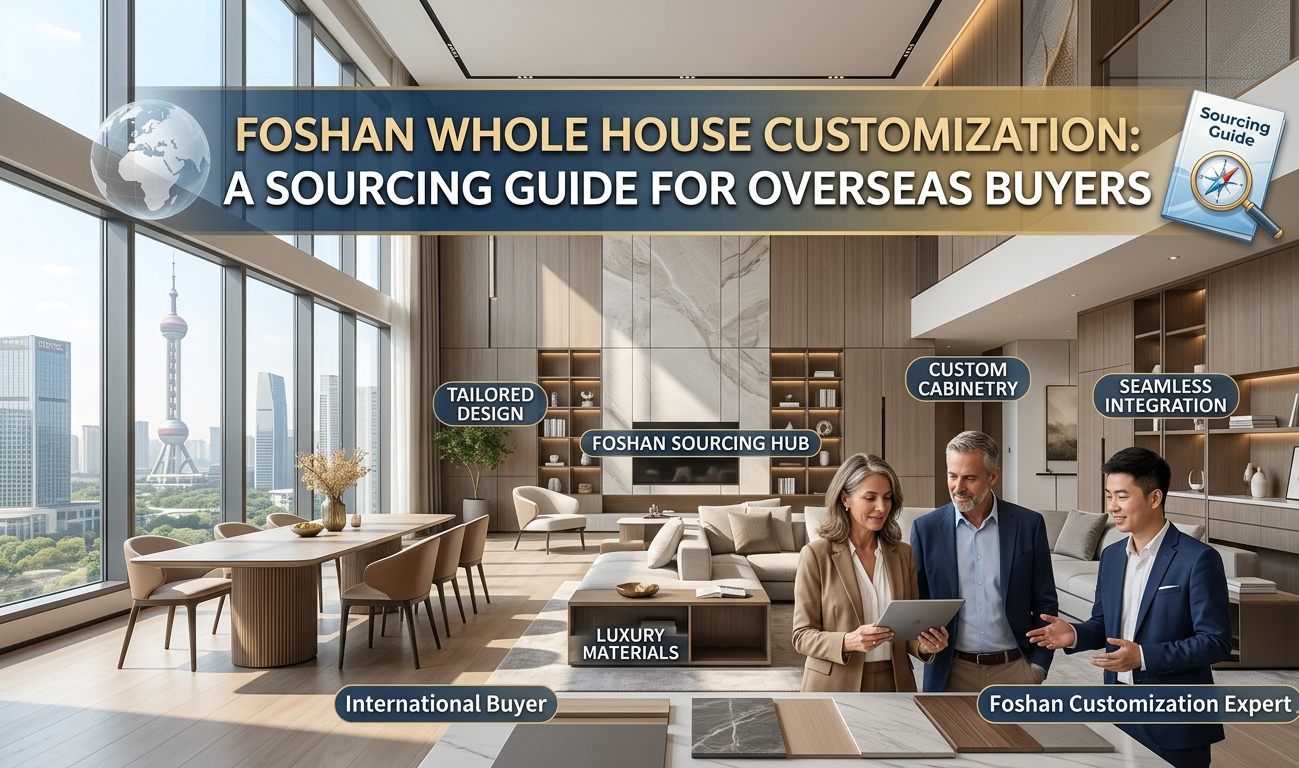
Buying custom furniture and fixed joinery from halfway across the world can feel like a high-stakes engineering project. For overseas developers and homeowners, the term “Whole House Customization” represents more than just a style; it is a specialized procurement model that centralizes the design, production, and logistics of every fixed element in a building.
Foshan is the undisputed heart of this industry. However, successfully navigating this hub requires more than just a flight ticket or a browse through an online directory. It requires a technical understanding of how the Foshan supply chain operates. This guide breaks down the reality of sourcing whole-house interiors for international projects.
Why has Foshan become the global center for custom interiors?
The reason isn’t just low cost; it is industrial density. In Foshan, specifically within the Shunde and Nanhai districts, you aren’t just finding a factory—you are finding an ecosystem.
A single customization factory is supported by hundreds of nearby suppliers specializing in CNC precision cutting, laser edge-banding, specialized PVD metal coatings, and hardware engineering. This allows Foshan manufacturers to execute complex designs that combine wood, stone, glass, and metal—all within one production line. For an overseas buyer, this means you can achieve a “designer look” at a fraction of the cost of local millwork, provided you can bridge the communication and technical gap.
What are the main product categories included in a Foshan whole-house package?
When we talk about whole-house customization, we are referring to the “fixed” or “built-in” furniture that defines the architecture of the interior. A standard package typically includes:
- Kitchen Systems: Cabinets, islands, and integrated appliance housing.
- Storage Solutions: Floor-to-ceiling wardrobes, walk-in closets, and entryway shoe cabinets.
- Bathroom Vanities: Custom-sized cabinets with integrated stone or ceramic tops.
- Internal Doors & Wall Paneling: Coordinated wood veneers or lacquered panels that wrap entire rooms.
- Home Office & Media Units: Built-in shelving and TV consoles.
The primary benefit is aesthetic synchronization. By sourcing these from one hub, you ensure the walnut veneer in the kitchen perfectly matches the wall panels in the living room—something nearly impossible to achieve when buying from separate vendors.
How can overseas buyers manage the measurement and installation risks?
The biggest “fail point” for custom sourcing is the tape measure. A 10mm error in a drawing can lead to a cabinet that won’t fit into its alcove 6,000 miles away.
Professional buyers mitigate this through The Three-Step Verification:
- As-Built vs. Planned: Never order based on the architect’s initial blueprints. You must provide the “as-built” measurements taken after the drywall is finished.
- Detailed Shop Drawings: The factory must provide CAD shop drawings for every unit. Your local contractor must sign off on these to ensure plumbing and electrical points align with the furniture.
- The Trial Assembly: This is non-negotiable. Before any item is packed, the factory must fully assemble the kitchen and wardrobes on their floor. We inspect these in person (or via high-definition video/photos) to verify hinge alignment, drawer smoothness, and finish quality.
What is the reality of logistics and shipping for custom-built furniture?
Shipping “fixed joinery” is different from shipping a standard sofa. You have two main options:
- Flat-Pack (RTA): Cabinets are shipped as panels. This saves a massive amount of container space (and cost) but requires a highly skilled installation team at your destination.
- Pre-Assembled: Cabinets arrive as built units. This is easier to install but consumes significantly more shipping volume.
For large-scale development projects, flat-pack is the industry standard. To prevent damage, we insist on Reinforced Packaging: every panel edge is protected with foam, and entire sets are crated in plywood boxes rather than just cardboard.
Key Takeaways
- Centralize for Consistency: Sourcing all fixed joinery from one Foshan hub ensures materials, hardware, and finishes match perfectly across the project.
- Engineering First: Treat procurement as a technical task. CAD drawings and “as-built” dimensions are more important than the initial design photos.
- Mandatory Trial Assembly: Never pay the final balance until the factory has physically assembled and tested every custom unit on their floor.
- Plan for Lead Times: Custom manufacturing in Foshan usually takes 35 to 50 days, plus shipping. Start the process early in the construction phase.
FAQ: Navigating the Custom Process
Q: Can I customize the internal hardware, like hinges and drawer slides?
A: Yes. This is one of the best ways to “value engineer” your project. You can choose premium brands like Blum or Hettich for high-traffic areas (the kitchen) and use high-quality, unbranded Foshan-made hardware for guest rooms to stay within budget.
Q: How do we handle “Eco-Friendly” standards for overseas markets?
A: Most reputable Foshan factories offer E0 or ENF grade boards (the highest standards for low formaldehyde). We verify these certifications and perform air-quality “smell tests” during the QC phase to ensure they meet your local health regulations.
Q: Do factories provide installation support?
A: Usually, they provide 3D exploded diagrams and installation videos. Sending a crew overseas is rarely cost-effective. We recommend hiring a local finishing carpenter and providing them with the factory’s technical documentation before the container arrives.
Technical Precision with HSY Sourcing
At HSY Sourcing, we understand that “Customization” is only as good as the quality control behind it. Operating from the center of the Foshan cluster, we act as your technical eyes and ears on the factory floor.
We manage the CAD review process, oversee the critical trial assemblies, and ensure that your whole-house package is packed with the structural integrity needed for a long ocean voyage.