

Executing a large-scale renovation—whether it involves updating a 50-unit apartment building, refreshing a boutique hotel, or finishing a premium villa development—is notoriously difficult to keep on schedule. The primary point of failure rarely stems from a lack of design ideas. Instead, it happens during the procurement phase, when hundreds of line items on a Bill of Quantities (BOQ) must be sourced, verified, and shipped under tight constraints.
For international buyers, trying to manage individual production lines across different provinces introduces extreme coordination risks. Centralizing your supply chain within a single major industrial cluster changes the math completely.
Key Takeaways
- Consolidate to Cut Hidden Admin Fees: Buying flooring, lighting, and cabinetry from separate regions multiplies your domestic logistics costs and communication overhead.
- Audit Before the Balance Payment: Never authorize a final factory wire transfer based entirely on catalog photos. Third-party physical inspections on the factory floor are mandatory to prevent defects from reaching your shipping container.
- Balance Container CBM and Weight: Mix high-weight structural assets (like ceramic tiles) with high-volume, low-weight fixtures (like loose furniture) to maximize your ocean freight capacity.
- Enforce Strict Regional Compliance: Ensure local building code standards, such as specific formaldehyde limits (E0/E1) or fire retardancy certifications, are written into the manufacturing agreements before any deposits are paid.
Why Does Fragmented Material Sourcing Delay Multi-Family Renovations?
Traditional renovation procurement is highly siloed. A developer typically tasks an internal team with finding separate vendors for each asset category. They might buy porcelain tile from one factory, sanitary ware from a second, and custom doors from a third.
While chasing the absolute lowest unit price on individual factory invoices looks smart on paper, the real-world execution frequently fails. When you deal with isolated manufacturers scattered across different regions, you inherit completely uncoordinated production timelines.
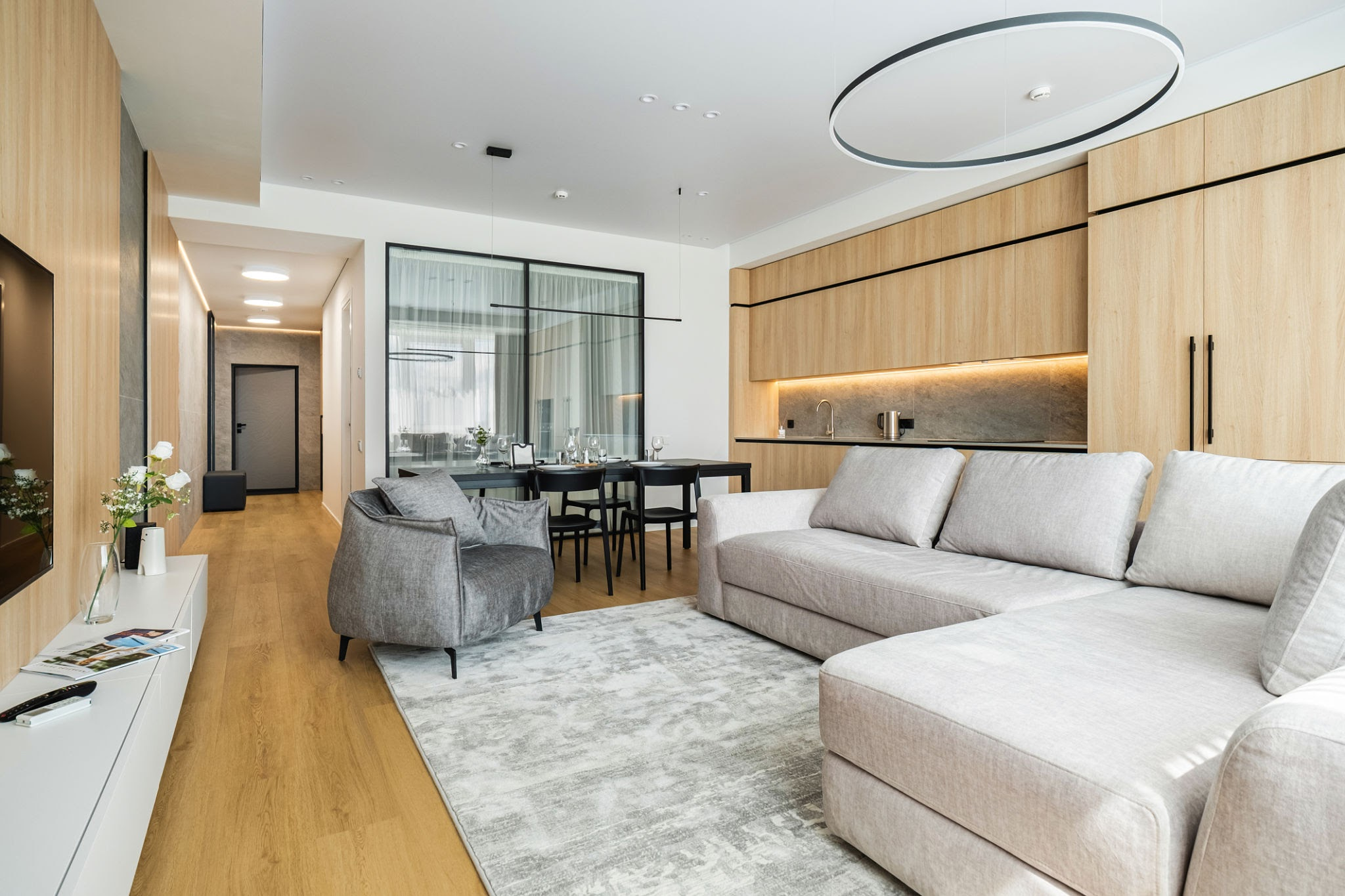
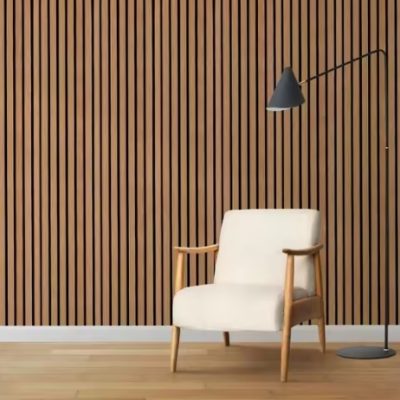
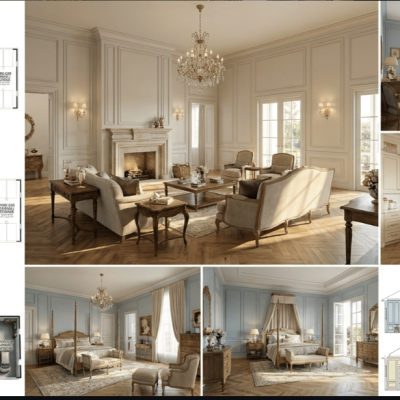
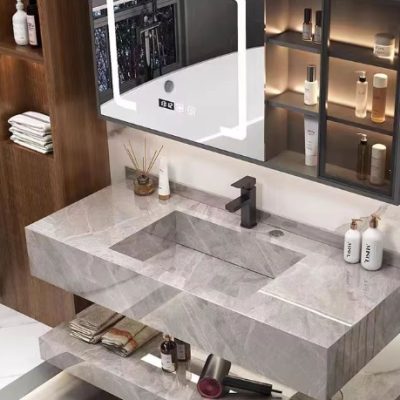
Coordinated Interior Elements Sourced via Local Industrial Clusters. Source: Valentin Orsik / Getty Images
If the cabinet workshop slips behind by two weeks due to a local raw material shortage, your entire on-site tiling and plumbing crew stands idle. Because the structural interfaces are dependent on each other, a bottleneck at one factory triggers a cascade of delays across your entire site layout, inflating local labor overhead and delaying your property’s time-to-market.
How Can Centralizing Procurement in Foshan Protect Your Project Budget?
The city of Foshan in Guangdong province fundamentally addresses procurement fragmentation through its geographic layout. The region does not operate as a generalized industrial town; instead, it is a highly concentrated network of specialized, world-class material ecosystems located within a 30-minute driving radius.
- Chancheng District: Specializes in porcelain slab flooring, ceramic wall tiles, and commercial-grade sanitary ware.
- Shunde District: Functions as a massive global hub for loose furniture, built-in wardrobes, custom kitchen cabinetry, and upholstery.
- Nanhai District: Handles structural aluminum profiles, commercial windows, exterior doors, and functional architectural hardware.
This proximity gives project managers a structural financial advantage. It completely eliminates cross-province domestic freight bills. More importantly, it bridges the communication gap between separate factories.
When a custom stone bathroom counter cut in Chancheng needs to integrate flawlessly with a wooden vanity chassis built in Shunde, the two engineering teams can physically share technical templates locally within a single morning. This prevents the costly field modifications that commonly occur when isolated factories work without local cross-verification.
What Are the Most Common Inspection Failures in Batch Custom Cabinetry?
Custom cabinetry and millwork represent the highest financial risk during an apartment or hotel renovation. Because every building features minor masonry variances, mass-produced cabinets will not fit properly without strict manufacturing tolerance controls.
The most common defect uncovered during on-floor inspections is incorrect edge-banding sealing. Low-tier workshops often run their edge-banding lines too fast or use low-grade EVA glues. When these panels are shipped across oceans and exposed to varying humidity, the edges crack and lift, exposing the internal substrate to moisture and causing the wood to swell.
Substandard EVA Edge-Banding (High Risk):
[Speed-Run Application] ──> [Ocean Transit Humidity] ──> Glue Fails ──> Edge Lifts ──> Core Swells

Premium PUR Hot-Melt Sealing (HSY Standard):
[Polyurethane Reactive Application] ──> [Irreversible Chemical Cross-Link] ──> Completely Watertight
To protect your asset lifecycle, your purchasing contract must specify PUR (Polyurethane Reactive) hot-melt edge sealing. PUR glue undergoes an irreversible chemical reaction with moisture in the air, creating a completely watertight, heat-resistant seal that will not delaminate even when exposed to steam from kitchen appliances or high-humidity bathroom environments.
How Do You Optimize Container Loading for Mixed Building Materials?
International ocean freight invoices are billed per container slot, regardless of how effectively you pack the space. Shipping individual categories in isolation results in significant structural waste.
Heavy construction assets like ceramic tiles, stone sheets, and iron pipes hit legal payload weight limits while utilizing less than 50% of the container’s physical volume. You wind up paying full shipping rates to transport empty air. Conversely, lightweight, high-volume items like sofas, mattresses, and architectural acoustic panels fill the container’s physical space while using under a third of the allowable weight capacity.
A unified sourcing hub solves this through mechanical container engineering at a local staging warehouse. By gathering your entire BOQ package under a single roof in Foshan, logistics staff can pack containers efficiently.
Heavy ceramics, flooring crates, and stone basins are loaded flat across the container floor to establish a low, stable center of gravity. Lightweight, boxed furniture components and flat-packed cabinetry are then stacked securely on top. This optimization strategy maximizes both payload weight and CBM limits, regularly reducing the total container count on a multi-family project by 15% to 20%.
Why Choose HSY Sourcing for Your Renovation Project?
Operating directly from the center of Foshan’s manufacturing clusters, HSY Sourcing functions as your independent project management, quality engineering, and supply chain consolidation office on the ground in China.
- Cross-Category Technical Auditing: We don’t just act as product finders. We analyze your full project drawings and BOQ line by line, ensuring that custom joinery clearances, plumbing cutouts, and door tolerances align across your chosen factories before production lines are booked.
- Hands-On Production Floor Checks: We do not rely on factory self-reporting or polished showroom samples. Our quality control engineers conduct unannounced visits to the production lines in Chancheng and Shunde to test raw material moisture content, verify core density, and inspect structural joinery before packing begins.
- Centralized Warehouse Staging: We utilize our own local warehouse facilities to collect, securely store, and palletize your multi-category interior packages. We directly oversee container packing to ensure fragile items are physically isolated from heavy building materials.
- Fully Transparent Verification Reports: We supply unedited, clear inspection reports featuring digital measurement readouts, weight metrics, and raw photography so you can verify order accuracy before authorizing final balance payments.
Visit www.hsysourcing.com to share your project’s architectural floor plans and material schedules. Let our ground engineers build a streamlined, risk-free interior supply chain for your next property development.
Frequently Asked Questions (FAQ)
Q: How do you handle the different production lead times between basic building materials and custom furniture?
A: Flooring tiles and standard sanitary ware generally have shorter production lead times (15 to 25 days) compared to custom built-in wardrobes and loose sofas (35 to 45 days). We reverse-engineer your purchasing timeline, releasing production deposits for the custom furniture and cabinetry first. The structural building materials are scheduled later so that all categories arrive at our local warehouse within a synchronized window, avoiding long-term storage fees.
Q: Can we request custom sizes for apartment kitchen cabinets without paying a massive customization penalty?
A: Yes. Because Foshan’s commercial contract factories utilize automated CNC wood routers and computerized panel saws, changing the width or height of a cabinet box does not require expensive new structural molds. As long as the project batch satisfies the factory’s minimum volume baseline, dimensions can be adjusted to match your CAD floor plans with a minimal surcharge based purely on raw material consumption.
Q: How do you guarantee that the materials sourced from Foshan comply with our country’s environmental laws?
A: We build your target market’s mandatory compliance standards (such as European E1/E0 formaldehyde limits, US CARB Phase 2, or specific fire safety certifications like CAL 117 or BS 5852) directly into the initial manufacturing specifications. We then verify compliance on the ground by reviewing raw material certifications and executing physical flame and chemical testing checks during production floor audits.