
In large-scale commercial real estate developments—such as a 150-room hotel fit-out or a multi-story student housing complex—furniture logistics often represent a greater budgetary wild card than the raw manufacturing cost. Traditional upholstered sofas are among the most inefficient items to transport because they are essentially rigid frames surrounding large volumes of trapped air.
To address this spatial challenge, contract manufacturers have developed vacuum-compressed (or “sofa-in-a-box”) engineering. This process uses high-power hydraulic machinery to extract the air from the foam core, collapsing the unit into a fraction of its operational size.
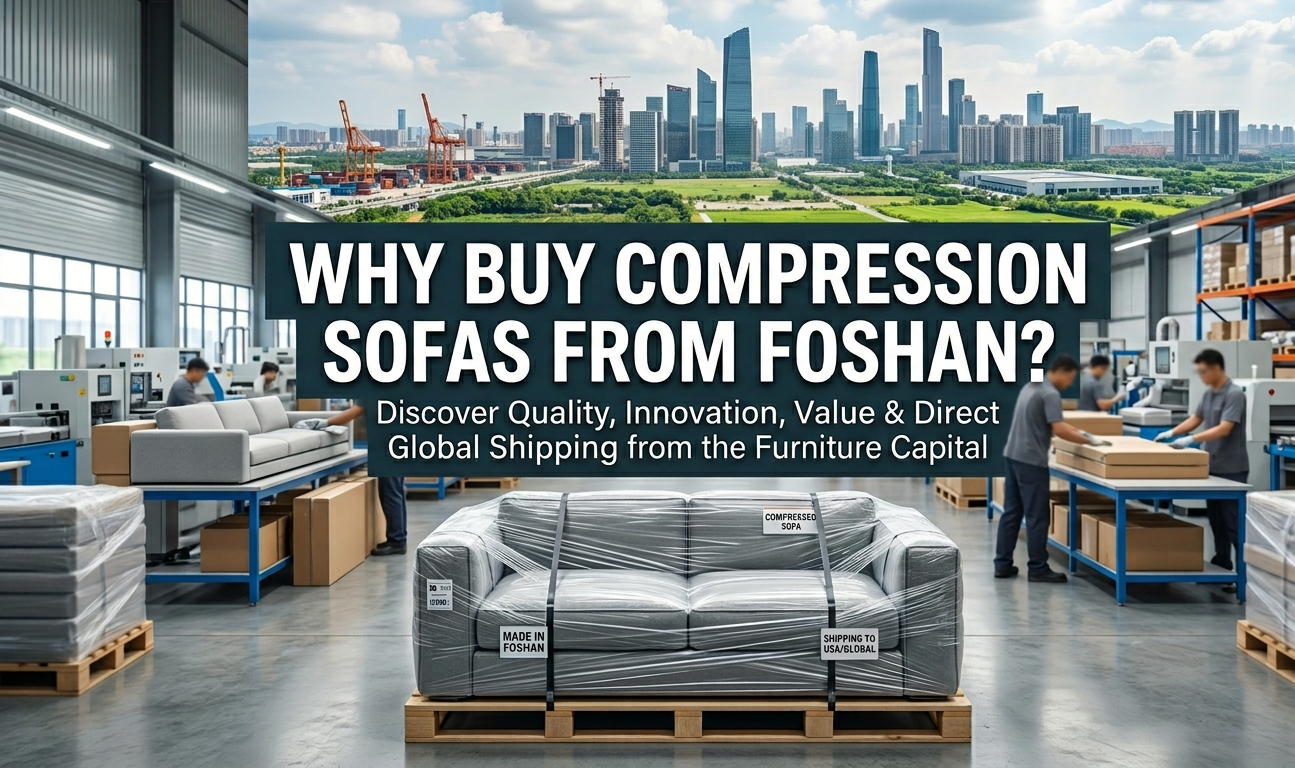
As the global capital of upholstered furniture manufacturing, Foshan has integrated this compression technology deeply into its local supply chain. Sourcing these optimized pieces directly from the Foshan cluster allows developers to dramatically reduce landed costs while maintaining high build quality.
How Do Compression Sofas Reduce International Shipping Costs?
The financial viability of an international furniture order depends heavily on ocean freight efficiency. Freight lines bill full containers based on a flat rate per slot, regardless of how much dead space is inside.
A standard fully assembled three-seater sofa typically consumes between 1.5 and 1.8 cubic meters (CBM) of volume. Consequently, a standard 40ft High Cube container hits its volumetric limit at roughly 35 to 40 units, leaving the container significantly under its safe weight allowance.
Volumetric Shipping Footprint Comparison (Per Unit CBM):
┌──────────────────────────────────────────────┐
│ Traditional Assembled Sofa                   │
│ [==================================] 1.6 CBM │
├──────────────────────────────────────────────┤
│ Vacuum-Compressed / Flat-Boxed Sofa          │
│ [========] 0.45 CBM                          │
└──────────────────────────────────────────────┘
When a sofa is engineered for compression, its arms, backrest, and seating cushions are detached into modular elements or built using a flexible, frame-free structure. Once vacuum-sealed and flat-packed into heavy-duty corrugated cartons, the individual volume drops to approximately 0.4 CBM to 0.5 CBM.
This spatial optimization allows the exact same 40ft HQ container to hold 120 to 150 units. By tripling the payload capacity of a single container, you immediately cut your per-door shipping cost by up to 70%.
Can a Compressed Sofa Recover Its Shape and Density After Weeks in a Container?
The primary concern for procurement directors considering vacuum-packed seating is material deformation. If a sofa remains flattened inside a hot shipping container for 45 days during ocean transit, will the foam permanently sag or develop visible surface wrinkles upon unboxing?
The answer depends strictly on the chemical formulation and density of the polyurethane foam core. Low-grade retail furniture workshops use cheap, low-density foam (under 25kg/m³) mixed with heavy mineral fillers to lower production costs. Under sustained hydraulic pressure, the thin cell walls of low-density foam crack and rupture permanently, meaning the cushion will never recover its original loft.
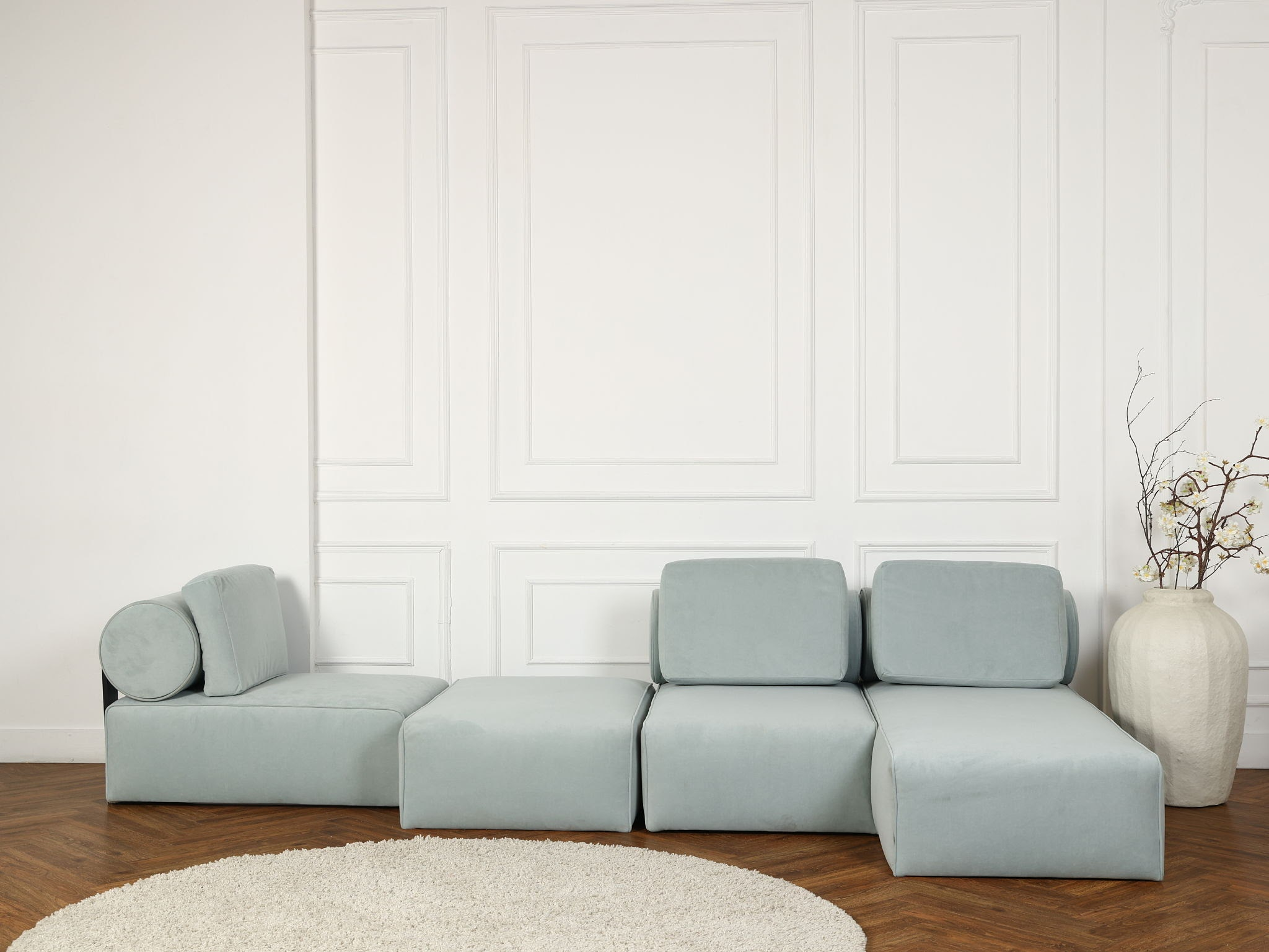
Modern Modular Furniture Layouts Designed for Flexible Spatial Configurations. Source: diczman / Getty Images
Foshan’s tier-one contract manufacturers prevent this by utilizing high-resilience (HR) polyurethane foam with a minimum density baseline of 35kg/m³ to 45kg/m³. HR foam features an open-cell, highly elastic molecular structure that acts like microscopic springs.
When the vacuum bag is sliced open on-site, air rushes back into these open cells, causing the foam to regain 95% of its original structural shape within 30 minutes, and reaching 100% calibration within 48 hours without any structural degradation.
Why Is Foshan the Best Hub for Sourcing Vacuum-Packed Furniture?
While vacuum packing might seem like a simple packaging trick, it requires an advanced, highly synchronized regional manufacturing infrastructure to execute reliably at volume. Foshan’s industrial layout provides three distinct advantages for this specific product class:
- Advanced Machinery Infrastructure: Longjiang and Lecong house specialized machinery plants that design heavy-duty industrial hydraulic presses capable of applying up to 20 tons of uniform pressure without tearing the underlying upholstery seams.
- Polymer Film Technology: Standard plastic bags tear under the extreme internal pressure exerted by rebounding foam. Foshan suppliers utilize heavy-duty, multi-layered TPU (Thermoplastic Polyurethane) and PE composite bags equipped with proprietary one-way mechanical air valves that guarantee an airtight seal for up to 180 days.
- Integrated Modular Framing Clusters: To compress a sofa successfully, the internal framing must be rethinked. Foshan’s technical designers work alongside local hardware and wood mills to engineer heavy-duty interlocking steel brackets and reinforced knock-down (KD) timber skeletons that slide together securely post-delivery without requiring complex tools.
How Do Compression Sofas Simplify On-Site Installation for Multi-Story Buildings?
The logistical challenges of a hotel or apartment fit-out do not end when the shipping container clears customs. Moving traditional bulk furniture from the delivery bay up to rooms on the 15th floor is incredibly labor-intensive and frequently causes structural property damage.
Traditional wide-set sofas often cannot fit inside standard passenger elevators, forcing moving crews to carry heavy loads up winding fire stairwells. This slow process leads to high on-site labor costs, scratched hallway walls, and dented door frames during the final property handover phase.
On-Site Staging and Handling Workflow:
┌─────────────────────────────────────────────────────────────┐
│ Assembled Sofa: Needs 2-3 workers -> Elevator bottleneck    │
│ -> High risk of scuffing walls                              │
├─────────────────────────────────────────────────────────────┤
│ Boxed Compressed Sofa: Handles via hand-truck -> Fits normal│
│ passenger lifts -> Rapid room deployment                    │
└─────────────────────────────────────────────────────────────┘
Because compressed sofas ship in uniform, flat-boxed geometric packages, they can be stacked cleanly onto basic warehouse hand-trucks and moved rapidly by a single worker. They slide easily through standard apartment doorways and narrow interior corridors. The packaging is peeled away only once the item is safely placed inside its designated room zone, completely eliminating transit scuffs and ensuring a pristine interior presentation.
Why Choose HSY Sourcing for Your Project?
Operating directly within Foshan’s primary building material and furniture manufacturing zones, HSY Sourcing serves as your independent technical engineering, quality assurance, and logistics coordination office on the ground.
- Foam Formulation Verification: We don’t rely on a factory’s verbal promises. Our quality control engineers conduct unannounced visits to the production line, physically measuring foam core density via weight-displacement tests and testing rebound velocity before compression begins.
- Pressure Duration Stress Tests: We mandate that factories execute a 72-hour trial compression hold on sample units from your production batch. This testing confirms that both the one-way mechanical valves and the TPU polymer film walls can withstand sustained storage without micro-leaks.
- Comprehensive Project BOQ Consolidation: We utilize our local staging warehouse to combine your vacuum-packed sofa assets with heavy construction materials (like porcelain tiles, stone kitchen islands, and bathroom ceramics). We organize the container loading plan directly, placing dense building materials on the floor while utilizing compressed furniture boxes to fill the upper vertical volume safely.
- Clear, Unedited Inspection Reports: We provide transparent, metrics-driven documentation including real-time video feeds, digital caliper readouts, and weight verifications so you can audit product accuracy prior to clearing final factory balance wires.
Visit www.hsysourcing.com to share your project furniture schedules and interior drawings. Let our local engineers build a secure, highly optimized, and predictable supply chain for your next property development.
Key Takeaways
- Enforce High Density Standards: Never compress polyurethane foam with a core density rating under 35kg/m³; anything lower will suffer permanent cellular collapse during ocean transit.
- Leverage Container Volume: Use flat-boxed compression items to fill the empty upper vertical volume of containers carrying heavy structural building assets, maximizing your total logistics spend.
- Enforce Technical Fabric Specifications: Specify fabrics with high structural tensile strength and a minimum rating of 30,000 Martindale double rubs to ensure the textile handles the mechanical stress of uncompressing cleanly.
- Plan the Unboxing Window: Ensure your on-site scheduling allows for a 48-hour conditioning window post-unboxing, giving the compressed foam cores sufficient time to regain full structural calibration before tenant usage.
Frequently Asked Questions (FAQ)
Q: How long can a compression sofa safely remain vacuum-sealed inside its packaging box without suffering damage?
A: For optimal performance and shape recovery, we strongly advise keeping compressed upholstered items sealed for no longer than 60 to 90 days. While high-grade 40kg/m³ HR foam can technically survive longer durations, leaving it fully compressed beyond 3 months increases the risk of setting deep creases into the outer fabric lining.
Q: Do compression sofas feel overly firm or stiff compared to traditional residential sofas?
A: Initially, yes. Because the foam core must utilize a high-density, high-resilience structure to handle the physical compression cycle, the seating profile feels noticeably supportive and firm upon immediate unboxing. Over the first two to three weeks of regular ambient air absorption and usage, the open-cell framework softens slightly, settling into its intended commercial comfort specification.
Q: Are there specific upholstery fabrics that cannot be used on compression sofas?
A: Yes. Thick, natural split leathers and highly rigid, resin-backed heavy jacquards do not handle vacuum compression well, as they are prone to developing permanent, unfixable structural crease marks. We highly recommend specifying engineered synthetic microfibers, high-tensile polyester blends, or flexible performance linens that possess excellent elastic recovery properties.