
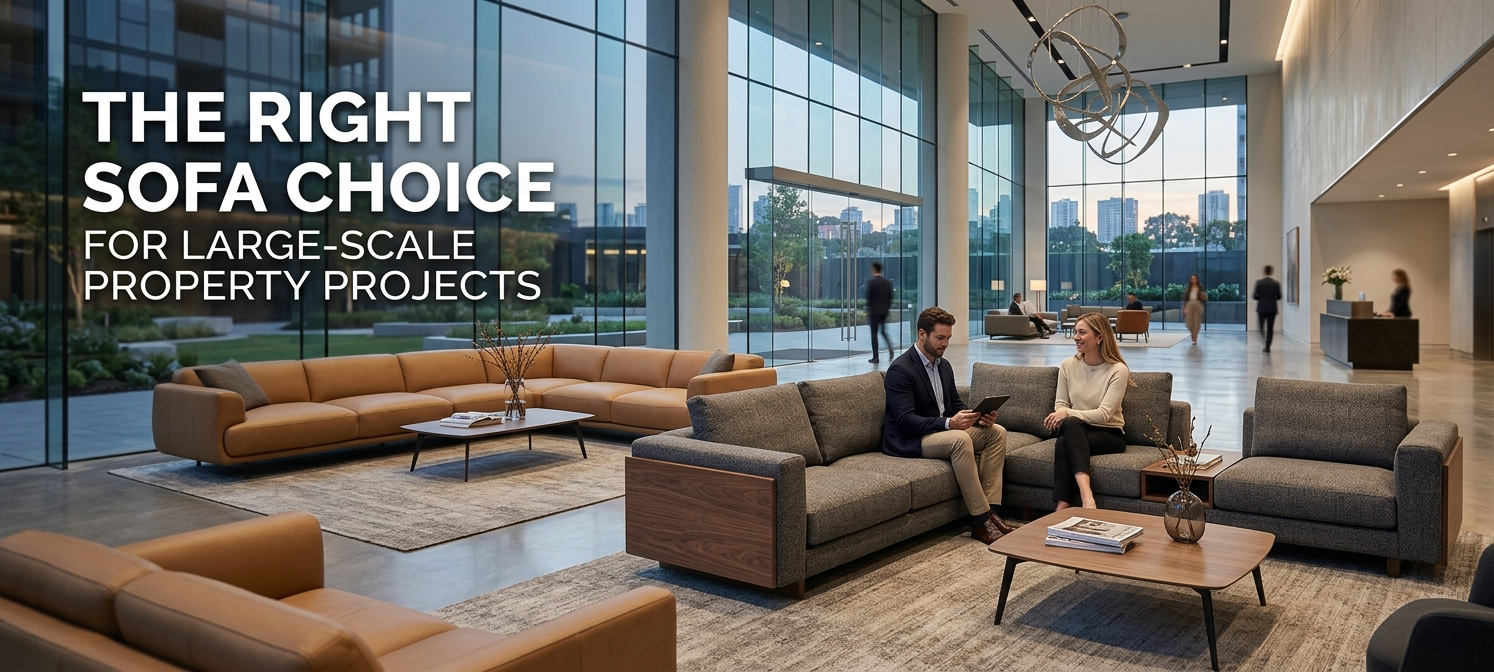
Procuring upholstered seating for a large-scale real estate development—whether a 200-key commercial hotel, a multi-block student housing project, or a luxury villa portfolio—requires a shift in evaluation metrics. Unlike residential retail buying, where a consumer selects based on immediate aesthetic appeal and soft initial comfort, commercial procurement demands strict engineering calculations.
A sofa deployed in a public or rental space must withstand high-frequency physical stress, maintain its structural profile under varying weight distributions, and optimize container shipping economics.
Foshan, housing the world’s most dense concentration of upholstered furniture factories, offers deep manufacturing capacity for these projects. However, securing a reliable return on investment requires specifying clear mechanical baselines before production lines are scheduled.
Key Takeaways
- Specify a Minimum of 35kg/m³ Foam Density: Lower densities degrade rapidly under commercial usage, leading to sagging, hollowed seats, and loose, wrinkled fabric coverings.
- Insist on Kiln-Dried Hardwood or Steel Sub-Frames: Restrict timber moisture content to below 12% to prevent structural warping when furniture transitions to climate-controlled rooms.
- Adopt Knock-Down (KD) Designs for Volume Constraints: Converting standard fixed silhouettes into modular, interlocking component packages reduces individual unit CBM, allowing up to three times more cargo per container.
- Verify Rub Counts and Fire Certifications Locally: Match fabric selections to your target market’s specific regulatory frameworks (e.g., CAL 117 or BS 5852) and enforce a minimum 30,000 Martindale rub threshold.
Why Does Fabric Specification Dictate the Long-Term Cost of a Property Project?
In high-occupancy commercial developments, the outer upholstery fabric is the first component to fail. Retail fabrics often look premium but lack the structural tight-weave backing needed to handle the friction of continuous tenant use. Selecting an unrated fabric leads to rapid surface pilling, fiber thinning, and split seams within the first year of operation.
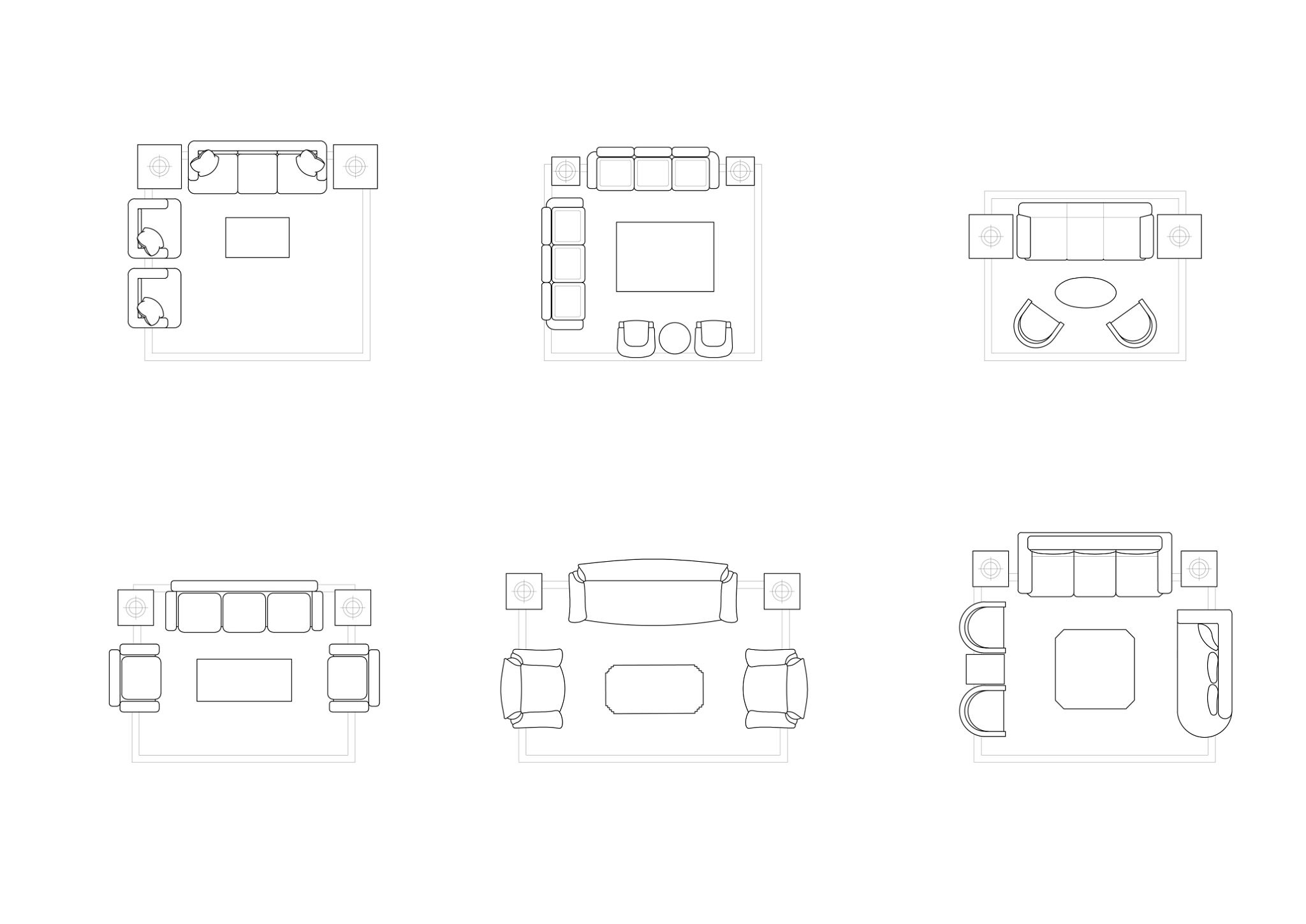
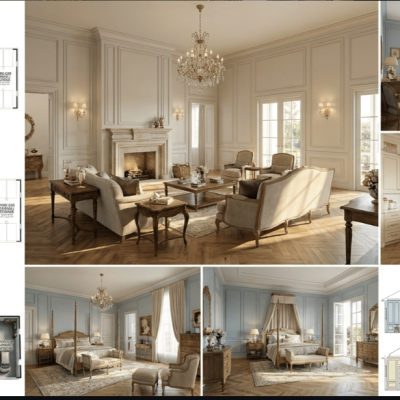
Spatial Footprint and Layout Engineering for Property Project Living Zones. Source: Afdol Jehyeng / Getty Images
When compiling your Bill of Quantities (BOQ), you must require factories to supply verified technical material data sheets. The primary metric to evaluate is abrasion resistance, measured via the Martindale or Wyzenbeek method. For standard apartment lounges, a minimum rating of 30,000 double rubs is mandatory. For high-traffic hotel lobbies or communal student lounges, this baseline should be elevated to 50,000 to 100,000 rubs.
Additionally, focus on stain management. Specifying fabrics treated with hydrophobic polymer coatings (such as nano-tech stain-release barriers) prevents liquids from penetrating into the underlying foam core, allowing property maintenance staff to clear spills using basic water-wipe protocols rather than deep steam cleaning.
How Can Procurement Managers Prevent Sofa Cushions from Sagging After 12 Months?
Cushion sagging is a common reason hospitality properties are forced to execute premature furniture replacement cycles. This failure stems directly from factories using low-density polyurethane foam or, worse, stuffed fiber fills and recycled scrap foam padding blocks to lower their production costs. Low-density foam contains large air pockets that collapse permanently under sustained mechanical pressure.
Low-Density vs. High-Resilience Foam Performance Over Time:
┌───────────────────────────────────────────────────────────────┐
│ Low-Density Retail Foam (<25kg/m³)                            │
│ [Initial: Plush/Soft] ──(12 Months Use)──> [Collapses / Sags]  │
├───────────────────────────────────────────────────────────────┤
│ High-Resilience Commercial Foam (35-45kg/m³)                  │
│ [Initial: Firm/Supportive] ──(Years of Use)──> [Retains Shape]│
└───────────────────────────────────────────────────────────────┘
To guarantee shape retention, the technical specification sheet must mandate the use of High-Resilience (HR) polyurethane foam with a core density rating between 35kg/m³ and 45kg/m³. HR foam features an irregular cell structure that compresses linearly and rebounds immediately when weight is removed.
For the seating base, this foam core should be wrapped in a thin layer of continuous dacron fiber batting to provide a smooth aesthetic look, and supported underneath by heat-tempered steel sinuous springs or high-tension elastomeric webbing bands spaced no further than 10cm apart.
What Role Does Internal Frame Geometry Play in Large-Scale Shipping Logistics?
Ocean freight rates significantly influence the landed cost of furniture assets. Traditional sofas are constructed as monolithic, non-yielding wooden blocks. Because a standard three-seater model typically measures roughly 2.2 meters in length and close to a meter in depth and height, it consumes between 1.5 CBM and 1.8 CBM of volume inside a shipping container.
This spatial inefficiency means a standard 40ft High Cube container hits its volumetric capacity at roughly 35 to 40 fully assembled units, leaving the container significantly under its maximum weight limit.
Container Volume Optimization (40ft HQ Container Capacity):
┌───────────────────────────────────────────────────────────────┐
│ Fully Assembled Traditional Sofas                             │
│ █ █ █ █ █ █ █ █ █ █ █ █ █ █ █ █ █ █ █ █ [35-40 Units Max]     │
├───────────────────────────────────────────────────────────────┤
│ Knock-Down (KD) Modular Fabricated Sofas                      │
│ ██████████████████████████████████████ [120-150 Units Max]    │
└───────────────────────────────────────────────────────────────┘
Large-scale property projects can resolve this through Knock-Down (KD) structural engineering. By designing the sofa so that the arm sections, rear backrest panel, and main seating platform detach and ship flat within standardized heavy-duty corrugated boxes, the volume per unit drops to approximately 0.4 CBM to 0.5 CBM.
This spatial optimization allows the exact same 40ft HQ container to hold 120 to 150 units. Beyond cutting your ocean freight costs per unit by up to 70%, flat-boxed components can be handled easily by a single worker on-site, fitting into standard service elevators and eliminating the risk of scraping finished corridor walls during building setup.
How Does Sourcing Directly from the Foshan Hub Reduce Procurement Risks?
Managing a bulk upholstered order via detached trading offices or scattered provincial factories introduces significant coordination risks. An upholstered sofa is a composite item requiring wood milling, steel spring formation, foam pouring, chemical flame-retardant treatment, and precision fabric stitching.
Foshan’s geographic specialization clusters these secondary supply layers within an immediate local area. Longjiang handles the mechanical hardware components and foam chemical formulations, while Lecong provides large-scale consolidation infrastructure.
This extreme industrial density allows for rapid engineering modifications. If a custom hotel sofa requires a modification to its internal framing to accommodate a specific electrical power hub or USB data plate within the armrest, the adjustment can be mapped out, prototyped, and structurally stress-tested within days rather than weeks, keeping your project execution on schedule.
Why Choose HSY Sourcing for Your Project?
Operating directly from the center of Foshan’s manufacturing districts, HSY Sourcing functions as your independent project management, quality engineering, and logistics consolidation office on the ground in China.
- Pre-Production Technical Auditing: We review your architectural drawings and furniture schedules to identify potential long-term issues. We ensure that the factory’s internal structural shop drawings incorporate correct bracket specs and precise assembly tolerances.
- Unannounced Production Floor Inspections: We do not accept factory-provided photos. Our quality control engineers conduct unannounced physical audits on the factory floor during production, checking frame timber moisture using digital meters and verifying foam density by weight before upholstery begins.
- Compliance Documentation Tracking: We oversee the collection and third-party verification of required environmental and safety documentation (such as CAL 117, BS 5852 Crib 5, or E0 formaldehyde ratings), ensuring your production run matches your local regional building codes.
- Volumetric Cargo Optimization: We utilize our local staging facility to receive, inspect, and organize your assets. We manage container loading plans directly, using heavy building materials to form a stable base layer while stacking your boxed compression furniture securely on top to maximize container capacity and prevent crushing.
Visit www.hsysourcing.com to submit your furniture schedules and project drawings. Let our ground engineers construct a stable, highly efficient, and transparent supply chain for your next property development.
Frequently Asked Questions (FAQ)
Q: Can we request custom sofa dimensions for small apartment floor plans without a massive price penalty?
A: Yes. Because Foshan’s contract factories utilize computerized CNC wood routers and automated fabric cutting tables, altering the length or depth of a sofa frame does not require expensive new tooling. As long as you meet the factory’s minimum order quantity (MOQ) for the project batch, physical size adjustments carry a minimal surcharge based strictly on raw material consumption.
Q: How do we verify that the factory is actually using high-resilience foam rather than cheap scrap foam?
A: We perform physical weight and compression audits directly on the production floor. Cheap recycled or low-density foam feels heavy due to added mineral fillers but lacks rebound velocity. We pull random cushion cores directly from the assembly line, compress them to 50% thickness, and measure the recovery time and cell uniformity under a magnifying tool to ensure structural compliance.
Q: What is the typical manufacturing lead time for an order of 100 apartment sofas in Foshan?
A: For standard configurations using available contract fabrics, the production window typically runs 25 to 30 days from final shop drawing approval. If your project requires custom-dyed fabrics, specialized fire-retardant chemical treatment, or custom frame adjustments, the timeline generally shifts to 35 to 45 days.