

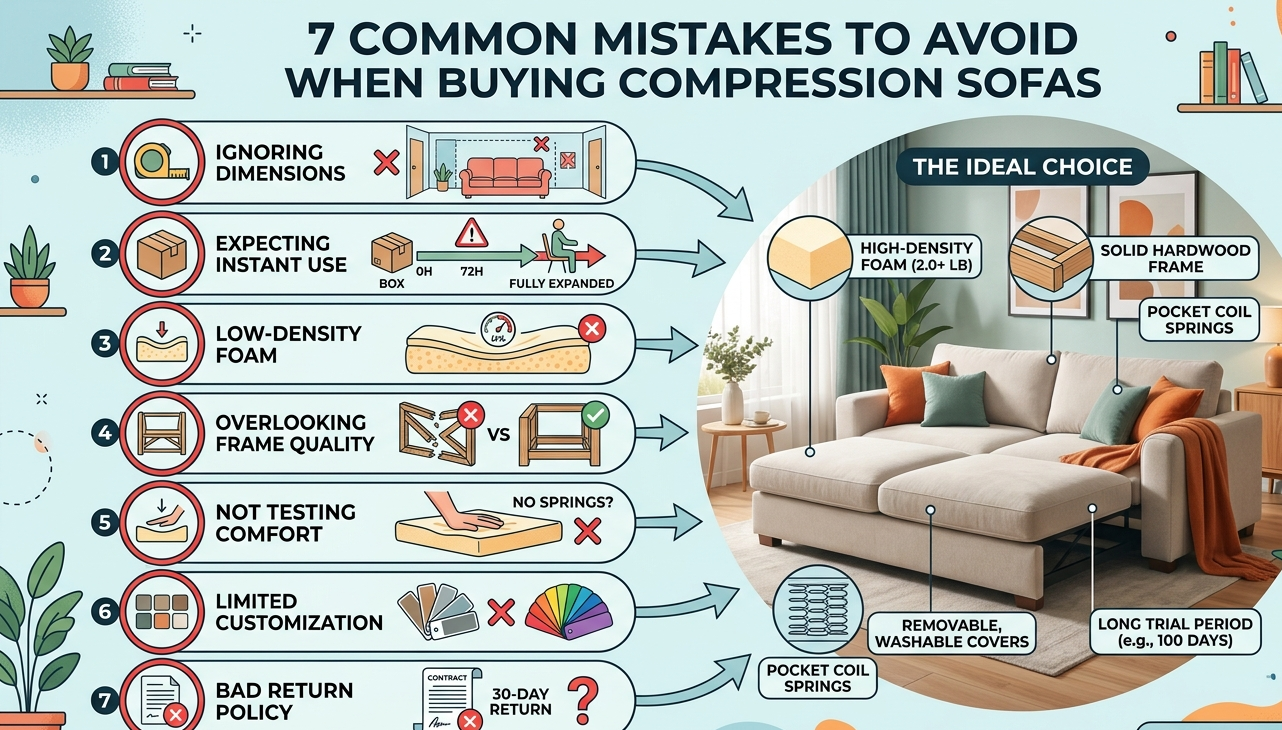
Key Takeaways:
- Foam Density is the Baseline: Never buy compression sofas utilizing foam under 35kg/m³. Low-density foam will collapse permanently under vacuum pressure.
- Mind the Storage Clock: Compressed furniture has an expiration date in its packed state. Leaving units sealed for over 3 to 4 months causes irreversible deformation.
- Fabric Structural Limits: Natural fibers like linen and heavy pile velvets do not survive long-term vacuum packing without permanent aesthetic damage.
- Machine Capability Matters: Small workshops using manual shop vacuums cannot maintain the sealed environment needed for long ocean voyages; commercial hydraulic compression is required.
Using vacuum-compressed sofas is one of the most effective ways to lower logistics costs for multi-unit property developments. By removing the “empty air” from seating, you can pack up to three times as many units into a single 40HQ container, significantly reducing your freight cost per key.
However, vacuum compression subjects furniture to extreme structural stress. If you treat compressed sofas exactly like traditional furniture during the procurement phase, you run a high risk of receiving deformed, wrinkled products that cannot be used in a commercial project.
Below are the seven most common mistakes procurement managers make when sourcing compression sofas from China, and how to avoid them.
Why Does Low-Density Foam Ruin a Compression Sofa Project?
The single most expensive mistake you can make is approving a cheap foam specification to save on the initial unit cost.
When a sofa is vacuum-sealed, the air is completely extracted from the polyurethane foam cells, flattening the material under immense pressure. When unboxed, the foam relies on its own cellular elasticity to pull air back in and rebound to its original shape.
[Standard Cheap Foam (<30kg/m³)]  --> Vacuum Pressure --> Cell Walls Collapse Permanently --> Deflated, Lumpy Sofa
[High-Resilience Foam (≥35kg/m³)] --> Vacuum Pressure --> Cells Flex But Keep Elasticity --> 98% Rebound to Sharp Edges
Budget factories frequently use 25kg/m³ to 28kg/m³ foam. Under compression for a 30-day ocean voyage, the cell walls in this low-density foam rupture and collapse permanently. The sofa will arrive looking lumpy, loose, and severely undersized. For commercial projects, you must explicitly specify High-Resilience (HR) foam with a minimum density of 35kg/m³ for backing and 40kg/m³ to 45kg/m³ for seat cushions.
Which Fabric Choices Lead to Permanent Wrinkles After Unboxing?
Not every upholstery fabric is structurally suited to handle being crushed into a tight roll or flat box for weeks at a time.
Procurement teams often select fabrics based solely on design swatches without considering structural memory.
- Linen and Cotton Blends: These natural fibers lack elasticity. Once compressed, they develop sharp, hard creases that often require industrial steaming to remove—adding major labor costs on-site.
- Heavy Pile Velvets: The intense plastic wrapping pressure permanently flattens the nap (pile) of the velvet, leaving shiny, discolored pressure lines across the cushions.
For compression furniture, stick to high-polyester synthetic performance fabrics, structural microfibers, or specialized tech-leathers. These materials possess high physical memory, meaning they naturally smooth out as the internal foam expands.
How Long Can You Safely Keep Sofas Vacuum-Sealed in a Warehouse?
A compression sofa is not a non-perishable good. It has a strict countdown timer that begins the moment the hydraulic press seals the plastic wrap.
A common project management failure is ordering the furniture too early, causing the compressed pallets to sit in a transit warehouse or on the job site for months while waiting for drywall or flooring installation to finish.
The 3-Month Rule: High-resilience foam can comfortably recover after 30 to 45 days inside a container. However, if left compressed past 90 to 120 days, even premium foam begins to lose its rebound capacity.
Ensure your local sourcing agent coordinates production schedules precisely with your shipping departure, so the sofas are unboxed as soon as possible after arriving at the destination.
Why Is Relying on a Factory’s Standard Frame a Risk for Commercial Use?
If you are buying compression sofas for a high-traffic environment like a hotel lobby, student housing, or short-term holiday rentals, an “all-foam” design may not provide enough structural longevity.
Many buyers assume compression sofas only come as unstructured foam blocks. The mistake is failing to ask for Knock-Down (KD) structural frames.
| Sofa Structure | Longevity Type | Shipping Efficiency | Best Used For |
| All-Foam Modular | Medium Durability | Maximum (Roll-Packed) | Modern Apartments, Lounges |
| Standard Fixed Frame | High Durability | Poor (Massive CBM) | Traditional Luxury Hotels |
| Knock-Down (KD) Frame | High Durability | Excellent (Flat-Packed + Compressed Cushions) | Commercial Multi-Unit Projects |
By specifying a KD frame, the solid wood or steel inner chassis is flat-packed into a carton, while only the high-density cushions are vacuum-sealed. This gives you the rigid support of a commercial-grade sofa with the volumetric shipping advantages of compression packing.
What Happens If the Factory Uses Inadequate Compression Equipment?
Industrial vacuum packing requires heavy hydraulic machinery that exerts consistent, uniform tonnage across the entire surface of the sofa before the bag is heat-sealed.
Smaller, lower-tier workshops in furniture hubs often try to mimic this process using simple manual shop vacuums and thin plastic wrap. While the package may look tight when it leaves the workshop floor, these low-grade seals almost always fail.
During the vibrations and temperature fluctuations of ocean freight, microscopic leaks develop. The sofa slowly sucks in air inside the box, expanding prematurely. This causes the cardboard boxes to warp, burst, and jam against other cargo inside the shipping container, making decompression dangerous and unloading highly inefficient.
Are You Forgetting Country-Specific Commercial Fire Certifications?
When sourcing custom or wholesale furniture from overseas, aesthetic appeal often overshadows local legal compliance.
For residential villas, standard foam may pass customs. However, for commercial developments, apartments, and hotels, local building regulations are strictly enforced:
- United States: Must comply with CAL 117 (California Technical Bulletin 117-2013) for flame retardancy.
- United Kingdom: Must meet the much stricter BS 5852 fire regulations.
- Australia: Requires compliance with AS/NZS 3744 standards.
You cannot simply add fire-retardant chemicals to low-density foam; the chemical treatment alters the foam’s cell structure. The factory must formulate the high-density HR foam specifically to meet these certifications before running it through the compression line.
Why Is Skipping a 30-Day Pre-Shipment Sample Test a Costly Mistake?
Never allow a factory to begin bulk production on a compression order based on a standard, uncompressed showroom prototype.
The final, crucial mistake is failing to run a localized compression simulation. Before wire-transferring the bulk production deposit, require your sourcing agent to execute a physical test protocol on the golden sample:
[Produce 1 Prototype Sample] --> [Compress in Factory Machine] --> [Store in Warehouse for 30 Days] --> [Unbox & Measure Rebound Rate]
If the cushions fail to restore their exact dimensions, or if the seams show signs of tearing under tension, the product design must be modified before the factory line begins cutting fabric for your 100-unit order.
Why Choose HSY Sourcing for Your Furniture Procurement?
Operating directly out of the Foshan furniture manufacturing cluster, HSY Sourcing serves as your technical protective barrier against these common procurement failures.
- Physical Density Verification: We don’t just rely on factory spec sheets. Our QC team uses portable testing equipment to physically verify that the foam blocks being loaded into your sofas meet the mandatory 35kg/m³–45kg/m³ density requirements.
- Machinery & Seal Audits: We inspect the actual compression lines of our partner factories in Longjiang, ensuring they utilize heavy-duty hydraulic machinery and commercial-grade, puncture-resistant polymer bags that will hold a vacuum seal for the duration of long ocean voyages.
- Strict Certification Checks: We verify that flame-retardant foam formulations and fabric coatings match the exact certification paperwork required by building inspectors in your destination country (CAL117, BS5852, etc.).
- Logistical Optimization: We ensure your flat-packed frames and vacuum-sealed cushions are loaded in the correct structural sequence inside the container, preventing heavy building materials from crushing your furniture assets during transit.
Visit www.hsysourcing.com to submit your project’s furniture schedule, and let our team ensure your bulk order is engineered correctly for long-haul transport.
Frequently Asked Questions (FAQ)
Q: Can a vacuum-compressed sofa be re-compressed if our project site moves its delivery date?
A: No. Re-compressing a sofa using manual tools on-site is practically impossible without industrial hydraulic machinery. Additionally, subjecting foam to a second cycle of heavy compression severely degrades its lifespan. If your site faces delays, it is much better to store the furniture in its original compressed state in our Foshan warehouse until the site is ready.
Q: Do the seams of the sofa stretch or rip during the vacuum-sealing process?
A: This happens if the factory uses standard stitch lengths or low-tensile sewing threads. For compression furniture, factories must utilize reinforced double-stitching with high-tensile nylon thread to withstand the lateral forces generated when the foam is flattened and rolled.
Q: Will a compressed sofa feel softer or different from a traditional, non-compressed sofa once it fully expands?
A: If premium High-Resilience foam (above 35kg/m³) is used, there will be no perceptible difference in firmness or comfort compared to a standard sofa. If cheap, low-density foam was substituted, the sofa will feel significantly softer, unsupportive, and hollow within days of unboxing.