
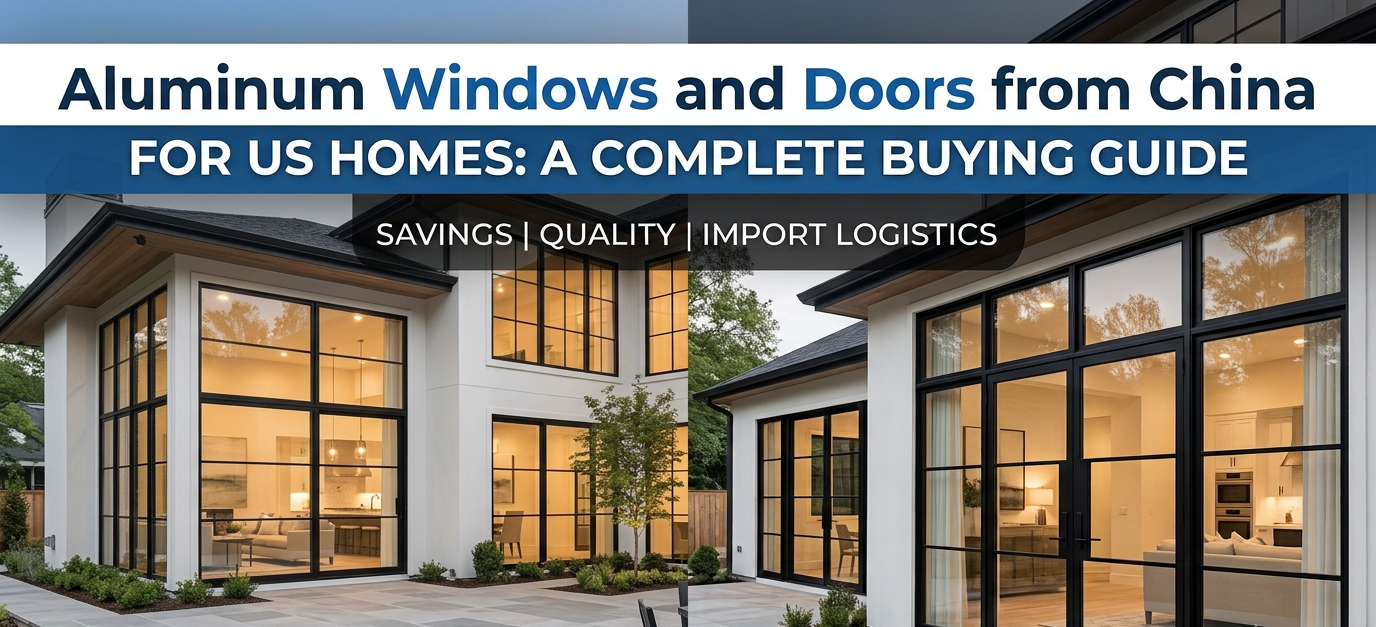
Enclosing a luxury custom villa in the United States with high-performance glazing is one of the most capital-intensive phases of construction. Floor-to-ceiling slim-frame sliding systems, motorized pocket doors, and large-curtain-wall assemblies from North American or European brands often represent a significant portion of the total build budget, with lead times ranging from four to eight months.
Foshan, Guangdong—specifically the Nanhai district—houses the world’s most concentrated manufacturing cluster for architectural aluminum extrusions and structural glazing systems. Chinese fabricators offer high-end thermal break technology, narrow-sightline profiles, and multi-point German or Italian locking hardware at competitive price points.
However, importing custom windows and doors for a US residential project requires strict attention to detail. Differences in structural load calculations, glass safety certifications, thermal insulation requirements, and imperial-to-metric conversions mean that buying off-the-shelf catalog items from overseas carries real risks.
This guide details the technical requirements, code compliance checks, profile selections, and quality assurance protocols necessary to successfully source luxury aluminum window and door systems from Foshan for US residential builds.
Key Takeaways
- Code Compliance is Essential: All glass installed in US residential projects must carry physical SGCC (Safety Glazing Certification Council) or IGCC certification marks stamped directly on the glass.
- Specify Thermal Breaks Correctly: Do not import non-thermal aluminum profiles into US climate zones requiring energy compliance. Specify PA66 GF25 (Polyamide 66 with 25% glass fiber) thermal break strips to meet target U-Factors.
- Hardware Dictates Durability: High-performance door assemblies rely on heavy-duty stainless steel rollers and concealed multi-point locking systems (e.g., Sobinco, Giesse, Siegenia, or premium local brands like HOPO).
- Accurate Shop Drawings Are Mandatory: Manufacturing must never proceed based on architectural elevation drawings alone. Factory CAD shop drawings with exact rough opening (R.O.) dimensions, sub-frame details, and sill drainage channels must be formally approved by the US general contractor.
- On-Ground Technical Oversight Prevents Rework: Working with a Foshan-based sourcing agent like HSY Sourcing ensures third-party profile wall thickness verification, pre-shipment water tightness testing, and container loading supervision.
Why Are US Custom Builders Sourcing Aluminum Windows and Doors from Foshan?
The primary driver is the balance between architectural customization, material quality, and total cost. Foshan produces over 30% of China’s architectural aluminum extrusions, hosting an integrated ecosystem of die-makers, surface finishing plants, glass processors, and assembly factories within a 20-mile radius.
[Aluminum Billets (6063-T5/T6)] ➔ [Extrusion & Anodizing/AAMA 2605]
                                          │
[SGCC Low-E Glass Units] ➔ [Assembly & PA66 Thermal Break] ➔ [Dry-Fit QC & Export]
For custom luxury villas requiring expansive glass panels—such as 10-foot to 12-foot tall sliding glass walls, corner glass-to-glass units, or integrated bi-fold door systems—US domestic lead times can exceed 30 weeks, accompanied by high custom engineering surcharges.
Foshan manufacturers utilize advanced CNC machining centers and automated insulating glass unit (IGU) lines. They can produce custom-extruded, thermally broken profiles with narrow sightlines (as thin as 20mm to 35mm visible frame width) in 6 to 8 weeks. Even after accounting for ocean freight and import duties, US custom builders typically realize 30% to 50% overall cost savings while acquiring structural configurations that standard domestic distributors treat as custom orders.
What Structural, Thermal, and Safety Standards Must Chinese Windows Meet for US Building Codes?
Imported window and door assemblies will face scrutiny from local building inspectors in the United States. Before issuing production deposits, verify that your chosen manufacturer can fabricate to these four core US benchmarks:
1. Safety Glazing Compliance (SGCC / ANSI Z97.1)
Any glass installed adjacent to doors, in wet areas (bathrooms), or within 18 inches of the floor must be safety glazing (tempered or laminated). US inspectors require a permanent, etched certification mark in the corner of every glass pane showing compliance with ANSI Z97.1 and CPSC 16 CFR 1201, certified by the SGCC (Safety Glazing Certification Council) or equivalent accredited testing body.
2. Thermal Performance Guidelines (NFRC Parameters)
Energy codes in the US (such as Title 24 in California or IECC standards nationwide) mandate specific U-Factors (thermal transmittance) and SHGC (Solar Heat Gain Coefficient) ratings depending on your climate zone:
| Climate Zone | Recommended U-Factor (BTU/h·ft²·°F) | Recommended SHGC | Profile & Glass Spec Strategy |
| Zone 1–2 (Hot/Humid – FL, TX, AZ) | ≤ 0.40 | ≤ 0.25 | Thermal Break + Double Glazed Low-E + Tint/Solar Control |
| Zone 3–4 (Mixed – NC, CA, VA) | ≤ 0.30 | ≤ 0.25–0.40 | PA66 Thermal Strip (24mm+) + Double Low-E + Argon Fill |
| Zone 5–7 (Cold – NY, IL, CO) | ≤ 0.22 – 0.26 | ≥ 0.20–0.40 | PA66 Thermal Strip (34mm+) + Triple Glazed Double Low-E + Argon |
Note: While small-scale custom factories in China may not always hold active NFRC physical lab listing stickers for every custom profile, they can build to these thermal targets using verified components (e.g., Technoform thermal strips, double-pane Low-E glass with warm-edge spacers).
3. Hurricane & Impact Resistance (ASTM E1886 / E1996)
For coastal builds in Florida, Texas, or the Carolinas, windows must withstand wind-borne debris. This requires laminated glass configurations using structural interlayers such as Kuraray SGP (SentryGlas) or heavy-gauge PVB. Frame profiles must feature reinforced aluminum wall thickness (minimum 2.5mm–3.0mm) and stainless steel corner cleats.
4. Surface Finish Durability (AAMA Specifications)
Exterior aluminum profiles must withstand UV exposure, salt spray, and atmospheric pollution. Specify exterior coatings that conform to AAMA 2604 (5-year weatherability) or AAMA 2605 (10-year high-performance fluoropolymer/PVDF paint from AkzoNobel or PPG) to prevent fading, chalking, or peeling over time.
How Do You Select the Right Aluminum Profile, Thermal Break, and Glass Configuration?
Not all aluminum windows manufactured in Foshan are built to the same engineering standard. Selecting the correct technical specifications is crucial to long-term performance.
+-----------------------------------------------------------------------+
|                       TYPICAL THERMAL BREAK CROSS-SECTION              |
|                                                                       |
|   [Exterior Aluminum Profile] ◄── 6063-T6 Alloy (2.0mm Wall)          |
|                 │                                                     |
|         ================= ◄── PA66 GF25 Polyamide Strip (24mm–34mm)   |
|                 │                                                     |
|   [Interior Aluminum Profile] ◄── 6063-T6 Alloy (1.8mm Wall)          |
+-----------------------------------------------------------------------+
Profile Alloy and Wall Thickness
- Alloy Grade: Ensure the factory uses 6063-T5 or 6063-T6 primary billet aluminum (avoid recycled aluminum scrap).
- Profile Wall Thickness: For standard casement/tilt-and-turn windows, wall thickness should be at least 1.4mm to 1.8mm. For large structural sliding doors (10ft+ height), specify wall thicknesses between 2.0mm and 3.0mm to prevent frame deflection under wind load.
Thermal Break Method: Strip vs. Pour-and-Debridge
- Polyamide Strip System (PA66 GF25): The industry standard for high-performance windows. Two separate aluminum extrusions are mechanically joined by structural polyamide strips reinforced with 25% fiberglass. This method allows multi-color options (different interior and exterior frame finishes) and superior structural integrity.
- Pour-and-Debridge: Liquid polyurethane is poured into a single aluminum channel and cut back. While thermal performance is acceptable, strip systems offer higher shear strength for large architectural glass doors.
Insulating Glass Unit (IGU) Specifications
A standard high-performance IGU configuration for US residential installations consists of:
- Outer Pane: 6mm Tempered Clear or Extra-Clear (Low-Iron) Glass.
- Air Gap: 12mm to 18mm aluminum or warm-edge spacer filled with 90%+ Argon Gas.
- Inner Pane: 6mm Tempered Glass with a high-performance Single or Double Low-E Coating (e.g., Xinyi or CSG glass) on Surface #2 or #3.
What Are the Critical Quality and Dimensional Risks in Overseas Window Manufacturing?
Importing custom window frames and glass packages across the Pacific leaves zero room for site adjustments if dimensions or details are incorrect. The most common technical failure points include:
- Inaccurate Rough Opening (R.O.) Deductions: Chinese factories manufacture to exact unit dimensions. If your US builder provides rough opening sizes without deducting clearance for installation shims, expanding foam sealant, and sub-frame flashing (typically 1/2″ to 3/4″ total deduction), the window frame will not fit into the wall cavity.
- Inadequate Sub-Frame and Sill Drainage: High-end modern windows require flush-bottom tracks for sliding doors. Without proper sub-sill drainage channels, weep holes, and check-valves, wind-driven rain can back up and penetrate interior hardwood flooring.
- Incompatible Sub-Fin / Flashing Details: Standard Chinese window frames are often designed for masonry wall construction (flushed installation with masonry anchors). For US wood-frame construction (2×4 or 2×6 stud framing), you must explicitly specify nailing fins (flange installation) positioned at the correct setback distance from the exterior face.
- Hardware Failure under Heavy Loads: Massive panel sliding doors (weighing 300–600 lbs per panel) require heavy-duty tandem stainless steel roller carriages and solid stainless steel tracks. Sub-standard rollers will freeze or wear out within months.
What Does a Step-by-Step Window & Door Sourcing Workflow Look Like?
To systematically manage risk, your procurement process should follow an established technical sequence:
[1. Architectural Review] ➔ [2. Sub-Frame & Flange Spec] ➔ [3. CAD Shop Drawings]
                                                                  │
[6. Container Loading] ◄── [5. Water & Assembly QC] ◄── [4. Sample & Extrusion]
- Architectural Elevation Review: Transmit window schedules, elevation sheets, site wind-load requirements, and target energy values to the engineering team.
- Sub-Frame & Nailing Fin Strategy Selection: Determine whether windows will be installed using integrated perimeter nailing fins, structural sub-frames (buck installation), or direct strap anchors based on your wall framing detail.
- CAD Shop Drawing Generation & Approval: The factory produces detailed CAD shop drawings showing profile cross-sections, glass build-ups, overall unit sizes, rough opening clearances, weep hole positions, and hardware placement. The US architect or general contractor must sign off on these drawings.
- Sample & Profile Approval: Hardware swatches, corner profile cutaways showing thermal breaks, and powder-coating color chips are dispatched via express courier for physical review.
- Mid-Production Audit & Mock-up Testing: Factory assembly is audited. For major custom villa packages, a full-scale mock-up of key window units is assembled in the factory to perform water spray tests and operational checks.
- Export Packaging & Crating: Glass and frames are packed separately or as complete units (depending on size). Structural frames are wrapped in protective film; glass panels and complete windows are secured inside ISPM 15 heat-treated, fully enclosed wooden crates with internal steel strapping and foam cushioning.
Why Choose HSY Sourcing for Your Villa’s Window and Door Package?
Navigating specialized window extruders in Foshan without dedicated local engineering oversight exposes your project to quality and communication risks. HSY Sourcing operates as your independent technical procurement representative directly on the ground in Foshan.
- On-Ground Architectural CAD Reconciliation: We do not simply pass factory drawings back and forth. Our team verifies Chinese factory CAD shop drawings against your US architectural wall sections, ensuring correct nailing fin setbacks, rough opening deductions, and structural sub-frame interfaces.
- Physical Factory Audits & Material Verification: We physically inspect the window manufacturing facilities in Nanhai and Shunde. We verify profile wall thickness using digital calipers, test coating thickness with mil gauges, and inspect glass SGCC compliance stamps before assembly begins.
- Factory Water-Tightness & Operation QC: Before your order is crated, we perform on-site functional testing—verifying multi-point lock alignment, smooth roller operation on large sliding doors, and water spray resistance on factory mock-ups.
- Full Villa Material Consolidation: We manage your window and door package alongside other custom finishings (such as cabinetry, tiles, stone, and sanitary ware) from our local Foshan warehouse. We pack and load full containers (FCL) to minimize freight costs and prevent shipping damage.
- Transparent Pricing & Trade Security: We operate on a clear agency service model, securing true factory-direct pricing without hidden markups or unauthorized component substitutions.
Frequently Asked Questions (FAQ)
Can Chinese window manufacturers provide embedded perimeter nailing fins for US wood-frame construction?
Yes. Leading Foshan export factories manufacture profiles with integrated perimeter nailing fins (typically 1″ to 1-1/2″ flange depth) or snap-on aluminum fins specifically engineered for US wood-stud framing installations. This detail must be specified during the shop drawing phase.
How are oversized sliding glass doors packaged to prevent damage during ocean transit?
For extra-large glass panels (e.g., 10ft x 8ft panels), frames are shipped in knock-down (KD) format with pre-machined corner cleat joints. Insulated glass units are packed vertically inside custom-built steel-reinforced wooden A-frames or enclosed crates fitted with shock-absorber pads, desiccant bags, and moisture barriers.
What is the typical total timeline for a custom villa window package from Foshan to a US jobsite?
The complete timeline generally ranges from 12 to 16 weeks:
- 3–4 weeks: Engineering review, shop drawing sign-offs, and color sample approval.
- 5–6 weeks: Aluminum extrusion, thermal break assembly, glass tempering/IGU fabrication, and factory QC.
- 4–6 weeks: Ocean transit, port clearance, and final delivery to your US site via flatbed truck.
Do I need to order extra glass panes in case of breakage during transportation or jobsite installation?
For complex custom-sized glass units or specialized Low-E coatings, it is best practice to order 1–2 extra replacement glass panes for primary units (or include them in the crate container). Because freight for a single replacement glass pane after the container arrives is expensive, having spare glass on-site protects your construction timeline against jobsite accidents.