
Everyone wants to be the next big name on Amazon or the “disruptor” in the kitchen appliance niche. The dream is simple: find a cool air fryer in China, slap your logo on it, and watch the sales roll in.
But if you’ve actually tried doing this from your laptop in London or New York, you know it’s not that easy. Shunde is the “Appliance Capital of the World,” but it is a maze of thousands of factories. Some are world-class; others are just assembly sheds.
If you want to build a real private label brand that lasts longer than a single season, you need to understand the “unfiltered” steps of the process.
Why can’t I just put my logo on any appliance I find?
Technically, you can. It’s called “white labeling.” You find a factory’s existing model and print your logo on the side. But here is the catch: If you can buy it that easily, so can everyone else. If ten other sellers are selling the exact same white-label blender from the same Shunde factory, the only way you can compete is by lowering your price. That’s a race to the bottom.
To build a Private Label brand, you need to offer something slightly better—a better color, a better set of accessories, or a higher-quality motor (like the copper ones we discussed in our last post). This requires a factory that is willing to listen to your “small” changes.
How do I find a factory that actually wants my “small” order?
In Shunde, there are two types of factories you’ll run into:
- The Giants: They make the appliances for Midea, Philips, or Black & Decker. They are amazing, but they will ignore you. Their MOQ (Minimum Order Quantity) is usually 3,000 to 5,000 units. If you want 500, they won’t even reply to your email.
- The Specialized Mid-Tier: This is where the magic happens. These factories have 100-300 workers. They have their own R&D team but are still “hungry” enough to take a chance on a growing brand.
Our job as your agent is to find the mid-tier guys who have the right machines but are flexible enough to accept an MOQ of 1,000 (the standard starting point for most electronics).
Who pays for the certifications (CE, ETL, RoHS)?
This is the most common point of confusion.
- The Factory’s Certs: Most Shunde factories have their own CE or ETL certificates for their standard models.
- The Problem: Those certificates are in their name, not yours. If you want the product to be legally under your brand name (which you need for big retailers or insurance), you have to pay for a “Multiple Listing” (ML).
This basically “copies” their safety certification over to your brand name. It’s a paperwork fee (usually $500 – $1,500 depending on the lab), but it’s a cost many new importers forget to budget for. If a factory says “Don’t worry about it,” they are usually being lazy, and you are the one who will face the legal risk.
Can I change the color or design without spending a fortune?
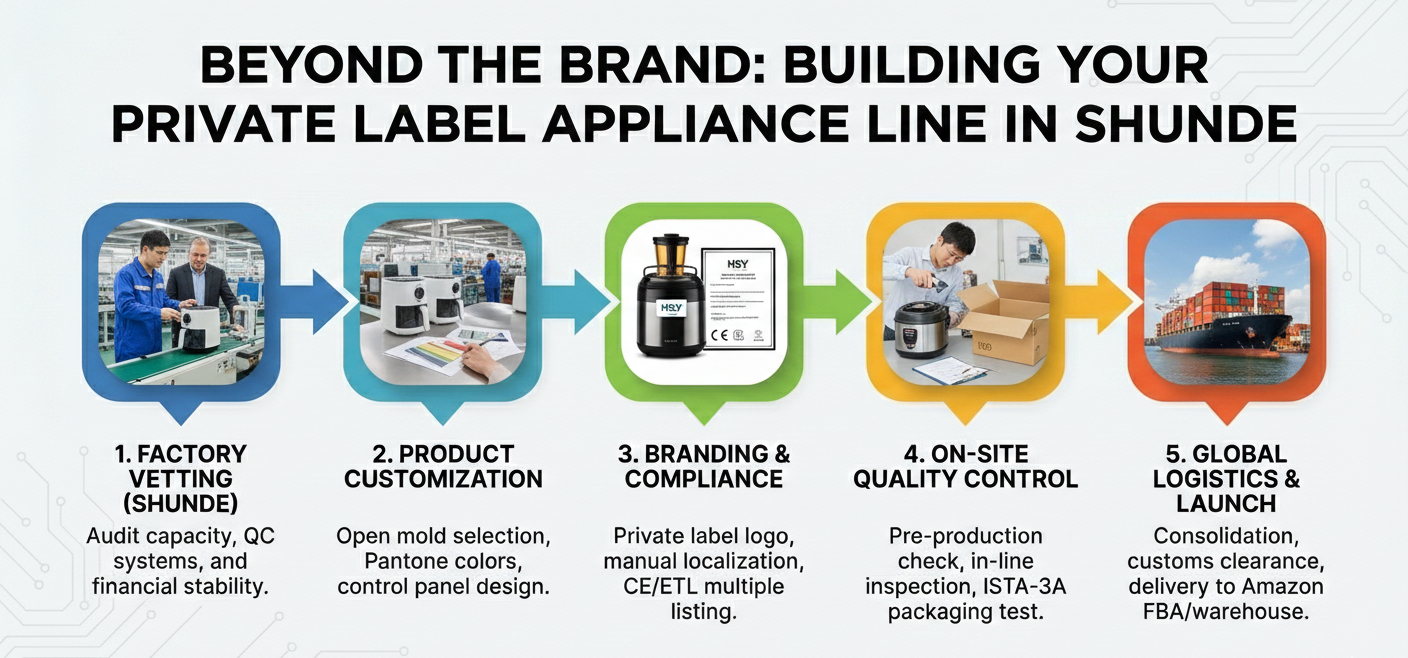
If you want a unique shape that no one else has, you have to pay for “Tooling” (New Molds). For a medium-sized air fryer, a full set of plastic molds can cost $30,000 to $50,000. For most startups, that’s too expensive.
The “Real World” Alternative:
- Custom Pantone: You can ask the factory to use a specific color for the plastic. Most factories will do this for free if your order meets their MOQ.
- Control Panel Customization: Changing the icons or the layout of the digital touch screen is much cheaper than changing the plastic shell. This is the fastest way to make an appliance look “yours.”
Why is the box almost as important as the machine?
If you are an Amazon seller, the box is your biggest enemy. Shunde factories love “Retail Packaging”—thin, pretty boxes meant for a shelf in a supermarket.
If you put that thin box into a shipping container and then mail it to a customer, it will arrive smashed. Amazon will give you a “Defective Product” strike. As your agent, we insist on ISTA-3A Packaging Standards. This means double-walled cardboard and internal foam that can survive a 1-meter drop. It might cost $0.50 more per unit, but it saves you $5.00 in returns.
How we manage the chaos on the ground
Building a private label line isn’t a “set it and forget it” business. It’s about checking the details:
- Did the factory use the right color Logo?
- Is the instruction manual written in “real” English or “Google Translate” English?
- Is the plug the right one for your country? (You’d be surprised how often factories get this wrong).
We are in Shunde every week. We don’t just look at samples; we look at the first 100 units off the line. If the logo is crooked on the first 100, we stop the line before they make 1,000.
Building your own brand is the best way to make a real profit in the appliance business. It just takes a bit of “boots on the ground” reality to make it happen.
FAQ: The “No-Nonsense” Truth About Private Labeling
Q: Can I start my brand with just 100 or 200 units?
A: Honestly? It’s tough. For appliances, Shunde factories usually order the plastic housing, the gift boxes, and the instruction manuals from their sub-suppliers in batches of at least 1,000. If you only want 100, the factory has to charge you for the wasted materials. We can sometimes negotiate 500 units if we use a “standard” box with a custom sticker, but for a fully branded experience, 1,000 is the realistic entry point.
Q: Does the factory’s CE/ETL certificate cover my brand too?
A: Legally, no. The certificate is tied to the factory’s name. If you sell the product under “Your Brand Name,” the original certificate won’t match your invoice. You need a Multiple Listing (ML). We help coordinate this with labs like Intertek or SGS. It costs a bit of money and takes 2–4 weeks, but it’s the only way to sleep at night knowing your insurance and customs paperwork are solid.
Q: Can I just send you a photo from Pinterest and have a factory make it?
A: We wish it were that easy. Unless you have $30,000+ for new injection molds, we have to start with a factory’s “Open Mold” (existing design). We then “brand” it using custom colors, different button layouts, or unique accessories. This gives you a custom look without the massive R&D cost.
Q: How do I know the “Sample” I see isn’t better than the “Mass Production”?
A: This is called the “Golden Sample Trap.” The factory spends days making one perfect sample for you. To prevent the mass production from being lower quality, we seal the sample. We keep one, you keep one, and we give one to the factory. During our final inspection, we compare the production line items directly to the sealed sample. If the plastic feels thinner or the motor sounds louder, they don’t get paid until it’s fixed.
Q: What happens if the product fails after it arrives in my country?
A: This is why we are here. Most Shunde factories offer a 1% FOC (Free of Charge) spare parts policy. We negotiate for the most critical parts (like circuit boards or sensors) to be included in your container. If there’s a major systemic failure, having a local agent means we go to the factory office in person to negotiate a credit or replacement for your next order. Trying to do that over email from 5,000 miles away is almost impossible.