
For international developers, hotel procurement executives, and commercial general contractors, sourcing building materials from China is a proven method to optimize project budgets. However, importing containers of construction finishes is not as simple as visiting a generic wholesale market.
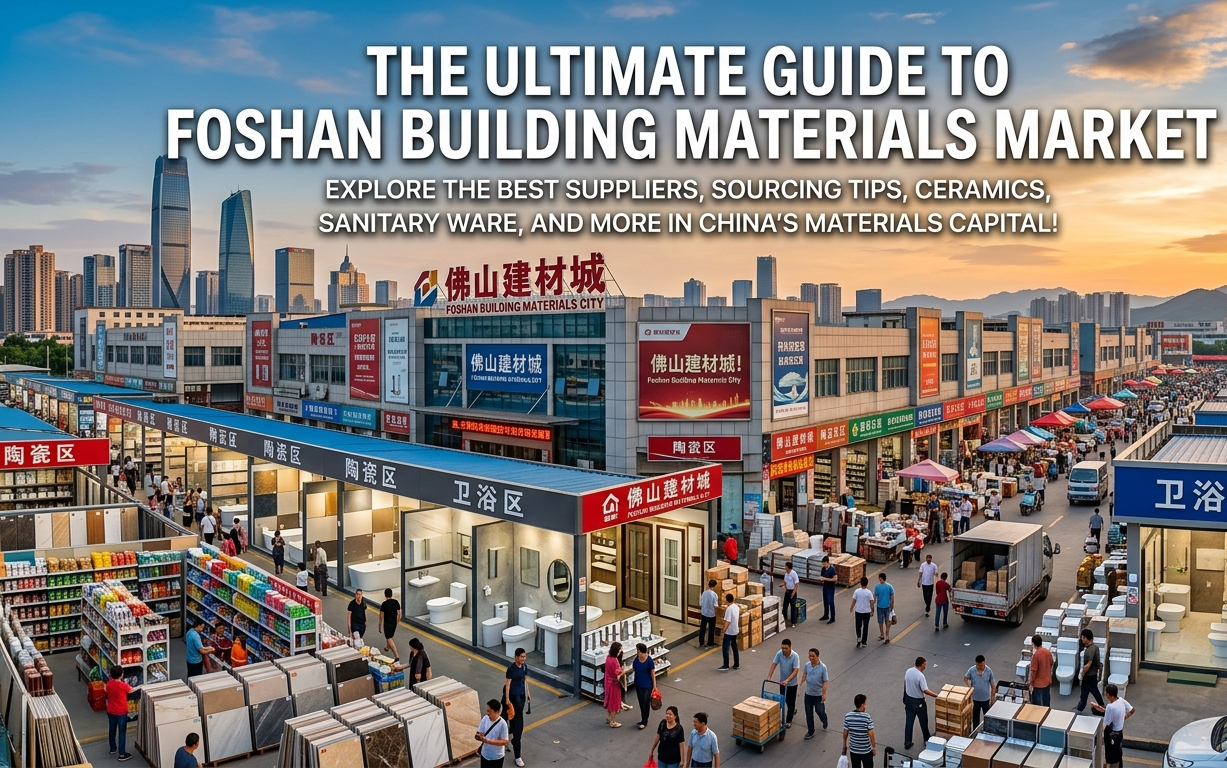
Foshan is recognized globally as the capital of building materials and furniture. But “Foshan” is not a single market under one roof; it is a massive municipal industrial zone divided into highly specialized, district-level manufacturing clusters.
To prevent expensive logistical mistakes and avoid wasting weeks on the ground, project buyers must understand the exact geographical distribution of these markets, the differences between wholesale trading centers and direct OEM factories, and the mechanics of local cargo consolidation.
Key Takeaways
- Geographical Specialization: Foshan’s markets are segregated by product category. You must visit Chancheng for ceramics, Lecong for furniture, Dali for aluminum fenestration, and Leliu for structural hardware.
- High-Volume vs. Showroom Sourcing: While major showrooms (like China Ceramics City or Louvre Furniture Mall) are excellent for design inspiration and custom prototyping, actual bulk order fulfillment should be negotiated directly with direct-to-factory OEM lines located in the surrounding industrial parks.
- Consolidation is the Profit Margin: Managing a multi-category project build requires centralized warehouse staging in Foshan to combine heavy materials (tiles, marble) with volumetric goods (flat-pack cabinetry, sofas) to optimize container payload limits.
Where are the primary building material markets located in Foshan?
Navigating Foshan efficiently requires treating the city as a map of separate industrial districts. Attempting to source tiles, cabinetry, and windows in a single day is geographically impossible. Below is the actual distribution of the core wholesale and manufacturing clusters:
1. Ceramics and Sanitary Ware (Chancheng and Nanzhuang Districts)
Foshan produces a massive percentage of the world’s porcelain tiles and ceramic surfaces.
- China Ceramics City : Located in Chancheng, this is the primary B2B gateway showroom. It houses hundreds of mid-to-high-end brands. It is highly organized and ideal for procurement managers who need to review certified testing data (SGS, CE, ASTM) and match color palettes quickly.
- Casa Ceramics & Sanitary Ware Mall : A massive commercial trading zone focused on high-volume wholesale accounts. It offers highly competitive pricing on porcelain slabs, mosaic tiles, and commercial-grade sanitary ware.
- Direct Factory Clusters (Nanzhuang Town): This is where the physical continuous-kiln factories are located. While showrooms in the city center display the samples, high-volume contract orders (e.g., projects requiring $>5,000\text{ m}^2$ of tile) are processed and loaded directly from the Nanzhuang industrial parks.
2. Contract Furniture and FF&E (Lecong Town, Shunde District)
Lecong is the largest furniture trading hub in the world, stretching over several kilometers along the National Highway 325.
- Louvre Furniture Mall : The premier showroom for high-end residential and hotel furniture. While the display units are expensive, the top floors house specialized OEM manufacturers who produce bespoke contract furniture for global hotel chains.
- Sunlink Furniture Mall : Split into North and South sections. The South section focuses heavily on commercial office, hotel, and outdoor furniture, making it highly relevant for commercial developers.
- Red Star Macalline : A massive, modern complex hosting top-tier Chinese domestic manufacturers. It is highly structured and ideal for sourcing high-end villa fit-outs.
3. Aluminum Windows, Doors, and Façades (Dali Town, Nanhai District)
- Dali Aluminum Market: Dali is the industrial heart of China’s aluminum extrusion industry. This area does not host luxury consumer retail showrooms. Instead, it consists of technical engineering offices and factories fabricating structural curtain walls, thermal-break double-glazed windows, bifold glass doors, and aluminum honeycomb panels.
4. Custom Kitchen Cabinetry and Wardrobes (Shunde District)
- Shunde Cabinetry Cluster: Shunde houses highly automated cabinetry plants utilizing computerized CNC lines (such as German Homag systems). These factories do not operate within standard city showrooms; their engineering teams are based on-site at the production facilities, where they convert architectural CAD drawings directly into machine cutting codes.
What is the difference between sourcing from wholesale showrooms and direct OEM factories?
A common mistake made by first-time international project buyers is placing large-scale commercial orders directly with standard showroom sales reps.
[Showroom Sales Representative] ➔ [Hidden Trading Markups] ➔ [Secondary Sub-Contracted Factories]
[Independent Sourcing Agent]    ➔ [Direct Factory-Floor Engineering] ➔ [Strict Quality Control Gates]
Showrooms in prime locations (like China Ceramics City or the main levels of Louvre) carry high overhead costs, which are built directly into their quotes. Furthermore, many of these showrooms operate as trading companies that sub-contract production to smaller, unverified workshops, creating a high risk of color-matching errors and delivery delays.
For multi-unit developments (such as a 100-unit apartment block or a resort build), the correct procurement strategy is:
- Use Showrooms for Standardizing Specifications: Use showrooms to select the initial material benchmarks, surface textures, and hardware configurations.
- Migrate the Order to Direct OEM Lines: Instruct your local sourcing agent to bypass the showroom trading arm and take those exact specifications directly to the manufacturing facilities located in the outer industrial rings of Shunde or Nanhai. This ensures you access true factory-floor pricing, direct engineering support, and transparent production timelines.
How do you manage the logistics of a multi-category building materials order?
Sourcing from different specialized factories in Foshan means your goods will finish production on different schedules. If you allow each factory to ship their goods independently as Less-than-Container-Load (LCL) freight, you will face high ocean freight rates, redundant customs fees, and excessive destination port handling charges.
To prevent this, you must run a centralized Container Consolidation operation:
- Use a Centralized Staging Warehouse: Establish a dedicated local warehouse in Foshan where all your suppliers (tile, window, door, and cabinet manufacturers) must deliver their goods.
- Implement Density-Stratified Loading: Heavy, high-density materials like porcelain tiles, quartz countertops, and ceramic toilets must be loaded onto the container floor to serve as a stable base ballast.
- Layer Volumetric Goods on Top: Flat-packed cabinetry, pre-hung doors, and compressed upholstery are layered safely on top of the heavy ballast.
By balancing weight and volume within a single 40ft HQ container, you maximize container utilization, eliminate unnecessary destination terminal fees, and protect fragile materials from crushing damage during transit.
What hidden risks should international developers avoid when sourcing from Foshan?
Importing construction materials directly from China offers substantial savings, but only if you actively manage these three commercial variables:
1. Wood Moisture Content and Climate Shifts
Foshan is located in humid, subtropical Southern China. Raw timber, MDF, and plywood panels naturally absorb ambient moisture during fabrication. If these boards are sealed and packed while holding more than 14% moisture, they will shrink, warp, and crack when shipped to drier Western or Middle Eastern job sites. Your purchase contract must mandate that core wood moisture sits strictly between 8% and 12% at the factory floor.
2. Standard EVA vs. PUR Adhesive
Budget cabinet and wall panel manufacturers use standard EVA (Ethylene Vinyl Acetate) glues to bind edge strips. EVA is a thermoplastic adhesive that softens when exposed to kitchen steam, oven heat, or bathroom humidity, causing the edges to peel. Project contracts should specify Polyurethane (PUR) hot-melt edge-banding, which forms an irreversible chemical bond that does not release under moisture or high heat.
3. Local Building Code and Compliance Certification
Do not accept generic factory statements like “export quality.” You must contractually demand independent test reports (such as SGS or Intertek certifications) proving that glass meets local safety standards (e.g., SGCC for the US, CE for Europe), that boards comply with formaldehyde emission limits (E0 or CARB Phase 2), and that materials achieve required fire-retardant ratings (Class B1).
Why Choose HSY Sourcing as Your On-The-Ground Partner in Foshan?
The HSY Sourcing Team functions as your independent, technical procurement and engineering office on the ground in China. We protect your project budget, timeline, and quality benchmarks through direct field representation:
- 100% Independent Representation: We maintain zero factory alliances and accept no supplier commissions. We operate entirely on a transparent service-fee structure, ensuring you get direct-from-factory pricing with complete transparency.
- On-the-Floor Technical Inspections: We do not perform remote paperwork checks. Our QC engineers visit the factory lines in person to verify material moisture content, measure board tolerances with digital calipers, and test the strength of the PUR lamination bond before anything is approved for packaging.
- Cross-Category Material Coordination: We coordinate finishes between independent suppliers. We physically transport master control samples of paint, veneers, and films between your cabinetry, interior door, and wall panel manufacturers in Foshan, ensuring a seamless color and grain match at your job site.
- Turnkey Logistics and Staging: From our local staging facilities, we manage the receipt of goods from multiple vendors. We design and execute optimized container load plans, construct heavy-duty export-grade wooden crates, and manage the entire customs clearance manifest under a single unified Bill of Lading.
Frequently Asked Questions (FAQ)
Is it necessary to physically travel to Foshan to manage project procurement?
While visiting Foshan is helpful for initial material selections, it is not required for project execution. Once you provide your architectural blueprints and Bill of Quantities (BOQ), our engineering team can handle the shop drawings, coordinate direct-to-factory prototyping, manage the 1:1 physical mockup approvals, and send you detailed video and caliper-verified quality inspection reports remotely.
How do you handle custom modifications or missing parts found on-site?
We mitigate this by requiring a strict 5% to 8% overage buffer on all tiles, trim profiles, matching hardware, and fasteners. Because custom shipping from China takes time, having extra matching components on-site is standard insurance against local installation errors or transit damage.
Can we mix loose furniture and heavy building materials in the same container?
Yes. This is the primary method we use to lower landed shipping costs. By loading heavy tiles, natural stone, and sanitary ware on the container floor, we create a solid base ballast. We then secure flat-packed cabinets and compressed furniture on top, maximizing both the container’s weight limit and volumetric space.
How do we verify that the hardware supplied by a factory is authentic?
We perform direct audits on the factory floor. Our QC team matches the laser-etched serial numbers on the delivered hinges and drawer slides (such as DTC or Blum) with the manufacturer’s direct delivery logs, preventing low-tier factories from substituting authentic commercial-grade hardware with cheaper replicas during mass production.