
Key Takeaways:
- Prioritize Base Board Stability: Luxury villa projects frequently specify premium natural or engineered wood veneers. To prevent warping across high floor-to-ceiling spans, these veneers should be laminated onto advanced, dimensionally stable substrates like bamboo charcoal fiber or high-density fiberboards (HDF), rather than raw plywood.
- Execute Precise Color Calibration: Villa interiors rely on continuous design lines where wall panels interface directly with custom doors and cabinetry. Centralizing procurement in Foshan allows physical master swatches to be routed across adjacent factories, preventing mismatched wood stains.
- Account for Vertical Expansion Joints: Large-format wall sheets require calculated expansion tolerances. Omitting hidden aluminum transitional profiles or precise joint clearances will cause panels to buckle when the property’s central climate control system alters room humidity.
- Audit Lamination Adhesives: High-end residential clients maintain strict environmental standards. To guarantee zero toxic outgassing, specify PUR (Polyurethane Reactive) hot-melt lamination over standard cold-press urea-formaldehyde solvents.
Sourcing wall cladding for a luxury villa or private estate project differs fundamentally from bulk commercial apartment procurement. While commercial builds prioritize raw cost-per-square-meter efficiency, a villa project focuses on finish precision, grain continuity, and material durability.
Because a luxury residence features expansive spaces, high ceilings, and integrated concealed doors, any technical imperfection in the wall lining is immediately visible to the client.
Foshan’s industrial infrastructure offers access to high-end cladding technology, but navigating the options requires an engineering-first approach to material selection and structural tolerances.
Which Panel Substrates Deliver High-End Aesthetics Without Warping Over Time?
Luxury residential architecture often demands clean, seamless vertical surfaces that extend uninterrupted from the floor to the ceiling, sometimes exceeding 3 meters in height. Traditional solid wood paneling or low-grade plywood backings absorb moisture from underlying masonry, causing the wood to twist, expand, and pull away from the wall structural anchors.
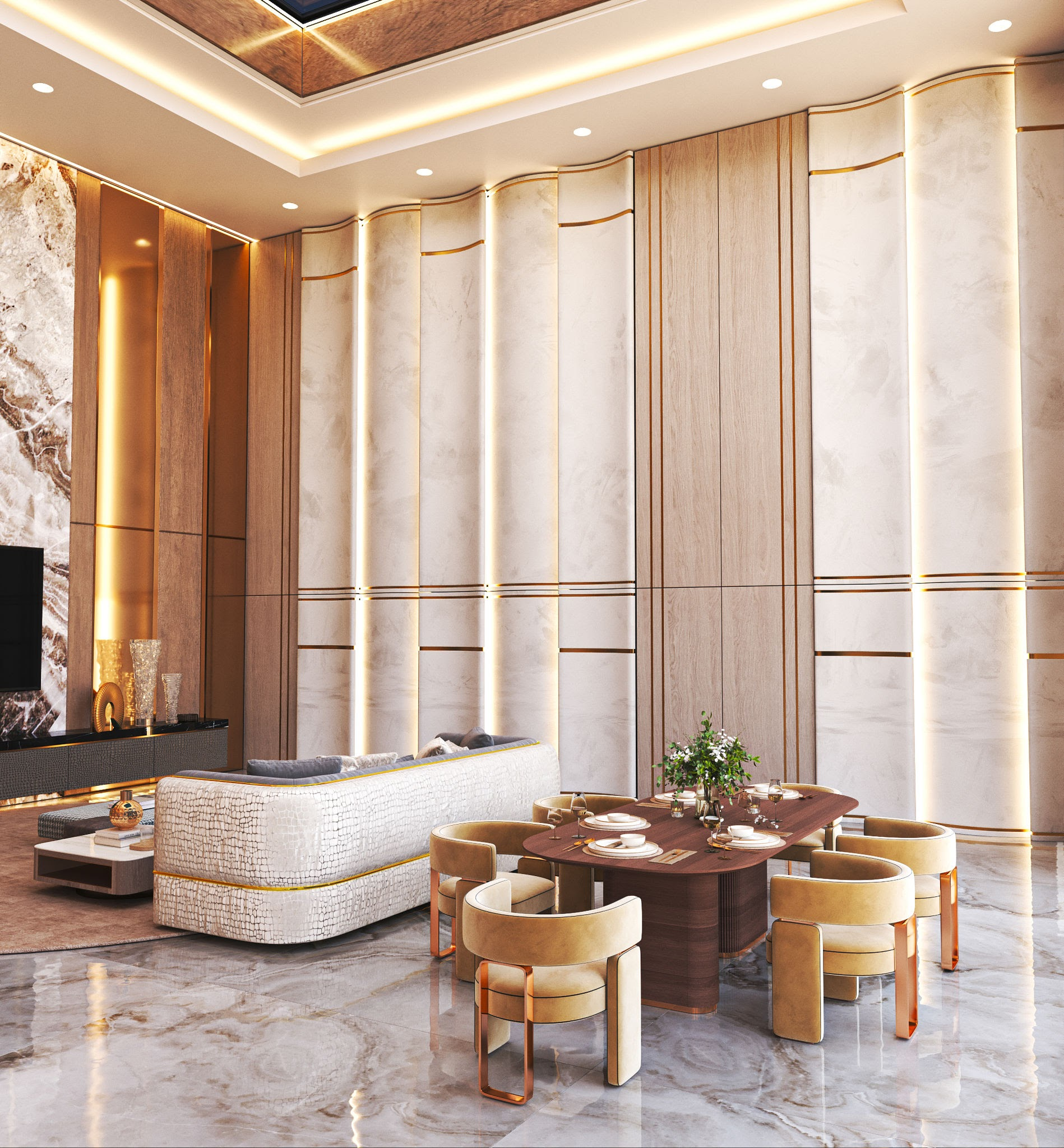
Integrated Luxury Wall Cladding in a High-End Residential Project. Source: Victoriia Kovalchuk / Getty Images
To maintain the flat surface alignment seen in high-end projects, procurement managers must evaluate the core engineering of the panel:
- Engineered Wood Veneer on Bamboo Charcoal Fiber: This composite substrate combines the authentic tactile feel of real wood (such as sliced oak, walnut, or ebony) with the inert physical properties of a carbon-polymer core. It does not swell when exposed to localized humidity, making it ideal for coastal villas or lakeside properties.
- High-Density Fiberboard (HDF) with Moisture-Resistant Treatment: Suitable for intricate geometric wall routing and integrated acoustic grooves. Ensure the specification sheet denotes a minimum density of 800kg/m³ and includes a green-tinted moisture-barrier core additive.
- Co-Extrusion Composites: Best for semi-outdoor transition zones, indoor pool house linings, or basement entertainment lounges. The co-extrusion layer provides complete water protection and eliminates the need for future sanding or lacquering.
How Do You Coordinate Color Tones Across Panels, Cabinetry, and Internal Doors?
A common visual defect in luxury handovers is the “patchwork” effect, where the wall panels, walk-in closet doors, and custom room-dividers display slightly different undertones despite all being ordered under the same generic color code (e.g., “Natural Walnut”).
This occurs because independent factories utilize different finishing equipment and wood lot selections. A furniture manufacturer in Shunde may apply a spray-applied PU lacquer, while a panel factory nearby utilizes automated UV-cured roller coating lines.
Fragmented Procurement Workflow (High Variation Risk):
Panel Factory (Uses Film Lot A) ───┐
Cabinet Factory (Uses Wood Lot B) ──┼─> [Arrives on Site] ──> Visible Color Shift
Door Factory (Uses Lacquer Run C) ──┘

Consolidated Foshan Alignment Workflow:
Master Wood Control Swatch Selected ──> Managed Routing by Local Sourcing Agent ──> Physical Factory Verification ──> Coordinated Production Release
To resolve this before production starts, leverage Foshan’s physical industrial density. Do not rely on digital photos or PDF approval sheets. Your local sourcing agent must secure a physical master control sample from the lead designer.
This single piece of wood is hand-carried to each separate production floor to calibrate the staining machines, ensuring that the natural grain variation remains within an acceptable baseline across all architectural joinery elements.
Why Is the Selection of Production Adhesives Critical for Villa Projects?
Luxury residential buyers are sensitive to indoor air quality, frequently conducting strict VOC (Volatile Organic Compound) testing prior to final project acceptance. Low-tier workshops often trim costs by utilizing cheap cold-press white glues or urea-formaldehyde binders to secure decorative films or wood veneers to the core boards. These adhesives slowly break down over several years, releasing formaldehyde vapors into the home.
| Adherence Technology | Chemical Composition | Environmental Rating | Delamination Risk |
| Standard Cold Press Glue | Water-based Polyvinyl Acetate / Urea | E1 to E2 (Variable outgassing) | High when exposed to direct sunlight or HVAC dry cycles |
| PUR Hot-Melt Lamination | Polyurethane Reactive (Solid moisture-cure) | E0 / Super E0 (Zero VOC detection) | Zero; forms an irreversible chemical cross-link bond |
When drafting production contracts with Foshan manufacturers, specify PUR hot-melt lamination technology. PUR adhesives do not contain solvents and undergo a secondary moisture-curing reaction that creates an unbreakable, heat-resistant bond. This ensures the veneer will never bubble or delaminate, even when installed near floor-to-ceiling glass windows exposed to continuous solar heat.
How Should Sub-Frame Interlocking Systems Be Configured for Heavy Slabs?
Luxury designs frequently combine lightweight wood panels with massive, heavy architectural accents like book-matched sintered stone, porcelain slabs, or solid marble panels. Attempting to glue these disparate materials directly to a standard gypsum drywall sheet introduces a significant structural risk.
Incorrect Direct Masonry Bonding:
Raw Brick Wall (Uneven) ──> Heavy Adhesive Mortar ──> Sintered Stone Slab (Prone to Shear Failure / Cracking)

Correct Structural Metal Sub-Frame Configuration:
Raw Brick Wall ──> Mechanical Anchor Bolts ──> Adjustable Steel Framing Grid ──> Hidden Interlocking Aluminum Z-Clips ──> Secure Cladding Panel
For safe, long-term installation, the engineering drawings must incorporate an integrated structural metal sub-frame matrix. A network of galvanized steel or aluminum tracks is mounted mechanically to the raw concrete blockwork using expansion bolts.
The heavy stone slabs and matching timber panels are then suspended using heavy-duty, hidden interlocking stainless steel Z-clips. This installation method offers three advantages:
- It redistributes the dead-weight load directly into the building’s structural concrete framework.
- It creates a 20mm to 40mm structural cavity for routing smart-home wiring, hidden LED drivers, and HVAC control lines.
- It permits minor, independent material expansion and contraction, preventing the stone faces from cracking during minor seasonal structural shifting.
Why Choose HSY Sourcing for Your Villa Project?
Operating directly within Foshan’s high-end building material and furniture manufacturing ecosystem, HSY Sourcing functions as your independent engineering, quality oversight, and logistics consolidation team on the ground.
- Cross-Factory Material Matching: We handle the complex task of coordinating your material finishes. We physically carry master swatches between panel extruders, custom cabinetry plants, and door manufacturers to ensure color uniformity before you authorize production deposits.
- Strict Factory Floor Quality Audits: Our quality control inspectors conduct hands-on testing on the factory floor. We verify substrate wood moisture content using digital pin meters, inspect the edge milling tolerances with precision calipers, and verify adhesive types directly at the lamination lines.
- Custom Shop Drawing Verification: We don’t just act as product finders. We analyze your architectural blueprints and joinery details to ensure the factory’s production drawings correctly account for hidden LED tracking slots, power outlet cutouts, and corner trim components.
- Reinforced Logistics Consolidation: High-end villa cladding sheets are long and fragile. We manage the collection of your orders at our local warehouse, supervising the construction of fully enclosed, heavy-duty horizontal wooden crates to ensure your premium veneers and stone slabs arrive in pristine condition.
Visit www.hsysourcing.com to share your project drawings and material schedules. Let our local engineers build a secure, precise, and completely transparent supply chain for your luxury development.
Frequently Asked Questions (FAQ)
Q: Can we utilize the same interior wall panels for a villa’s covered outdoor terrace or balcony areas?
A: No, standard interior-grade wood veneer or charcoal fiber panels should not be used outdoors. UV light exposure will rapidly degrade interior lacquers, and ambient external moisture can weaken the lamination line. For outdoor patios or terrace ceilings, you must specify high-performance co-extrusion composite cladding or solid exterior-grade High-Pressure Laminates (HPL) manufactured with specific anti-UV stabilizers.
Q: What is the optimal panel thickness for a villa feature wall that needs to support a heavy wall-mounted TV or floating shelving?
A: If the panel is mounted via an aluminum batten system, the panel core itself should be at least 8mm to 12mm thick to maintain rigidity. However, the panel itself should not support the dead-load of heavy equipment like TVs or large stone shelving. You must install solid structural wood blocking or secondary steel support tracks directly within the sub-frame grid behind the panel layer to anchor those heavy fixtures safely.
Q: How do we manage minimum order requirements (MOQs) when a luxury villa only requires a small quantity of several different custom styles?
A: High-end villa projects often run into factory MOQ constraints because factories dislike resetting their mass-production lamination lines for small quantities. We resolve this by sourcing from specialized premium project-tier manufacturers in Foshan who adapt their production lines for lower volumes using flexible CNC tooling. Alternatively, we can help negotiate a setup fee with the factory to run a custom batch, which remains cost-effective when consolidated with your wider furniture and flooring package.