
In the world of property development, the most expensive sentence you can hear is: “The cabinets are here, but the plumbing hasn’t arrived.”
On a construction site, timing is everything. If your floor tiles are delayed by a week, your tilers are sitting idle while you’re still paying their day rates. If your custom kitchen cabinets arrive before the flooring is finished, they sit in a dusty, high-moisture environment, risking damage and theft.
The “Foshan Advantage” isn’t just about getting a lower price; it’s about synchronized delivery. Here is the realistic process of how we coordinate multi-category building materials to ensure that when the container door opens at your site, the installation is seamless.
Why is “Just-in-Time” delivery so difficult for international projects?
In domestic construction, you can call a local supplier for a missing valve. In international sourcing, you are dealing with a 30-to-45-day ocean freight lead time. You cannot afford to be “almost” right.
The biggest friction point isn’t the shipping; it’s the production mismatch. A tile factory might have a 15-day lead time, while custom cabinets take 45 days, and designer faucets are ready in 10. If you ship them as they are ready, you end up with three separate shipping bills and a logistical nightmare at the port. We solve this by “staging” production—triggering the long-lead items first so that everything converges in our Foshan warehouse in the same 72-hour window.
How do we synchronize technical specs between three different factories?
The “Seamless Installation” begins months before the goods reach the site. It happens during the Technical Cross-Check.
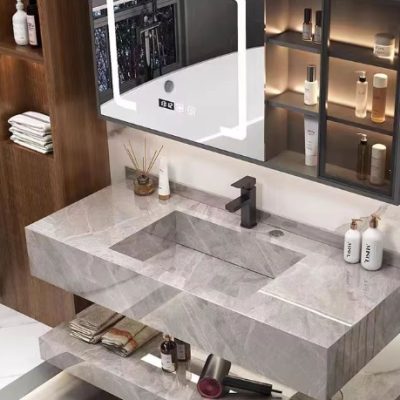
We don’t just send a PO to the cabinet factory and a PO to the sink factory and hope they fit. We physically take the technical drawing of the sink drainage to the cabinet manufacturer. We verify that the “rough-in” plumbing requirements match the cutouts in the back of the vanities. In many cases, we have a sample of the faucet sent to the stone countertop fabricator to ensure the pre-drilled holes are exactly centered. This prevents the “site-fix” disaster where contractors have to hack into finished cabinetry to make a pipe fit.
What does a “Logical Loading” plan look like for building materials?
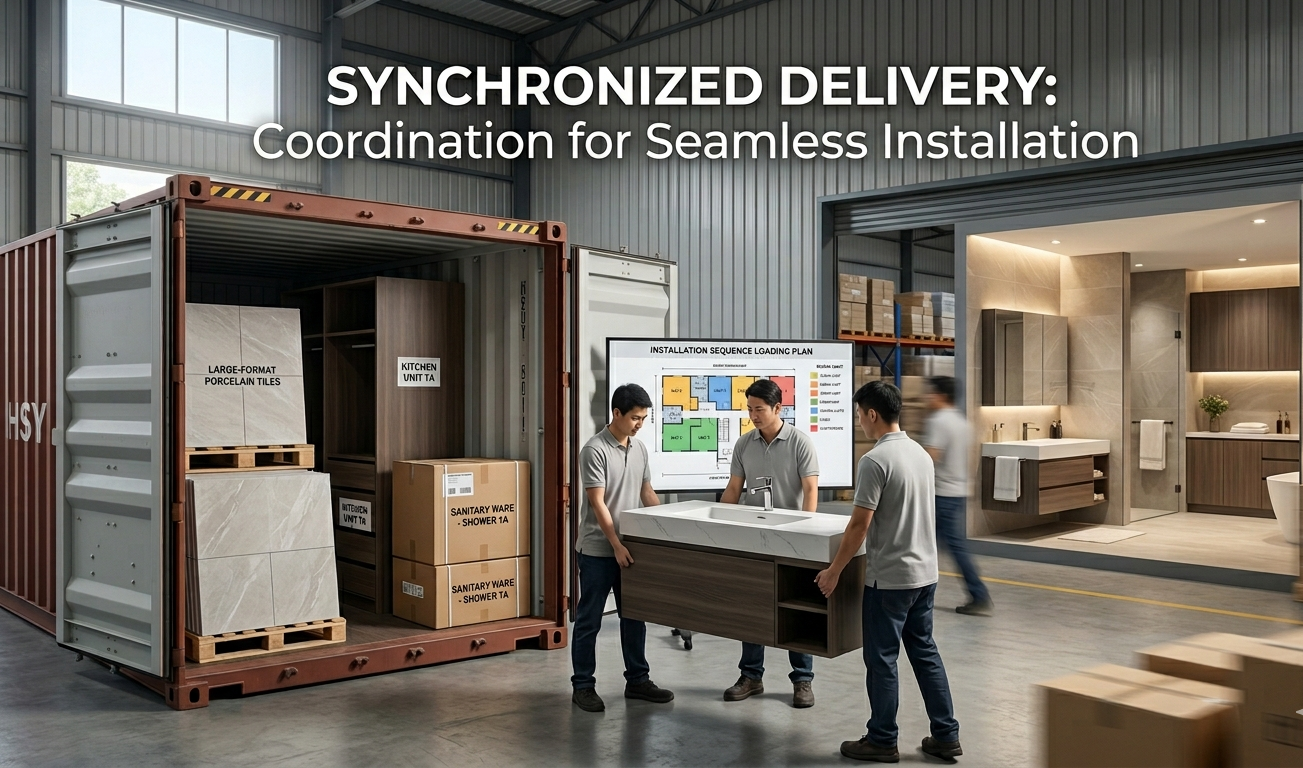
Most people think about container loading in terms of weight and volume (Tetris). We think about it in terms of Installation Sequence.
While we must put heavy items like porcelain tiles and stone on the bottom for stability, we try to group items by “Room Units.” For an apartment project, we aim to load the container so that the materials for the first floors to be finished are the most accessible. We also ensure that “mating” parts—the cabinet, its specific hardware, and its matching countertop—are clearly labeled and positioned near each other. This reduces the time your site crew spends hunting through 40 feet of boxes to find a single missing handle.
How does the Foshan warehouse act as your “Project Buffer”?
Construction sites are unpredictable. Weather delays, labor strikes, or permit issues can push your schedule back by weeks. If your goods are already on the water, you’re in trouble.
Our warehouse in Foshan acts as a pressure valve. If your site isn’t ready, we hold the goods. It is significantly cheaper to pay for an extra two weeks of local warehousing in China than to pay demurrage fees at a US port or rent a temporary warehouse in a high-cost city like New York or London. We only pull the trigger on the final container loading when your site supervisor confirms they are ready for the “internal fit-out” phase.
Key Takeaways
- Lead-Time Staggering: Don’t order everything at once; order based on the factory’s production speed to ensure a unified finish date.
- The “Sink-to-Cabinet” Test: Always verify the interface between different categories (plumbing vs. joinery) at the factory level.
- Buffer Strategy: Use a local consolidation hub to hold inventory if your construction site faces unexpected delays.
- Sequence Labeling: Demand that your agent labels boxes not just by “Product,” but by “Floor” or “Unit Number” to speed up site distribution.
FAQ: Coordinating Multi-Category Logistics
Q: What if one factory is late and the others are ready?
A: This is why we build a 7-10 day “buffer” into the consolidation schedule. If a factory is significantly late, we have the local leverage to push their production line or, in extreme cases, move the order to a backup supplier in the same district to keep the container on schedule.
Q: Do you assemble the cabinets before shipping?
A: For most large projects, we ship “Flat-Pack” (RTA) to save on freight costs. However, we always require a Trial Assembly of one unit per style at the factory. We film the assembly to ensure all parts are present and the instructions are clear for your local crew.
Q: How do you handle the “Small Parts” like screws and gaskets?
A: These are the items that usually cause the biggest delays. We consolidate all “Hardware and Accessories” into clearly marked “Master Kits.” We often include a 5% “overage” of common screws and fasteners because we know things get lost on a busy construction site.
Eliminate Site Friction with HSY Sourcing
At HSY Sourcing, we don’t just see ourselves as buyers; we are your Logistics Architects. We know that the goal isn’t just to get the goods to the port—it’s to get them installed and functional.
By managing your project from our hub in Foshan, we provide:
- Pre-Loading Integration Checks: We make sure the sink fits the hole and the tile matches the trim.
- Sequenced Consolidation: We load your containers based on how you plan to build.
- Inventory Staging: We hold your goods until your site is actually ready for them.