
Key Takeaways:
- Cross-Industry Aggregation: Foshan centralizes specialized manufacturing zones for furniture, lighting, sanitary ware, and ceramics within a 1-hour driving radius, reducing supplier vetting timelines from months to weeks.
- The Power of Mixed-Load Containers: Consolidating fragile finishes (like lighting and sanitary ware) with structurally dense goods (like tiles and stone slabs) optimizes container space and lowers structural shipping damages.
- Unified Blueprint Coordination: Sourcing via a single local ecosystem prevents dimensions from clashing (e.g., ensuring kitchen cabinetry cutouts precisely fit appliances sourced from neighboring industrial parks).
- Phased Warehouse Buffer: Utilizing localized staging warehouses allows procurement teams to match factory production lines with fluctuating on-site building timelines.
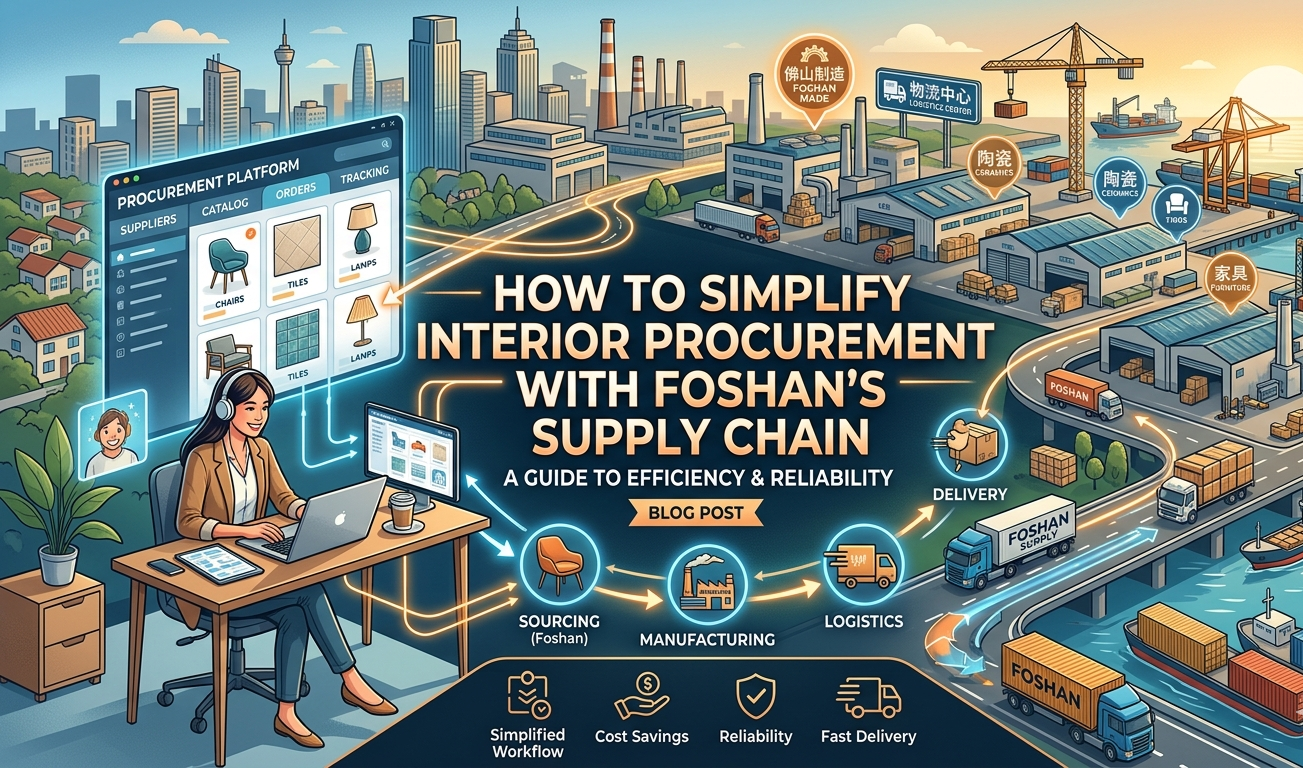
Managing an interior fit-out for a commercial development—whether a 150-room boutique hotel, a multi-unit luxury apartment building, or a high-end villa project—presents severe supply chain challenges. A typical project bill of quantities (BOQ) spans hundreds of unique line items, forcing procurement managers to communicate across dozens of disparate factories.
When your supply chain is fragmented across different regions, misaligned lead times, split logistics fees, and communication errors inevitably create project delays. For international developers, leveraging Foshan’s localized industrial clusters simplifies this entire operational overhead.
Why Is Foshan Structured to Handle Complete Interior Procurement?
Foshan is not just a general manufacturing city; it is an interconnected ecosystem of highly specialized industrial districts. Each district operates as a dedicated hub for specific building and interior components:
- Lecong & Longjiang: Global centers for commercial furniture, custom joinery, seating, and loose FF&E (Furniture, Fixtures, and Equipment).
- Nanhai District: The hub for architectural aluminum windows, interior doors, partitions, and hardware systems.
- Shiwan & Nanzhuang: The epicenter for commercial-grade ceramic tiles, sintered stone slabs, and porcelain finishes.
- Chancheng & Adjacent Shunde Areas: Global production bases for sanitary ware, kitchen cabinetry, and custom storage solutions.
Because these districts border one another, specialized suppliers collaborate regularly on technical integration. For a developer, this means you can review raw material samples, approve shop drawings, and run production audits across your entire interior package without wasting weeks traveling between distant provinces.
How Does a Consolidated Supply Chain Prevent Site-Installation Errors?
On-site errors frequently occur because factories work in isolation. For example, if a wardrobe manufacturer in one city builds a custom walk-in closet, and a lighting manufacturer in another city produces the LED strip profiles, any minor miscommunication regarding voltage or millimetric spacing results in field modifications on the job site.
By anchoring your procurement inside the Foshan supply chain, these technical interfaces can be managed proactively. Physical cross-factory testing becomes standard practice.
A master finish sample (such as a specific wood veneer or a PVD metal finish) can be physically moved from the cabinetry factory directly to the door manufacturer or the loose furniture factory to verify visual consistency under uniform lighting conditions before mass production begins.
What Are the Real Financial Benefits of Mixed-Container Cargo Consolidation?
Shipping empty air or paying for multiple Less-than-Container Load (LCL) shipments significantly degrades a project’s margins. Fragmented sourcing forces developers to pay separate customs declaration fees, export handling costs, and inland trucking charges for every independent vendor.
Foshan’s supply chain solves this through Full Container Load (FCL) mixed-cargo stabilization.
[Tile & Stone Factories] ------>  [ Central Foshan ]  ------> [ Optimized FCL Container ]
[Sanitary Ware Vendors]  ------>  [ Staging Hub    ]  ------> (Heavy Tiles Stacked Bottom,
[Furniture Manufacturers] ------>  [ Warehouse      ]  ------>  Fragile FF&E Secured Top)
Heavy, structurally dense items like porcelain flooring tiles provide a solid weight base at the bottom of the container. Lightweight, high-volume items like custom cabinetry, mattresses, or boxed lighting fixtures fill out the remaining upper cubic capacity. This strategic packing minimizes cargo shifting during ocean transit and drops the localized logistics overhead to its lowest possible baseline.
How Do You Sync Factory Production Timelines with Construction Phases?
A common failure in project management is delivery misalignment. If bathroom vanities arrive at the site before the wet-area waterproofing and drywall works are completed, the materials sit exposed to moisture, dust, and structural damage on-site.
Managing a unified project timeline requires strict factory sequencing based on your construction schedule:
| Interior Fit-Out Phase | Core Product Categories | Production & Consolidation Windows |
| Phase 1: Basic Fitout | Ceramic Tiles, Sanitary Pipes, Window Frameworks | 30 – 40 Days |
| Phase 2: Fixed Joinery | Kitchen Cabinets, Built-in Wardrobes, Interior Doors | 35 – 45 Days |
| Phase 3: Fixtures | Bathroom Ware, Faucets, Technical Lighting | 25 – 30 Days |
| Phase 4: Final Dressing | Loose Furniture, Mattresses, Decorative Fabrics | 20 – 30 Days |
Foshan’s infrastructure supports this sequencing via localized warehousing. Factories deliver their respective outputs to a centralized consolidation facility as they finish production. The goods are held securely in a buffer inventory and are packed into containers sequentially, arriving on-site exactly when the installation crews are ready to receive them.
Why Choose HSY Sourcing as Your On-Ground Partner in Foshan?
At HSY Sourcing, we act as your physical procurement team operating inside Foshan’s industrial zones. We bridge the gap between complex architectural blueprints and local manufacturing capabilities.
- BOQ Deconstruction: We take your raw Bill of Quantities (BOQ) and distribute it across our verified network of direct factories in Lecong, Nanhai, and Shiwan, cutting out trading company margins.
- Technical Drawing Control: Our engineers cross-verify factory shop drawings with your primary architectural floor plans to ensure all plumbing, electrical, and structural interfaces align before fabrication.
- Strict Pre-Shipment Inspection: Our QC inspectors conduct on-site product testing at every factory—checking porcelain tile color consistency, testing faucet water-seals, and running abrasion tests on upholstery fabric.
- End-to-End Consolidation: We operate local staging warehouses where we track, receive, and safely pack multi-vendor items into secure, itemized shipments, saving you thousands in international logistics friction.
Visit www.hsysourcing.com to submit your project specification plans and allow our team to structure a streamlined procurement workflow for your development.
Frequently Asked Questions (FAQ)
Q: Can we mix custom hotel furniture and building materials in the exact same shipping container?
A: Yes. This is one of the key logistical advantages of sourcing from Foshan. We systematically orchestrate the loading sequence so that heavy building materials are packed first, with lighter, fragile furniture or fixtures secured on top, protecting your entire asset list from damage.
Q: How do you handle intellectual property and custom design specs when working with multiple factories?
A: We sign legally binding manufacturing agreements and non-disclosure agreements (NDAs) with each factory partner. Your proprietary designs, interior renderings, and CAD specifications remain confidential and are only allocated to the specific production line handling that component.
Q: What happens if an on-site building delay occurs while our factories are already mid-production?
A: Through our local Foshan consolidation warehouse, we provide flexible, short-term holding solutions. If your site installation is pushed back by 3 or 4 weeks, we can pause or stage your completed shipments in our facility, releasing them only when your project site is structurally ready.