
When international buyers think of sourcing products from China, they often think of the country as one giant factory. But experienced procurement professionals know the truth: China is a collection of highly specialized industrial clusters.
If you want the world’s best consumer electronics, you go to Shenzhen. If you need small commodities and trinkets, you go to Yiwu. But if your business relies on premium sanitary ware—specifically bathroom tubs—there is only one place that matters: Foshan.
Located in the heart of the Greater Bay Area, Foshan isn’t just another manufacturing city. It is the global capital of ceramics and bathroom furnishings. From the ceramic tiles in Dubai’s luxury hotels to the freestanding bathtubs in American renovation projects, a staggering percentage of them originate from this single city.
At HSY Sourcing, our headquarters are located right here in Foshan. We drive past these factories every day. We know that sourcing heavy, fragile, and expensive items like bathtubs requires more than just finding a supplier online; it requires being in the right place. Here is a realistic look at why Foshan dominates this industry and what that means for your business.
How did a single city become the center of the sanitary ware universe?
To understand why you should buy from Foshan, you have to understand the “Industrial Cluster Effect.”
In many parts of the world, a factory is an island. They have to import their raw materials from far away, wait for spare parts when machines break, and struggle to find skilled engineers. In Foshan, the entire supply chain is compressed into a one-hour driving radius.
History plays a huge role here. Foshan has a heritage of ceramic production that dates back hundreds of years (to the Ming Dynasty). While bathtubs today are often made of acrylic or stone resin rather than ceramic, this historical foundation created a massive pool of skilled labor and engineering talent focused on bathroom products.
Today, if a bathtub factory in Foshan needs a specific stainless steel mold, the mold maker is down the street. If they need high-grade resin, the chemical supplier is in the next district. If they need specialized cardboard for heavy-duty packaging, the packaging plant is nearby.
For you as a buyer, this “ecosystem” translates to three things: speed, cost, and stability. When a factory doesn’t have to wait weeks for raw materials, your lead time drops. When they don’t have to pay high freight costs for components, your price drops. And when the support network is strong, the factory is less likely to go bankrupt or fail to deliver.
Does “Made in Foshan” actually mean premium quality?
Ten or fifteen years ago, Chinese manufacturing was often associated with “low cost, low quality.” That era is largely over in Foshan, especially in the sanitary ware sector. The market has forced a brutal survival-of-the-fittest evolution.
Because there are thousands of sanitary ware companies in this region, competition is fierce. Factories that produced low-quality, yellowing acrylic tubs have largely been pushed out of the market or relegated to domestic low-end sales. The factories that survived and thrived are the ones that invested in automation and better materials.
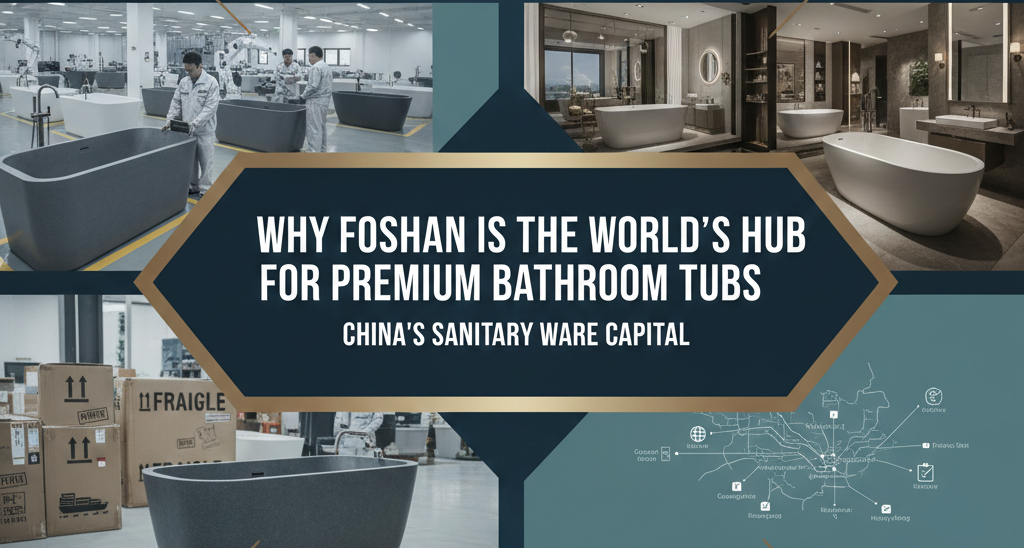
When we inspect factories for our clients today, we aren’t just seeing workers hand-polishing tubs in a dusty shed. We are seeing temperature-controlled curing rooms for stone resin tubs to ensure they don’t crack. We are seeing robotic arms spraying fiberglass reinforcement to ensure perfectly even thickness.
Foshan is where the big international brands (the ones you see in high-end showrooms in Europe and North America) do their OEM manufacturing. These brands demand strict adherence to ISO standards, CE certification for Europe, and cUPC for North America. Because Foshan factories have adapted to serve these demanding giants, even smaller buyers benefit from the elevated quality standards that are now the norm in the region.
Why is the raw material supply chain here different from other regions?
A bathtub is only as good as what goes into it. This is where Foshan has a distinct advantage over other emerging manufacturing hubs in Southeast Asia or inland China.
Take acrylic bathtubs as an example. The quality of the acrylic sheet determines if the tub will stay white for ten years or turn yellow in six months. Foshan is a major hub for the distribution of high-quality, pure acrylic sheets (PMMA). Factories here have immediate access to premium materials from global suppliers like Lucite, as well as top-tier domestic brands that have matched international standards.
The same applies to the hardware. A freestanding tub needs adjustable feet and a high-quality overflow drain. Foshan is also a hub for stainless steel and hardware processing. The overflow drains produced here are designed to prevent rust and leakage, matching the lifespan of the tub itself. When a factory in a remote province tries to make a tub, they often have to buy these components from Foshan anyway, adding cost and losing control over quality. By sourcing directly from the source, you cut out the logistical inefficiency.
Can Foshan manufacturers keep up with changing design trends?
The global bathroom market moves fast. One year, the trend is claw-foot vintage tubs; the next, it’s ultra-thin matte black stone resin; the year after, it’s fluted or textured exteriors.
If you work with a factory that is disconnected from the global market, they will always be a year behind. Foshan factories are on the front lines of design. Because the city hosts the bi-annual Canton Fair (in nearby Guangzhou) and the Foshan Ceramic Fair, suppliers here are constantly exposed to international feedback.
We see a level of agility here that is hard to find elsewhere. Foshan manufacturers are masters of mold development.
Creating a mold for a new bathtub design is expensive and technically difficult. In many countries, developing a new mold can take months. In Foshan, because of the concentration of skilled mold engineers, factories can often go from a 3D drawing to a physical prototype in a matter of weeks. This allows our clients to launch custom designs (ODM) quickly, seizing market trends before their competitors do. Whether you need a specific ergonomic curve or a unique compact size for city apartments, the engineering capability is right here.
How does the location impact shipping and logistics for such heavy goods?
We cannot talk about bathtubs without talking about shipping. They are “bulky cargo.” You are essentially shipping packaged air. This makes logistics a massive part of your landing cost.
Foshan’s geography is a logistical dream for heavy exporters. We are situated in the Pearl River Delta, giving us easy access to some of the world’s busiest and most efficient ports: Nansha, Shekou, and Yantian.
This proximity means that once your goods are finished and inspected, they can be on a container vessel within days. It also reduces the “domestic logistics cost”—the cost of trucking the container from the factory to the port. If you were sourcing from a factory deep inland, that trucking fee alone could eat up your profit margin.
Furthermore, because Foshan ships so much sanitary ware, the local logistics companies and freight forwarders are experts in handling these specific goods. They know how to load a container to maximize space without crushing the cartons. They know how to handle the heavy pallets of stone tubs. This specialized knowledge reduces the risk of transit damage, which is the number one headache for bathtub importers.
Why does having a partner like HSY Sourcing in Foshan make a difference?
While Foshan is undeniably the best place to source tubs, it is also a massive, overwhelming marketplace. There are thousands of suppliers. Some are world-class manufacturers; others are trading companies posing as factories; some are small workshops with inconsistent quality.
This is where we come in.
Because HSY Sourcing is based in Foshan, we don’t manage your supply chain via email. We manage it in person.
When you hire a sourcing agent located in Shanghai or Yiwu to manage a bathtub order in Foshan, they have to take a flight or a long train ride to visit the factory. They might visit once during the whole production.
For us, visiting the factory is a short drive. We can pop in unannounced. We can check the raw materials before production starts. We can inspect the semi-finished shells before they are reinforced. If there is a delay, we are at the factory gate demanding answers, not waiting for a WeChat reply.
We know the local reputation of these factories. We know which bosses pay their suppliers on time (a sign of financial health) and which ones are cutting corners to save money. This local intelligence is something you cannot get from an Alibaba profile.
Conclusion
Sourcing premium bathroom tubs is a high-stakes investment. The product is large, the shipping is expensive, and the quality expectations are incredibly high. You cannot afford to guess.
Foshan has earned its title as the world’s hub for premium bathtubs not through marketing, but through decades of building a complete, efficient, and high-quality supply chain. It is the only place where raw material access, engineering talent, and logistical power converge.
However, the “Foshan advantage” is only accessible if you can navigate the market effectively. You need to distinguish the real manufacturers from the traders, and the quality-focused partners from the price-cutters.
At HSY Sourcing, we are your team on the ground. We utilize our location, our industry knowledge, and our physical presence to ensure that when you buy from Foshan, you are buying the very best this city has to offer.
Frequently Asked Questions About Sourcing Tubs in Foshan
Can I mix different bathroom products in one container?
Yes, and this is actually the biggest advantage of sourcing in Foshan. Because the tile, toilet, and faucet factories are all neighbors, we can easily consolidate a container for you. You don’t need to buy a full container of just bathtubs (which takes up a lot of space but doesn’t weigh much). We often help clients fill the “empty space” in a bathtub container with heavier items like toilets or hardware to maximize your shipping value.
What is the typical Minimum Order Quantity (MOQ) for bathtubs?
Direct factories usually ask for at least 10 to 20 pieces per model because changing the production mold takes time. However, because HSY Sourcing has stable relationships with these factories, we can often negotiate lower MOQs for trial orders, or help you combine several models to meet the factory’s requirements.
How do you prevent the bathtubs from cracking during shipping?
We don’t rely on the factory’s standard packaging if we think it’s too weak. For independent importers or e-commerce sellers, we recommend “honeycomb cardboard” boxes which are incredibly strong, or wooden crate reinforcement for stone resin tubs. We also strictly supervise the loading process to ensure heavy goods are never stacked on top of the tubs.
Do I need to visit Foshan personally to place an order?
While you are always welcome to visit our office and tour the showrooms, it is not necessary. We act as your eyes on the ground. We can provide live video calls during factory inspections and send you physical samples of the material (like acrylic or stone resin cut-outs) via express courier so you can check the finish quality before committing to a bulk order.
Are Foshan bathtubs certified for my country?
Most export-focused factories in Foshan hold cUPC (North America) and CE (Europe) certifications. However, not every factory has them, and some use expired certificates. We verify the authenticity of these documents directly with the testing laboratories to ensure you don’t face any issues with customs or building inspectors in your home country.