
For real estate developers managing hotel fit-outs, apartment complexes, or luxury villa projects, ocean freight is a massive variable in the total project budget. When a project’s Bill of Quantities (BOQ) involves multiple categories—ranging from heavy floor tiles to volumetric custom cabinetry—shipping these items directly from separate factories is highly inefficient.
Fragmented shipping leads to partially empty containers, redundant customs declaration fees, and compounding domestic logistics costs. The most effective structural solution for international project buyers is cargo consolidation. By centralizing procurement and logistics in Foshan, buyers can engineer mixed containers that maximize both weight and volumetric capacity, drastically reducing the landed cost per unit.
Why does Foshan hold a unique geographic advantage for cargo consolidation?
Executing a mixed container strategy requires physical proximity between the manufacturer and the consolidation warehouse. If you purchase lighting from a northern province, sanitary ware from the east, and furniture from the south, the domestic trucking costs to bring them to a single port will wipe out any savings gained from consolidating the ocean freight.
Foshan is structurally unique because it operates as an aggregated industrial cluster specifically for interior finishing materials. Within a 50-kilometer radius, procurement teams have direct access to specialized manufacturing zones:
- Shiwan & Nanzhuang: The epicenter for heavy cargo, including porcelain tiles, sintered stone, and ceramic sanitary ware.
- Lecong & Leliu: The global hub for contract furniture, custom millwork, and upholstery (high-volume cargo).
- Dali: The primary district for architectural aluminum, windows, and doors.
Because these supply chains physically neighbor each other, a Foshan-based sourcing team can dispatch trucks to pick up completed goods from multiple factories and stage them at a local consolidation warehouse on the same day, keeping domestic freight expenses at an absolute minimum.
How does mixed-container loading lower total project freight costs?
Ocean freight rates for Full Container Loads (FCL) are fixed per container size (e.g., 20GP, 40HQ), regardless of what is inside. Therefore, efficiency means utilizing 100% of the allowable payload weight and 100% of the internal Cubic Meter (CBM) volume.
Building materials naturally fall into two conflicting logistical categories:
| Material Type | Logistical Profile | Freight Inefficiency if Shipped Alone |
| Tiles, Stone, Sanitary Ware | High Density (Heavy) | Reaches maximum legal container weight limit while physically leaving 40-50% of the container space empty. |
| Sofas, Cabinets, Mattresses | High Volume (Light) | Fills the container’s physical CBM space entirely while utilizing only a fraction of the paid weight capacity. |
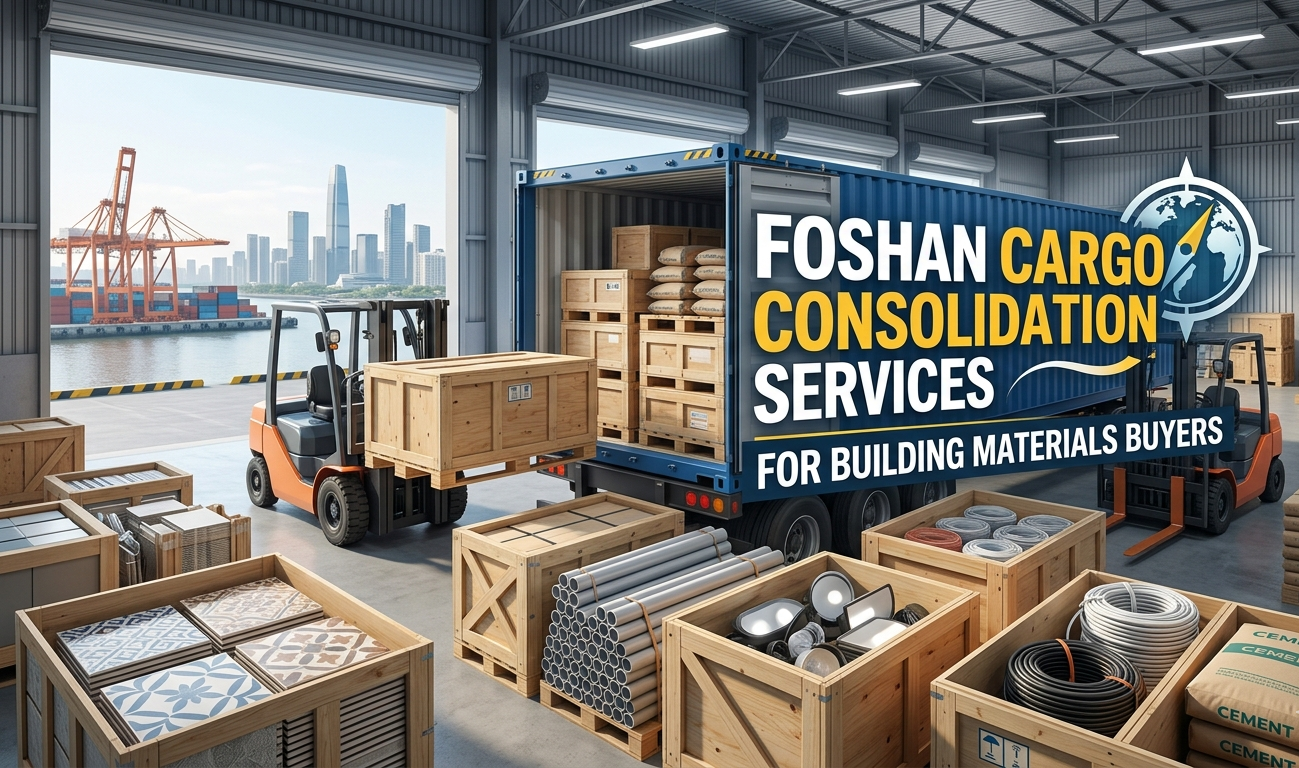
Consolidation solves this. A professional warehouse team will engineer the loading plan to balance these extremes. Heavy pallets of floor tiles and stone are loaded flat across the bottom of the container to establish a stable, weight-bearing base. The remaining volumetric air space is then packed with lightweight furniture, interior doors, and lighting fixtures. This ensures you do not pay to ship empty air.
How do you coordinate production schedules across multiple factories?
A consolidation warehouse is a staging area, not a long-term storage facility. If materials arrive weeks apart, the buyer will incur severe storage fees, and the goods risk exposure to warehouse damage.
Different materials require fundamentally different production timelines. Standard porcelain tiles might be manufactured or pulled from inventory in 15 days. Custom hotel cabinetry and upholstered headboards, however, require 40 to 45 days for shop drawings, material preparation, and assembly.
Effective consolidation requires reverse-engineering the timeline. You must stagger the release of factory deposits. The purchase orders for the custom furniture and millwork must be executed first. The orders for the fast-producing items (tiles, standard toilets, hardware) should be intentionally delayed so that all factory completion dates align. The goal is to have all disparate components arrive at the Foshan loading dock within the same 48 to 72-hour window.
What quality control steps are necessary before sealing the container?
The most critical vulnerability in overseas procurement is the “Sample Approved, Bulk Rejected” scenario. If a defect is discovered only after a consolidated container arrives at your project site in the US, Europe, or the Middle East, the cost of returning the goods is prohibitive, and the construction delays are catastrophic.
Consolidating goods in Foshan allows for a final, physical barrier of quality control before export:
- Incoming Verification: As goods arrive from various factories to the warehouse, inspectors verify quantities against the BOQ and check for domestic transit damage.
- Structural and Dimensional Checks: Cabinet moisture levels are tested, hardware alignment is verified, and tile batch colors are checked under standardized lighting.
- Export Packaging Reinforcement: Standard factory packaging is rarely sufficient for mixed-load ocean transit. The warehouse team ensures heavy items are on ISPM-15 fumigated pallets, uses heavy-duty plywood to build internal bridges separating heavy cargo from fragile items, and applies rigid strapping to prevent cargo shift during rough seas.
Key Takeaways
- Geographic Density: Foshan’s unique concentration of building material factories allows for rapid, low-cost domestic collection into a central warehouse.
- The Weight-Volume Ratio: Mixing heavy tiles with bulky furniture in a single 40HQ container maximizes your shipping ROI.
- Timeline Synchronization: Successful consolidation requires staggering purchase orders so that slow-producing and fast-producing items arrive at the warehouse simultaneously.
Why Choose HSY Sourcing for Your Project Consolidation?
Managing multiple factories, enforcing production timelines, and engineering container loads cannot be done effectively through emails and digital catalogs. HSY Sourcing operates as your dedicated, on-the-ground procurement and logistics department in Foshan, specifically serving commercial real estate developers.
- Turnkey Warehouse Operations: We operate local consolidation facilities. We receive your goods, handle the staging, and execute complex mixed-load plans that maximize CBM output.
- In-Line Factory Auditing: We do not rely on factory-supplied photos. Our team conducts physical inspections during production and at the warehouse receiving dock to ensure every specification matches your BOQ.
- Unified Customs Documentation: Handling multiple suppliers means navigating complex export paperwork. We classify all items under their correct HS codes and consolidate the commercial invoices and packing lists into a single, clean export declaration, ensuring seamless customs clearance.
- Direct Factory Pricing: We bypass trading intermediaries, connecting your project directly with audited OEM manufacturers to secure baseline commercial pricing across all categories.
Frequently Asked Questions (FAQ)
What is the minimum volume required to make cargo consolidation worthwhile?
Consolidation makes financial sense when your combined project requirements can fill at least one 20GP container (roughly 28 CBM) or a 40HQ container (roughly 68 CBM). This volume is standard for a multi-unit apartment fit-out, a boutique hotel, or a large private villa.
How do you prevent fragile items from being crushed by heavy materials in a mixed container?
We enforce strict load-planning architecture. Heavy masonry, tiles, and structural metals are always placed at the floor level. We use load-bearing dunnage, airbags, and reinforced plywood dividers to create a physical barrier before loading fragile or volumetric goods (like cabinetry or glass shower enclosures) on top.
Can we consolidate goods purchased from suppliers outside of Foshan?
Yes. While the core advantage is sourcing heavy materials locally to avoid domestic freight, we routinely receive specialized items from other regions (e.g., specific commercial lighting from Zhongshan or hardware from Wenzhou). We coordinate the domestic logistics to bring these items into our Foshan warehouse for final container loading.
Who is responsible if an item is damaged during domestic transit to the warehouse?
Because we inspect all goods at our warehouse receiving dock before accepting them for export, any goods damaged during domestic transit are immediately flagged. We hold the domestic factory accountable, utilizing our local presence to enforce rapid replacements before the container is scheduled to load.