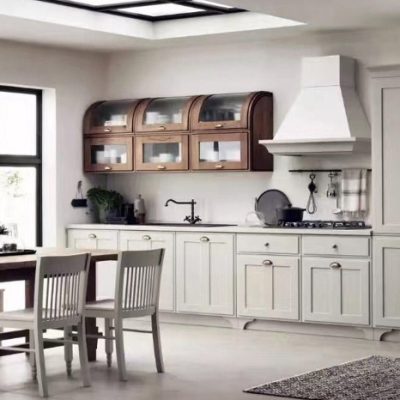


When planning a high-end custom kitchen for a private villa, many owners assume that specifying a “premium” or “luxury” kitchen is a straightforward matter of selecting an expensive stone worktop, high-end appliances, or an attractive door finish. However, when you send your architectural drawings, interior elevations, and 3D renders to a custom cabinet factory—particularly when sourcing from manufacturers in China—you quickly realize that a visual design does not equal a technical specification.
If your procurement document simply states “Use premium plywood for all cabinets with luxury lacquer doors,” you leave wide room for interpretation. A factory quotation saying “Premium plywood, High-end MDF, European finish, Luxury hardware” does not provide enough technical information for you to compare suppliers fairly or ensure the finished kitchen matches your expectations.
To bridge the gap between architectural intent and manufacturing reality, you must specify your villa kitchen component by component. This article explains how to translate general quality expectations into an exact, actionable material specification that a custom cabinet factory can quote, manufacture, and deliver accurately.
1. Start by Defining What “Premium” Means for Your Kitchen
The word “premium” is too vague for procurement. Different homeowners—and different factories—associate “premium” with entirely different characteristics:
- Natural wood appearance and genuine timber grain
- Flawless, highly durable painted finishes
- High-performance engineered substrates with superior stability
- Heavy-duty hardware supporting oversized, heavy doors and deep drawers
- Precise architectural veneer matching (such as bookmatching)
- Exceptional moisture resistance in wet zones
- Low-emission materials meeting strict environmental standards
- Sophisticated internal storage and integrated lighting
Rather than asking a supplier for “the most expensive material available,” define the specific performance and appearance required for each part of the kitchen. Instead of a single blanket statement, a practical specification distinguishes between elements such as painted doors, veneer doors, the structural carcass, exposed end panels, internal shelves, drawer boxes, and the sink cabinet. This immediately creates a more useful procurement document.
2. Separate the Cabinet Into Individual Components
A custom villa kitchen is not made from one uniform material. Specifying premium cabinetry requires breaking the kitchen down into its individual physical components.
| Cabinet Component | What Should Be Specified |
| Cabinet Sides (Carcass) | Board type, core material grade, thickness, surface coating, edge treatment |
| Top / Bottom Panels | Material, thickness, structural load requirement |
| Shelves | Material, thickness, edge treatment, support pin system, maximum load span |
| Back Panels | Material, thickness, fixing method (grooved-in vs. screwed-on) |
| Doors | Substrate material, surface finish system, edge profile, balancing layer |
| Drawer Boxes | Material (e.g., solid wood, plywood, coated steel), construction joints, finish |
| Drawer Fronts | Substrate, finish, edge treatment, grain matching if applicable |
| End Panels | Substrate, visible surface finish, matching grain or color |
| Fillers / Trims | Material, finish, dimensions for on-site scribing |
| Toe Kicks | Material, finish, moisture protection at the floor level |
| Sink Cabinet | Moisture-resistant core construction, protective aluminum bottom foil, sealed edges |
| Tall Units | Structural reinforcement, anti-warp mechanisms for tall doors |
| Island | Load reinforcement for stone worktops, service integration channels |
Breaking down the kitchen in this manner ensures that hidden areas (such as carcass interiors and structural backs) receive appropriate engineering, while visible surfaces receive the exact aesthetic finish intended by your interior designer.
3. Specify the Cabinet Carcass Material Properly
When ordering custom cabinets, simply writing “18mm premium plywood” is insufficient. Plywood is a broad category encompassing various core species, glue types, veneer grades, and void tolerances. Likewise, writing “MFC” (Melamine Faced Chipboard) or “MDF” without qualification leaves critical structural details open.
When specifying your cabinet box (carcass), confirm the following parameters with your supplier:
- Exact board type and core construction: Specify whether the core is eucalyptus, birch, poplar, or mixed hardwood plywood, or an engineered particleboard/MDF core.
- Grade and emission standard: Reference the applicable formaldehyde emission standard (such as CARB P2, E0, or ENF) if indoor air quality is a priority.
- Thickness: Evaluate thickness in relation to cabinet dimensions, structural design, and shelf spans. A thicker board is not automatically superior if the joinery and hardware support are poorly engineered.
- Surface laminate: Specify the interior and exterior melamine or decorative paper facing (e.g., paper weight, texture, color match to doors).
- Edge banding: Define the material (PVC, ABS, or laser edge banding) and thickness applied to the exposed edges of the carcass.
If you are comparing different core materials, refer to our detailed technical guide on Plywood vs MDF vs MFC for Luxury Villa Kitchen Cabinets to understand how each substrate performs under various structural and environmental conditions.
4. Specify Doors Separately From the Cabinet Boxes
One of the most common misconceptions in custom kitchen procurement is that the cabinet doors and the internal box must be made from the same material. In high-end villa kitchens, they rarely are.
Doors have different functional and aesthetic requirements than carcasses: doors require exceptional surface flatness, dimensional stability, and a refined finish, whereas carcasses require internal screw-holding strength and load-bearing capacity.
Your specification for doors should identify:
- Substrate: For instance, smooth, high-density MDF is frequently specified for painted or routed profile doors because its homogeneous structure prevents grain telegraphing and moisture cracks at joints. Stable engineered cores or multi-layer plywood may be specified for flat-panel veneer doors.
- Surface material: Paint, lacquer, natural wood veneer, high-pressure laminate (HPL), or acrylic.
- Finish system: Matte, high-gloss, open-pore, or closed-pore coating.
- Color and gloss reference: International color matching systems (such as RAL or NCS) paired with a specified gloss percentage.
- Edge treatment and profile: Edge radius, chamfer, or shaker profile detailing.
- Back balancing: Specify that the rear face of the door must have a balancing laminate or matching finish to prevent warping over time.
5. Be Precise About Natural Veneer and Wood Finishes
For luxury villa projects, natural wood veneer brings warmth and architectural sophistication. However, writing “natural oak finish” in a quotation leaves too much room for factory interpretation.
To ensure the final installation matches your design intent, your veneer specification should address:
- Wood species and cut: Specify the exact species (e.g., European White Oak, American Walnut) and the cutting method (Crown cut, Quarter cut, or Rift cut), as each produces a distinct grain pattern.
- Veneer thickness: Specify slicing thickness where relevant for sanding and durability.
- Matching method: Define how adjacent panels and doors are matched. For a high-end villa, you may require bookmatching (where adjacent veneer leaves are mirrored) or slip matching (where leaves are laid out in sequence), as well as vertical continuous grain matching across multi-tier tall units.
- Color consistency and grading: Acknowledge natural timber variations and specify whether you require select-grade (minimal knots and uniform color) or character-grade timber.
- Surface protection: Specify the protective clear coat (such as UV-cured polyurethane or water-based acrylic lacquer) and its resistance to yellowing, UV exposure, and household liquids.
6. Specify the Surface Finish, Not Just the Colour
A color description alone—such as “matte white” or “dark grey”—does not inform the factory about the coating chemistry, durability, or tactile quality of the surface.
For painted or lacquered cabinetry, your specification should define:
- Coating technology: Polyurethane (PU) paint, UV lacquer, polyester finishes, or water-based coatings.
- Gloss level: Specify the exact gloss unit (GU) measurement or industry standard (e.g., dead matte 5%–10% gloss, satin 20%–30% gloss, or high gloss 90%+ gloss).
- Texture and feel: Smooth silk finish, tactile open-grain texture, or anti-fingerprint nano-coating.
- Coating layers: While exact coat counts vary by manufacturing system, specifying a multi-layer priming, sanding, and topcoat process ensures proper sealing and depth of color.
Because digital screens and photographs cannot accurately convey gloss, texture, and undertones, a physical sample must always be referenced.
7. Treat Edge Banding as Part of the Material Specification
Buyers frequently specify the primary board material while ignoring how the edges are sealed and finished. Edge banding is critical not only for aesthetics—preventing visible seams between the face and edge—but also for preventing moisture ingress into the substrate.
Your material specification should address:
- Edge material: Matching PVC, ABS, solid wood lipping, or laser-fused edging.
- Thickness: Typically ranging from 1mm to 2mm for high-impact durability on heavy-use doors and shelves, or thinner tape for internal concealed edges.
- Application method: Specify PUR (Polyurethane) adhesive for high-moisture environments due to its superior heat and water resistance compared to standard EVA hot-melt glue, or zero-joint laser edge banding for a seamless appearance on solid-color and high-gloss panels.
8. Give Special Attention to Wet and High-Use Areas
Luxury villa kitchens endure rigorous daily use, particularly around sinks, dishwashers, water filtration systems, and coffee stations. Specifying a standard cabinet box in these zones often leads to premature swelling or degradation.
When detailing wet and high-use areas, your specification should include:
- Sink cabinet construction: Require moisture-resistant substrate cores (often identified by green or blue core dyes in specific regional board standards) for the sink base and surrounding panels.
- Protective lining: Specify an embossed aluminum foil sheet fitted to the bottom of the sink cabinet to catch condensation or minor leaks and protect the underlying board.
- Edge sealing: Ensure all cut-outs for plumbing pipes, electrical wires, and drop-in sinks are factory-sealed with waterproof silicone or edge tape rather than being left exposed on site.
- Dishwasher surrounds: Require moisture barriers or waterproof foil taped to the underside of adjacent worktop panels and cabinet side panels directly exposed to steam discharge cycles.
9. Specify the Interior of the Cabinets, Not Only the Visible Doors
It is common for homeowners to focus heavily on external door finishes while leaving cabinet interiors entirely undefined. A kitchen that looks exquisite from the outside but features low-grade, poorly finished melamine or unsealed edges inside does not meet luxury standards.
Your specification should clearly detail internal elements:
- Interior surface: Matching melamine, textured decorative laminate, or interior wood veneer that complements the exterior design.
- Shelf construction: Thickness (e.g., 18mm or 25mm depending on span length), core material, and edge banding on all four sides—not just the front edge.
- Drawer box specification: Material construction (e.g., solid timber with dovetail joints, powder-coated steel side profiles, or veneer-wrapped multi-layer board) and internal bottom thickness.
- Internal accessories: Pull-out pantry frames, wire baskets, waste sorting bins, cutlery inserts, and integrated corner pivot systems.
10. Specify Hardware as Part of the Cabinet System
Hardware is an integral part of the cabinet’s structural and mechanical performance. While hardware selection warrants careful consideration—as explored in our dedicated guide on Blum, Grass or Chinese Hardware: What Should a Villa Owner Choose?—it must be integrated directly into your material specification.
Your specification should identify:
- Hinge systems: Opening angle, integrated soft-close dampening mechanisms, clip-on mounting plates, and corrosion-resistant finishes (crucial for coastal villas).
- Drawer slide systems: Undermount or side-mount runners, full-extension capability, dynamic load capacity ratings (e.g., 40kg, 60kg, or heavy-duty 80kg+ for wide pan drawers), and push-to-open or soft-close synchronization.
- Lift mechanisms: Gas struts, mechanical spring systems, or electric servo-drive assists for overhead wall cabinets.
- Structural coordination: Ensure that heavy mechanisms (such as tall pull-out pantries or heavy corner carousels) are specified alongside reinforced cabinet side panels and sturdy fixing blocks.
11. Match Materials to the Villa’s Climate and Use
The geographic location and operational environment of your villa should actively influence your material and hardware specifications. A specification optimized for a dry inland climate may fail in a humid coastal environment.
- Coastal Villas: High humidity and salt-laden air accelerate corrosion and board degradation. Specify marine-grade or stainless steel hardware (such as 304 or 316 grade stainless steel hinges and screws), highly sealed edge banding, and moisture-resistant board substrates.
- Tropical and Humid Climates: Require enhanced moisture-resistant board cores throughout the entire kitchen—not just under sinks—along with adequate ventilation design behind tall units and islands to prevent trapped humidity.
- Dry Climates: Focus on dimensional stability to prevent timber splitting or veneer cracking caused by extreme seasonal humidity drops and indoor heating or air conditioning cycles.
- High-Frequency Family Residences vs. Vacation Homes: For active primary residences, prioritize high-cycle-tested hardware, scratch-resistant door surfaces (such as anti-fingerprint laminates or textured finishes), and robust drawer box joinery.
12. Don’t Specify the Entire Kitchen With One Material
A common mistake in kitchen procurement is attempting to apply a single material specification to every single cabinet in the room. A technically robust villa kitchen specification embraces a hybrid construction model, tailoring materials to specific functional zones.
Example A: Painted Contemporary Villa Kitchen
- Doors: Moisture-resistant MDF substrate with an approved multi-layer polyurethane painted finish.
- Carcass: High-grade engineered board with matching interior melamine.
- Shelves: 19mm engineered board engineered to prevent sagging over wide spans.
- Sink Unit: Moisture-resistant core board with an aluminum protective bottom sheet and sealed edges.
- Exposed End Panels: MDF substrate finished to match the doors perfectly.
- Hardware: Soft-close full-extension undermount runners with integrated dampening.
Example B: Natural Veneer Villa Kitchen
- Doors: Stable engineered core with premium quarter-cut American Walnut veneer, bookmatched across elevations.
- Tall Panels: Coordinated walnut veneer with vertical grain continuity.
- Carcass: High-density engineered board with coordinating wood-grain melamine interior.
- Drawer Boxes: Solid walnut dovetail construction with concealed runners.
- Island: Reinforced structural carcass designed to support heavy stone worktop loads and overhangs.
Using different materials for different components ensures that each part of the kitchen performs its specific function effectively.
13. How to Turn Your Material Preferences Into a Factory Specification
To eliminate ambiguity when requesting quotations or issuing purchase orders, transform general descriptions into structured technical lines.
Plaintext
Cabinet Doors:
- Substrate: 18mm high-density MDF (CARB P2 compliant)
- Surface Finish: 3-coat polyurethane matte lacquer, RAL 9010 Pure White, 20% gloss
- Edge Treatment: R2 rounded edge, laser edge-banded with matching lacquer finish
- Balancing: Rear face white balancing laminate

Cabinet Carcasses:
- Board Type: 18mm eucalyptus core plywood, E0 emission standard
- Surfaces: White melamine interior and exterior
- Edge Banding: 1mm PVC matching edge tape applied with PUR adhesive

Drawer Boxes:
- Sides: Double-walled powder-coated steel system (soft-close, 40kg load rating)
- Bottom & Back: 16mm moisture-resistant particleboard matching carcass interior

Sink Cabinet:
- Construction: Moisture-resistant core board with sealed silicone joints and aluminum floor liner
Detailing your requirements in this format ensures that factories quote based on identical technical parameters.
14. What Should You Ask a Chinese Cabinet Factory Before Approving the Material Specification?
When communicating with custom cabinet manufacturers in China, asking direct, technically grounded questions prevents misunderstandings before production begins.
- What exact board product, core species, and emission standard will be used for each cabinet component?
- What is the exact thickness of the door panels, carcass sides, backs, and shelves?
- What substrate material is underneath the visible door finish (e.g., MDF vs. particleboard)?
- What coating system and number of layers will be applied for painted or lacquered doors?
- Is the wood appearance achieved via solid wood, natural veneer, reconstructed veneer, or melamine decor?
- How are natural veneer panels matched across adjacent doors and tall pantry units?
- What adhesive (PUR vs. EVA) and edge banding thickness are used for exposed edges?
- What specific board material and protective detailing are utilized around sink and dishwasher cabinets?
- What is the exact brand, model series, and load rating of the proposed hardware systems?
- What physical material samples will be produced and approved before mass manufacturing begins?
Reviewing these questions alongside your architectural and technical drawings—as detailed in our guide on What Drawings Does a Chinese Factory Need to Manufacture Custom Villa Cabinets?—ensures complete alignment between designer, buyer, and manufacturer.
15. How to Compare Two Premium Cabinet Quotations
When sourcing custom cabinetry from overseas, homeowners frequently encounter significant price differences between factory quotations. Without a detailed material specification, it is impossible to determine whether a higher price reflects superior engineering or simply inflated markup, or whether a lower price reflects compromised materials.
For example, compare two vague quotations:
- Factory A: “Premium plywood kitchen — USD 25,000”
- Factory B: “Custom villa kitchen — USD 18,000”
Comparing these numbers directly is meaningless. A proper commercial and technical comparison requires examining every line item:
- Are both factories quoting the same carcass thickness and core board grade?
- Does the lower quotation substitute MDF doors with lower-cost MFC slab doors?
- Are the drawer systems specified from premium international brands or local alternatives?
- Is edge banding applied with moisture-resistant PUR adhesive in both proposals?
- Do both quotations include finished exposed end panels, custom filler pieces, and toe kicks, or are those billed separately?
A transparent specification levels the playing field, allowing you to evaluate supplier quotations fairly. For a deeper analysis of price discrepancies, refer to our article on Why Two Custom Kitchen Quotes From China Can Have a 2× Price Difference.
16. Approve a Physical Material Sample Before Full Production
For high-value villa kitchens, digital renders and PDF color charts are insufficient for final approval. Before authorizing mass production, you should require physical sample boards representing your specified finishes.
A physical sample allows you to verify:
- Color accuracy and tone under natural and artificial lighting.
- Gloss level and surface texture (confirming whether a matte finish feels silky and absorbs light appropriately).
- Veneer character, grain pattern, and stain consistency.
- Edge banding quality, ensuring seamless transitions without glue lines.
- The visual relationship between the door finish and the internal carcass laminate.
Ensure that the approved physical sample is signed, dated, and referenced in your final purchase contract and shop drawings. For natural materials like timber veneer, clarify acceptable ranges of natural color and grain variation in writing before production commences.
17. Material Specification Must Match the Drawings and Purchase Documents
A material specification should never exist as an isolated document separate from your technical drawings. To prevent errors on the factory floor, all project documentation must tell the exact same story:
- Architectural layout and interior elevations
- Factory shop drawings
- Material specification schedule
- Signed physical samples
- Commercial quotation and purchase contract
Before approving shop drawings for production—a critical milestone outlined in our guide on What Should a Villa Owner Do Before Approving Factory Shop Drawings?—verify that every material callout on the drawings matches your agreed specification schedule. Once CNC machines begin cutting boards in the factory, modifications become costly and difficult.
Frequently Asked Questions
What is the best material for premium villa kitchen cabinets?
There is no single “best” material for an entire kitchen. The appropriate choice depends on the specific component, door finish, moisture exposure, structural load, and design style. High-end kitchens typically utilize a hybrid specification, combining stable engineered substrates for painted doors, robust engineered boards or plywood for structural carcasses, and specialized moisture-resistant materials in wet zones.
Is plywood always better than MDF for a luxury kitchen?
No. While plywood offers excellent screw-holding strength and moisture resistance for cabinet boxes, MDF is frequently superior for painted or routed cabinet doors because its smooth, uniform surface prevents grain telegraphing and joint cracking.
Should I use the same material for doors and cabinet boxes?
Not necessarily. Doors and cabinet boxes serve different functions. Doors require a stable, flawless surface finish and precise edge detailing, whereas cabinet boxes require structural rigidity and high internal screw-holding capacity. Using different materials optimized for each role is standard practice in high-end cabinetry.
What should I specify for a painted kitchen?
For a painted kitchen, specify a smooth, high-density MDF substrate, a multi-layer polyurethane or UV lacquer coating system, exact color references (such as RAL or NCS), specific gloss levels, laser or PUR edge banding, and a physical sample board for final approval.
Is “premium plywood” enough for a factory quotation?
No. “Premium plywood” is a marketing term, not a technical specification. A proper specification must define the core wood species, grade, emission standard (such as CARB P2 or E0), exact thickness, surface finish, and intended component application.
How should I specify natural veneer for a villa kitchen?
Your natural veneer specification should define the timber species, cutting method (e.g., quarter-cut or crown-cut), matching method (such as bookmatching or continuous vertical grain matching), color variation allowances, protective topcoat, and physical sample approval.
What should I specify for the sink cabinet?
For the sink cabinet, specify a moisture-resistant core board, factory-sealed edges around all cut-outs, and an embossed aluminum protective floor liner to guard against plumbing condensation or minor leaks.
Can Chinese factories provide premium cabinet materials?
Yes. Chinese manufacturers supply a vast range of material grades, hardware brands, and custom finishes for luxury residential projects worldwide. However, the quality of the finished kitchen depends entirely on the clarity and rigor of your material specification and your verification of factory capabilities prior to production.
Key Takeaways
- “Premium” is not a specification: Vague marketing terms lead to ambiguous factory quotations and unexpected results.
- Specify component by component: Break the kitchen down into doors, carcasses, shelves, drawer boxes, and panels rather than choosing one material for everything.
- Separate substrate from surface: Understand that the underlying core material and the visible surface finish serve distinct engineering and aesthetic functions.
- Define technical details: Explicitly state thickness, finish systems, edge banding adhesives, and wet-area protections in your procurement documents.
- Rely on physical samples: Always approve physical sample boards for critical finishes, colors, and veneers before mass production begins.
- Unify all documentation: Ensure your quotation, material schedule, shop drawings, and purchase contract all reference the exact same technical specifications.
How HSY Sourcing Can Help
HSY Sourcing is a Foshan-based China sourcing and procurement coordination company supporting overseas residential and villa projects. For private villa owners and interior designers planning a custom kitchen, our scope of work typically includes:
- Identifying suitable cabinet manufacturers matching your quality tier and design requirements
- Distributing your architectural drawings and material specifications to collect comparable quotations
- Clarifying technical proposals, material options, and construction details with suppliers
- Coordinating physical sample production and international courier delivery
- Reviewing shop drawings and communicating technical requirements to the factory
- Conducting milestone inspections during manufacturing according to agreed project standards
- Receiving, inspecting, and consolidating goods from multiple suppliers into secure export containers
- Coordinating shipping and logistics arrangements to your destination port
We act as your on-the-ground procurement coordination team in Guangdong, ensuring that your specified materials and design intent are accurately translated into manufactured products.
If you already have your kitchen layout drawings, interior elevations, BOQ, or material requirements and would like support navigating suppliers in China, contact the HSY Sourcing team to discuss your project.