
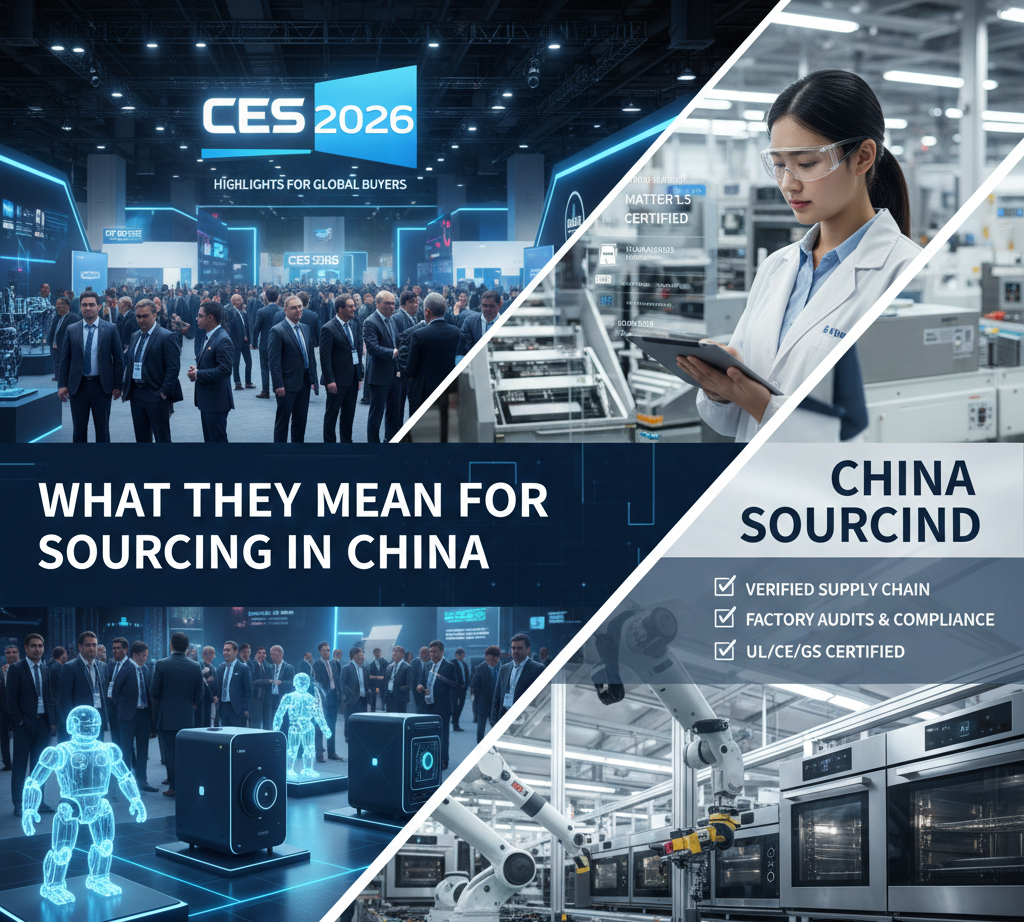
Each January, CES in Las Vegas sets the tone for what products and technologies buyers will talk about all year. In 2026, the show again was full of AI, smart home, energy, health and mobility innovations that will quickly move from exhibition halls to real projects and retail shelves.
For overseas brands, importers, e‑commerce sellers and project owners, CES is not only a tech show. It is a big “product idea marketplace”. The real question is: how do you turn these ideas into real, reliable products by sourcing in China?
This article looks at CES 2026 highlights from a global buyer’s point of view, and explains what they mean for sourcing from Chinese manufacturers with the help of a local sourcing partner.
1. How Is CES 2026 Changing What We Buy for Smart Homes and Buildings?
One clear trend at CES 2026 is the smart home moving from “gadgets” to “invisible, integrated systems”. Many products focus on comfort, safety and energy savings instead of just showing off technology.
For global buyers, this means more demand for:
- smart locks, sensors, switches and small devices that quietly fit into homes and buildings
- integrated hardware and building material solutions, not only single pieces
Most of these products need strong hardware, stable electronics and reliable firmware. China remains one of the main bases for these components and finished products. For you as a buyer, the challenge is not “Can China make it?”, but “Which Chinese suppliers can really handle the quality, certifications and long‑term support this new generation of smart products needs?”.
This is where working with a sourcing company in China becomes important. A local team can help you filter suppliers who only follow trends from those who truly have R&D, production capacity and after‑sales support.
2. What Does “AI Inside Everything” at CES 2026 Mean for Your China Suppliers?
At CES 2026, AI is no longer a buzzword on slides – it is built into many devices: home robots, smart mirrors, energy management systems, security devices, health wearables and more.
For sourcing, this has a few clear impacts:
- More products are a mix of hardware, sensors, connectivity modules and cloud services.
- The supply chain often involves more than one factory: plastic, metal, PCB, assembly, packaging.
- Firmware updates, app quality and data security become part of the “product”, not an afterthought.
If you buy such complex products from China, you need more than a price list. You need someone on the ground who can:
- check if the factory really develops and controls its own software and hardware
- audit their partners and subcontractors
- coordinate tests, certifications and small improvements between batches
A sourcing agent in China can help manage this complex supplier network, especially for new CES‑style products that may still be evolving.
3. How Do CES 2026 Energy and Home Trends Affect Builders and Building Material Buyers?
CES is not only about phones and TVs anymore. In recent years the show also presents smart windows, energy‑saving materials, new lighting systems and home comfort solutions that connect directly to building and renovation projects.
For builders, hotel owners, real estate developers and building material importers, this means:
- more “smart” components that can be used in doors, windows, lighting and interior solutions
- new product concepts you may want to test in your local market, starting with small orders
China already has strong supply chains in doors, windows, lighting, hardware and other construction materials. If you see a new idea at CES – for example, a smarter door lock, a new type of window sensor, or a more efficient lighting control – there is a good chance similar or compatible components can be developed and produced in China.
A sourcing partner on the ground can help you:
- search for manufacturers that already produce similar building material products
- adapt existing designs to match your project and local standards
- control quality and packaging so these new items arrive safely on site.
4. How Should Global Buyers Adjust Their China Sourcing Strategy After CES 2026?
If you are a global buyer, it is easy to get excited at CES and then feel stuck when you go back home. The gap between an exciting prototype and a stable, shippable product can be huge.
To make CES trends work for your business when sourcing in China, you can think in three steps:
- Clarify your real opportunity
Decide if you want to:- import existing “CES‑style” products from Chinese manufacturers;
- co‑develop improved versions;
- or integrate new technology into your current product line.
- Define what you need from Chinese suppliers
For example:- required certifications in your market;
- expected lifetime, warranty and after‑sales support;
- volume plan (test order vs. large ongoing orders).
- Work with a sourcing partner to find the right path
A local sourcing company can help you choose between:- off‑the‑shelf products with minor customizations;
- ODM solutions from existing Chinese factories;
- or more long‑term joint development with one or two key partners.
By doing this, CES 2026 becomes not just “interesting news”, but a source of realistic, profitable product plans.
5. Why Does Sourcing in China Still Matter After CES 2026?
Some global buyers worry that China is “too competitive” or “too complicated” now. At the same time, many of the CES 2026 products – especially smart home, devices, components and building‑related hardware – still depend heavily on Chinese manufacturing and supply chains.
China continues to offer:
- strong ecosystems for electronics, hardware, plastics and building materials
- flexible production from small test runs to mass production
- competitive total cost when you also count tooling, assembly and packaging
The key is not to treat “China” as one factory, but as a huge network where you need help to navigate. A good sourcing partner reduces risk and gives you more options.
6. How Can HSY Sourcing Help You Turn CES 2026 Ideas into Real Products in China?
HSY Sourcing is a sourcing company based in China that helps overseas brands, importers and project owners find and manage the right manufacturers. When new product ideas or categories appear at shows like CES 2026, HSY can support you in a few concrete ways:
- Market and product mapping
Help you check if similar products or components already exist in China, and what level of quality and price you can expect. - Supplier search and evaluation
Identify and compare manufacturers that can produce CES‑style products or building‑related items, not only by price but also by technical capability, quality system and communication. - Sampling and small trial orders
Arrange samples, pilot runs and small initial shipments so you can test the market with limited risk before scaling up. - Production follow‑up and inspection
Follow production on site, share updates, and perform inspections to control quality, packaging and labeling, especially for more complex smart products. - Logistics and consolidation
Combine different products and suppliers into one shipment if needed, so your CES‑inspired product line can move efficiently from China to your warehouse or project site.
7. What Is the Next Step If You Want to Source CES 2026‑Style Products from China?
If you attended CES 2026 or followed the news and found product ideas that match your market, now is the right time to turn inspiration into action.
You can start by making a simple list: what type of products or components interest you, what target price range you have in mind, and what quality or certification level you need. With that information, HSY Sourcing can help you explore realistic sourcing options in China, from ready‑made products to more customized solutions.
Instead of letting CES 2026 be just a week of exciting demos, you can use it as the start of your next profitable sourcing project – with a local partner in China to walk through every step with you.
FAQ: CES 2026 and Sourcing in China for Global Buyers
Q1: Why should global buyers care about CES 2026 if they source products from China?
CES 2026 shows what kinds of smart home, device, energy and building‑related products customers will expect in the next 1–2 years, and many of these products or components will still be manufactured in China.
Q2: I saw an interesting product at CES 2026. How do I know if Chinese factories can make something similar?
You can share photos, basic specs or links with a China sourcing agent like HSY Sourcing, and we can check if similar products or compatible components already exist in China, or if factories are willing to develop them with you.
Q3: What is the biggest risk when turning CES 2026 ideas into real orders in China?
The main risks are choosing factories that only copy the look but cannot guarantee quality, certifications or long‑term support, especially for AI and smart home devices, so supplier evaluation and testing are critical before large orders.
Q4: How can a sourcing agent in China help with new CES‑style smart home and hardware products?
A sourcing agent can help you screen manufacturers, clarify technical requirements, arrange samples, follow up production, do inspections and coordinate logistics, so you do not manage complex China supply chains alone from overseas.
Q5: Do I need to attend CES in person to benefit from these trends when sourcing in China?
Not necessarily; even if you follow CES 2026 online, a sourcing partner in China can help you translate these trends into concrete product ideas, supplier lists and trial orders that fit your budget and market.
Q6: What information should I prepare before asking HSY Sourcing about CES 2026‑style products?
It helps to prepare basic product ideas, target price range, expected order quantity, required certifications and your main sales channel, so HSY Sourcing can quickly check realistic options with Chinese manufacturers.