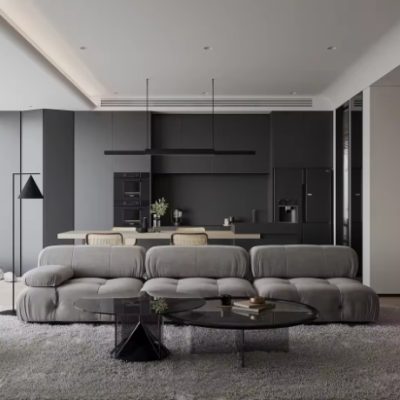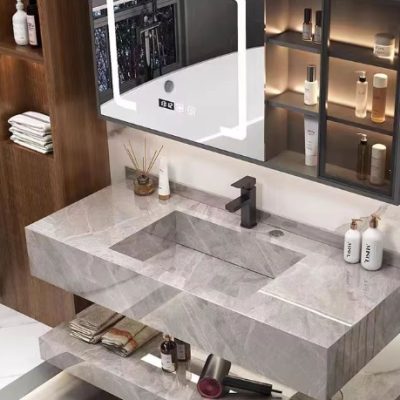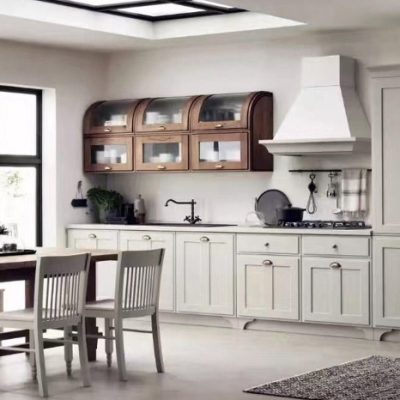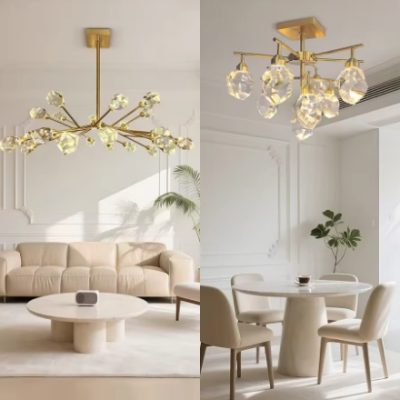

For many international developers, the dream of “One-Stop Sourcing” in China often feels like a logistical puzzle. You need high-end furniture from one town, custom kitchen cabinets from another, and porcelain tiles from a third. Managing these as separate entities is a recipe for mismatched finishes, shipping delays, and ballooning costs.
True one-stop sourcing isn’t just about buying everything in one country; it’s about integration. It’s the ability to coordinate the technical specs of a bathroom faucet with the pre-drilled holes of a vanity, and the color tone of a bedroom wardrobe with the flooring.
What does “One-Stop Sourcing” actually look like in practice?
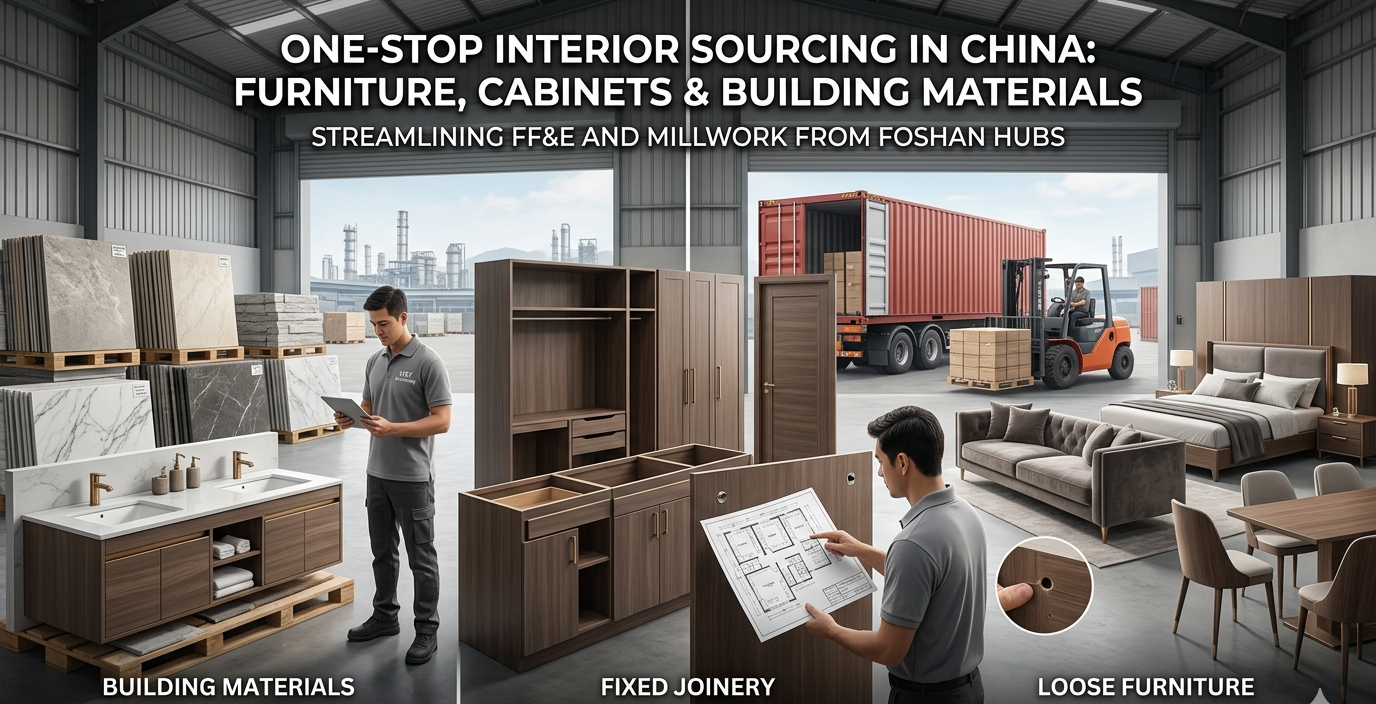
In the context of a professional property development project, one-stop sourcing covers three main pillars:
- Fixed Joinery (The “Hard” Fit-out): Kitchen cabinets, wardrobes, vanities, and internal doors. These are the items that require precise CAD drawings and site measurements.
- Building Materials: Flooring (tiles, SPC, wood), sanitary ware (toilets, faucets, showers), and wall coverings.
- Loose Furniture (FF&E): Sofas, beds, dining sets, and lighting.
The “One-Stop” approach means these three categories are treated as a single ecosystem. Instead of you chasing fifteen different factory managers, a single procurement partner synchronizes the production timelines so that the tiles arrive at the warehouse first, followed by the heavy cabinets, and finally the delicate furniture—all ready to be loaded into the same containers in a logical sequence.
Why is Foshan the undisputed hub for interior procurement?
You will hear the name “Foshan” constantly in this industry, and for good reason. Unlike other manufacturing zones that specialize in a single product, Foshan is a multi-industry cluster.
Within a 30-minute drive of our office, you have the world’s largest furniture markets (Lecong), the premier ceramic and tile hub (Shiwan), and thousands of specialized cabinetry and hardware factories. For a developer, this proximity is a massive risk-mitigator. It means we can take a fabric sample from a sofa factory and physically bring it to a wallpaper manufacturer to ensure the colors coordinate under the same light. This level of “on-the-ground” cross-checking is impossible if your suppliers are scattered across different provinces.
How do you maintain quality and design consistency across different factories?
The biggest risk of sourcing from multiple factories is “Batch Variance.” If you buy a “warm grey” cabinet and a “warm grey” tile from two different suppliers, they will almost certainly not match when they arrive at your site.
We solve this through Centralized Material Control. We select a master color palette or a physical “control sample” (like a specific wood veneer or metal finish). We then distribute pieces of that master sample to every factory involved in your project. Each supplier is required to match their production to that specific sample. Before any balance is paid, we conduct a joint QC where we look at the cabinet panels, the furniture legs, and the door trims side-by-side in our warehouse to ensure the aesthetic is unified.
What are the logistical benefits of consolidating multiple categories?
Logistics is where “One-Stop” sourcing pays for itself. If you buy from ten factories individually, you are paying for ten separate export filings, ten local trucking fees, and ten sets of documentation.
By consolidating Furniture, Cabinets, and Building Materials into a single flow in Foshan:
- Container Optimization: We use heavy building materials (tiles/stone) as the “floor” of the container and pack lighter, high-volume items (sofas/cabinets) on top. This maximizes every cubic meter of the 40HQ container.
- Reduced Port Fees: One shipment means one Bill of Lading and one customs clearance process at your destination.
- Staged Delivery: We can hold your furniture in our warehouse if your construction site is delayed, ensuring you don’t have $100k worth of leather sofas sitting in a dusty, unfinished building.
Key Takeaways
- Coordinate at the Source: Don’t wait until the goods arrive to see if the faucet fits the sink. Perform technical cross-checks at the factory level in China.
- The Power of Proximity: Use the Foshan cluster to your advantage; the ability to move samples between factories is your best defense against design kitsch.
- Logical Loading: Load containers based on the installation sequence—tiles and plumbing first, furniture last.
- Single Point of Accountability: One-stop sourcing only works if you have one partner on the ground who is responsible for the entire “Interior Package.”
FAQ: Navigating Multi-Category Sourcing
Q: Is there a Minimum Order Quantity (MOQ) for one-stop sourcing?
A: For loose furniture, many factories are flexible. However, for custom cabinets and building materials, we generally recommend a minimum of one 20ft container to make the logistics and export costs financially viable.
Q: How do you handle the different VAT and tax invoices from multiple factories?
A: This is a major hurdle for independent buyers. As your sourcing partner, we handle the consolidation of all domestic invoices and manage the VAT refund process and export license, providing you with one single, clean commercial invoice for your project.
Q: Can I mix “Designer Brands” with “White Label” factory goods?
A: Absolutely. Many of our clients spend more on “statement” pieces for the lobby or penthouse while using high-quality, value-engineered customization for the standard units. The “One-Stop” model allows for this mix-and-match strategy.
Simplify Your Procurement with HSY Sourcing
At HSY Sourcing, we take the “puzzle” out of Chinese procurement. We don’t just find factories; we manage the interface between them.
From our base in Foshan, we provide:
- Cross-Category Design Management: Ensuring your wood, metal, and fabric finishes are consistent across every supplier.
- Technical Integration: Verifying that all building materials and fixed joinery work together before they are packed.
- Consolidated Logistics: Professional warehouse staging and container loading that saves you thousands in freight and site labor.