
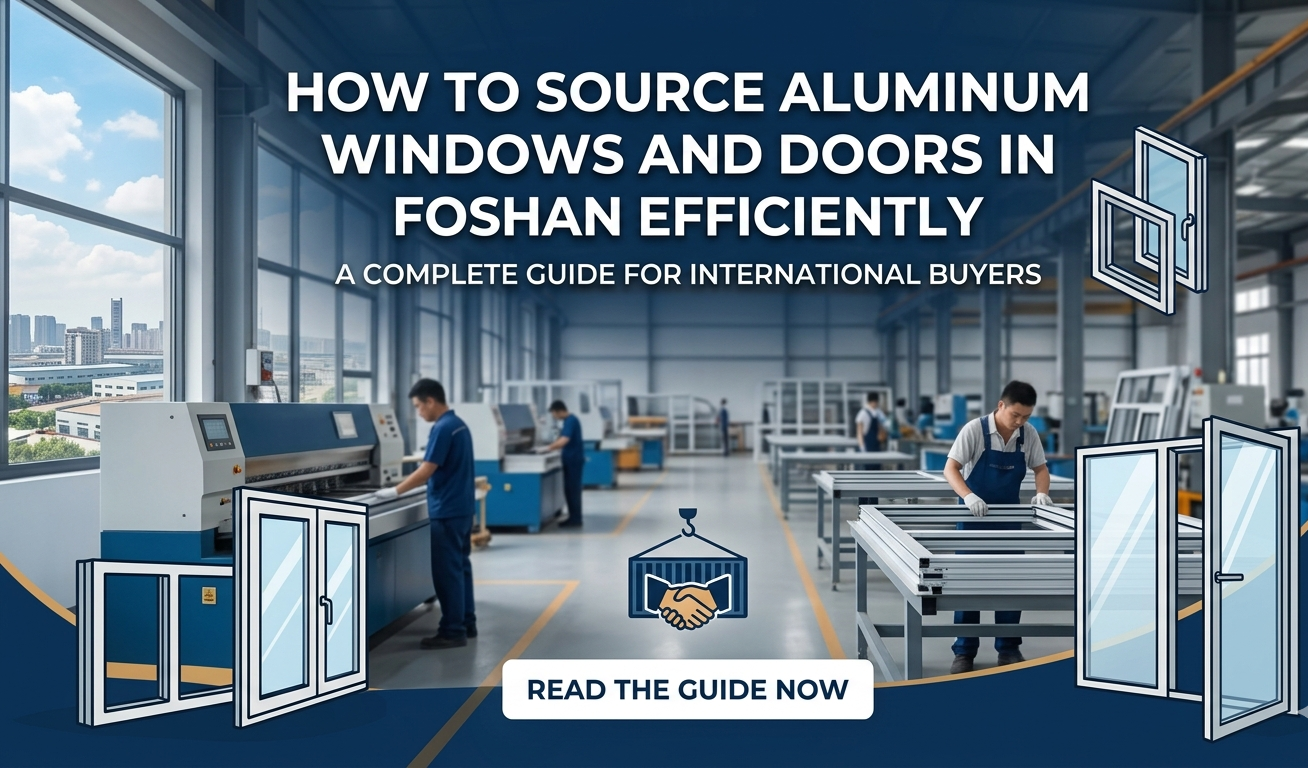
If you are buying architectural windows and doors for a commercial development, a hotel, or a high-end residential project, your supply chain will eventually lead to Foshan, China. Specifically, the Nanhai District in Foshan is the global hub for aluminum extrusion.
However, buying from Foshan is not as simple as clicking “order” on Alibaba. Google Search data shows a massive shift in how professional buyers operate: they are no longer searching for “cheap windows in China.” Instead, they are searching for specific technical terms like “PA66 thermal break Foshan,” “AS2047 certified doors,” and “KinLong hardware.”
To source efficiently, you must stop treating windows like commodities and start treating them as engineered building materials. Here is the practical reality of how to manage a window procurement project in Foshan.
What do Google Trends tell us about window sourcing in 2026?
A quick look at Google Trends for B2B building materials reveals a clear pattern: the search volume for “trading companies” is dropping, while searches for “direct extrusion factories” and “Nanhai aluminum” are rising.
This means your competitors have realized that buying from a middleman in Shenzhen or Guangzhou adds a 20% to 30% markup to the landed cost. The most efficient buyers are now bypassing the traders and going directly to the source. Foshan factories don’t just assemble windows; they melt the aluminum billets, extrude the profiles, and apply the fluorocarbon (PVDF) coatings all within a 15-kilometer radius. This extreme industrial density is what actually drives the price down and speeds up lead times.
How do you separate real Foshan factories from office-based traders?
Most overseas buyers get tricked by beautiful English websites. A trading company in a high-rise office will often pose as a factory. If you want factory-direct pricing, you need to verify their physical assets.
Before you ask for a quote, ask for proof of production:
- The CNC Machines: Request a video of their 5-axis CNC cutting machines and double-head miter saws. Real factories have noisy, active shop floors.
- Extrusion vs. Assembly: Very few factories do both. Understand that you are likely buying from an “assembly factory” that purchases raw aluminum profiles from massive local extruders like Jianmei or Fenglu.
- The Address: Check the business license. If the address is in a downtown commercial district rather than an industrial park in Nanhai or Shunde, you are talking to a broker.
What technical specifications must you define in your RFQ?
If your Request for Quotation (RFQ) simply says “sliding aluminum doors,” you will receive the cheapest, thinnest product possible. Factories quote to win, and vagueness is an invitation for quality fade. You must define the engineering specs:
- Aluminum Wall Thickness: Do not accept anything under 1.4mm for standard residential windows. For large patio sliding doors or commercial storefronts, mandate 2.0mm or 2.5mm to prevent the frame from sagging under the weight of the glass.
- Thermal Break Specs: If you are in a climate with cold winters or hot summers, you need thermally broken profiles. Explicitly specify PA66 Nylon strips. Do not accept PVC, which degrades quickly under UV exposure.
- Glass Configuration: Specify the exact makeup. For example: 5mm Tempered + 12A (Argon Gas) + 5mm Low-E Tempered.
- Hardware: The locking mechanism will break before the aluminum does. Demand specific brands like German Hoppe, Siegenia, or top Chinese brands like KinLong or Cmech.
How should you handle the logistics of fragile glass and heavy frames?
A perfectly manufactured window is useless if it arrives shattered. Shipping heavy metal frames attached to fragile glass requires strict protocols that you must write into your contract.
- Packaging Requirements: Never accept standard cardboard wrap. Mandate that all units are packed in fully enclosed, IPPC-stamped (fumigated) wooden crates or heavy-duty steel A-frames.
- Container Loading: Glass must always be loaded vertically. If a factory stacks windows horizontally to fit more into a container, the pressure will crack the glass during ocean transit.
- Spare Parts: Always negotiate a 1% to 2% surplus of common hardware (screws, hinges, weather stripping) to be shipped in the container. Finding a matching Chinese metric hinge in a local UK or US hardware store is a nightmare.
Key Takeaways
- Location Matters: Focus your search strictly on Foshan (Nanhai District) to leverage the true source of aluminum extrusion and cut out trading markups.
- Dictate the Specs: Control your quality by explicitly defining profile thickness (1.4mm+), PA66 thermal breaks, and specific hardware brands in your initial inquiry.
- Verify the Factory: Look past the website; demand video proof of CNC machinery and verify their industrial park address.
- Prioritize Packaging: The cost of wooden crating is negligible compared to the cost of replacing shattered custom glass on a job site.
Why Choose HSY Sourcing?
Sourcing architectural windows requires technical oversight on the factory floor, not just email communication. Based directly in the Foshan building materials cluster, HSY Sourcing provides the physical presence developers and contractors need to execute complex orders safely.
- Technical Drawing Review: We don’t just forward PDFs. We verify the factory’s CAD shop drawings against your architectural plans to ensure rough openings and installation fins are accurate.
- Direct Factory Access: We bypass the traders. We take you straight to verified assembly plants in Nanhai, ensuring your money goes into the product, not a middleman’s commission.
- In-Process QC: We use digital calipers to measure aluminum thickness and physically inspect the thermal break materials before the frames are sealed and glazed.
- Secure Loading: We oversee the crating and container loading process locally, ensuring your fragile cargo is secured vertically for safe ocean transit.
Stop risking your building envelope on unverified suppliers. Contact the team at HSY Sourcing today.
FAQ
Q1: Can Foshan factories provide AS2047 or NFRC certified windows?
A: Yes, many top-tier export factories in Foshan hold AS2047 (Australia) and NFRC (North America) certifications. However, certified glass and profiles cost more. You must state your compliance requirements before they quote.
Q2: What is the typical lead time for custom aluminum windows?
A: Once you approve the final CAD drawings and pay the deposit, production typically takes 25 to 35 days. If you require a non-standard powder coating color, add another 7 to 10 days.
Q3: Is it better to buy windows fully assembled or as raw extrusions?
A: For 95% of overseas developers, buying fully assembled and glazed windows is much more cost-effective. The local labor costs to assemble frames and source custom tempered glass in Western countries will immediately erase any freight savings.
Q4: What happens if glass breaks during shipping?
A: If you work with a professional sourcing agent, the contract will state that breakage due to poor factory packaging is the factory’s liability. A local agent can enforce this and have replacement glass air-freighted or included in your next container.