
For a 200-room hotel fit-out or a multi-unit apartment development, interior materials account for a massive percentage of the capital expenditure. Sourcing these materials internationally introduces strict logistical challenges. If your bathroom tiles arrive on site, but your custom aluminum windows are delayed at a different port, construction halts and labor costs multiply.
Historically, buyers would source lighting from Zhongshan, doors from Zhejiang, and furniture from Dongguan. Today, professional project managers are consolidating their entire interior supply chain into one specific city: Foshan.
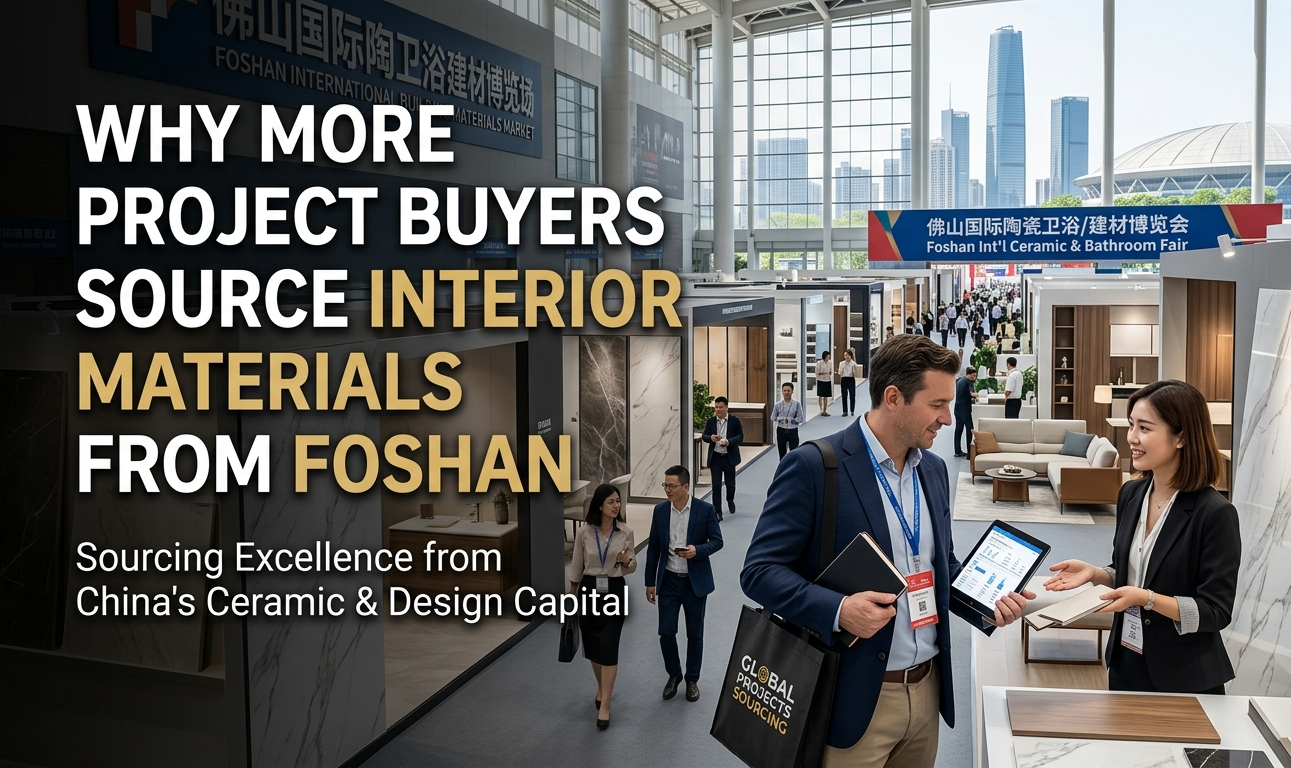
This shift is not just about product variety. It is a calculated move to reduce inland freight costs, synchronize project timelines, and execute strict cross-category quality control. Here is the physical and economic logic behind sourcing one-stop interiors from Foshan.
Why is geographic density crucial for large-scale interiors?
Foshan is the world’s most concentrated industrial cluster for interior building materials and FF&E (Furniture, Fixtures, and Equipment). Within a 50-kilometer radius, you have distinct, world-class manufacturing zones:
- Nanzhuang & Shiwan: The global epicenter for porcelain tiles, sintered stone, and sanitary ware.
- Dali Town: The primary hub for 6063-T5 aluminum extrusions, curtain walls, and commercial windows.
- Longjiang & Lecong: The manufacturing base for hospitality furniture, mattresses, and commercial upholstery.
For a project buyer, this density means your sourcing team can physically audit a tile factory in the morning, verify window extrusion thickness at noon, and inspect a hotel bed mockup in the afternoon. This localized ecosystem makes true “one-stop” procurement physically possible.
How does a one-stop cluster reduce inland freight costs?
When you fragment your supply chain across different Chinese provinces, you pay for it in logistics.
If you buy interior wooden doors from northern China and sanitary ware from the south, you must arrange multiple LCL (Less than Container Load) shipments or pay exorbitant inland trucking fees to bring the goods to a single port.
By sourcing exclusively within Foshan, inland logistics are reduced to local truck runs. All materials can be delivered to a single, centralized consolidation warehouse within hours. This eliminates redundant domestic shipping fees and significantly lowers the baseline cost of your procurement operation.
What is the risk of managing multiple provincial suppliers?
Quality control requires physical presence. If your suppliers are spread 1,000 miles apart, it is economically unviable to deploy engineers to inspect every single production run. The result is “cloud sourcing”—relying on factory-provided photos—which inevitably leads to on-site defects.
Sourcing locally in Foshan mitigates this risk entirely. It allows a dedicated, on-the-ground team to execute DUPRO (During Production) inspections across all your material categories simultaneously. If a factory attempts to substitute PA66 thermal breaks with cheaper PVC in your windows, or uses low-density foam in your hotel sofas, a local inspector can catch and correct the issue on the assembly line, long before the goods are crated.
How does cross-category consolidation maximize container ROI?
This is the exact mathematical advantage that experienced developers use to lower their landed costs. Shipping containers have two limits: Maximum Weight and Maximum Volume (CBM).
- Heavy Materials: Porcelain tiles, marble, and soundproof glass hit the weight limit very quickly. A container of tiles will be physically half-empty, but legally full.
- Light Materials: Upholstery, case goods, and lighting are “volume cargo.” They take up massive space but weigh very little.
When you source your entire interior package from Foshan, you can instruct your local warehouse to mix these categories. You load the heavy building materials on the floor of the container and stack the lightweight furniture and lighting on top. You hit 100% of the weight capacity and 100% of the CBM capacity, effectively shipping your lighter interior items for zero additional freight cost.
Key Takeaways
- Logistical Proximity: Foshan houses tiles, aluminum, and furniture within a single, highly dense industrial zone, eliminating the need to manage scattered suppliers.
- Reduced Inland Freight: Centralizing procurement in one city removes expensive long-distance domestic trucking from your project budget.
- Physical Quality Control: Localized sourcing allows a single engineering team to conduct physical audits across all your product categories on the same day.
- Container Optimization: Mixing heavy building materials with high-volume FF&E in the same container drastically reduces your global shipping costs.
Why Choose HSY Sourcing?
Managing a multi-category interior fit-out requires a technical team operating directly at the source. HSY Sourcing is headquartered in Foshan, serving as the localized procurement and engineering hub for global real estate projects.
- Engineering-First Audits: We do not just act as translators. We use digital calipers to verify aluminum wall thickness, test foam density for commercial sofas, and check water absorption rates for porcelain tiles.
- Warehouse Consolidation: We operate local hubs to receive your diverse interior materials. We meticulously sequence the loading of your heavy and light goods to squeeze the maximum ROI out of your ocean freight.
- Direct Factory Negotiation: Led by our team bypasses trading companies. We connect developers directly with Tier-1 extrusion plants, ceramic kilns, and furniture workshops to secure true factory-direct pricing.
- Project Synchronization: We align factory production schedules with your on-site construction timeline, ensuring your windows, tiles, and furniture arrive in the exact order required for installation.
Streamline your supply chain and protect your project budget. Contact the HSY Sourcing team today.
FAQ
Q1: Do Foshan factories meet international building codes for commercial projects?
A: Yes, but you must specify the requirement upfront. Top-tier Foshan factories regularly produce materials compliant with AS2047/AS2208 (Australia), CE (Europe), and SGCC/NFRC (USA). We physically verify that the factory holds the correct, valid certification reports before placing the order.
Q2: Can I source custom-designed furniture and lighting alongside standard building materials?
A: Absolutely. Foshan’s infrastructure is built for customization. Whether it is custom dimensions for Handmade Woven Lighting or bespoke headboards for a hotel room, we manage the CAD drawing approval process directly with the specialized local workshops.
Q3: How do you handle the packaging of fragile items like glass and ceramics?
A: We enforce strict commercial packaging mandates. All windows and fragile sanitary ware must be packed in fully enclosed, fumigated (or artificial wood) plywood crates with EPE foam separators. We supervise the container loading to ensure these crates are braced securely against heavy materials.
Q4: What is the typical lead time for a complete one-stop interior package?
A: Because we synchronize the orders, the longest lead time dictates the shipment. Custom aluminum windows usually take 35-45 days. We schedule the faster items (like standard tiles or furniture) to finish at the exact same time, so your consolidated container is ready to ship within 45 days of deposit.