
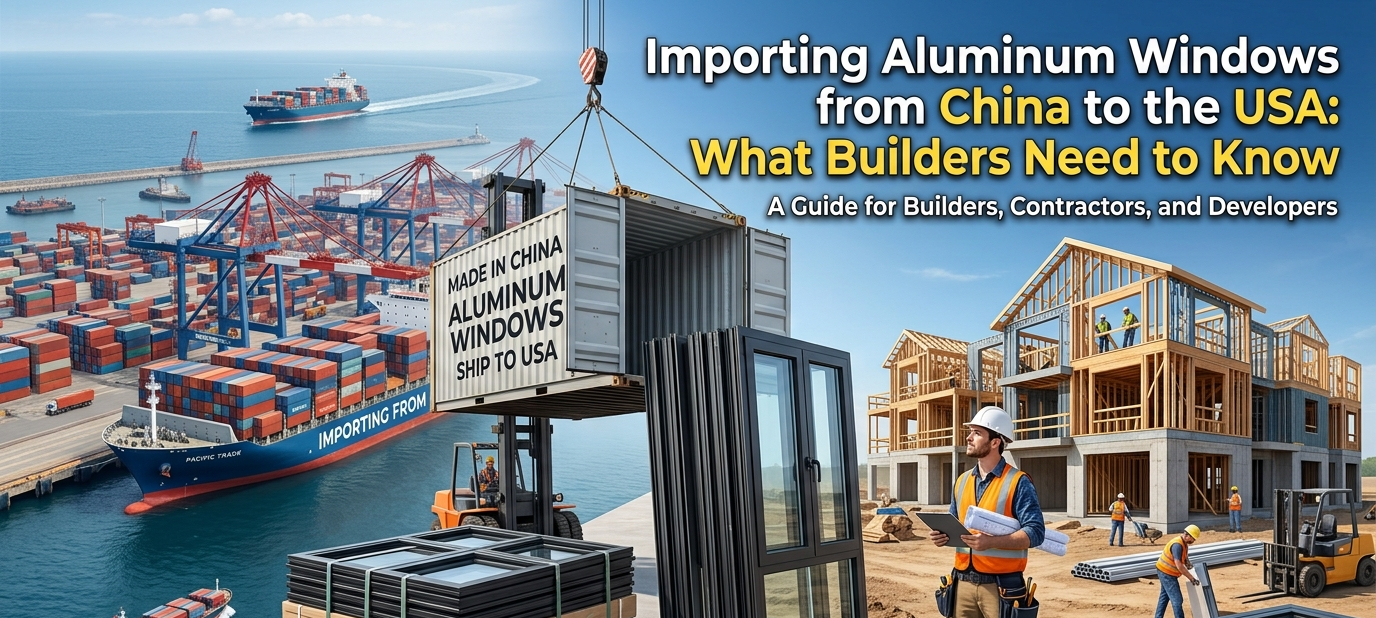
For general contractors, custom home builders, and real estate developers managing luxury residential builds, fenestration represents one of the largest single trade packages on the line-item budget. Modern villa designs increasingly demand expansive glass openings—such as 10-foot-tall multi-slide patio doors, slim-frame panoramic casements, and structural curtain wall assemblies.
Procuring these high-specification thermally broken aluminum windows directly from manufacturing hubs like Foshan, Guangdong can reduce material expenditures by 35% to 50% compared to domestic US dealer pricing.
However, importing architectural glazing requires navigating clear technical barriers: local building code enforcement, mandatory glass safety certifications, customs tariffs, precise rough opening measurements, and ocean transport protection.
This guide details the practical realities of importing custom aluminum windows from China to the United States, outlining the compliance requirements, cost drivers, and quality controls needed to execute a successful window package.
Key Takeaways
- Strict Code Mandates: Imported window units must feature permanent etched SGCC (ANSI Z97.1) marks on safety glass and documented NFRC thermal test reports to pass municipal US building inspections.
- Metric vs. Imperial Measurement Precision: Chinese factories build strictly to exact overall outer frame dimensions in millimeters. US builders must account for Rough Opening (R.O.) fitting clearances and nail fin setbacks before sign-off.
- Real Tariffs and Landed Cost Calculation: Landed cost calculations must factor in international ocean freight, US harbor maintenance fees, brokerage fees, and federal Section 301 tariffs on aluminum profiles and glass assemblies.
- Structural Protection in Transit: Windows and sliding doors must be loaded vertically on reinforced wooden A-frame skids, ratcheted to container walls, and cushioned with dunnage air bags to prevent frame racking or glass breakage.
- The Need for On-Ground Oversight: Reconciling architectural elevation sheets into factory CAD shop drawings requires an on-ground engineering eye in Foshan to verify hardware, weep holes, and thermal break specs before production starts.
What Building Codes and Certifications Are Required for Importing Windows to the US?
US building inspectors will reject imported window assemblies at the jobsite if they lack verified physical certification marks. When specifying windows from export-oriented factories in Foshan, two core certification standards must be established during the shop drawing phase:
+-----------------------------------------------------------------------------------+
|                     MANDATORY US FENESTRATION CERTIFICATIONS                      |
+--------------------------+--------------------------------------------------------+
| Certification / Standard | Technical Requirement & Inspection Checkpoint          |
+--------------------------+--------------------------------------------------------+
| SGCC / ANSI Z97.1        | Permanent logo etched into glass corners for safety    |
|                          | glazing (tempered/laminated) near doors & floor level. |
+--------------------------+--------------------------------------------------------+
| NFRC / IECC Compliance   | Standardized U-Factor and SHGC performance labels      |
|                          | required to satisfy state energy code submittals.      |
+--------------------------+--------------------------------------------------------+
| ASTM E1886 / E1996       | Structural impact & wind load testing for coastal      |
| (Miami-Dade / Florida)   | hurricane zones requiring laminated impact glass.      |
+--------------------------+--------------------------------------------------------+
Safety Glazing Certification (SGCC)
Under IRC and IBC building codes, safety glass is legally required in doors, hazardous locations, and windows positioned close to floor levels or walking surfaces.
- Every tempered or laminated insulating glass unit (IGU) must carry a permanently etched SGCC (Safety Glazing Certification Council) logo referencing ANSI Z97.1.
- Removable paper stickers or temporary printed labels will fail site inspection, risking forced glass replacement.
Thermal Energy Ratings (NFRC Parameters)
Local energy codes (such as California Title 24, IECC 2021, or local municipal green codes) enforce strict limits on thermal transmittance (U-Factor) and solar heat gain (SHGC).
- Thermally broken aluminum frames utilizing PA66 GF25 polyamide insulation strips combined with double- or triple-pane Low-E glass filled with Argon gas can achieve U-Factors down to 0.22–0.28.
- Factories must supply formal NFRC test reports and thermal simulation documentation during the plan review phase to secure building permits.
How Do You Prevent Costly Measurement Errors Between US Plans and Chinese Factory CAD Drawings?
The single most common operational failure when importing windows is a failure of drawing translation. US architectural plans reference Rough Openings (R.O.) in feet and inches, whereas Chinese manufacturing equipment processes exact Outer Frame Dimensions (O.D.) in millimeters.
US ARCHITECTURAL PLAN             FOSHAN FACTORY CAD SHOP DRAWING
  Rough Opening (R.O.)       ──>     Exact Outer Frame Size (O.D.)
  Example: 60" W x 80" H             Subtract 1/2" (12.7mm) gap per side
                                     Result: 1498mm W x 2006mm H
The Rough Opening Calculation
If a contractor provides a factory with a raw Rough Opening measurement of $60″ \times 80″$ ($1524\text{ mm} \times 2032\text{ mm}$), and the factory builds the frame to that exact size, the window will not fit into the framed timber stud wall.
A qualified local sourcing agent verifies that factory CAD shop drawings incorporate necessary installation fitting gaps:
- Perimeter Deduction Allowance: Subtracting approximately $1/4″$ to $3/8″$ ($6\text{ mm}$ to $10\text{ mm}$) along each side to allow for shimming, leveling, and low-expansion foam insulation.
- Nailing Flange (Nail Fin) Setback: Wood-frame residential construction in North America relies on integrated perimeter nailing fins for flashing integration. The depth setback of the nail fin must match the exterior wall sheathing and rainscreen detail (e.g., $1/2″$ or $3/4″$ setback).
- Subframe Anchoring Details: For masonry or steel-frame structures, flush subframes must be detailed with thermal isolators before main frame fabrication.
What Is the Real Landed Cost of Importing Aluminum Windows from Foshan?
While factory-gate prices in Foshan are significantly lower than US retail prices, calculating the true landed cost requires factoring in international freight, port logistics, and federal import tariffs.
[Factory Gate Price (EXW/FOB Foshan)]
               +
[Ocean Freight & Marine Cargo Insurance]
               +
[US Customs Duties & Tariffs (Section 301 / 232)]
               +
[Port Handling, Brokerage, & Destination Inland Trucking]
               =
[TOTAL LANDED JOBSITE COST]
Breaking Down Tariff and Duty Overhead
When importing aluminum fenestration products from China into the United States, several trade duty categories apply:
- Base HTS Duty: Standard Harmonized Tariff Schedule duties for aluminum windows and doors under HTS code 7610.10 range around 5.7%.
- Section 301 Tariffs: Federal trade actions impose additional tariffs (typically 25%) on specific Chinese aluminum products and manufacturing components.
- Section 232 Duties: Aluminum tariff adjustments may apply depending on current federal trade rulings and material composition classifications.
Landed Cost Financial Reality
Even after adding 25%+ federal tariffs, $4,000 to $8,000 in 40ft HQ ocean container shipping costs, customs brokerage fees, and local flatbed trucking, a complete villa window package sourced directly from Foshan typically yields net savings of 35% to 50% compared to equivalent quotes from North American luxury architectural brands.
The financial margin is particularly wide on large-scale sliding door systems, motorized glass assemblies, and custom anodized profiles where domestic manufacturers charge steep custom surcharges.
How Are Oversized Glass Assemblies Protected During Ocean Transit?
Shipping heavy aluminum frames and double- or triple-pane glazed units across 6,000 miles of ocean requires specialized packing engineering. Loose or horizontally stacked cargo will rack frame corners, crack thermal breaks, or break glass panels during sea transit.
+-------------------------------------------------------------------------+
|                  CONTAINER PACKING & SECURING DETAIL                    |
|                                                                         |
|  [SIDE WALL]                                             [SIDE WALL]    |
|  +--------------------+                       +--------------------+    |
|  | Vertical Wooden    |  [Inflatable Dunnage  | Vertical Wooden    |    |
|  | A-Frame Skid       |   Air Bags in Void]   | A-Frame Skid       |    |
|  | (Glazed Assemblies)|                       | (Frame Bundles)    |    |
|  +--------------------+                       +--------------------+    |
|  |  [Steel Ratchet Strap] ── anchored to ── [Container Tie-Down Ring]  |
+-------------------------------------------------------------------------+
Structural Skid Packaging Rules
- Vertical Skid Mounting: Windows, sliding door panels, and glass units are never laid flat. They are mounted vertically on heavy-duty, custom-built wooden A-frame skids or steel transport racks.
- Fumigation Stamp Compliance: All solid wood skids, pallets, and bracing materials must display legible ISPM 15 heat-treatment (HT) stamps to pass US Customs and Border Protection (CBP) agriculture checks without port rejections.
- Corner Cushioning & Moisture Controls: Frame corners are protected with high-density EVA foam caps and wrapped in heavy stretch film. Silica gel desiccant packs are distributed inside sealed packaging to prevent condensation staining during humid sea crossings.
- Container Anchoring: Skids are ratcheted directly to interior container tie-down rings using heavy-duty nylon webbing straps. Remaining voids between rows are filled with commercial inflatable dunnage air bags to suppress lateral cargo movement during vessel roll.
Why Choose HSY Sourcing for Importing Windows from Foshan?
Managing custom window engineering, factory production, quality control, and international logistics from North America creates operational exposure. HSY Sourcing serves as your dedicated on-ground technical procurement manager and quality inspector in Foshan.
- CAD Shop Drawing Reconciliation: We review factory shop drawings against your US architectural plans. We check Rough Opening deductions, nail fin setbacks, hardware mounting heights, and weep hole placement before production starts.
- On-Site Pre-Shipment QC Audits: We do not rely on factory photos. HSY inspectors visit the production facility in Nanhai or Shunde to perform hands-on checks—verifying aluminum profile wall thickness with digital calipers, testing corner crimping strength, auditing hardware operations, and conducting water-penetration spray tests on sample assemblies.
- Code and Markings Verification: We inspect every glass pane to confirm that permanent, etched SGCC logos are present. We verify that PA66 thermal break strips match specs and confirm that all packaging displays ISPM 15 heat-treatment stamps.
- Supervised Container Loading & Dunnage Securing: HSY staff personally supervise the loading process at our staging warehouse or factory dock. We oversee the installation of wooden A-frames, verify heavy-duty ratcheting, ensure proper placement of inflatable dunnage air bags, and send you video and photo documentation of every layer.
- Transparent Agency Structure: We operate on a clear, flat agency fee model. You receive genuine factory-direct invoices with zero middleman price markups, paired with full export documentation support for your US customs broker.
Frequently Asked Questions (FAQ)
How long does the entire process take from signing window drawings to jobsite delivery in the US?
A typical project timeline ranges from 10 to 14 weeks:
- Shop Drawing Approval: 1 to 2 weeks.
- Factory Manufacturing: 4 to 5 weeks (including extrusion cutting, assembly, glazing, and dry-fit checks).
- Ocean Freight & Port Customs Clearance: 4 to 5 weeks (depending on whether shipping to US West Coast or East Coast ports).
- Inland Jobsite Delivery: 3 to 5 days.
Can Foshan window factories provide NFRC performance labels for local building submittals?
Yes. Leading export-focused manufacturers in Foshan maintain formal NFRC testing documentation and thermal modeling reports for their main window and door profile series. HSY Sourcing collects these test sheets and performance ratings during pre-production so your project architect or contractor can submit them to local building departments for plan permits.
What happens if an insulated glass unit (IGU) arrives cracked at the US construction site?
While supervised loading and custom A-frame skids minimize shipping risks, transit accidents can occur. HSY Sourcing assists by coordinating with the factory to ship spare hardware and glass panels in the original container. If a replacement pane is needed post-delivery, local US glass fabricators can cut and glaze a replacement double-pane IGU locally using the frame’s removable interior glazing beads without replacing the entire aluminum frame.
What is the minimum project scale to justify importing windows from China?
Importing is most cost-effective for whole-house custom villa packages, multi-unit residential developments, or commercial builds requiring at least $30,000 to $50,000+ in total window material value (typically 25+ window/door units). At this scale, the financial savings comfortably cover ocean freight, tariffs, customs fees, and agency representation while yielding net project savings.