
For any real estate developer or contractor, a 200-unit kitchen cabinet project is a “war of details.” If you place an order with a Foshan factory based solely on original architectural blueprints, you are likely heading toward a disaster. By the time the containers arrive at your overseas job site, you might discover that sink cutouts are off by 10cm, wall cabinets block the ventilation flues, or—worst of all—the cabinets are too long to fit into the allocated wall space.
At HSY Sourcing, we have managed numerous large-scale hospitality and residential projects. We have learned that success doesn’t depend on how big the factory’s showroom is; it depends on how you manage the stack of technical drawings and measurement data. Here is the boots-on-the-ground logic of how we manage cabinet measurements and delivery in Foshan.
Why are architectural drawings insufficient for factory production?
A common mistake made by first-time buyers is sending a PDF of the construction plans to the factory and waiting for a quote.
In a real construction environment, walls are never perfectly 90-degree angles, and the thickness of plaster varies. If a drawing says a kitchen is 3000mm wide, the finished space might actually be 2985mm. For a large project, a 15mm error means the cabinets simply won’t fit.
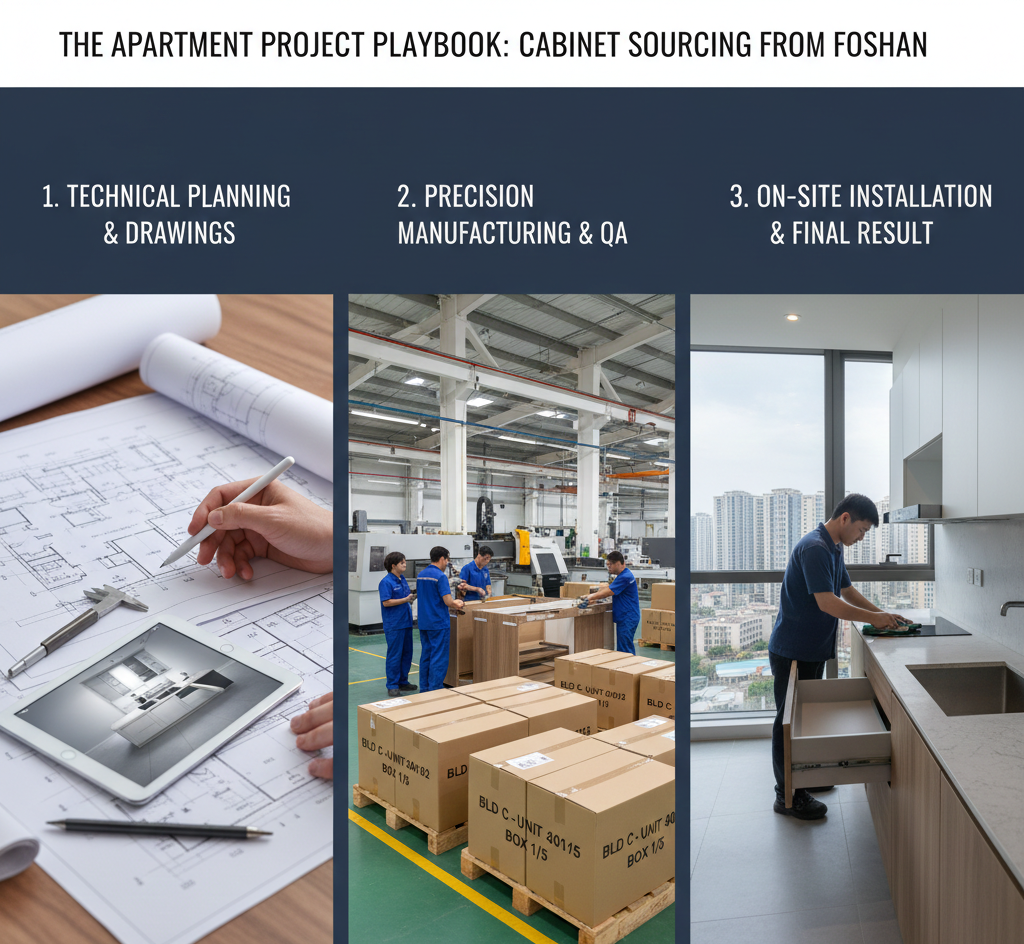
This is why our first step is always “Shop Drawings.” We require the factory’s technical team to translate architectural plans into production-ready drawings. We check the “clash points”: Will the cabinet door hit the refrigerator handle? Is there enough clearance for the dishwasher’s electrical outlet? Catching these errors on a computer screen in Foshan is free; fixing them at a job site in London or New York is incredibly expensive.
How do you lock in dimensions when the building isn’t finished yet?
This is the biggest challenge: cabinets usually need to be ordered before the interior finish is complete to meet the construction deadline. However, the tiles might not even be on the walls yet.
Our strategy relies on the “Type-Based Template Method.” In a 200-unit project, there are usually only 4 to 5 main floor plans (Type A, B, C, etc.).
- Prioritize Mock-up Rooms: We request the developer to finish one unit of each floor plan type first.
- Physical Verification: Our team visits the site (or coordinates with the site manager) to record the “Net Dimensions” after tiles are installed.
- The Filler Panel Secret: This is a pro tip. At the end of every cabinet run that meets a wall, we include a 20-50mm Filler Panel. If the wall is slightly narrower than expected, the installer simply trims the filler panel. If it’s wider, the panel covers the gap. This is much more logical than hoping for “perfect” wall dimensions.
How do you prevent missing parts for 200 different kitchens?
Managing 200 units means handling thousands of panels, doors, and boxes of hardware. If the drawer slides for a Type A unit are packed into a Type B unit’s crate, installation efficiency drops to zero.
We implement a “Unit-Based Coding & Packing System”:
- Unique ID Labels: Every single panel and carcass is labeled before leaving the assembly line with the
Project Name - Building - Room Number - Cabinet ID. - Unitized Pallets: We strictly require the factory to pack by “Room.” This means when the workers unload the container at the site, they simply push the pallet marked “Room 402” into Room 402. All the parts for that specific kitchen are right there.
- Hardware Bags: Handles, hinges, and screws for each specific unit are sealed in a dedicated bag inside that unit’s box. This prevents workers from “borrowing” screws from other rooms.
What exactly do we check during the inspection in Foshan?
For a 200-unit project, you cannot wait until all 200 units are finished to start your inspection. If a color error is found then, the factory will never meet your shipping deadline.
We perform a “First-Article Trial Assembly.” Before mass production starts, the factory must produce one complete kitchen for each unit type.
- Full Assembly Check: We visit the factory and require the workers to fully assemble these units, including countertops and toe kicks.
- Hardware Simulation: We repeatedly open and close every drawer and door to check the soft-close tension and alignment.
- Packaging Stress Test: We inspect the box quality. For sea freight, we insist on 5-layer or 7-layer double-corrugated boxes with reinforced corner protectors.
Once these “Mock-up Units” are approved, the remaining units are produced following that exact standard. This “Correct Once, Multiply Many” logic eliminates 90% of quality risks.
How do you manage countertop measurements and transit?
The countertop is the highest-risk part of any kitchen project. If you choose quartz or sintered stone, the measurements must be flawless because stone cannot be easily adjusted on-site.
For 200-unit projects, we recommend:
- Standardized Appliances: Require the developer to buy the same sink and stove models for all units. This allows the factory to use one single template for all cutouts.
- Logistics Protection: Countertops must be shipped in A-frame steel-reinforced wooden crates and placed vertically. If slabs are laid flat during sea transit, the vibration of the ship will crack them.
FAQ: Common Questions on Large-Scale Cabinet Projects
Q: Can we just send you our CAD files to start?
A: Yes. However, we will use those to create “Shop Drawings” adapted to the factory’s machinery. These production drawings must then be signed off by your architect to ensure everyone is on the same page.
Q: What is the typical lead time for 200 units?
A: Once the drawings and material samples are confirmed, Foshan factories typically need 35 to 45 days. The bottleneck is usually the drawing approval phase—the faster you confirm the technical details, the faster we ship.
Q: How do you handle missing or damaged items at the job site?
A: We include a “Service Kit” in the container. This contains extra hinges, handles, and standard-sized door panels. We also include color-matched touch-up pens and extra edge-banding. If a custom piece is missing, we use our local presence in Foshan to expedite a replacement within 48 hours.
Conclusion
Managing a 200-unit kitchen project in Foshan is not about “buying furniture”; it is about managing certainty. You have to solve every potential problem—wrong sizes, color variance, or transit damage—before the first piece of wood is even cut.
In Foshan, you have the world’s best supply chain, but you need a team that speaks the language of the factory floor and understands the pressure of your construction schedule.
Is your project currently in the design phase? Don’t wait until the installation starts to find out the measurements are wrong. Contact HSY Sourcing today. We can audit your current drawings and help you build a foolproof delivery plan for your 2026 developments.