
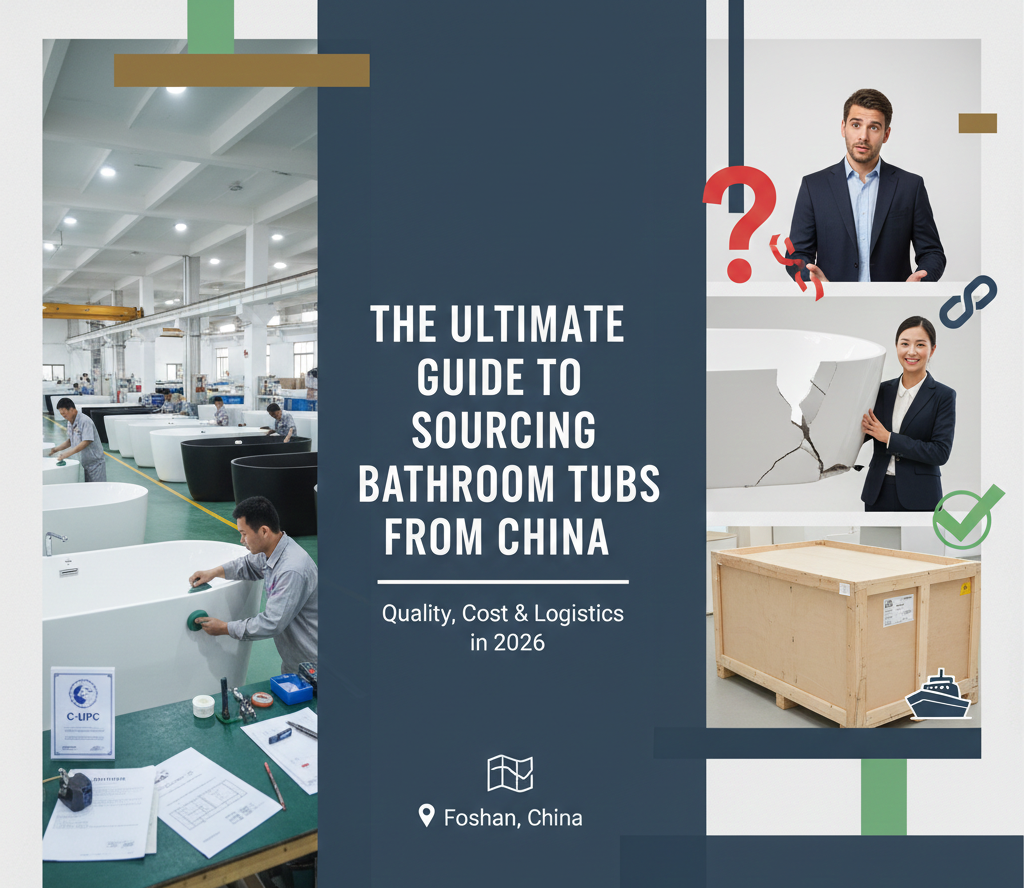
If you ask any experienced importer which products give them the most anxiety, “Bathtubs” will likely be at the top of the list.
Unlike sourcing phone cases or kitchen utensils, importing bathtubs is a heavy, high-stakes game. They are voluminous, taking up massive amounts of container space. They are fragile; a single crack during transit renders the product worthless. And they are heavily regulated; fail a plumbing code inspection in the US or Europe, and you have a warehouse full of unsellable stock.
Yet, despite these challenges, China remains the undisputed global hub for bathtub manufacturing. In 2026, the opportunity for profit in this category is still immense for those who know how to navigate the market. Whether you are a hotel developer, a specialized retailer, or a construction contractor, the key to success isn’t just finding a factory—it’s managing the details that others overlook.
At HSY Sourcing, based right here in the heart of China’s sanitary ware industry, we guide clients through this process every day. We wrote this guide to share the reality of what it takes to source bathroom tubs successfully this year.
Why is China, and specifically Foshan, still the primary source for bathtubs?
In the past few years, we have seen some manufacturing sectors move to Southeast Asia. However, the sanitary ware industry has largely stayed put in China. The reason is simple: the supply chain ecosystem here is impossible to replicate quickly.
Making a high-quality bathtub isn’t just about molding plastic or casting iron. It requires a complex network of raw material suppliers—from high-grade acrylic sheets and fiberglass reinforcement to precision stainless steel hardware for the feet and frames.
This is where location matters. If you are sourcing tubs, you will likely hear the name Foshan.
Foshan is not just a city; it is the global capital of ceramics and bathroom furniture. When you source from this region, you are tapping into a mature cluster where factories have decades of experience. The specialized labor force here knows the difference between a “good enough” polish and a “mirror finish.” For our clients, this proximity means faster lead times and, crucially, consistent quality that newer manufacturing hubs simply cannot match yet.
How do you choose the right material for your target market?
Before you even look for a supplier, you must be crystal clear about the material. In 2026, the market is segmented, and choosing the wrong material can kill your margins.
Acrylic remains the volume king. It is lightweight, which saves on shipping costs, and it is warm to the touch. However, the quality variance is huge. Cheap acrylic turns yellow after a year of UV exposure. We always advise clients to specify “pure acrylic” reinforced with fiberglass, rather than the cheaper ABS composites that some factories try to pass off as high-end.
Cast Iron is the traditional choice for luxury vintage styles. These are incredibly durable but incredibly heavy. Shipping cast iron tubs requires a completely different logistics strategy because the weight limit of the container will be reached long before the volume limit.
Solid Surface (Stone Resin) is the current trend for high-end modern homes and 5-star hotels. These tubs have a beautiful matte finish and feel like natural stone. The challenge here is the molding. If the factory’s mold is old or their polishing process is rushed, you will see pinholes or uneven textures. This material requires the strictest quality control standards.
What separates a real manufacturer from a middleman?
If you search for “bathtub factory” online, you will find thousands of results. The reality? A large percentage of them are trading companies.
There is nothing inherently wrong with trading companies, but when you are dealing with a product as technical as a bathtub, you want direct access to the source. You need to know that the person you are talking to can walk onto the production floor and change a drain placement or reinforce a corner.
So, how do we tell the difference?
Real manufacturers invest heavily in molds. When we visit a potential supplier, the first thing we look at is their mold storage room. A factory with hundreds of well-maintained molds is a factory that has been in business for a long time. We also look at their curing ovens. Proper curing takes time and space; factories that rush this process to save money will produce tubs that warp or crack later.
Another tell-tale sign is the dust management. A top-tier bathtub factory—especially for solid surface tubs—needs a dust-free environment for the final stages. If we see dust floating around the finishing area, we walk away, because that dust will end up embedded in your product.
Why are certifications and compliance non-negotiable?
This is the most boring part of sourcing, and also the part that can bankrupt you.
Bathtubs are not just furniture; they are plumbing fixtures. In North America, if your tub does not have cUPC certification, most licensed plumbers will refuse to install it. If you are selling to a hotel project, the building inspector will demand to see the paperwork. If you don’t have it, the tubs have to be ripped out.
In Europe, the CE marking is essential.
Many smaller factories in China will tell you, “No problem, we have quality.” But “quality” is subjective; a certificate is not. Obtaining these certifications costs the factory thousands of dollars and involves rigorous testing. A factory that has invested in cUPC or CE certification is a factory that is serious about the export market.
At HSY Sourcing, we verify these certificates directly with the issuing bodies before we let our clients place a deposit. We don’t take a PDF file at face value.
How do we ensure quality before the goods leave the factory?
You cannot inspect a bathtub by just looking at photos. Photos hide waves in the acrylic, they hide rough edges, and they definitely hide leaks.
Our inspection process for tubs involves being physically present. We perform a water test. We fill a random sampling of tubs with water and let them sit. We are looking for leaks, of course, but we are also checking drainage. Does the water drain completely, or does a small pool remain at the bottom because the slope angle is wrong? Standing water is a major defect that leads to customer complaints about mold and hygiene.
We also check the structural integrity. We look at the underside of the tub—the part the customer never sees. This is where factories cut corners. Is the fiberglass reinforcement sprayed evenly? Is the wooden baseboard (which supports the tub’s weight) completely encapsulated? If the reinforcement is thin, the tub might feel “bouncy” or flexible when a heavy person steps in. That is a sign of poor quality.
Finally, we check the color consistency. If you are ordering a white tub and a white sink, they need to be the same white. “White” in China can range from yellowish-cream to blueish-cool. We use color cards to ensure consistency across your entire order.
How can you prevent damage during the risky shipping process?
This is the single biggest fear for bathtub importers: opening the container and finding cracked shells.
Bathtubs are mostly air. They are large, hollow objects. If you stack them incorrectly, the bottom ones will crush. If you pack them loosely, they will bounce and shatter.
The packaging method depends on your sales model.
If you are a wholesaler buying in bulk to store in a warehouse, we often use “stack packing” (nesting tubs inside each other) to maximize the container space. This saves massive amounts of money on freight, but it requires the factory to use precise protective foam blocks between the tubs to prevent friction scratches.
If you are an e-commerce seller who ships directly to the final customer, you need “mail-order packaging.” This usually involves a heavy-duty 7-layer honeycomb cardboard box with reinforced corners and drop-test approval.
For high-value stone resin or cast iron tubs, we often recommend fully enclosed plywood crates.
When we supervise container loading, we play a game of “Tetris.” We ensure that heavy items (like toilets or hardware) are never stacked on top of the bathtubs. We ensure the cartons are strapped down tight so they don’t shift when the ship hits rough water.
What hidden costs should you budget for?
When you calculate your landing cost, don’t just look at the FOB price (the price of the product at the Chinese port).
Bathtubs have a terrible “volume-to-value” ratio. You are paying to ship a lot of empty space. This means ocean freight will be a significant percentage of your total cost, much higher than if you were shipping electronics.
You also need to consider anti-dumping duties. Depending on your country, there may be special tariffs on ceramic or bathroom products from China. These laws change frequently. It is vital to consult with a logistics expert or customs broker before you order.
Lastly, consider the domestic logistics in your home country. Delivering a 150kg crate to a residential address requires a truck with a liftgate and a scheduled appointment. These “last mile” costs can be shocking if you haven’t accounted for them.
Is customized design (OEM/ODM) worth the effort?
In 2026, the market is crowded. Selling a standard white rectangular tub is a price war you probably don’t want to fight.
The real opportunity lies in design. China’s manufacturing capabilities have evolved to the point where creating a custom mold is surprisingly affordable. We are seeing a surge in demand for colored tubs (black, grey, even pink), textured exteriors (fluted designs), and compact sizes designed for smaller urban apartments.
Working with a factory to create a unique design allows you to own a niche. However, this requires patience. You will need to go through 3D rendering, 3D printing of a prototype, and mold adjustments. This is where having a team like HSY Sourcing on the ground is invaluable. We translate your design vision into engineering speak that the factory understands, ensuring the final product looks like your drawing.
Conclusion
Sourcing bathroom tubs from China is not for the faint of heart. It involves technical knowledge, strict quality control, and careful logistics planning. But when done right, it allows you to bring premium, spa-quality products to your market at a competitive price.
The key is to respect the complexity of the product. Don’t just look for the cheapest price; look for the safest pair of hands.
At HSY Sourcing, we are your partners in Foshan. We know the factories, we know the pitfalls, and we know how to get your containers loaded safely. Whether you are looking for the latest solid surface designs or reliable acrylic standards, we are here to manage the risk so you can focus on the reward.