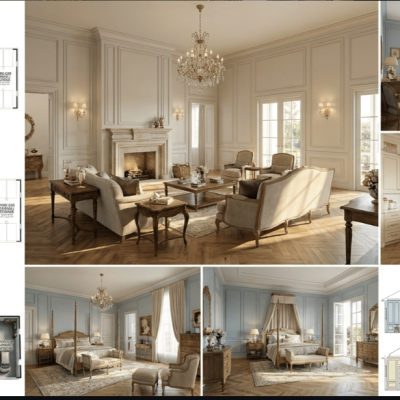

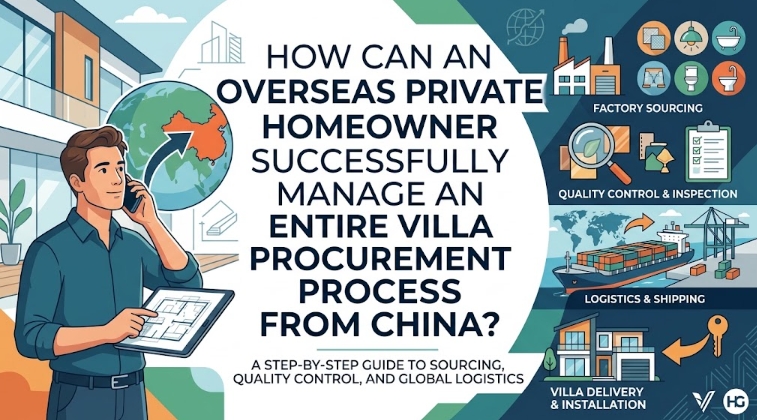
Managing a full-scope villa procurement project from China is rarely a simple shopping exercise. For an overseas private homeowner building a new residence, purchasing land for a development, or undertaking a comprehensive structural renovation, sourcing from China offers access to world-class manufacturing ecosystems, extensive customization, and significant material options.
However, a villa procurement project is fundamentally a management and coordination challenge. Beyond identifying suppliers, it requires synchronizing technical specifications, production schedules, quality control checks, consolidation logistics, and international shipping across dozens of distinct product categories.
To understand how to navigate this process successfully, private homeowners must treat procurement as an organized engineering and logistical workflow.
Can a Private Homeowner Really Manage an Entire Villa Procurement Project From China?
Purchasing a few off-the-shelf items from an online marketplace is vastly different from executing a complete villa procurement project. A custom residential project involves multiple specialized manufacturing sectors, non-standard dimensions, strict structural requirements, and complex interior shop drawings.
A typical high-end villa project from China may involve:
- Aluminum doors and windows: Requiring strict structural calculations, wind-load ratings, thermal break profiles, and specific glass performance standards.
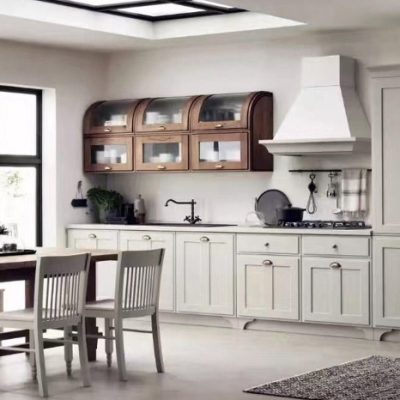
- Millwork and joinery: Including custom kitchen cabinetry, walk-in wardrobes, wall panelling, and vanity units manufactured to exact site dimensions.
- Hard finishes: Natural marble slabs, sintered stone, large-format porcelain tiles, and engineered hardwood flooring.
- Furnishings & fixtures: Custom loose furniture, integrated architectural lighting, sanitary ware, and custom metalwork.
Managing this volume directly means interacting with 10 to 20 separate factories, each operating on different production lead times, issuing technical drawings in varied formats, using different trade terms, and utilizing distinct packaging standards. Without a structured oversight process, managing this network remotely can lead to misaligned lead times, uncoordinated container loads, and costly specification errors that only become apparent upon jobsite delivery.
What Information Should You Have Before Starting Villa Procurement From China?
To receive accurate, actionable factory quotes, you must provide comprehensive design and engineering documentation. While preliminary inquiries can begin with basic floor plans, formal procurement requires a complete architectural and interior package.
Essential Documentation Package
- Architectural & Floor Plans: CAD files (
.dwg), structural layouts, and dimensioned floor plans. - Interior Design Package: 3D renders, material finish boards, spatial layouts, and detailed elevation drawings.
- Technical Schedules: Door and window schedules, millwork/joinery drawings, kitchen layout plans, and sanitary schedules.
- Bill of Quantities (BOQ): Itemized material schedules specifying quantities, required dimensions, and baseline performance criteria.
- Project Logistics Data: Target delivery dates, destination port details, site access limits, and destination country electrical or structural standards.
The Procurement Data Hierarchy
Understanding how your data transitions through the procurement supply chain prevents miscommunication:
$$\text{Project Information (Design)} \longrightarrow \text{Sourcing Information (Breakdown)} \longrightarrow \text{Factory Quotation (Execution)}$$
- Project Information: The macro-level design intent provided by your architect or designer (e.g., renders, CAD files, aesthetic concepts).
- Sourcing Information: The translation of design intent into technical manufacturing parameters (e.g., aluminum profile wall thickness, core board densities, veneer species, stone edge profiles, hardware series).
- Factory Quotation Information: The final commercial document reflecting shop drawings, precise material inclusions, hardware selections, packing specifications, and lead times.
Which Villa Materials Are Practical to Source From Foshan and Guangdong?
Foshan and the broader Pearl River Delta region in Guangdong province represent one of the world’s most concentrated manufacturing hubs for building materials, home furnishings, and architectural hardware. Sourcing from this regional ecosystem is highly practical due to industrial clustering, enabling efficient material matching and localized quality control.
| Category | Typical Sourcing & Technical Considerations |
| Aluminum Windows & Doors | Thermal break profiles, double/triple glazing specs, hardware systems (e.g., Siegenia, Hopo), wind-load resistance, local building code compliance. |
| Kitchen Cabinets | Carcass materials (marine plywood, moisture-resistant MDF), door finishes (lacquer, wood veneer, PET), hardware (Blum, DTC), appliance integration dimensions. |
| Wardrobes & Joinery | Internal layout configurations, integrated LED driver locations, carcass thickness, glass door frame profiles, custom veneer matching. |
| Natural Stone & Sintered Stone | Block selection, slab veining/book-matching, slab thickness ($12\text{mm}, 20\text{mm}$), edge processing, crating protection, breakage allowances. |
| Tiles & Flooring | Wear layer thickness, absorption rates, batch color consistency, non-slip ratings, edge rectified specs, sea-freight breakage allowances ($3\text{–}5\%$). |
| Furniture (Loose) | Frame timber/metal specs, high-density foam ratings, fabric/leather certifications, custom dimensions, protective export packaging. |
| Sanitary Ware & Fittings | Ceramic glazing quality, flushing mechanisms, brass content in tapware, thread standards (NPT vs. BSP), cartridge types, local plumbing certifications. |
| Lighting | Voltage requirements ($110\text{V}$ vs. $220\text{V}\text{–}240\text{V}$), driver certifications (UL, CE, SAA), color temperature (Kelvin), CRI ratings, custom drop lengths. |
Should You Buy Everything From One Chinese Supplier?
It is rarely advisable to source an entire villa project from a single factory. Multi-category suppliers or general trading companies that claim to manufacture everything internally typically outsource sub-categories to third-party workshops, adding margins while reducing direct quality control over specialized lines.
An optimized villa procurement structure balances factory specialization with centralized management:
- Windows & Doors: Sourced from a specialized window fabricator equipped with aluminum extrusion and testing facilities.
- Cabinetry & Joinery: Sourced from a dedicated millwork manufacturer with automated CNC edge-banding and finishing lines.
- Natural Stone: Sourced directly from stone processing yards in Shuitou or Foshan specializing in slab cutting and edge finishing.
- Loose Furniture: Sourced from high-end furniture workshops in Shunde.
- Lighting: Sourced from specialized architectural lighting factories in Guzhen/Zhongshan.
While specialized sourcing maximizes product quality and cost-efficiency, it requires centralized coordination to align production timelines, standardizations, and consolidated shipping schedules.
How Should a Villa BOQ Be Converted Into Actual Chinese RFQs?
Distributing a 100-page master BOQ to individual factories leads to delayed responses, inaccurate pricing, or ignored inquiries. Factories require clean, categorized Request for Quotations (RFQs) tailored specifically to their manufacturing discipline.
                  ┌────────────────────────────────────────┐
                  │          Master Villa BOQ              │
                  └───────────────────┬────────────────────┘
                                      │
         ┌────────────────────────────┼────────────────────────────┐
         ▼                            ▼                            ▼
┌─────────────────┐          ┌─────────────────┐          ┌─────────────────┐
│   Package A:    │          │   Package B:    │          │   Package C:    │
│ Windows & Doors │          │ Cabinetry & Wood│          │ Stone & Surfaces│
└────────┬────────┘          └────────┬────────┘          └────────┬────────┘
         │                            │                            │
         ▼                            ▼                            ▼
┌─────────────────┐          ┌─────────────────┐          ┌─────────────────┐
│ Window Factory  │          │ Millwork Plant  │          │ Stone Processor │
│   Specific RFQ  │          │   Specific RFQ  │          │   Specific RFQ  │
└─────────────────┘          └─────────────────┘          └─────────────────┘
Essential Information Accompanying Each Package RFQ:
- Scope Drawings: Relevant floor plans, extracted elevation cuts, and section details.
- Material Specifications: Clear material expectations (e.g., “304 stainless steel, PVD brass finish” or “E0 grade plywood, natural oak veneer”).
- Hardware Inclusions: Brand and model expectations for functional hardware (hinges, drawer slides, locks).
- Compliance Requirements: Destination market certifications (e.g., glazing safety standards, electrical certifications).
- Commercial Parameters: Required delivery timeline, packaging requirements for ocean freight, and target delivery port.
How Do You Compare Chinese Factory Quotes When Every Factory Uses Different Specifications?
Directly comparing line-item prices without evaluating exact technical specifications is a common mistake in offshore procurement. The lowest initial quote often reflects omitted components, lower-grade raw materials, or standard hardware rather than high-performance systems.
Case Study: Evaluating Two Kitchen Cabinetry Quotations
A homeowner receives two quotes for a custom kitchen design:
- Factory A Quote: $\$18,500$
- Factory B Quote: $\$26,200$
A superficial review suggests Factory A offers better value. However, an analysis of the underlying line-item specifications reveals the structural differences:
| Parameter | Factory A ($18,500) | Factory B ($26,200) |
| Carcass Material | $16\text{mm}$ standard particle board | $18\text{mm}$ marine-grade, moisture-resistant plywood |
| Door Panel Finish | Melamine laminate on MDF | Natural wood veneer with polyurethane lacquer finish |
| Drawer Systems | Generic local soft-close slides | Blum Legrabox soft-close system with internal dividers |
| Countertop Material | $15\text{mm}$ engineered quartz | $20\text{mm}$ premium sintered stone slab |
| Corner Units | Standard blind corner shelves | Kesseböhmer pull-out storage mechanics |
| Assembly & QC | Flat-pack knocked-down (KD), no trial assembly | Pre-assembled unit testing in factory prior to packing |
Factory A’s quote represents a lower specification level. To make quotes comparable, you must establish a baseline specification matrix before assessing commercial terms.
How Should a Private Homeowner Control Product Specifications and Design Changes?
Specification drift and unrecorded modifications pose significant risks during remote manufacturing. Verbal agreements or informal notes sent across messaging apps frequently result in production errors.
Best Practices for Version Control
- Formal Shop Drawings: Never authorize production based on conceptual design renders. Require the factory to produce detailed shop drawings showing precise dimensions, joinery details, structural re-inforcements, and cross-sections.
- Numbered Revisions: Maintain clear drawing block approvals (e.g.,
DWG-KIT-001_Rev3_APPROVED.pdf). Ensure the factory sign-off references the exact revision number. - Sign-off Documentation: Require written confirmation for every technical change, covering cost adjustments, lead-time impacts, and drawing updates.
- Central Master File: Keep an updated master register tracking all approved drawing revisions, material finish codes, and signed specification sheets across all active suppliers.
How Do You Manage Samples Before Placing Large Villa Orders?
Physical samples bridge the gap between digital renders and final production. For custom private villa projects, sample sign-offs must follow a two-tier verification workflow:
- Material & Finish Approval (Pre-Production):
- Review $300\times300\text{mm}$ cut-offs of stone slabs to check color variation, veining, and surface treatment (honed, polished, leathered).
- Approve physical wood veneer samples, lacquer sheen levels ($10\%, 30\%, 50\%$), tile control samples, and anodized or powder-coated aluminum profile sections.
- Production / Mock-Up Approval (Mid-Production):
- For complex cabinetry, custom lighting, or high-value furniture, require a full-scale physical mock-up or assembled sample unit at the factory prior to mass batch execution.
- Sign off on functional operations, joint alignment, reveal gaps, and hardware mechanics.
An approved physical sample serves as the binding quality standard against which final pre-shipment inspections are measured.
How Do You Manage Multiple Chinese Suppliers Without Losing Control of the Project?
Maintaining control over a multi-supplier villa procurement project requires a centralized tracking model. Relying on isolated email threads with separate suppliers can lead to missed deadlines and poor coordination.
               ┌─────────────────────────────────────────────────┐
               │    Central Procurement Master Schedule          │
               └────────────────────────┬────────────────────────┘
                                        │
     ┌───────────────────┬──────────────┴────────┬───────────────────┐
     ▼                   ▼                       ▼                   ▼
┌──────────────┐  ┌──────────────┐        ┌──────────────┐    ┌──────────────┐
│ Window Works │  │ Joinery Mill │        │ Stone Yard   │    │ Furniture Co │
├──────────────┤  ├──────────────┤        ├──────────────┤    ├──────────────┤
│ Status: Frame│  │ Status: Shop │        │ Status: Slab │    │ Status: Frame│
│ Cutting      │  │ Drawing Rev2 │        │ Selection    │    │ Assembly     │
├──────────────┤  ├──────────────┤        ├──────────────┤    ├──────────────┤
│ Est. Comp:   │  │ Est. Comp:   │        │ Est. Comp:   │    │ Est. Comp:   │
│ Oct 15       │  │ Oct 28       │        │ Oct 10       │    │ Nov 05       │
└──────────────┘  └──────────────┘        └──────────────┘    └──────────────┘
Key Metrics to Monitor in Your Master Register:
- Commercial Status: Contract sign-off date, deposit payment confirmation, balance schedules.
- Technical Approvals: Shop drawing approval status, material sample sign-off dates.
- Production Milestones: Raw material procurement, frame/carcass fabrication, surface finishing, assembly, final packaging.
- QC & Logistics Timeline: Scheduled pre-shipment inspection date, warehouse delivery window, targeted container loading slot.
How Should Quality Control Work for a Villa Sourced From Multiple Factories?
Quality control (QC) for custom villa manufacturing must be systematic, standard-driven, and completed prior to final factory payments and container loading. Attempting to address custom manufacturing errors after ocean transport is costly and disruptive to jobsite schedules.
Comprehensive Inspection Parameters
- Dimensional Accuracy: Verification of key dimensions against approved shop drawings using laser measurement tools.
- Material & Finish Verification: Cross-checking finishes against signed control samples under standardized lighting conditions.
- Functional & Operational Testing: Testing soft-close mechanisms, door swings, window weather-sealing, drawer slide alignment, and weight tolerances.
- Pre-Assembly Verification: Trial assembly of complex joinery, large vanities, or modular architectural elements at the factory to verify fit.
- Packaging & Protection: Checking export packaging standards, edge protections, waterproofing, and structural wooden crating for heavy stone or glass elements.
What Happens When Different Suppliers Finish at Different Times?
Individual manufacturing categories operate on varying lead times:
- Natural Stone Slabs: 15–25 days
- Aluminum Windows & Doors: 30–45 days
- Custom Kitchen & Joinery: 45–60 days
- Custom Furniture & Upholstery: 30–40 days
Because suppliers complete orders on different schedules, a central receiving warehouse in China is necessary.
[Factory 1: Windows]  ──▶ Complete Oct 10 ──┐
[Factory 2: Stone]    ──▶ Complete Oct 18 ──┼─▶ [Central Foshan Warehouse] ──▶ Consolidated 40ft HQ Containers
[Factory 3: Joinery]  ──▶ Complete Nov 05 ──┘   (Receiving, Inspection, Staging)
Functions of a Central Receiving Warehouse:
- Goods Staging: Storing completed items securely in a dry facility while awaiting balance categories.
- Inbound Verification: Checking crate piece counts, shipping marks, and exterior packaging conditions upon arrival.
- Consolidation Management: Grouping items logically by room, floor, or jobsite installation phase rather than shipping them in fragmented supplier-by-supplier batches.
How Can One Villa Be Consolidated Into a Manageable Shipment From China?
Consolidating products into dedicated 20ft or 40ft High Cube (HQ) ocean containers lowers logistics overhead and simplifies jobsite receiving. However, efficient consolidation requires careful load planning based on volume, weight, and fragility.
 Container Back (First In) ───────▶ Center ───────▶ Container Front (Last In / First Out)
┌─────────────────────────────┬──────────────┬──────────────────────────────────┐
│ Heavy / Dense Cargo         │ Crated Items │ Fragile / Custom Millwork       │
│ (Tiles, Stone, Sanitary)    │ (Windows)    │ & Loose Upholstery Furnishings   │
└─────────────────────────────┴──────────────┴──────────────────────────────────┘
Key Load-Planning Principles
- Weight Distribution: Placing high-density items (stone, tiles, sanitary ware) flat along the container floor to keep within structural axle weight limits.
- Protection & Layering: Placing heavy wooden crates on the floor and stacking lighter, padded cabinetry or furniture cartons on top.
- Unloading Sequencing: Loading materials in reverse order of site installation where possible (e.g., windows and framing first, loose furniture last).
What Should a Homeowner Check Before the Container Leaves China?
Before authorizing final payments and container sealing, verify that all pre-shipment steps are complete:
[ ] All pre-shipment inspection reports approved (with photos/videos).
[ ] Factory balance payments settled against verified QC clearance.
[ ] Inbound warehouse piece counts match master packing lists.
[ ] Ocean container load-plan finalized based on volume and weight limits.
[ ] Wooden packing materials treated and ISPM-15 fumigation stamped.
[ ] Commercial invoices, packing lists, and Certificates of Origin matched to destination customs requirements.
[ ] Container seal numbers recorded and container loading photos archived.
What Parts of the Villa Procurement Process Still Need to Be Handled Locally?
Sourcing building materials and interiors from China optimizes production costs and customization, but it does not remove the need for qualified local jobsite management.
       CHINA PROCUREMENT SCOPE                    DESTINATION JOBSITE SCOPE
┌─────────────────────────────────────┐    ┌─────────────────────────────────────┐
│ • Factory Selection & Sourcing      │    │ • Site Survey & Final Field Dimensions│
│ • Technical Shop Drawing Production │    │ • Architectural Sign-off & Permits  │
│ • Sample Verification               │    │ • Customs Clearance & Port Handling │
│ • Quality Control & Inspections     │ ──▶│ • Local Freight & Jobsite Offloading│
│ • Warehouse Staging & Consolidation │    │ • Professional Installation & Fitting│
│ • Container Loading & Export Docs   │    │ • Plumbing, Electrical, Structural  │
└─────────────────────────────────────┘    └─────────────────────────────────────┘
Clear division of responsibilities ensures that products sourced from China integrate smoothly with local site conditions and regulatory frameworks.
How Can a Homeowner Control the Total Cost Instead of Just the Factory Price?
Evaluating procurement based solely on factory prices (EXW or FOB) can obscure the total cost of bringing materials to the jobsite. A complete budget must account for all landed cost factors.
$$\text{Total Landed Cost} = \text{Product EXW Price} + \text{Customization/Tooling} + \text{QC \& Inspections} + \text{Domestic Logistics} + \text{Warehousing \& Staging} + \text{Export Crating} + \text{Ocean Freight \& Insurance} + \text{Import Duties \& Local Taxes} + \text{Destination Port Charges} + \text{Jobsite Delivery \& Offloading}$$
Calculating the total landed cost early in the process ensures realistic budget comparisons between local procurement options and China-based sourcing.
When Does Managing China Procurement Yourself Become Unrealistic?
Direct management can work for simple purchases, such as a single shipment of tiles or standard furniture. However, managing direct procurement becomes challenging when a project involves:
- Sourcing across more than 4 separate product categories simultaneously.
- Custom, made-to-measure joinery requiring site-dimension verification and multiple shop drawing revisions.
- Strict build timelines requiring precise, multi-factory coordination.
- Inability to conduct in-person pre-shipment inspections at various regional factories in China.
- Complex logistics involving multiple partial deliveries that require consolidation into full container loads (FCL).
Under these conditions, administrative overhead, communication barriers, and quality risks often outweigh the direct management approach.
What Does a China Sourcing Agent Actually Manage for a Private Villa Owner?
A dedicated procurement partner acts as your local project management office in China. They bridge the gap between design intent and factory execution, protecting your interests throughout the project lifecycle.
Core Sourcing Responsibilities
- Supplier Screening: Shortlisting verified factories based on technical capabilities, machinery quality, and export experience.
- RFQ Structuring & Commercial Negotiation: Standardizing quote requests to enable clear price comparisons and securing favorable commercial terms.
- Technical Translation & Communication: Aligning architect specifications with factory technical teams to ensure drawing accuracy.
- Sample & Shop Drawing Coordination: Managing physical sample approvals and tracking drawing revision registers.
- Production Monitoring & On-Site QC: Conducting mid-production and final pre-shipment inspections directly at the factory.
- Warehousing & Consolidation: Operating receiving warehouses to stage, inspect, and load goods safely into ocean containers.
- Export Documentation: Preparing commercial invoices, packing lists, and shipping documents to streamline destination port clearance.
Note: A sourcing partner manages supply chain processes in China; they do not replace local architects, structural engineers, or site installation contractors.
A Practical Villa Procurement Workflow
A typical villa procurement project follows a structured 12-stage process:
[01. Project Review] ──▶ [02. Procurement Plan] ──▶ [03. Supplier Screening]
                                                                │
[06. Purchase Orders] ◀── [05. Samples & Drawings] ◀── [04. RFQ Comparison]
         │
         ▼
[07. Production Tracking] ──▶ [08. Quality Inspection] ──▶ [09. Receiving & Staging]
                                                                    │
[12. Local Installation] ◀── [11. Ocean Freight] ◀─── [10. Container Loading]
- Stage 1 — Project Review: Review floor plans, architectural drawings, BOQs, and target budgets.
- Stage 2 — Procurement Planning: Group project requirements into specialized product packages.
- Stage 3 — Supplier Research: Shortlist qualified, high-capability factories in manufacturing hubs like Foshan.
- Stage 4 — RFQs & Quote Comparison: Standardize supplier quotations against uniform technical specifications.
- Stage 5 — Samples & Drawings: Finalize and approve physical finish samples and factory shop drawings.
- Stage 6 — Purchase Orders: Execute commercial contracts with precise specifications, payment terms, and timelines.
- Stage 7 — Production Tracking: Monitor factory schedules and resolve technical questions during manufacturing.
- Stage 8 — Quality Inspection: Perform detailed, on-site inspections against approved samples and drawings.
- Stage 9 — Receiving & Consolidation: Receive inspected items at a central staging warehouse in Foshan.
- Stage 10 — Container Loading: Plan cargo placement based on weight, volume, and protection needs.
- Stage 11 — International Shipping: Coordinate export customs, ocean transport documentation, and tracking.
- Stage 12 — Destination-Side Installation: Hand off goods to local contractors for unloading, fitting, and installation.
Note: In practice, these stages often overlap as different product categories move through production at different speeds.
What the Homeowner Needs to Control at Each Stage
| Procurement Stage | Key Questions to Address | Critical Control Elements |
| Project Review | What material scope is required? | Detailed floor plans, BOQs, performance standards, destination codes. |
| Supplier Selection | Which factory is best suited to execute this work? | Manufacturing capabilities, quality of raw materials, export history. |
| Quotation | Are these quotes directly comparable? | Detailed specification matrices, hardware inclusions, trade terms (EXW vs FOB). |
| Samples | Does the physical finish match the design intent? | Signed physical control samples (stone, wood sheen, frame finishes). |
| Production | Is manufacturing following the approved drawing? | Version-controlled shop drawings, revision logs, mid-stage checks. |
| QC | Does the finished product meet the required quality standards? | Dimensional checks, functional testing, surface defect checks, trial assemblies. |
| Receiving | Have all ordered items arrived safely at the warehouse? | Package piece counts, crating condition, damage checks upon receipt. |
| Consolidation | Is cargo loaded securely and efficiently? | Weight distribution, volume utilization, structural protection, loading sequence. |
| Shipping | Is the documentation correct for destination customs clearance? | Master packing lists, commercial invoices, bill of lading accuracy, certificates of origin. |
| Installation | Is the jobsite prepared to receive and install the materials? | Site dimensions, local trade coordination, fitting drawings, site access. |
What Usually Causes Problems in Overseas Villa Procurement?
Analyzing common project challenges helps establish effective risk management controls:
- Incomplete Specifications: Ordering items based on conceptual renders rather than detailed shop drawings led to missing dimensions or incorrect hardware.
- Uncontrolled Drawing Revisions: Factories using outdated drawing files because updates were communicated informally rather than via official revision documents.
- Selecting Suppliers Based On Price Alone: Choosing the lowest initial bid, which often leads to poor core materials, sub-standard hardware, or hidden fees later.
- Skipping Pre-Shipment QC: Discovering incorrect cabinet dimensions or damaged stone slabs after items arrive at the destination site.
- Uncoordinated Supplier Schedules: Incurring high warehouse storage fees because one supplier delayed production while others were completed early.
- Ignoring Destination Requirements: Sourcing electrical fixtures with incompatible voltages or tapware with non-compliant thread standards.
Hypothetical Example: Managing a Multi-Category Villa Package
Consider a homeowner in Australia building a $2.5\text{M}$ private residence who decides to source the following key packages from Foshan:
- Double-glazed aluminum window package ($220\text{m}^2$)
- Whole-house custom joinery (Kitchen, Butler’s pantry, 5 Wardrobes, 6 Vanities)
- Interior floor tiles and natural marble slabs for key feature walls
- Loose living and outdoor furniture package
Execution Strategy
- Package Allocation: The project is split among four specialized suppliers: a window manufacturer in Nanhai, a joinery factory in Shunde, a stone yard in Shuitou, and a furniture workshop in Longjiang.
- Specification Control: The homeowner’s local interior designer reviews and approves factory shop drawings, establishing $300\times300\text{mm}$ physical finish samples for wood veneer and marble.
- Staging & QC: A Foshan sourcing partner inspects the windows for water-tightness and profile thickness, tests cabinet soft-close mechanics, and checks marble slabs for cracks or veining flaws.
- Consolidation & Ocean Freight: Completed items are delivered to a Foshan warehouse over 12 days. The staging team consolidates the materials into two 40ft High Cube containers. Heavy tiles and stone are packed along the floor, framed windows are secured in wooden crates along the sides, and padded furniture is loaded on top. The shipments arrive in Melbourne together, ready for scheduled site installation.
Whole Villa Procurement Does Not Mean “Buy Everything From China”
A practical procurement plan recognizes that not every product should be imported. The goal is to maximize project value, design flexibility, and structural quality while minimizing operational risk.
       HIGH PROCUREMENT VALUE                       KEEP LOCAL
┌─────────────────────────────────────┐    ┌─────────────────────────────────────┐
│ ✔ Custom Cabinetry & Millwork       │    │ ✖ Structural Concrete & Rebar       │
│ ✔ Architectural Windows & Doors     │    │ ✖ Gypsum Board & Framing Timber     │
│ ✔ Sintered Stone & Marble Slabs     │    │ ✖ Standard Utility Electrical Wire  │
│ ✔ Architectural Lighting & Vanities │    │ ✖ Highly Regulated Gas Appliances   │
│ ✔ Custom Loose Furniture            │    │ ✖ Items Requiring Local Certs       │
└─────────────────────────────────────┘    └─────────────────────────────────────┘
By focusing on high-value, highly customized interior and exterior categories, homeowners can achieve significant customization benefits while keeping baseline structural materials local.
Frequently Asked Questions
Can a private homeowner source an entire villa from China?
Yes, provided the project is managed as an organized procurement project. Homeowners must ensure clear technical specifications, comprehensive shop drawings, systematic quality inspections, and centralized warehouse consolidation in China.
How many Chinese suppliers does a typical villa procurement project involve?
A typical custom villa project involves between 8 and 18 specialized suppliers, depending on project complexity, material choices, and customization needs across cabinetry, windows, stone, tiles, lighting, and furniture.
Do I need a BOQ before sourcing villa materials from China?
Yes. A detailed Bill of Quantities (BOQ) alongside CAD drawings and architectural elevations is essential for generating accurate, comparable factory quotations.
Can Chinese factories work from architectural drawings and 3D renders?
Architectural drawings and 3D renders define design intent, but factories cannot build from them directly. Factories must generate detailed technical shop drawings showing exact dimensions, joints, materials, and internal structures for formal approval before production begins.
How do I compare quotations from different Chinese factories?
Compare specifications first and prices second. Standardize quotes by reviewing core board materials, aluminum profile wall thickness, glass specs, hardware brands, surface finish processes, and included accessories.
How can I inspect custom villa products before shipment?
Conduct on-site pre-shipment inspections at the factory using specified quality standards. This includes verifying key dimensions against approved shop drawings, inspecting surface finishes, testing functional hardware, and verifying export packaging before paying balance amounts.
Can different Chinese suppliers’ products be consolidated into one container?
Yes. Products from multiple regional suppliers can be delivered to a central staging warehouse in China, inspected, and consolidated into dedicated 20ft or 40ft High Cube containers to streamline ocean shipping and site delivery.
Should I visit China before ordering villa materials?
While not mandatory, visiting factory showrooms and staging facilities in manufacturing hubs like Foshan can be beneficial for reviewing physical samples, confirming material choices, and meeting technical teams.
What happens if a factory produces something incorrectly?
If errors are identified during mid-production or pre-shipment inspections in China, the factory must correct them before final payment and container loading. Resolving production issues locally in China is significantly faster and less expensive than attempting post-delivery fixes on site.
Can a China sourcing agent manage procurement remotely?
Yes. A local sourcing agent acts as your project management office in China, handling factory vetting, technical communications, sample tracking, quality inspections, warehouse staging, and shipping logistics while sending you regular progress reports.
Does a sourcing agent replace my architect or contractor?
No. A sourcing agent manages supply chain operations, quality control, and export logistics in China. They work alongside your local architect, designer, and building contractor, who remain responsible for design sign-offs, local building compliance, and site installation.
Should everything in a villa be sourced from China?
No. High-customization, high-value categories (cabinetry, windows, stone, furniture, finished surfaces) offer the best return on investment. Commodity framing materials, utility wiring, structural concrete, and items requiring specialized local building certifications are typically best procured locally.
Key Takeaways
Managing an overseas villa procurement project from China successfully comes down to disciplined project management rather than price shopping. Sourcing custom building materials and interior finishes requires clear specification control, systematic quality verification, and efficient logistics alignment across every step of the supply chain.
By organizing your procurement scope into distinct packages, establishing strict drawing version controls, executing pre-shipment inspections, and utilizing centralized staging and consolidation in Foshan, you can navigate complex supply chains with confidence. This structured approach helps ensure that your custom villa products arrive on site built to specification, within budget, and ready for installation.